

A local network can look busy and still fail at coordination. People post needs. Other people offer help. A few high-context organizers quietly connect the dots in group chats, spreadsheets, DMs, and memory.
Then the volume grows. The organizer who knows everyone gets overloaded. Offers expire. Asks get duplicated. People who could help never see the right request. People who ask for help feel ignored even when the network had capacity.
Teams think the problem is participation. The real problem is routing.
That is why ai agents asks and offers is not a novelty feature. It is an architecture decision for local coordination. If agents are allowed to collect, classify, route, remind, and close the loop on asks and offers, the practical question is not whether the agent sounds smart. The practical question is whether the network becomes more reliable without becoming less human.
Table of contents
- Why ai agents asks and offers is an operations problem
- Model the network before you automate it
- Build the ask and offer schema
- Route requests through trust, not just relevance
- Design the agent workflow from intake to follow-up
- Keep humans in the ownership loop
- What breaks when ai agents asks and offers is implemented badly
- Measurement that actually helps the network
- Implementation sequence for local operators
- Product fit for d0rz.com and local coordination
Why ai agents asks and offers is an operations problem
Asks are demand signals, offers are capacity signals
A useful way to think about it is simple: an ask is a demand signal, and an offer is a capacity signal. Local networks already generate both all day.
An ask might be: I need a venue for a tenant meeting. I need someone to review a grant application. I need a ride to a clinic appointment. I need three volunteers for a food distribution shift.
An offer might be: I have a pickup truck. I can translate Spanish to English on weekends. I know the city permitting office. I can host twelve people after 6 p.m.
The mistake teams make is treating these as posts. Posts are easy to publish and hard to operate. A post has text, a timestamp, and maybe reactions. A coordination system needs status, urgency, location, eligibility, privacy, owner, expiration, and follow-up.
That changes the conversation. You are not asking whether an AI agent can summarize a chat thread. You are asking whether an agent can turn messy participation into structured coordination signals that a local network can route and resolve.
Practical rule: Never automate an ask or offer until you know what state it can be in and who owns the next action.
The agent layer changes timing
In human-only community operations, timing depends on who is online, who remembers, and who feels responsible. That works when the network is small and high-trust. It breaks when the network becomes useful.
Agents change timing because they can notice a new ask immediately, compare it to known offers, check unresolved items, and prompt the right human before the opportunity goes cold. The agent does not need to replace the organizer. It needs to reduce the delay between signal and response.
What breaks in practice is not usually the first match. It is everything after the first match. Did the helper accept? Did the requester reply? Did the need change? Did the offer expire? Did the organizer know the request stalled?
For local networks, the value of ai agents asks and offers is not clever matching. It is operational memory.
Model the network before you automate it
Map roles before prompts
Before writing prompts, map the roles in the network. Most local networks have more structure than they admit.
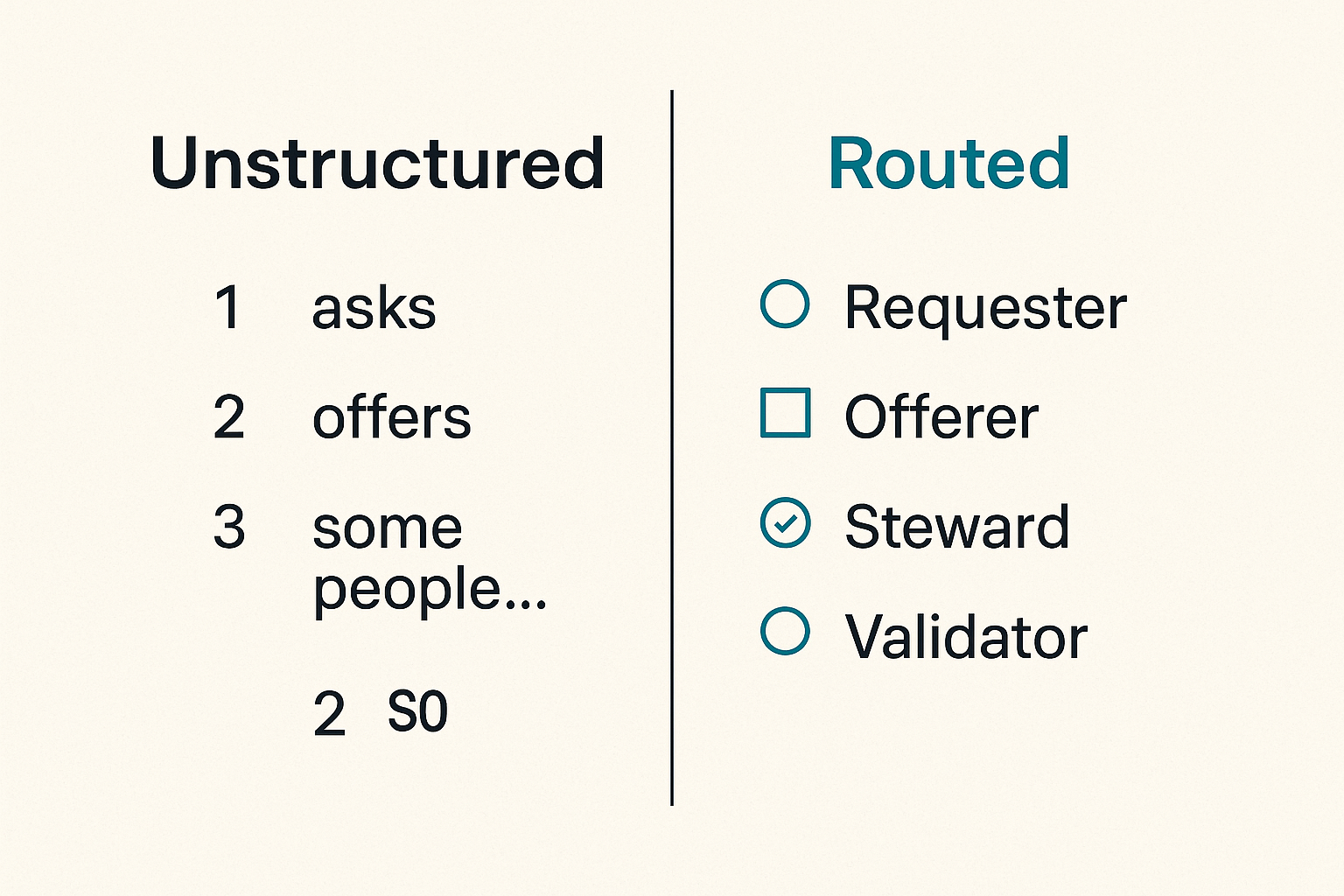
There are requesters, helpers, stewards, organizers, space owners, sponsors, connectors, public agencies, mutual aid leads, neighborhood captains, and informal validators. Some people can provide resources. Some people can approve access. Some people can vouch. Some people can route sensitive situations.
An AI agent that ignores those roles will route based on surface text. It will see car and send every transportation ask to everyone who mentioned cars. It will see childcare and route sensitive family needs to the wrong group. It will see legal and alert a volunteer who once attended a tenant rights workshop.
The practical question is: what role is each person playing for this type of ask?
A simple role model is often enough:
- Requester: person or group with the need.
- Offerer: person or group with stated capacity.
- Steward: human responsible for monitoring progress.
- Validator: person who can confirm trust, eligibility, or fit.
- Escalation contact: person who handles sensitive, urgent, or failed cases.
As guest contributors, the team at logicsrc.com sees the same pattern in agent platforms: the hard part is not generating text, but defining the roles, permissions, and workflow boundaries that make agent actions safe.
Separate coordination from conversation
Conversation is where community happens. Coordination is where commitments are tracked. The two should connect, but they are not the same thing.
If an agent treats every chat message as a coordination item, the network drowns in false positives. If it ignores chat entirely, real needs stay buried. The better pattern is to let conversation create candidate signals, then ask for structured confirmation before routing.
For example, a message like I might need help moving next week is not yet an ask. The agent can respond with a lightweight confirmation: Do you want this logged as an ask? If yes, what day, what area, and how many people do you need?
The same applies to offers. Someone saying I know a few electricians is not automatically offering electrician labor. The agent can ask whether this is an intro offer, advice offer, or direct service offer.
Practical rule: Treat chat as signal discovery, not as the source of operational truth.
Build the ask and offer schema
Minimum fields that matter
You do not need a huge database model to start. You do need a consistent schema. Without it, agents guess, organizers interpret, and follow-up becomes manual again.
A practical ask schema should include:
- What is needed.
- Who is requesting it.
- Where it applies.
- When it is needed by.
- How urgent it is.
- Whether it is public, limited, or private.
- What counts as resolved.
- Who owns follow-up.
- When the ask expires.
A practical offer schema should include:
- What is being offered.
- Who is offering it.
- Location or service area.
- Availability window.
- Limits or conditions.
- Whether an intro is required.
- Whether the offer is public or restricted.
- How often the offer can be used.
- When the offer expires or should be re-confirmed.
This is where many community tools get too loose. A big free-text box feels inclusive, but it pushes interpretation downstream. The agent can help by turning natural language into fields, but humans should still see and correct the important fields before the item is routed.
A simple comparison helps:
| Approach | What works | What fails |
|---|---|---|
| Free-text posts | Easy to submit, familiar to members | Hard to route, hard to close, hard to measure |
| Rigid forms | Clean data, easier automation | Feels bureaucratic, loses nuance |
| Agent-assisted intake | Natural input plus structured fields | Requires review rules and clear defaults |
| Human-only routing | High judgment, high trust | Does not scale beyond organizer memory |
The best local workflow usually combines agent-assisted intake with human review for sensitive or high-impact items.
Use context without over-collecting
AI agents become more useful when they have context: neighborhood, prior participation, skills, availability, preferred language, and known relationships. They also become riskier when they collect more than the network needs.
Do not collect identity data just because the agent could use it. Do not store sensitive needs in broad member profiles. Do not expose private offers to every requester. Local trust depends on restraint.
Good context fields are operational and bounded:
- Preferred contact channel.
- Areas where someone is willing to help.
- Categories of help they can provide.
- Times they are usually available.
- Whether they accept direct requests or steward-mediated requests.
- Languages they can support.
- Accessibility requirements for participation.
Poor context fields are speculative or intrusive:
- Broad personal history unrelated to coordination.
- Sensitive financial or medical details without a specific need.
- Unverified labels about reliability or personality.
- Permanent tags based on one interaction.
The agent should use the least context needed to make the next routing decision.
Route requests through trust, not just relevance
Relevance is not permission
Matching asks and offers by topic is easy. Matching them responsibly is harder.
If someone offers legal clinic space, that does not mean every legal issue should be routed to them. If someone once helped with emergency housing, that does not mean they want direct messages from strangers at midnight. If someone can translate, that does not mean they should see private health or immigration details.
Relevance answers: could this person help?
Permission answers: should this person be contacted about this ask, in this way, with this level of detail?
Local networks need both. AI agents that ignore permission create social debt. People feel exposed, helpers feel overused, and organizers spend time repairing trust instead of coordinating help.
A useful routing decision has at least four checks:
- Category fit: does the offer match the ask?
- Availability fit: is the offer active in the needed window?
- Trust fit: is this relationship allowed for this sensitivity level?
- Consent fit: has the helper agreed to this type of outreach?
Trust tiers make routing safer
You do not need a complicated reputation system. In fact, that can create more problems than it solves. Start with routing tiers.
For example:
- Public: visible to the whole network or a broad group.
- Member-only: visible to verified participants.
- Steward-mediated: visible to a trusted human who can decide next steps.
- Private: visible only to assigned operators and explicitly approved contacts.
This gives the agent a decision boundary. A public ask for folding chairs can be routed broadly. A private ask for emergency shelter should go to a steward, not to an algorithmic list of people who mentioned housing.
Practical rule: Let agents recommend matches, but make trust tier and consent determine who actually gets contacted.
The mistake teams make is encoding trust as a score and pretending the score settles the question. Local trust is contextual. A person may be trusted for tool lending but not for financial handling. A group may be trusted for public events but not sensitive referrals. The system should reflect that nuance without turning every decision into a debate.
Design the agent workflow from intake to follow-up
The five-step coordination loop
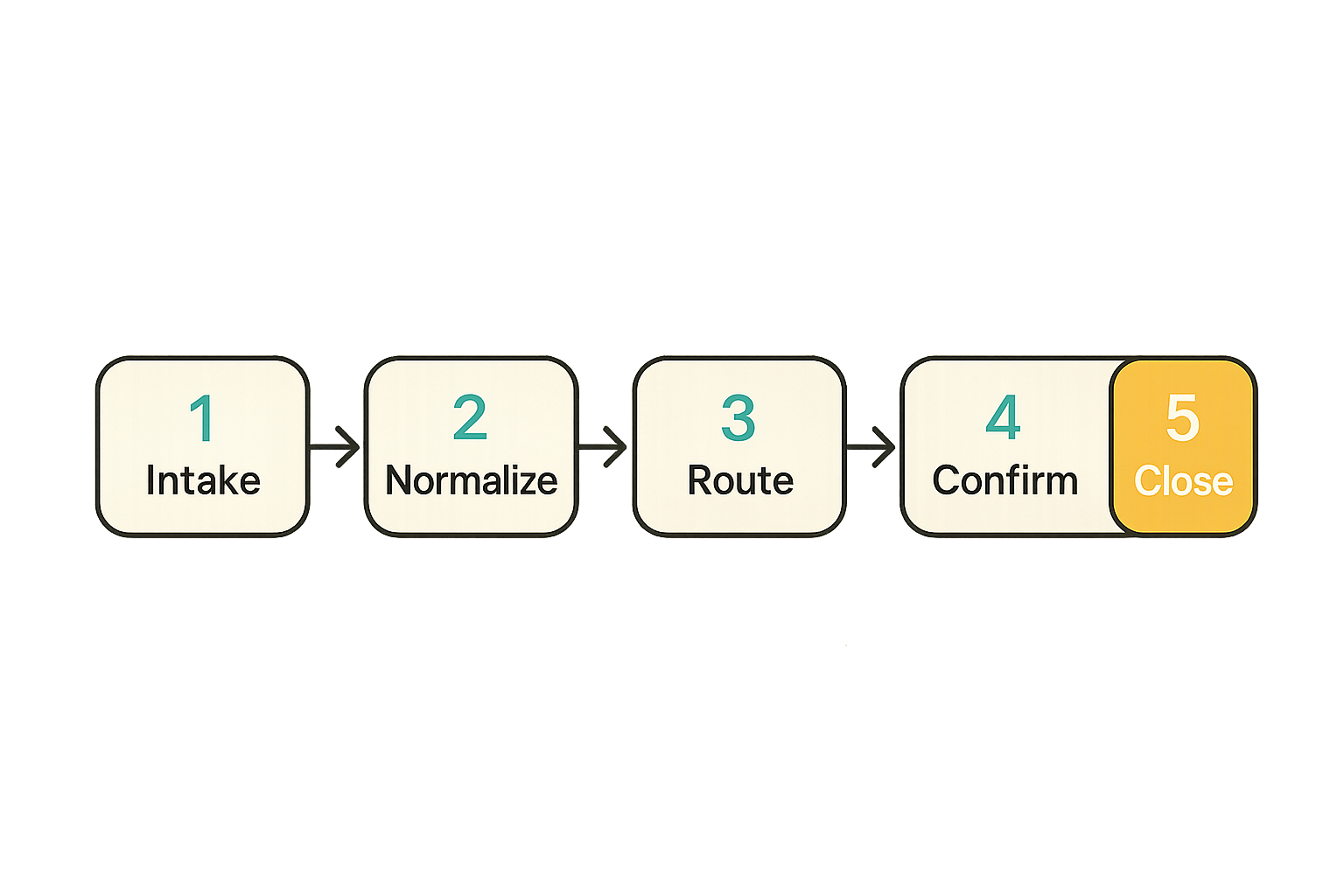
The agent workflow should be designed as a loop, not a one-time match. A useful implementation sequence looks like this:
- Intake: capture the ask or offer from a form, chat, SMS, email, or operator entry.
- Normalize: extract fields, detect missing information, classify urgency, and assign privacy level.
- Route: identify candidate offers, stewards, or groups based on category, availability, location, trust tier, and consent.
- Confirm: ask the relevant human to accept, decline, clarify, or escalate.
- Close: record the outcome, remind stalled parties, expire old items, and update future routing context.
Each step needs a status. Without status, the network cannot tell whether an ask is new, waiting on requester, waiting on helper, in progress, resolved, expired, or escalated.
A basic status model can be:
- Draft: captured but not confirmed.
- Open: confirmed and ready for routing.
- Routed: sent to one or more candidates.
- Accepted: a helper or steward has taken responsibility.
- In progress: action is underway.
- Resolved: the defined outcome happened.
- Expired: the time window passed.
- Escalated: moved to a human operator or special process.
That model matters more than the agent model. A very smart agent on top of vague statuses will still create confusion.
Where automation should stop
Agents can draft, classify, suggest, remind, and summarize. They should not silently make commitments on behalf of people.
For local networks, unsafe automation usually appears in small decisions:
- The agent promises a volunteer will show up.
- The agent shares a phone number without consent.
- The agent marks an ask resolved because someone reacted with a thumbs-up.
- The agent routes a sensitive ask to a broad list because the category matched.
- The agent keeps nudging the same helper until they burn out.
A safer boundary is: agents propose commitments, humans confirm commitments.
That does not mean every step needs organizer approval. A low-risk public request can be automatically posted to a relevant group. But any action that exposes private details, implies responsibility, or changes a real-world commitment should require explicit confirmation.
Keep humans in the ownership loop
Assign a steward for every unresolved ask
The strongest local networks are not the ones where everything is automated. They are the ones where nothing important is ownerless.
Every unresolved ask should have a steward. The steward may be a rotating organizer, a neighborhood captain, a working group lead, or the requester in low-risk cases. The point is not to centralize power. The point is to avoid orphaned needs.
The agent can help by assigning default stewards based on category or location. For example:
- Food access asks go to the mutual aid food team.
- Event space asks go to the venue coordinator.
- Volunteer staffing asks go to the shift lead.
- Sensitive housing asks go to a trained operator.
The steward does not need to do the work. The steward makes sure the next step is clear.
This is the difference between a coordination network and a bulletin board. A bulletin board can display needs. A coordination network knows which needs are moving.
Make escalation boring
Escalation should not feel dramatic. It should be a normal state transition.
Escalate when:
- The ask is urgent and no helper has accepted.
- The ask contains sensitive information.
- The requester appears at risk.
- The agent has low confidence in classification.
- Multiple helpers conflict or duplicate effort.
- A commitment is missed.
- A participant reports discomfort or misuse.
Make escalation visible to operators and simple for members. A button like ask a steward to review is often better than a complex complaint flow. The agent can gather context, but the human operator should decide what to do next.
Practical rule: If an ask can affect safety, money, housing, health, immigration, employment, or reputation, route it to a human steward before broad distribution.
What breaks when ai agents asks and offers is implemented badly
Failure mode one: the agent creates more work
Bad automation does not just fail. It creates clean-looking work for humans to clean up.
Common signs:
- Organizers receive long summaries but no actionable next step.
- Members are asked to fill out the same details repeatedly.
- Offers are routed after they have expired.
- The agent generates candidate matches with no confidence or reason.
- The system sends reminders without understanding the current state.
- Stale asks keep resurfacing and make the network feel unresponsive.
The root cause is usually missing workflow state. The agent is operating on text, not on coordination objects.
What works is boring:
- Every ask has a status.
- Every offer has an availability window.
- Every route has a recipient and outcome.
- Every reminder has a reason.
- Every unresolved item has an owner.
If those objects exist, the AI layer can help. If they do not, the agent becomes another chatty participant.
Failure mode two: the network loses trust
Trust failures are more expensive than technical failures. A bad match can be fixed. A member who feels exposed may leave quietly and tell others not to participate.
Risk patterns include:
- Over-sharing private context to make routing easier.
- Treating all members as equally available.
- Using opaque scores to rank helpers.
- Letting the agent message people too often.
- Hiding whether a message came from a human or an agent.
- Failing to explain why someone received an ask.
Local networks run on willingness. People stay available when they feel respected. They withdraw when the system acts like their time, contacts, or personal history are raw material.
A better agent message is specific and bounded:
You are receiving this because you offered help with event setup in Ward 3 on weekends. A steward is asking whether you are available this Saturday from 10 to noon. Reply yes, no, or ask for details.
That message gives context, preserves choice, and avoids pretending the agent knows more than it does.
Measurement that actually helps the network
Track movement, not vanity
Do not measure ai agents asks and offers like a social feed. Likes, comments, and message volume can be useful context, but they do not prove coordination.
Track whether needs move.
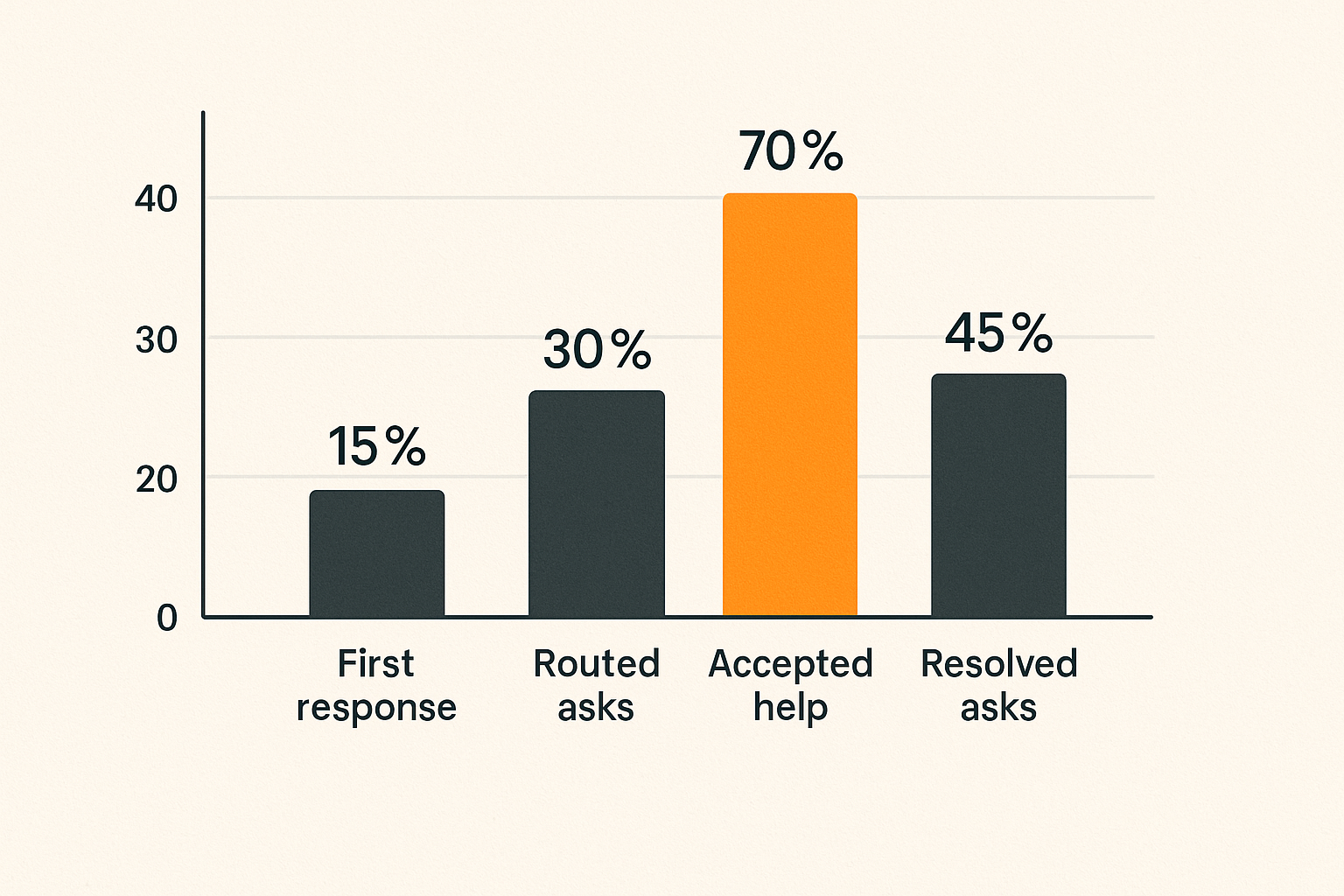
Useful measures include:
- Time from ask submitted to first human response.
- Time from ask confirmed to routed.
- Percentage of asks with an assigned steward.
- Percentage of routed asks accepted by a helper.
- Percentage of asks resolved before expiration.
- Number of stale offers re-confirmed or retired.
- Number of sensitive asks escalated before broad sharing.
- Helper response burden by person or group.
These metrics are not about producing a dashboard for its own sake. They tell operators where the network is clogged.
If first response time is slow, intake or steward assignment is the bottleneck. If routing is fast but acceptance is low, your offer data is stale or consent rules are too loose. If resolution is low after acceptance, follow-up and commitment tracking need work.
Use metrics to improve routing
A practical metrics review might ask:
- Which categories have many asks and few active offers?
- Which neighborhoods are over-served or under-served?
- Which helpers receive too many requests?
- Which stewards have too many unresolved items?
- Which offers are frequently matched but rarely accepted?
- Which asks are often escalated because the agent lacks confidence?
This is where local networks can become more equitable without turning the system into surveillance. You are not ranking people. You are improving coordination capacity.
For example, if translation asks in one language repeatedly wait three days, the answer may be recruitment. If venue requests are always routed to one person, the answer may be diversifying space relationships. If emergency asks are often misclassified, the answer may be better intake questions and stricter escalation.
Metrics should change operator behavior. If no one uses a metric to make a routing, staffing, training, or outreach decision, stop collecting it.
Implementation sequence for local operators
Start with one bounded use case
The fastest way to make this messy is to launch a universal community agent. Do not start there.
Pick one use case where asks and offers already exist, the stakes are understandable, and the workflow has a clear endpoint. Good first pilots include:
- Volunteer shift coverage for local events.
- Equipment lending among trusted members.
- Venue or room requests.
- Skill-share matching.
- Ride coordination for non-emergency events.
- Translation support for public meetings.
Avoid starting with emergency housing, medical needs, crisis response, or anything involving high legal or safety risk unless you already have trained human operators and clear escalation.
A bounded pilot lets you test the real architecture:
- Define the ask and offer schema.
- Define trust tiers and consent rules.
- Define statuses and owners.
- Define the agent actions allowed at each status.
- Define what requires human confirmation.
- Define success metrics and review cadence.
- Run the pilot with a small group.
- Retire or revise what does not work.
The mistake teams make is buying or building the AI layer first, then trying to invent operations around it. Reverse that. Write the operating model first, then attach the agent.
Pilot with explicit expectations
Members should know what the agent does and does not do.
Say it plainly:
- The agent helps collect and route asks and offers.
- A human steward reviews sensitive or unclear items.
- The agent may suggest matches but does not guarantee help.
- Members control whether they receive direct requests.
- Private information is not shared broadly without consent.
- Old offers may be re-confirmed or expired.
This reduces confusion and gives people a way to participate safely. It also protects organizers from being blamed for promises the system never should have made.
During the pilot, review real cases weekly. Do not just look at aggregate metrics. Read the asks that stalled. Read the agent messages that confused people. Ask stewards where they lost time. Ask helpers whether the requests felt relevant and respectful.
A good pilot ends with sharper rules, not just a launch decision.
Product fit for d0rz.com and local coordination
Where d0rz.com fits
For local networks, the interface is only the visible layer. The durable value is in the coordination infrastructure underneath: asks, offers, trust, routing, ownership, follow-up, and memory.
That is the natural product fit for d0rz.com. A community builder does not need another place where posts disappear into a feed. They need a way to turn participation into a local operating system: who needs what, who can help, what is safe to share, who owns the next step, and what happened after the match.
AI agents can support that model when they are designed as workflow assistants rather than community substitutes. They can reduce organizer load, surface forgotten capacity, remind people at the right time, and preserve context across events and projects. But they should sit inside a system that already respects local trust.
The practical question is not whether every community should have an AI agent. The practical question is where agent assistance removes friction without weakening relationships.
If you are building a neighborhood mutual aid group, a local business network, a civic volunteer circle, a creator community, or a place-based professional network, start by naming the coordination problem. Then decide where an agent helps:
- Intake messy asks without forcing a heavy form.
- Convert offers into reusable capacity records.
- Route low-risk requests quickly.
- Escalate sensitive requests to stewards.
- Remind people before commitments go stale.
- Close the loop so organizers learn what worked.
That is the operating model behind ai agents asks and offers. Not magic. Not a replacement for community leadership. A structured way to make local help easier to find, safer to route, and more likely to happen.
Try d0rz.com
d0rz.com helps local network operators turn asks, offers, trust, and follow-up into practical coordination infrastructure. If you are building a community where participation needs to become reliable action, Try d0rz.com.