

Community connections usually fail quietly.
Someone asks for help. Three people reply with encouragement. One person says they know someone. Nobody owns the handoff. Two weeks later, the original need is still unresolved, but the group chat feels active enough that nobody notices the miss.
Teams think the problem is participation. The real problem is coordination architecture.
In 2026, local organizers, freelance community leaders, and neighborhood network operators do not need more vague engagement. They need a practical system for turning asks, offers, trust, routing, and follow-up into something reliable. Community connections are not just relationships. They are operational paths between a real need and a real person who can help.
The practical question is not, "How do we get people to connect?" The practical question is, "How do we make sure useful connections survive timing, ambiguity, trust gaps, and follow-up failure?"
Table of contents
- Community connections are a routing system, not a vibe
- Start with the units of work
- Design the trust layer before scaling participation
- Build routing rules for community connections
- The operating workflow for reliable local matching
- What breaks when community connections are implemented badly
- What works and what fails
- Measure community connections without turning the network into a dashboard cult
- Implementation sequence for a local network operator
- Where d0rz.com fits into community connections
Community connections are a routing system, not a vibe

The visible layer is misleading
The visible layer of community connections is the part everyone talks about: events, introductions, posts, comments, group chats, referrals, and warm handshakes.
Those things matter. But they are not the system. They are interfaces.
The mistake teams make is treating activity as evidence that the network works. A busy room can still fail to route the right help to the right person. A large chat can still bury an urgent ask. A directory can still become stale within a month.
What breaks in practice is not the desire to help. It is the lack of structured movement from need to match to outcome.
The hidden layer is operational
A useful way to think about it is this: every useful community connection has four parts.
- A clear ask or offer
- A reason to trust the route
- A responsible handoff
- A follow-up signal showing what happened
If any of those are missing, the connection becomes fragile. It depends on memory, personal generosity, or the one organizer who knows everyone.
That changes the conversation. You stop asking, "How do we create more connection?" and start asking, "Where does the connection lose state?"
Practical rule: If a connection cannot be tracked from ask to handoff to outcome, it is not yet infrastructure. It is just a hopeful interaction.
Why this matters now
Local networks are carrying more operational load than they used to. People use neighborhood groups to find childcare, local contractors, translation help, emergency support, freelance work, business referrals, housing leads, and small business services.
At the same time, trust is thinner. People are tired of spam, vague requests, unreliable referrals, and platforms that optimize attention instead of resolution.
Related reading from our network: teams designing SOC workflows around real signals and ownership face a similar problem: activity is not the same as operational readiness.
Community connections need the same discipline. Not corporate bureaucracy. Not a giant CRM nobody maintains. Just enough structure so local coordination does not collapse under its own informality.
Start with the units of work
Define asks with enough surface area
An ask is not useful just because it is sincere. It has to be routable.
"I need help with my business" is emotionally valid but operationally weak. "I need someone to debug a broken website form this week, remote is fine, budget is limited, non-sensitive details only" is routable.
A routable ask should include:
- What needs to happen
- Where it matters geographically, if location matters
- Time sensitivity
- Constraints such as budget, language, access, availability, privacy, or tools
- What a good outcome looks like
- Who is allowed to contact the requester
This is where many community teams get nervous. They do not want to make asking for help feel like paperwork. That is fair. But the alternative is worse: unclear asks create social labor for everyone downstream.
A structured ask can still feel human. The structure is not for control. It is for routing.
Define offers as capacity, not identity
Offers have the same problem. People often describe themselves with labels: designer, handyman, coach, developer, organizer, translator, parent, elder, founder.
Labels are useful context, but they do not tell the network what can be routed.
A better offer describes capacity:
- What kind of help is available
- Whether it is paid, free, barter, volunteer, or exploratory
- Where the person can serve
- How quickly they can respond
- What they will not do
- What trust or experience signals matter
For example, a local provider offering remote website and automation help for local businesses is easier to route than a generic "tech person available" post. The network can understand fit, constraints, and likely use cases.
Practical rule: A good offer reduces interpretation. A bad offer creates hidden work for the organizer.
Separate interest from commitment
A common failure mode in local networks is confusing interest with commitment.
Someone says, "I can probably help." The organizer treats that as a match. The requester waits. The helper gets busy. Nobody wants to be rude, so the thread goes quiet.
Interest is a signal. Commitment is an operational state.
Use simple language:
- Interested: may be relevant, not yet confirmed
- Available: can respond within a defined window
- Matched: connected to a specific ask
- In progress: handoff happened and work started
- Closed: resolved, declined, expired, or redirected
You do not need heavy software to use these states. You need shared vocabulary. The vocabulary prevents vague goodwill from masquerading as coordination.
Design the trust layer before scaling participation
Trust is contextual
Trust in community connections is not a universal score. Someone may be trusted to translate a school letter but not to handle a payment issue. Someone may be great for emergency childcare referrals but not appropriate for legal advice.
The mistake teams make is treating trust as a personality trait instead of a context-specific routing condition.
A local network should ask:
- What is the risk if this match goes badly?
- Is money involved?
- Is access to a home, child, elder, account, vehicle, or private data involved?
- Does this require licensing, insurance, or specialized judgment?
- Can the requester evaluate quality themselves?
That changes the conversation from "Do we trust this person?" to "For what kind of request, under what boundaries, with what disclosure?"
Use lightweight trust signals
Most local networks do not need formal credentialing for every connection. They need lightweight trust signals that help route responsibly.
Useful trust signals include:
- Known by a specific member
- Previously completed a similar ask
- Clear public offer with boundaries
- Shared local affiliation
- Verified contact path
- Public portfolio or references when relevant
- Willingness to start with a small scoped task
The point is not to eliminate risk. That is not realistic. The point is to make risk visible enough that people can decide.
Related reading from our network: payment teams thinking through checkout, reconciliation, and trust boundaries deal with the same underlying issue in another domain: the interface is not the whole system; state and trust boundaries are the real work.
Do not outsource judgment to popularity
Popularity is a weak proxy for trust. The person who comments the most may not be the right person to route sensitive asks. The provider with the best self-promotion may not be the safest match.
What works is a small set of context-specific routing rules.
For low-risk asks, open matching may be fine. For medium-risk asks, route through known members or prior completions. For high-risk asks, require additional verification, a warm intermediary, or a referral to a formal service provider.
Practical rule: Trust rules should get stricter as the cost of a bad match increases.
Build routing rules for community connections
Route by fit, not by who is loudest
The loudest person in a local network often gets the most opportunities. That is not always malicious. It is just what happens when routing is informal.
Community connections get better when routing is based on fit:
- Need category
- Location
- Timing
- Language
- Cost expectations
- Trust requirements
- Prior outcomes
- Capacity
This does not mean every connection needs algorithmic matching. Many of the best local matches are still human-mediated. But the human mediator needs a routing model, not just memory.
If an organizer is the only search engine, the network does not scale. It just exhausts the organizer.
Create escalation paths
Not every ask can be solved inside the network. Some should be escalated, redirected, or declined.
Create basic escalation paths for:
- Safety concerns
- Legal, medical, or financial advice
- Housing emergencies
- Domestic conflict
- Requests involving minors or vulnerable adults
- Work that requires licensing
- Repeated no-shows or bad actors
Escalation does not mean the community failed. It means the network understands its boundaries.
A local network that routes everything internally will eventually route something it should not. That is how trust gets damaged.
Keep the handoff observable
A handoff should not disappear into private messages with no status.
You do not need to read private conversations. You do need a minimal status signal:
- Introduced
- Contacted
- No response
- Scheduled
- Completed
- Declined
- Needs another route
This is especially important when multiple people are helping. Without observable state, helpers duplicate work, requesters repeat their story, and organizers cannot tell whether the system is working.
The operating workflow for reliable local matching
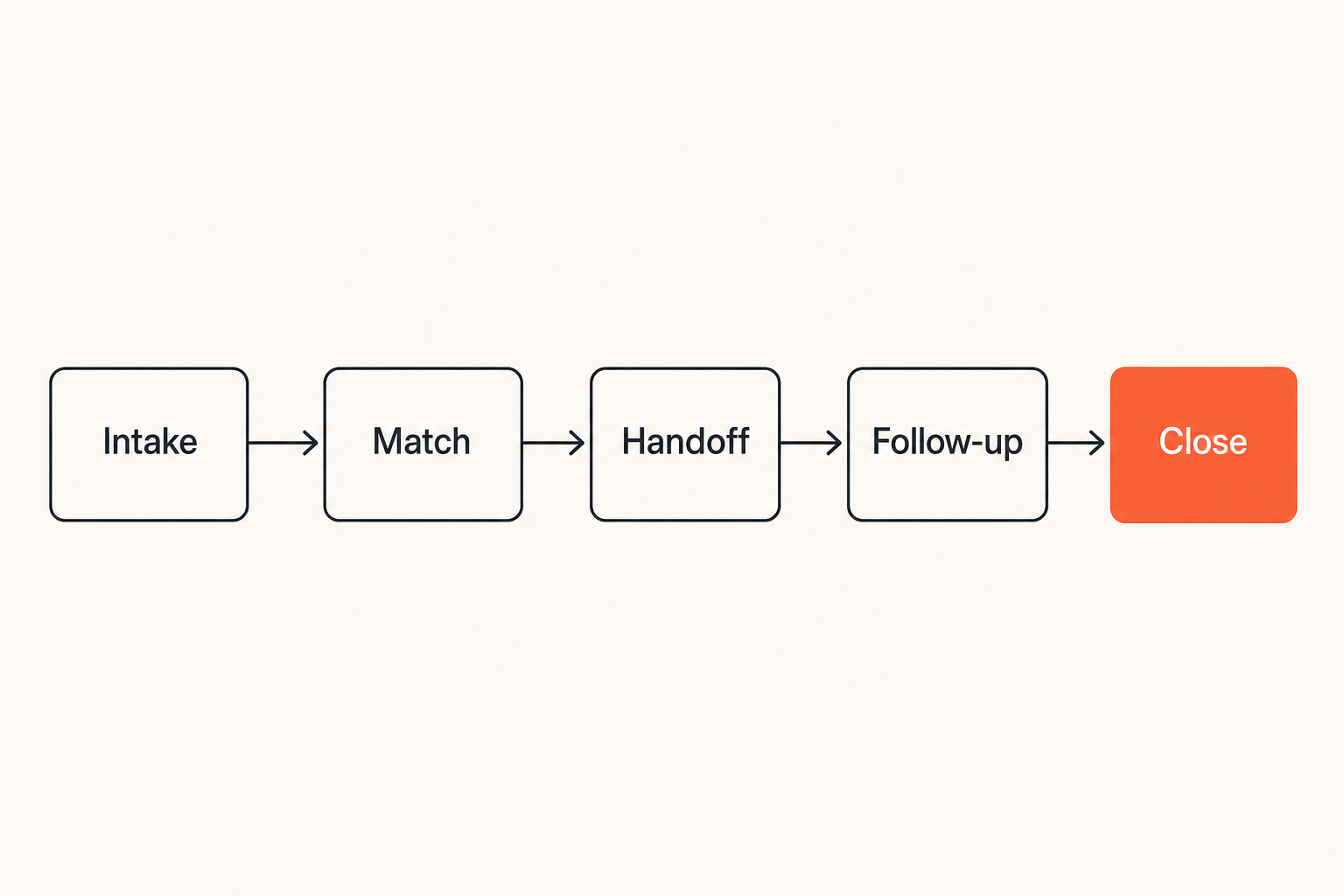
Intake the need
Reliable community connections start with intake. Intake sounds formal, but it can be simple.
For every ask, capture:
- The request in plain language
- Category and urgency
- Location or remote requirement
- Constraints and boundaries
- Preferred contact method
- Whether the request can be shared publicly, semi-privately, or only with selected people
This is the point where many community teams underbuild. They let requests enter through texts, DMs, comments, hallway conversations, and event chats. Then they wonder why follow-up is inconsistent.
You can accept requests from many channels. But they need to land in one operational queue.
Match against known capacity
Once the ask is clear, match it against known offers, trusted members, or external referrals.
A simple matching sequence works:
- Confirm the ask is appropriate for the network.
- Search known offers and prior helpers.
- Check capacity before making the introduction.
- Share only the necessary context.
- Ask both sides to confirm the handoff.
- Set a follow-up date.
- Record the outcome.
The practical question is not whether this is manual or automated. The question is whether the state survives the handoff.
A public ask such as seeking one business workflow to automate is useful because it gives potential helpers enough structure to self-select before an organizer has to intervene.
Close the loop
The loop closes when the network learns what happened.
Closed does not always mean successful. It may mean:
- Solved
- Partially solved
- Referred outside
- No response
- Expired
- Not appropriate for the network
- Needs a different type of help
This is where community connections become infrastructure. Every closed loop improves the next route. You learn which asks are common, which offers are reliable, where capacity is thin, and where trust rules need adjustment.
Related reading from our network: publishing teams building automation workflows with review gates hit the same lesson. Draft generation is not the system; review, routing, and completion are the system.
What breaks when community connections are implemented badly
The group chat becomes the database
Group chats are good for immediacy and bad for memory.
When the group chat becomes the database, important details get buried. New members cannot understand what is active. Old requests resurface without context. People rely on screenshots and vague recollections.
The result is coordination debt.
A chat can be an input channel, but it should not be the system of record. The system of record can be lightweight: a shared sheet, a small database, a board, or a purpose-built local network tool. What matters is that asks, offers, status, and outcomes have somewhere stable to live.
Volunteers become invisible infrastructure
Many local networks run on one or two people who remember everything.
They know who needs work, who has a truck, who speaks Spanish, who can fix a form, who is reliable with elders, who should not be referred for paid work, and who is overwhelmed this month.
That knowledge is valuable, but it is also a risk. If the organizer gets sick, burns out, moves, or becomes unavailable, the network loses routing capacity overnight.
The mistake teams make is praising the super-connector instead of reducing dependency on them.
Document enough of the routing logic that another trusted operator can step in.
Follow-up becomes optional
Without follow-up, the network cannot distinguish between connection and resolution.
This is one of the biggest sources of false confidence. The organizer made an intro, so the task feels done. But the requester may not have received help. The helper may have been unavailable. The match may have been wrong.
Follow-up does not need to be intrusive. A short check is enough:
- Did contact happen?
- Is the need still active?
- Was the match useful?
- Should we close, reroute, or escalate?
If you do not ask, you do not know.
What works and what fails
What works in production
What works is usually boring.
- Clear intake
- Specific asks
- Offers with boundaries
- Small trust signals
- Visible status
- Follow-up dates
- A weekly review rhythm
- A way to archive closed items
None of this requires a large team. A solo organizer can run a useful local network if the workflow is explicit.
The best community operators are not the ones who make the most introductions. They are the ones who reduce ambiguity for everyone else.
What fails repeatedly
What fails is also predictable.
- Announcing a directory and never maintaining it
- Creating a big group chat with no routing rules
- Letting every request become urgent
- Matching people without checking capacity
- Treating all trust as personal endorsement
- Ignoring outcomes because they are uncomfortable
- Building a platform before defining the workflow
The platform-before-workflow mistake is especially common. A team launches a site, map, database, or member portal. It looks credible for a while. Then the data goes stale because nobody owns intake, verification, routing, and follow-up.
Technology can help. But it cannot compensate for undefined operations.
The comparison that matters
| Approach | Looks like | What happens in practice | Better operating model |
|---|---|---|---|
| Engagement-first | Events, posts, comments, reactions | High activity, weak resolution | Track asks, offers, handoffs, outcomes |
| Directory-first | Member profiles and categories | Stale listings, unclear capacity | Offers with availability and boundaries |
| Organizer-memory-first | One trusted connector knows everyone | Fast early, fragile later | Shared routing notes and review rhythm |
| Automation-first | Forms and tools before policy | Cleaner intake, same bad matches | Rules before automation |
| Trust-by-popularity | Loud members get routed often | Uneven quality and hidden risk | Context-specific trust signals |
The practical question is not which model sounds more community-oriented. The practical question is which model still works when the network gets busy, the organizer is tired, and the ask is time-sensitive.
Measure community connections without turning the network into a dashboard cult
Track flow, not vanity engagement
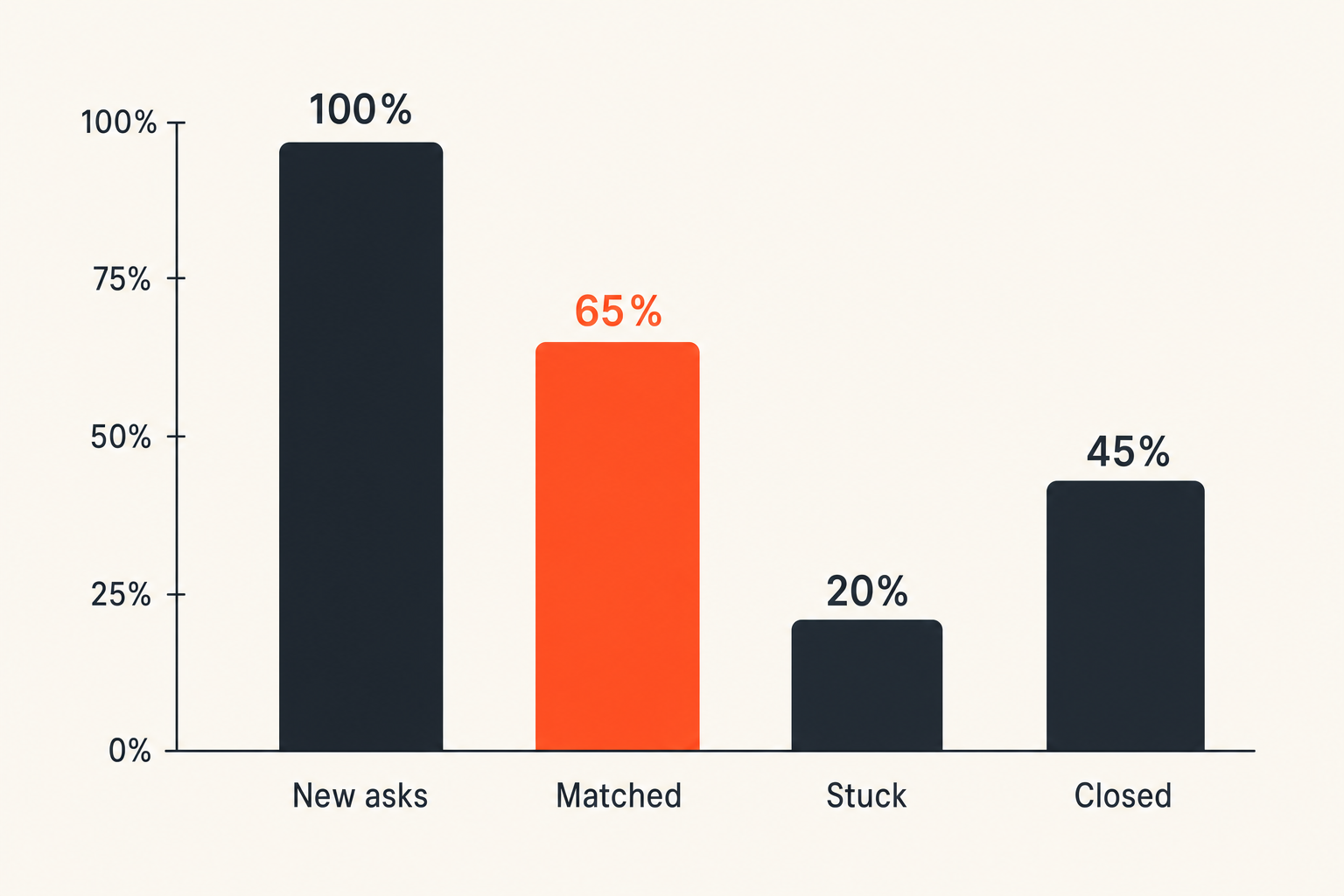
You do not need a dashboard cult. You need enough measurement to see flow.
Vanity engagement tells you who clicked, liked, attended, or commented. Operational measurement tells you whether needs moved.
For community connections, useful flow metrics include:
- New asks this week
- Active asks
- Matched asks
- Stuck asks
- Closed asks
- Average time to first useful response
- Repeat categories with no capacity
- Helpers with too many open commitments
These numbers do not need to be perfect. They need to be visible enough to guide decisions.
Use small operational metrics
Start with five metrics:
- Intake count: how many asks entered the system
- Match rate: how many got a plausible route
- Response time: how long until first useful response
- Closure rate: how many reached a known outcome
- Capacity gap: which categories had demand but no reliable offer
This is where community operators can become more precise without becoming cold. Measurement is not about reducing people to tickets. It is about noticing where people are waiting, repeating themselves, or falling through gaps.
Practical rule: Measure the friction people feel, not the attention your network receives.
Review the misses
The misses are where the system improves.
Review asks that were not resolved:
- Was the ask unclear?
- Was there no matching offer?
- Was trust too uncertain?
- Did the handoff fail?
- Did the requester stop responding?
- Did the helper lack capacity?
- Did the network need an external partner?
Do this without blame. The goal is not to shame helpers or requesters. The goal is to improve the routing model.
If the same category fails repeatedly, you have a capacity gap. If the same handoff fails repeatedly, you have a process gap. If sensitive asks create confusion, you have a trust policy gap.
Implementation sequence for a local network operator
Start with one category
Do not try to operationalize the whole community at once.
Pick one category where the network already has demand and some capacity. Good starting categories include:
- Local business workflow help
- Translation and document support
- Event setup volunteers
- Childcare referrals with strict boundaries
- Food pickup coordination
- Freelance referrals
- Website or payment form debugging
- Transportation for appointments
Starting narrow gives you enough repetition to learn. If every ask is unique, the workflow never stabilizes.
For example, a local network might start with small business support: broken website forms, payment links, scheduling cleanup, customer response workflows, and basic automation. A post about same-day website form and workflow debugging is concrete enough to route into that category.
Write the routing policy
Write a one-page routing policy. Not a constitution. Not a legal manual. Just the rules operators will use.
Include:
- Which asks belong in this category
- Which asks are out of scope
- What information is required for intake
- What trust signals are needed
- Who can make introductions
- When to escalate or decline
- How follow-up happens
- When an item is closed
This policy prevents emotional improvisation. It also helps new operators learn how the network thinks.
A simple example:
Category: local business workflow help
Allowed: public website forms, scheduling workflows, CSV cleanup, payment-link setup, non-sensitive automation
Not allowed: private customer data, credential sharing, tax/legal advice, emergency production access
Trust requirement: public offer, prior completion, or known referral
Follow-up: 3 business days after intro
Close states: solved, referred, expired, not appropriate, no response
That is enough to start.
Run the weekly connection review
A weekly review is the smallest habit that makes community connections reliable.
Review these items:
- New asks
- Unmatched asks
- Active handoffs
- Stuck items
- Closed outcomes
- Capacity gaps
- Trust or safety concerns
- Offers that need updating
Keep the meeting short. Thirty minutes is often enough for a small network.
The point is not discussion for its own sake. The point is to prevent silent failure. If something is stuck, reroute it. If an offer is overloaded, pause it. If a category has repeated demand, recruit capacity.
Where d0rz.com fits into community connections
A place for structured asks and offers
Community connections become more reliable when asks and offers have shape. That is the operating idea behind d0rz.com.
A local network does not only need another place to post updates. It needs a way for people to express what they need, what they can provide, where trust matters, and what follow-up should happen next.
This matters for small networks because the early stage is deceptively manageable. Five active people can coordinate through memory. Fifty cannot. Five hundred definitely cannot. The work shifts from knowing everyone to maintaining routing infrastructure.
A workflow, not a social feed
d0rz.com is a better fit when you are trying to coordinate practical local work: asks, offers, referrals, small services, availability, and follow-up.
It is not a replacement for every community surface. You may still use meetings, chats, newsletters, events, and personal introductions. The point is to give the operational layer somewhere to live.
The mistake teams make is expecting the social layer to carry the operational layer forever. It will not. The social layer creates attention. The operational layer creates resolution.
When you treat community connections as workflow, you can ask better questions:
- Which asks are active?
- Which offers are actually available?
- Which matches need follow-up?
- Which categories lack capacity?
- Which trust signals are enough for this route?
- Which connections produced outcomes?
That is the difference between a network that feels warm and a network that can be counted on.
Try d0rz.com
You are writing for people building practical local networks where asks, offers, trust, routing, and follow-up matter. If you want community connections to work as coordination infrastructure, Try d0rz.com.