
If you've tried to organize a community goods network — tools, rides, groceries, childcare swaps, skill-shares — you've probably hit the same wall. People show up enthusiastic for the first few weeks. A shared spreadsheet gets made. Someone builds a WhatsApp group. And then, slowly, the requests go unanswered, the spreadsheet rots, and the people who cared most quietly burn out.
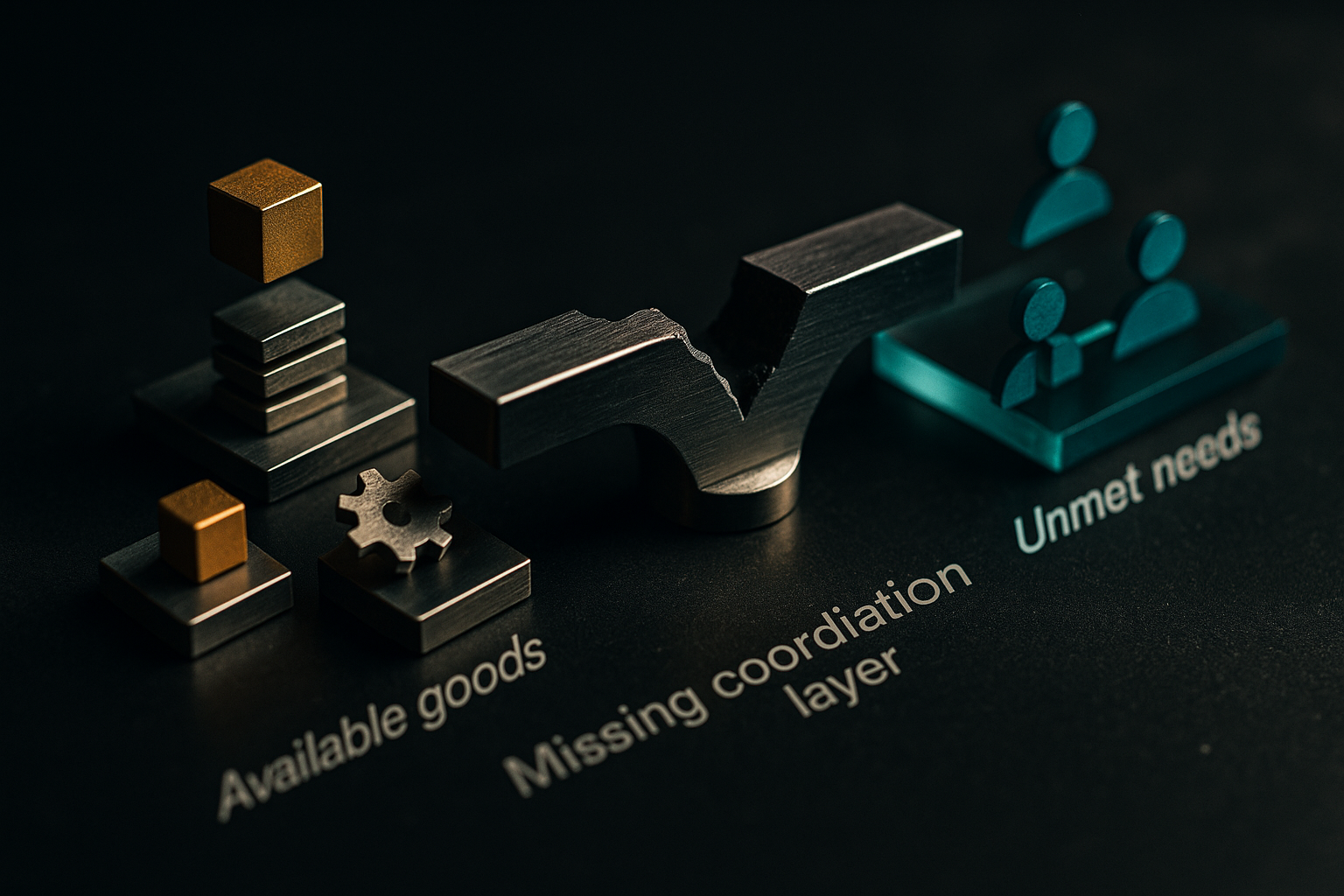
The instinct is to blame participation. "We just need more people to buy in." But in most cases the participation is there. What's missing is the coordination layer — the system that makes it legible who has what, who needs what, how requests get routed, and how trust accumulates over time.
Teams think the problem is community goods scarcity. The real problem is community goods coordination. You can have a neighborhood full of people willing to share a drill, offer a ride, or drop off groceries — and still have a system that functionally doesn't work because nobody knows how to reliably find, request, or fulfill anything.
This post is for organizers who are past the idealism phase and want to build something that actually holds together at scale. We'll cover the architecture of community goods systems, where they break, what makes them durable, and how to think about the transition from informal to operational.
Table of contents
- Why community goods is an architecture problem, not a values problem
- Mapping the goods: what you're actually coordinating
- Trust as infrastructure
- The request-fulfillment loop
- Reciprocity models: time banks, credits, and pure mutual aid
- Governance: who decides what, and how
- The onboarding problem: getting new members to the right starting point
- Scaling without breaking the culture
- Technology choices: tools that help vs. tools that create overhead
- Making community goods visible to the people who need them
- Common failure modes and what breaks first
- Building on a platform that does the coordination work
Why community goods is an architecture problem, not a values problem
Most community goods conversations start with values: sharing, solidarity, mutual support. Those values are real and they matter. But values don't route a request for a wheelchair ramp loan to the person three blocks away who has one sitting in their garage. Values don't send a reminder when a borrowed item hasn't come back. Values don't prevent the same three people from doing 80% of the fulfillment work until they quietly stop.
The mistake teams make is treating community goods as a motivation problem. If people just cared enough, the spreadsheet would stay updated, requests would get answered, and the network would grow. In practice, motivation fades in proportion to friction. The higher the coordination overhead, the faster even committed participants drop out.
The coordination gap that kills most efforts
A coordination gap exists when the network has goods and needs, but no reliable mechanism for connecting them. Signs you have one:
- Requests go into a group chat and get buried under conversation
- Nobody knows what's available without asking someone who might know
- Fulfillment depends on whoever happens to be watching the channel that day
- New members don't know how to participate without being individually walked through it
- There's no record of what's been shared, borrowed, or returned
This isn't a culture problem. It's a routing problem. The community goods exist. The willingness exists. What's missing is the layer that makes supply legible to demand.
What "operational" actually means for a local network
A community goods network is operational when a new member can discover available goods, make a request, get a response within a predictable timeframe, and complete an exchange — without needing to know a specific person or be manually guided through the process by a coordinator.
That bar sounds obvious. Most networks never reach it. Getting there requires making explicit decisions about inventory, request handling, trust, reciprocity, and governance — decisions most organizers defer until the network is already breaking.
Practical rule: If your network's functionality depends on one or two people holding all the context in their heads, it isn't operational — it's a personal favor network that happens to have a group chat.
Mapping the goods: what you're actually coordinating
Not all community goods are the same. Lumping tools, rides, skills, and perishable food into one coordination system is a common mistake. They have fundamentally different logistics requirements.
Durable goods vs. perishable goods vs. services
| Category | Examples | Key logistics challenge | Reciprocity model |
|---|---|---|---|
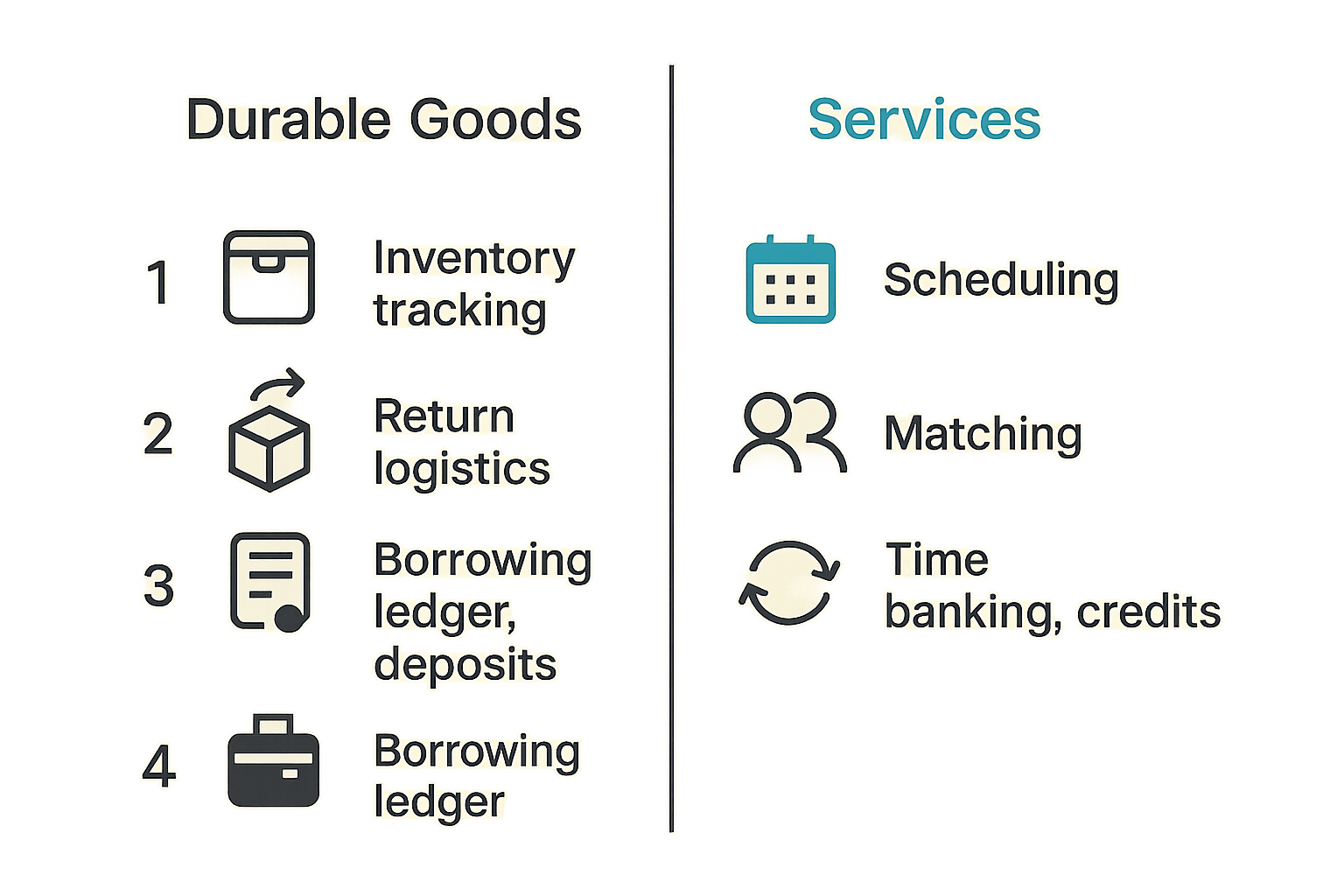
| Durable goods | Tools, equipment, furniture, books | Inventory tracking, return logistics | Borrowing ledger, deposits |
| Perishable goods | Food, plants, seedlings, medication | Time sensitivity, storage conditions | Pay-it-forward, donation |
| Services | Rides, childcare, skilled labor, repairs | Scheduling, matching, time equity | Time banking, credits |
| Spaces | Storage, workshop access, meeting rooms | Booking, access control | Membership, credits |
Each category needs its own mini-workflow. The failure mode is trying to run all of them through one undifferentiated request channel.
The inventory problem nobody wants to solve
Durable goods sharing collapses without inventory management. People don't want to catalog their stuff. But without a current, accurate list of what's available, the network defaults to "ask in the group chat and hope someone knows" — which is just informal asking with extra steps.
The practical question is: what's the minimum viable inventory system your members will actually maintain? In most networks, that's a simple listing interface where members can add items in under two minutes, see what others have listed, and mark things as unavailable when they're out on loan. Anything more complex than that and compliance drops to near zero.
Practical rule: Design your inventory system around the least motivated maintainer, not the most organized one. If it takes more than two minutes to update, it won't stay current.
Trust as infrastructure
Peer-to-peer exchange doesn't work without trust, and trust doesn't appear automatically just because people live near each other. In a community goods network, trust is infrastructure — it needs to be built deliberately, accumulated over time, and made visible enough that it actually changes behavior.
How trust accumulates in peer-to-peer systems
Trust in local networks typically builds through three mechanisms:
- Direct experience — I've exchanged with you before and it went well
- Vouching — someone I trust vouches for you
- Track record — the system shows you have a history of reliable exchanges with others
Most informal networks rely entirely on #1 and #2, which means trust is invisible to new members and doesn't scale. A new person joining has no way to know who's reliable and who isn't. They either take risks blindly or don't participate at all.
Building track record into the system — even something as simple as a completion count and a lightweight rating — changes the dynamic entirely. It gives new members a way to assess, and it gives reliable contributors a reason to keep participating.
What breaks when trust isn't tracked
- High-value items don't get listed because owners don't want to lend to strangers
- The network's effective goods pool is limited to what people are willing to risk losing
- Bad actors (even just flaky ones who don't return things) have no accountability
- Reliable contributors burn out because their track record confers no visible status
- New members churn because they can't figure out who's safe to transact with
For adjacent reading on how systems get discovered and cited based on their structural trustworthiness — a pattern that applies to networks, not just content — teams in the AI discoverability space face similar tradeoffs: Answer Engine Optimization for Blockchain: How Crypto Payment Infrastructure Gets Cited by AI.
The request-fulfillment loop
The request-fulfillment loop is the core workflow of any community goods network. It's the sequence from "I need something" to "I have it." Getting this loop right is the most important architectural decision you'll make.
Designing the loop for low friction
A well-designed loop has five steps:
- Request creation — member submits a request for a good or service, specifying what, when, and any relevant constraints
- Matching — the system identifies potential fulfillment sources (inventory listings, relevant skill profiles)
- Notification — potential fulfilllers are notified, with enough context to say yes or no quickly
- Confirmation — a match is confirmed, logistics are established (pickup/dropoff, timing)
- Completion and record — the exchange is marked complete; trust records are updated
The mistake teams make is designing for step 3 and ignoring everything before and after. The notification is only useful if the request was structured well, and the notification disappears into the void if there's no confirmation mechanism.
Common failure modes in the fulfillment layer
- No structured request format: Members post vague requests, fulfillers don't have enough info to respond, nobody responds
- No acknowledgment loop: Requesters don't know if anyone has seen their request
- Fulfillment depends on one coordinator: One person manually matches requests — that person burns out
- No completion record: The exchange happens but isn't logged, so trust doesn't accumulate and patterns aren't visible
- Race conditions: Multiple people offer to fulfill the same request, confusion ensues, one or more offer-makers feel ignored
Practical rule: Every request should have a visible status — open, matched, in-progress, complete. Members shouldn't have to ask whether their request is being handled.
Reciprocity models: time banks, credits, and pure mutual aid
How you handle reciprocity shapes who participates and how. There's no universally correct model — the right choice depends on your community's culture, the types of goods being exchanged, and how much overhead you can operationally support.
When to use formal reciprocity tracking
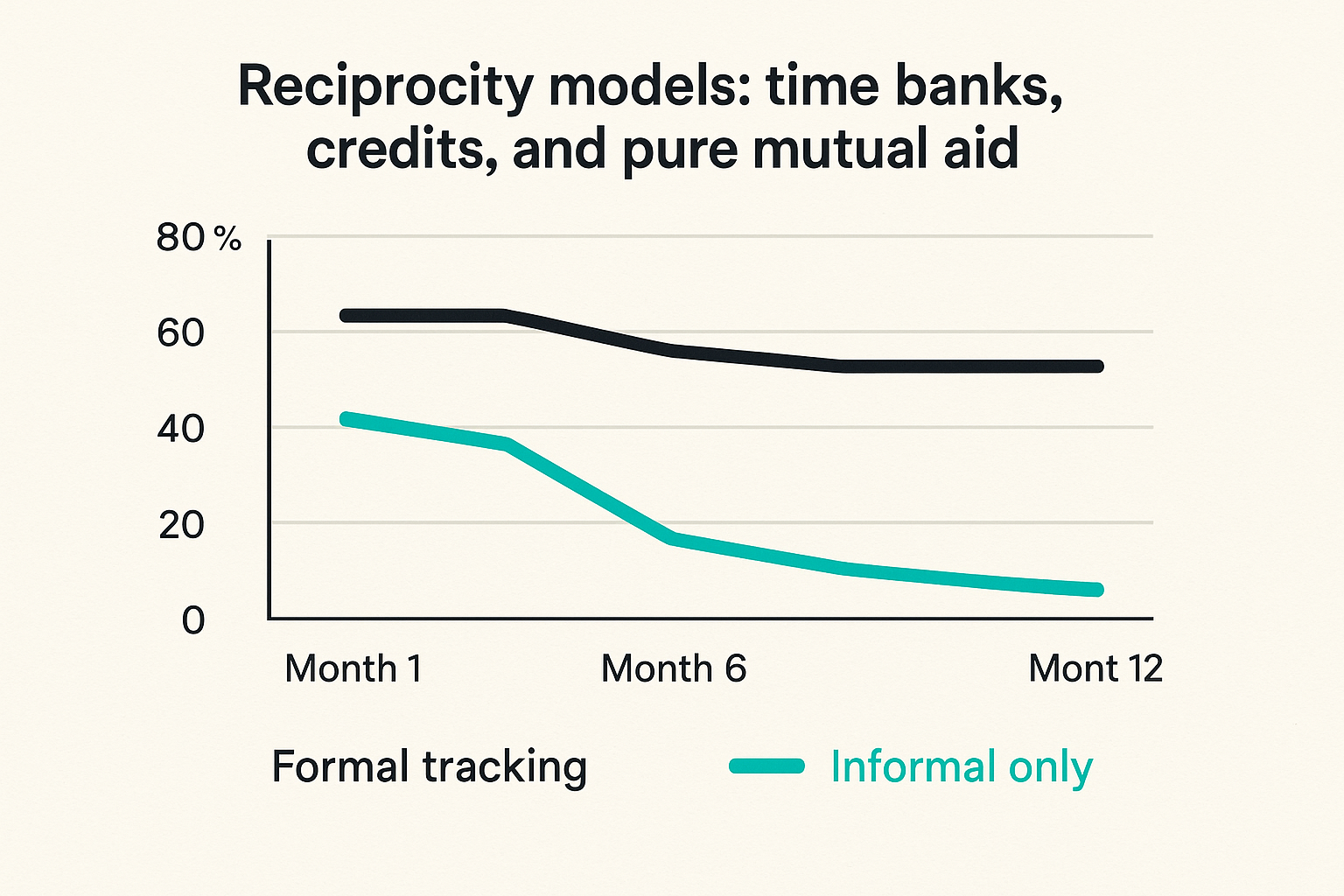
Formal tracking — time banks, credit systems, point ledgers — works best when:
- The exchange types are heterogeneous (rides, labor, skills, goods all in the same network)
- The network is large enough that informal social accountability doesn't cover everyone
- You want to prevent chronic free-riding from degrading participation
- Members are explicitly asking for a fair accounting mechanism
Time banks are the most established formal model: one hour of any service equals one time credit, regardless of what the service is. This is egalitarian and simple, but it creates administrative overhead and can feel transactional in communities where the culture leans toward pure generosity.
When informal reciprocity is enough
Informal reciprocity works when:
- The network is small enough (under ~150 members) that social accountability is real
- The goods being shared are relatively homogeneous and low-stakes
- The culture is strongly gift-economy oriented and formal tracking would feel alienating
- You don't have the infrastructure to run a credit system reliably
The trap is assuming informal reciprocity will scale. It doesn't. As membership grows, social accountability weakens and free-riding increases. Networks that start informal and never transition to any tracking mechanism often hit a wall around 100–200 members where participation starts to decay.
Governance: who decides what, and how
Community goods networks are governed, whether explicitly or not. The question isn't whether you have governance — it's whether the governance you have is legible and functional.
Lightweight governance structures that don't stall
The most durable local networks tend to use a simple layered model:
- Core circle (3–7 people): Sets policy, handles disputes, makes platform/tool decisions
- Coordinators (varies): Run specific categories (food, tools, transport, etc.) within agreed policy
- Members: Participate, flag issues, vote on major changes via simple async polls
Decisions are categorized: operational decisions are made by coordinators without escalation; policy decisions go to the core circle; major structural changes get member input. The key is writing down which decisions belong where — ambiguity about decision rights is what stalls networks.
What over-governance looks like in practice
Over-governance is as damaging as under-governance. Signs:
- Every request for a new goods category requires a committee meeting
- Coordinators can't make any decision without core circle sign-off
- Disputes sit unresolved because nobody has explicit authority to close them
- New members spend more time understanding governance than participating in exchange
If your governance is consuming more volunteer time than your actual exchange activity, something is misconfigured.
The onboarding problem: getting new members to the right starting point
Onboarding is where most community goods networks leak participation. A new member signs up, gets added to a chat, and then... doesn't know what to do. They're not sure what's available, how to request it, or what's expected of them in return. After a week of silence, they disengage.
Onboarding as trust initialization
Onboarding isn't just information delivery. It's trust initialization — it's the moment where the new member and the network start building a relationship. A good onboarding sequence does three things:
- Shows the new member what's actually available right now (real inventory, not hypotheticals)
- Explains the request process concretely, ideally with a low-stakes first transaction
- Establishes what's expected reciprocally — what the member is invited to offer, not just receive
Networks that onboard only on the receiving side create an early culture of consumption that's hard to correct later.
What a good onboarding flow actually contains
- Welcome message with a specific first action ("Here's one thing available near you right now")
- Two-minute profile setup that captures what they can offer, not just who they are
- Link to current inventory with a prompt to make one request this week
- Introduction to one other member (warm connection, not just a directory)
- Clear explanation of how the reciprocity model works
For a network operating in a dense urban area, the logistics of that first transaction matter a lot. Platforms like d0rz are built around local on-demand logistics — rides, errands, delivery — which means community networks can plug in last-mile fulfillment without building it themselves.
Scaling without breaking the culture
Every community goods network eventually faces the scaling question. Growth is good — more members means more goods, more capacity, more resilience. But growth also dilutes the social fabric that makes peer-to-peer trust work.
The neighborhood cluster model
The most effective scaling pattern for community goods is the neighborhood cluster: instead of one large network, you operate a federation of smaller clusters (30–80 members each) that share infrastructure but operate semi-autonomously.
Each cluster has its own coordinator and its own culture. Cross-cluster exchange is possible but optional. New members join a specific cluster, not the abstract network — which means their first experiences are with people geographically close and socially proximate.
This model borrows from how successful mutual aid networks actually operate in practice. For a city like Toronto, where d0rz is building local delivery and logistics infrastructure across different neighborhoods, the cluster model maps naturally onto the geographic reality of how people actually move and interact.
Federation vs. centralization
| Approach | Advantages | Risks |
|---|---|---|
| Centralized | Consistent policy, unified inventory, simpler tooling | Culture homogenization, coordinator bottlenecks, single points of failure |
| Federated clusters | Local culture preserved, resilient, scales organically | Inconsistent experience, harder to see cross-cluster goods, governance complexity |
| Hybrid | Best of both if well-designed | Significant architecture investment upfront |
Most networks start centralized by default (one chat, one spreadsheet) and discover the limitations only after they've grown into them. The practical question is: at what size do you want to make the federation decision? The answer for most networks is earlier than feels necessary.
Technology choices: tools that help vs. tools that create overhead
The tool conversation in community goods organizing tends to go one of two ways: either someone insists on using only free/open tools as a values statement, or someone over-engineers a custom platform that nobody adopts. Both are failure modes.
The spreadsheet ceiling
Shared spreadsheets are the default starting point. They work well for:
- Inventory listing when the catalog is small and static
- Simple member directories
- Tracking completed exchanges in retrospect
They break at:
- Any real-time coordination (who has the item right now?)
- Request routing and notification
- Trust tracking and reputation
- Onboarding new members to a complex system
- Any volume above ~50 active transactions per month
The spreadsheet ceiling isn't a criticism of the tool — it's a recognition that spreadsheets are designed for tabular data, not workflow coordination. When your community goods network hits the ceiling, the answer is a purpose-built coordination layer, not a more elaborate spreadsheet.
What a purpose-built platform changes
A platform purpose-built for local peer-to-peer exchange absorbs the coordination overhead that currently lands on your volunteer coordinators. Specifically:
- Inventory is browsable without asking someone
- Requests are structured and routable
- Notifications go to the right people automatically
- Exchanges are logged without manual entry
- Trust records are maintained passively through activity
The platform doesn't replace the community. It frees the community from spending its energy on coordination plumbing so it can focus on actual exchange and relationship-building. Organizers who want to understand d0rz's approach to building this kind of local infrastructure can review the d0rz investor overview for context on the underlying platform architecture.
Making community goods visible to the people who need them
A community goods network that only reaches existing members is leaving its most important users underserved: the people who most need access to shared goods and services and don't yet know the network exists.
Discoverability inside the network
Internal discoverability means a member can find available goods without knowing exactly who has them. This requires:
- A searchable or browsable inventory (not just a chat history)
- Category-based organization so members can browse by type of good
- Availability status that's kept current
- Geographic proximity filtering for goods that require physical exchange
Many networks have goods that go unlisted not because members are unwilling to share but because the listing process is too cumbersome or the member doesn't realize their item would be useful to others. Lowering the listing barrier directly expands the effective goods pool.
External reach without losing local trust
Growing the network externally while preserving internal trust requires a controlled entry point. The mistake is either keeping the network completely hidden (slow growth, insularity) or opening it completely (trust dilution, spam, bad actors).
A practical middle path: make the network's existence and general offerings publicly visible, but require a lightweight vetting step before a new member can transact. That might be a voucher from an existing member, a brief intake interview, or a probationary period where new members can receive but not yet offer high-value goods.
For organizers thinking about how niche networks become discoverable and authoritative in their local context — a challenge that parallels how specialized content gets surfaced by AI systems — this piece on how specialized niches get cited or ignored by LLMs offers useful structural thinking, even if the surface topic is different.
Common failure modes and what breaks first
Community goods networks fail in predictable patterns. Knowing them in advance is the best protection against them.
The volunteer coordinator bottleneck
This is the most common and most damaging failure mode. One or two highly motivated people become the load-bearing coordinators for everything — onboarding, matching, dispute resolution, inventory maintenance, communications. Everything works while they're active. When they burn out or move on, the network collapses.
The fix isn't finding more dedicated volunteers. It's distributing the coordination work into the system itself — automated routing, self-service inventory, structured request flows — so that no single person is a critical dependency.
The participation cliff after the first month
Many networks see strong initial engagement followed by a sharp drop-off around weeks 4–8. This happens because:
- Early adopters have exhausted their initial curiosity
- The network hasn't yet delivered enough successful exchanges to create habit
- New member flow has slowed, so the channel feels quiet
- There's no mechanism to re-engage members who've gone quiet
The antidote is a deliberate engagement rhythm: regular availability updates, proactive prompts ("someone near you needs X — can you help?"), and celebration of completed exchanges visible to the whole network. The goal is to make successful exchange visible enough that it reinforces participation for the members who see it.
Building that kind of launch rhythm — early engagement, structural habits, sustainable momentum — is a challenge that applies across community types, and the architecture thinking in this piece on product launch design maps onto community network launches in useful ways, even if the context is different.
Building on a platform that does the coordination work
The case for a purpose-built platform isn't about technology adoption for its own sake. It's about recognizing that coordination overhead is a real cost — paid in volunteer time, organizer burnout, and member churn — and that the right infrastructure reduces that cost structurally.
What the right platform absorbs
A platform designed for local peer-to-peer exchange should absorb:
- Inventory management (listing, availability, search)
- Request routing and notification
- Exchange logging and trust accumulation
- Basic onboarding workflow
- Geographic filtering for local matching
What it should not try to replace: community culture, relationships, governance decisions, and the human judgment that goes into dispute resolution. The platform handles the plumbing. The community handles the people.
Connecting community goods to on-demand local services
Community goods networks increasingly operate alongside (not instead of) on-demand local services. A member might borrow a neighbor's drill through the network, but also use a local service platform to get a grocery run when they're recovering from surgery. These aren't in tension — they're complementary layers of a local support ecosystem.
Platforms that operate in this adjacent space — local logistics, errands, delivery, transport — can serve as fulfillment infrastructure for community goods networks that need last-mile help. If you have questions about how that kind of integration works in practice, you can reach out to the d0rz team directly. Before plugging in any external platform, it's worth reviewing their privacy policy and terms of service to understand how member data is handled — an important trust consideration for any community goods network.
The practical architecture question is: what does your community need to build from scratch, and what can you plug into? Efficient networks are not built on pure self-sufficiency — they're built on understanding which coordination layers to own and which to delegate.
Try d0rz.com
d0rz is the local assistance marketplace for rides, errands, delivery, and on-demand help — infrastructure that community builders and local organizers can plug into rather than build themselves. Start at d0rz.com to see how local logistics can support your community goods network.