

Most communities say they want to help freelancers find work. Then they create a channel, a spreadsheet, or a monthly post where people can drop freelancing asks and offers.
For two weeks, it feels alive. A designer posts availability. A nonprofit asks for a grant writer. Someone offers bookkeeping help. Then the feed turns messy. Requests are vague. Offers sound like resumes. Nobody knows what happened after the intro.
Teams think the problem is participation. The real problem is coordination architecture.
Freelancing asks and offers are not just content. They are a workflow for turning latent capacity into trusted action. That changes the conversation. The practical question is not how do we get more posts. It is how do we design a system where the right ask reaches the right offer at the right moment, with enough context for both sides to act.
This matters more in 2026 because local networks are carrying more economic load. Freelancers are looking for resilient referral channels. Nonprofits and small businesses need flexible help. Civic groups want to keep talent circulating locally instead of losing it to anonymous platforms. But without structure, an asks-and-offers system becomes another noisy room.
Table of contents
- Why freelancing asks and offers are a coordination system
- Map the work before you collect posts
- Design asks that freelancers can actually answer
- Design offers that create confidence, not noise
- Run the freelancing asks and offers loop
- Build matching rules for trust and local context
- What breaks when implementation is loose
- Measure freelancing asks and offers like an operator
- Governance keeps the system fair
- Bringing freelancing asks and offers into d0rz.com
Why freelancing asks and offers are a coordination system
The marketplace trap
The mistake teams make is copying marketplace behavior without marketplace infrastructure. A public board looks simple: people post needs, people post services, and the group self-organizes.
In practice, marketplaces spend enormous effort on ranking, identity, reputation, dispute handling, payments, search, notifications, and supply quality. A local network usually has none of that. It has relationships, context, trust, and a shared reason to help. Those are valuable, but they do not replace workflow.
If your community treats freelancing asks and offers as a feed, the most visible people win. If you treat it as a coordination system, the most relevant connection wins.
Practical rule: Do not build a smaller marketplace. Build a better local coordination loop.
The community advantage
A local network has an advantage anonymous platforms cannot easily copy: situated trust. Members know who has shown up before. They know which nonprofit is under-resourced. They know which freelancer is reliable but bad at self-promotion. They know which small business pays quickly and which one needs clearer scopes.
That context is the asset. The system should preserve it.
A useful way to think about it is this: the community is not replacing search. It is reducing uncertainty. The value of an asks-and-offers system is not that every member sees every opportunity. The value is that the right members see opportunities with enough context to decide quickly.
The ownership question
Every system has an owner, even if nobody admits it. If nobody owns the workflow, the loudest participant owns the room.
For freelancing asks and offers, ownership does not mean controlling every match. It means someone is responsible for:
- setting the format for asks and offers
- routing unclear posts back for clarification
- noticing repeated unmet needs
- protecting members from low-quality or extractive requests
- closing the loop on outcomes
- improving the process over time
The owner can be a community manager, rotating steward, committee, or small working group. What matters is that the system is maintained.
Map the work before you collect posts
Separate demand, supply, matching, and follow-up
Most communities start with collection: gather asks, gather offers, put them somewhere. That is only one part of the job.
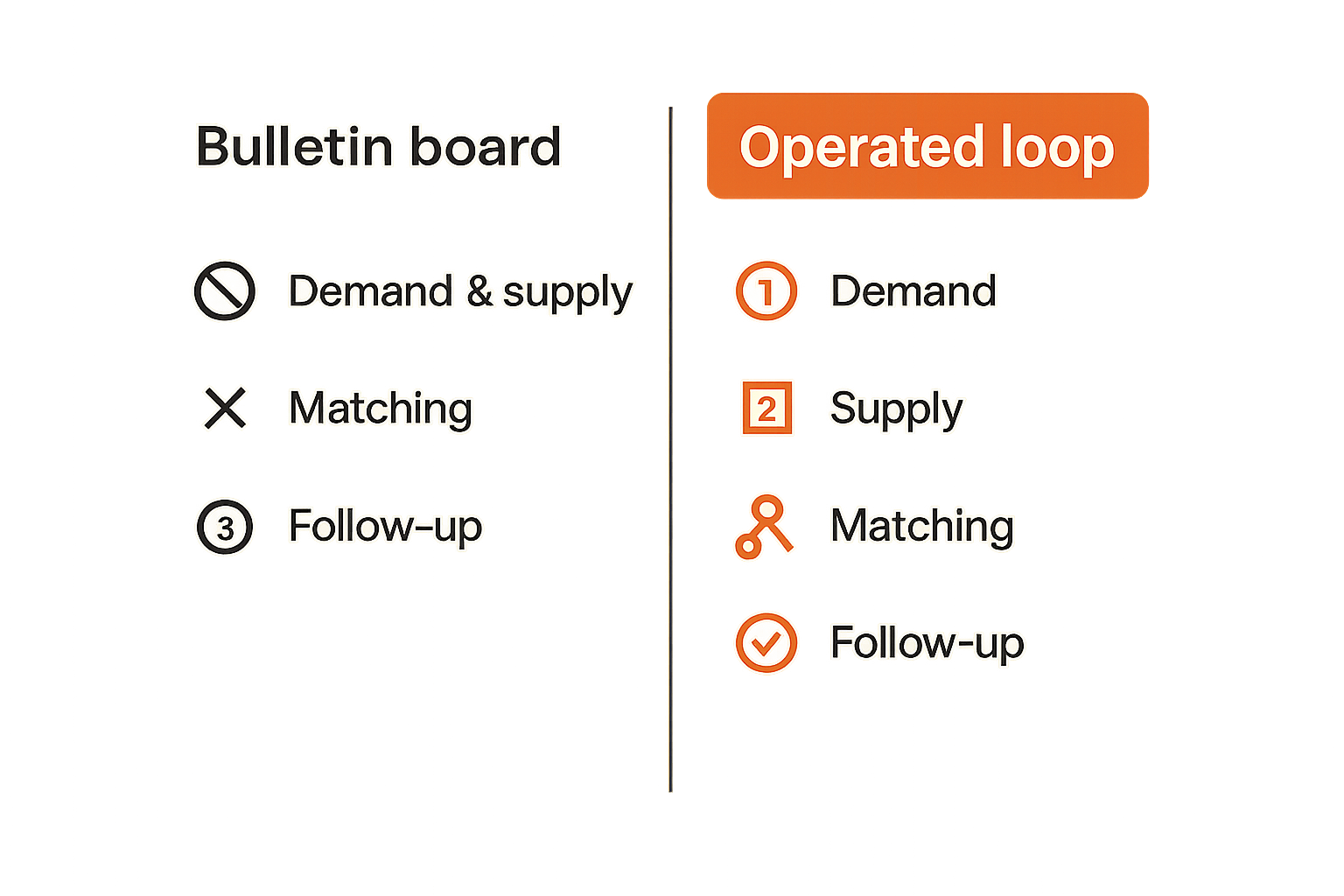
The work has four distinct flows:
- Demand: what work needs to be done, by when, under what constraints.
- Supply: who can help, with what skills, availability, and boundaries.
- Matching: how likely pairs are identified, introduced, and supported.
- Follow-up: what happened, what was learned, and what should change.
When those flows are mixed together, the system becomes hard to debug. If no matches happen, is there no supply, bad asks, bad routing, low trust, unclear budgets, or no follow-up? You cannot know.
Separate the flows and the operational problem becomes visible.
Define the minimum useful signal
A post is not useful because it is long. It is useful because it contains the signals needed for action.
For an ask, the minimum useful signal usually includes:
- the problem to solve
- the desired outcome
- timing
- budget or payment range
- required location or remote status
- decision owner
- next step
For an offer, the minimum useful signal usually includes:
- type of work
- strongest use cases
- proof or examples
- availability window
- rate model or pricing boundary
- preferred clients or projects
- best way to start a conversation
If these fields feel too formal, remember what breaks in practice: vague posts create unpaid discovery work. Freelancers spend time interpreting needs that may never become paid projects. Requesters get replies that do not fit. The community burns attention.
Practical rule: If a post cannot be acted on in under two minutes, it is not an ask or offer yet. It is raw material.
Use a simple operating table
You do not need heavy software to start. You need a shared operating model. The table below is enough to clarify the difference between a casual board and a managed loop.
| Layer | Loose bulletin board | Operated asks-and-offers system |
|---|---|---|
| Ask format | Free text | Required outcome, timing, budget, owner |
| Offer format | Bio or service list | Clear use cases, proof, availability, boundaries |
| Matching | Whoever sees the post | Stewarded routing plus member self-selection |
| Trust | Assumed | Context, references, prior participation, transparent rules |
| Follow-up | Rare | Outcome captured and used to improve future matches |
| Failure signal | Silence | Specific friction point identified |
The table is not bureaucracy. It is a map of the coordination work.
Design asks that freelancers can actually answer
Make the problem concrete
A weak ask says: need help with marketing.
A strong ask says: our neighborhood food co-op needs a freelancer to set up a three-email welcome sequence for new members before June 20. We have copy notes, a Mailchimp account, and a budget of 600 to 900.
The difference is not wording. It is decision quality. The second ask lets a freelancer decide whether they can help, whether the scope is real, and what the next question should be.
Community organizers often avoid structure because they do not want to scare people away. The opposite usually happens. Clear asks lower the social cost of responding.
Require timing and budget clarity
Budget ambiguity is one of the fastest ways to damage trust. Not every ask needs a precise number, but every paid ask needs a budget signal.
Acceptable signals include:
- fixed budget range
- hourly range
- grant-funded cap
- barter or trade, clearly labeled
- unpaid volunteer request, clearly labeled
- exploratory conversation, clearly labeled as unpaid and limited
The mistake teams make is allowing paid work, volunteer work, favors, and speculative projects to look the same. That blurs consent. It also pushes freelancers into awkward negotiation before they know whether the opportunity is real.
Timing matters for the same reason. A project due next week is not the same as a project planned for next quarter. A two-hour consult is not the same as ongoing execution.
Practical rule: No budget signal, no paid-work ask. No timeline signal, no priority.
Avoid the hidden job description
Some asks are actually full-time jobs in disguise. Others are procurement processes disguised as community requests. You will see phrases like wear many hats, looking for a partner, or quick project that includes strategy, design, implementation, training, and support.
A useful steward pushes these requests back into shape:
- What is the first paid milestone?
- What outcome must exist at the end?
- Who approves the work?
- What is not included?
- What can wait?
Freelancing asks and offers work best when asks are scoped to a real first step. The system should encourage smaller, clearer starts rather than giant ambiguous opportunities.
Design offers that create confidence, not noise
Offers need boundaries
Freelancers often introduce themselves broadly because they do not want to miss opportunities. I do branding, strategy, websites, content, operations, and AI consulting may be true, but it is not easy to match.
A better offer has boundaries:
- I help local nonprofits turn messy program notes into grant-ready narratives.
- I build simple booking and intake systems for solo service businesses.
- I photograph community events with same-week delivery for web and social use.
- I help tradespeople clean up invoices, estimates, and monthly bookkeeping.
As guest contributors, the team at ugig.net sees the same pattern across freelancer workflows: narrower offers are easier to route, easier to remember, and easier to buy.
The goal is not to reduce a person to one service. The goal is to make their current offer legible to the network.
Proof beats polish
A local network does not need a pitch-deck version of every freelancer. It needs enough proof to create confidence.
Useful proof can be lightweight:
- one short project example
- a before-and-after description
- a named sector or client type, if shareable
- a testimonial excerpt, if permitted
- a sample artifact
- a reference from inside the community
The proof should answer: why should someone trust this person with this kind of work?
Polish can hide risk. Proof reduces it.
Availability is part of the offer
An offer without availability is only a profile. For matching, availability is not a detail. It is part of the product.
Ask freelancers to state one of these:
- available for one small project this month
- open to discovery calls next week
- booking for July and August
- available for urgent work at rush rates
- not taking clients now but open to referrals later
This prevents dead leads. It also respects the freelancer. A strong community should not route work to someone who is unavailable and then treat silence as disengagement.
Run the freelancing asks and offers loop
The weekly operating rhythm
A system that runs only when someone remembers will decay. Set a rhythm.
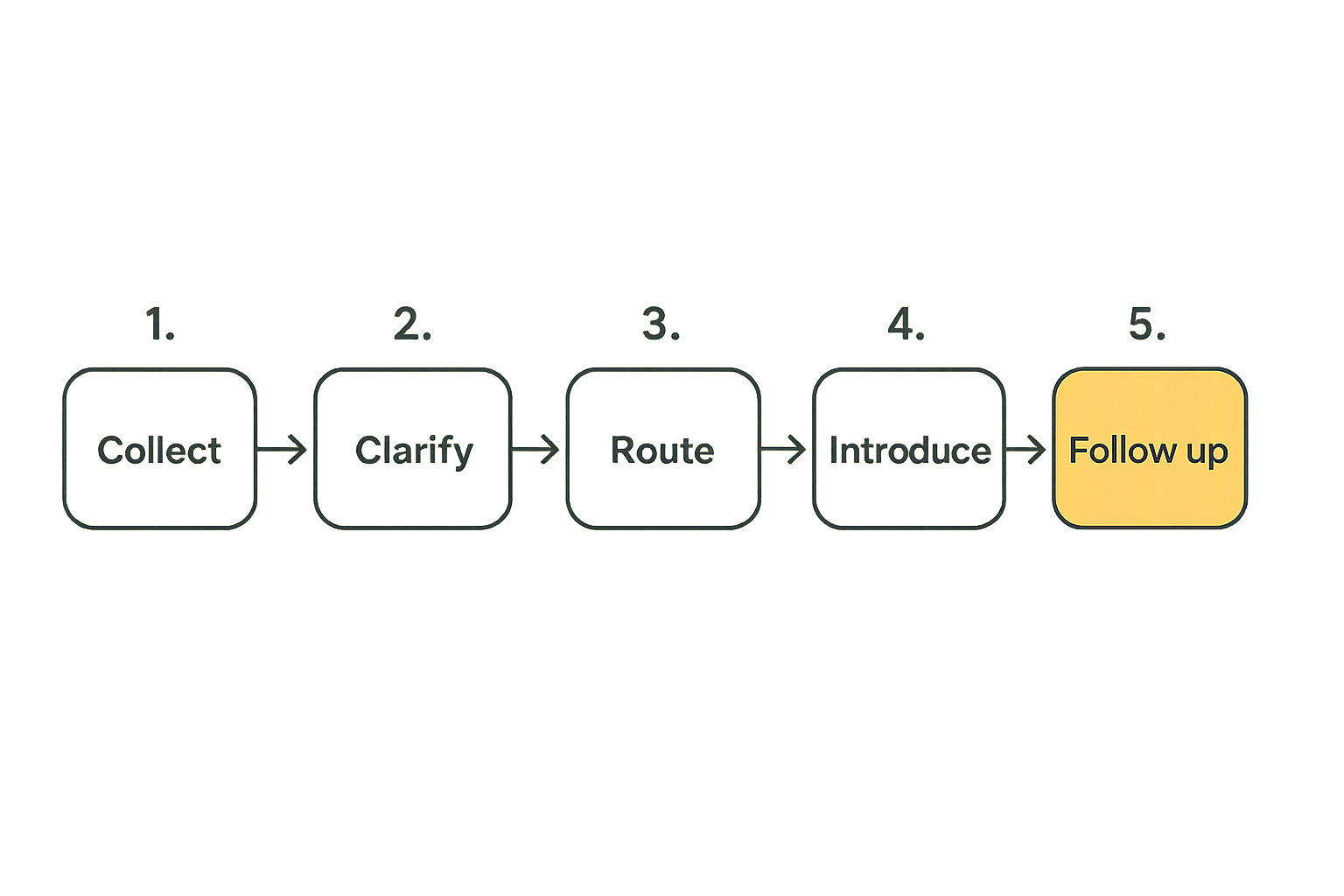
For many communities, a weekly loop is enough:
- Monday: collect new asks and offers using a simple form or guided post format.
- Tuesday: steward reviews for completeness and pushes back on vague entries.
- Wednesday: publish or route the best matches to the right members.
- Thursday: make warm introductions where context is needed.
- Friday: capture status updates and unresolved needs.
This does not need to be a full-time role. It does need to be predictable. Members learn when to submit, when to look, and when to expect follow-up.
The practical question is whether your system has a heartbeat. If it does not, participation becomes random.
The intake-to-intro workflow
Here is a simple implementation sequence for a local network launching freelancing asks and offers:
- Define categories. Start with 6 to 10 categories that match local demand, such as design, bookkeeping, events, writing, web help, grant support, operations, photography, coaching, and technical setup.
- Create two intake templates. One for asks, one for offers. Keep them short but require timing, budget signal, availability, and next step.
- Assign a steward. The steward checks for completeness and routes unclear posts back to the submitter.
- Create a matching view. This can be a board, spreadsheet, directory, CRM, or purpose-built community tool. The key is that asks and offers can be filtered by category, timing, and status.
- Make introductions with context. Do not just tag people. Explain why the match might make sense and what each person should do next.
- Track status. Open, contacted, matched, in conversation, completed, unresolved, archived.
- Review monthly. Look for repeated unmet needs, overloaded freelancers, confusing categories, and low-quality requests.
This sequence turns a social activity into an operational loop.
The close-the-loop habit
Follow-up is where most systems fail. Organizers assume that if two people connect, the system worked. Sometimes it did. Sometimes it created ghosting, scope confusion, underpayment, or a bad fit.
You do not need to police every project. You do need a lightweight check:
- Did the introduction happen?
- Did both sides respond?
- Did it become paid work, volunteer help, a referral, or no fit?
- Was the ask clear enough?
- Was the offer accurate enough?
- Should either party be routed differently next time?
That feedback is the difference between a community that learns and a board that forgets.
Build matching rules for trust and local context
Match on constraint before preference
Many matching systems start with preferences: industry, style, personality, mission alignment. Those matter, but constraints matter first.
A freelancer who cannot start for six weeks is not a match for urgent work. A requester with a 300 budget is not a match for a freelancer whose minimum engagement is 2,000. A remote-only freelancer is not a match for on-site event production. A volunteer ask is not a match for someone seeking paid work unless they explicitly opt in.
Match on constraints in this order:
- type of work
- timing
- budget or compensation model
- location requirement
- availability
- trust or proof threshold
- preference and style
This order prevents social pressure from overriding reality.
Use warm context without gatekeeping
Local networks can create better matches because they hold warm context. But context can become gatekeeping if only insiders receive opportunities.
A good system makes context explicit without making access opaque.
What works:
- public criteria for which asks get routed
- visible categories and status
- clear ways for new freelancers to add proof
- rotating spotlights for under-seen members
- transparent steward decisions when posts are held back
What fails:
- private backchannels for the same few people
- vague claims about quality without criteria
- hidden preference for long-time members
- introductions based only on friendship
Trust should improve the system, not turn it into a club.
Create escalation paths
Some matches are simple. Others need support. A community should decide in advance when a steward steps in.
Escalation triggers might include:
- repeated non-response from a requester
- unpaid work pressure
- unclear ownership of deliverables
- budget changes after introduction
- requests for free strategy before a paid scope
- complaints about professionalism
- safety concerns for in-person work
The goal is not to become a legal department. The goal is to protect the commons. If members feel the system exposes them to bad behavior, they will stop participating.
What breaks when implementation is loose
The empty ask problem
Empty asks sound active but contain no decision signal. They create the illusion of opportunity while pushing work onto responders.
Examples:
- Anyone know a good web person?
- Need help with social media.
- Looking for someone creative.
- We should do something with AI.
These are not bad intentions. They are incomplete inputs. The steward's job is to turn them into real asks before the network spends attention on them.
A useful response is: what outcome do you need, by when, and what budget or compensation model are you working with?
The endless offer directory
The opposite failure is the giant freelancer directory nobody uses. It looks impressive. It feels like infrastructure. But if profiles are stale, categories are broad, and availability is unknown, it becomes a graveyard.
Directories fail when they do not connect to current demand. A profile from eight months ago does not tell you whether the freelancer is available next week. A list of skills does not tell you which project they want now.
If you use a directory, treat it as supply memory, not the matching system itself. Current offers should still be refreshed.
The invisible outcome problem
The most damaging failure is invisible outcome loss. The organizer sees a post and a few replies and assumes value happened. But no one knows whether the work started, whether money changed hands, whether the ask was fulfilled, or whether the freelancer had a bad experience.
What breaks in practice is learning. Without outcome data, the community repeats the same mistakes:
- unclear asks keep getting approved
- unreliable requesters keep getting routed
- strong freelancers remain hidden
- categories do not evolve
- unpaid work pressure goes unnoticed
Follow-up is not admin overhead. It is how the system gets smarter.
Measure freelancing asks and offers like an operator
Track movement, not vanity
Do not optimize for number of posts. A noisy board can have high activity and low usefulness.
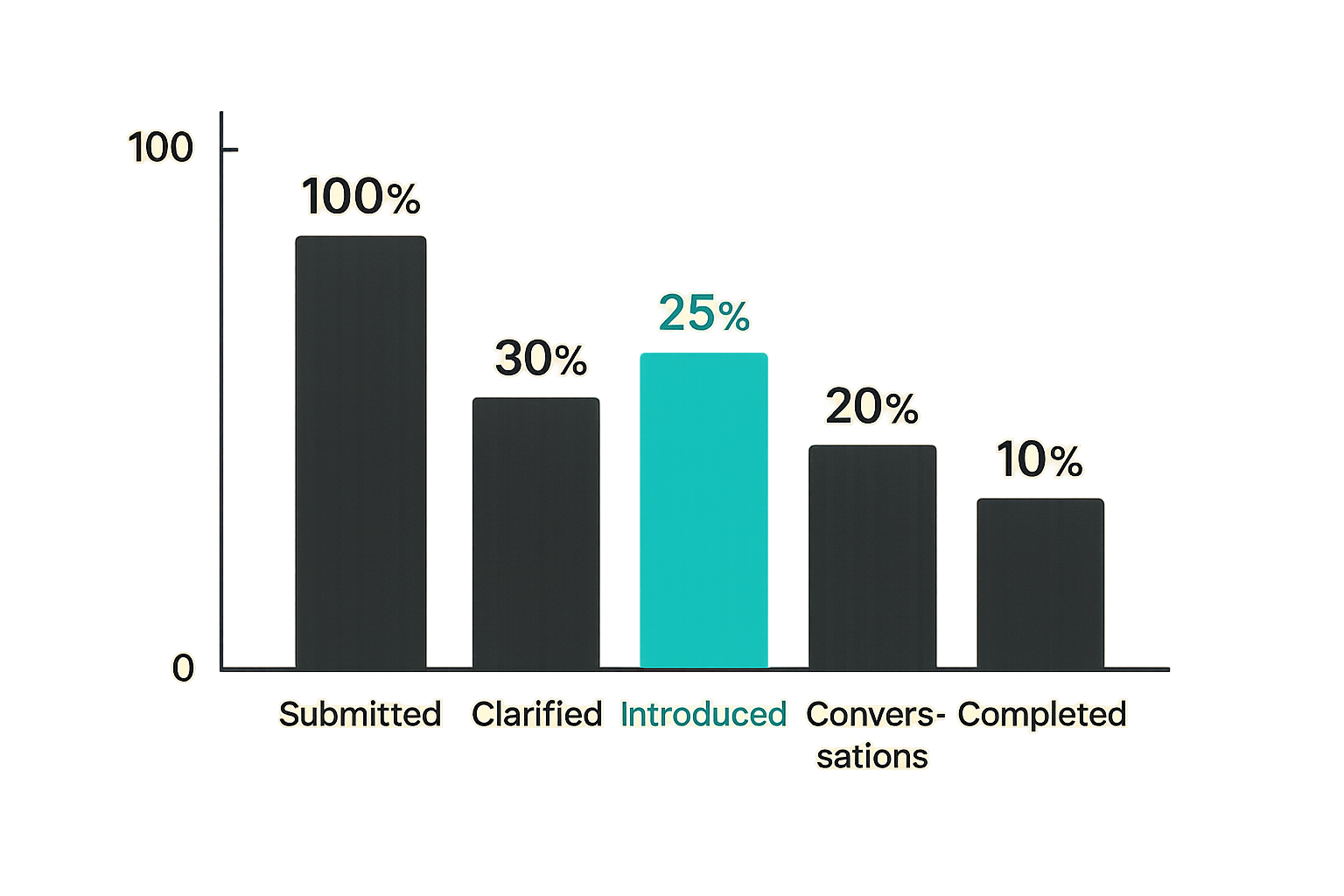
Better metrics track movement through the workflow:
- asks submitted
- asks clarified
- offers refreshed
- matches suggested
- introductions made
- conversations started
- paid projects created
- volunteer matches created
- unresolved asks
- average time from ask to first relevant response
You do not need perfect data. You need enough to see where attention is leaking.
If 40 asks are submitted and only 10 are clarified, intake is the bottleneck. If 30 introductions are made and only 5 conversations start, trust or fit is the issue. If conversations start but projects do not, budget, scope, or decision authority may be the problem.
Watch friction points
A practical dashboard can be simple. Use status counts and a monthly review. The questions matter more than the tool.
Ask:
- Which categories have more demand than supply?
- Which categories have supply but little demand?
- Which asks stall most often?
- Which freelancers receive too many requests?
- Which members never get matched despite strong offers?
- Which requesters need help scoping work?
This turns freelancing asks and offers into community intelligence. You start seeing what the local economy needs: grant writers, part-time operators, event support, bookkeeping cleanup, website maintenance, translation, childcare-adjacent logistics, creative production.
That changes programming too. If the same need appears repeatedly, maybe the community should run a workshop, form a shared service pool, or help members package offers better.
Use metrics to adjust the workflow
Metrics are only useful if they change behavior.
For example:
| Signal | Likely issue | Adjustment |
|---|---|---|
| Many vague asks | Intake too loose | Add required fields and steward review |
| Many offers, few matches | Offers too broad or stale | Require current availability and narrower use cases |
| Slow first response | Routing too passive | Add direct introductions or alerts |
| Matches but no projects | Scope or budget mismatch | Require clearer compensation and first milestone |
| Same freelancers get all work | Visibility bias | Rotate spotlights and review matching criteria |
| Complaints after intros | Trust rules unclear | Add escalation path and requester expectations |
The point is not to turn a community into a call center. The point is to stop guessing.
Governance keeps the system fair
Publish the rules of engagement
Freelancing asks and offers involve money, reputation, and social trust. That means the rules should be visible.
At minimum, publish expectations for:
- paid versus unpaid asks
- response times
- respectful negotiation
- no pressure for free strategy
- how introductions work
- what information is private
- when moderators or stewards may intervene
- how complaints are handled
This protects requesters too. Many small organizations do not know how to scope freelance work. Clear rules help them ask better and avoid accidental harm.
Protect members from extraction
Community goodwill can be exploited. A founder wants free design in exchange for exposure. A nonprofit asks for a full strategy before funding is approved. A business owner treats the network like a discount labor pool. A member repeatedly requests help but never follows through.
The system needs boundaries.
Useful boundaries include:
- unpaid asks must be labeled clearly
- speculative work requests are not allowed
- discovery calls have a suggested time limit
- requesters must state decision authority
- repeated no-shows can lose posting privileges
- high-effort volunteer requests require steward review
Practical rule: Generosity works when consent is clear. If compensation is ambiguous, the system is borrowing trust from freelancers.
Decide who stewards the commons
The steward role is not just moderation. It is commons management.
A steward notices when the system is becoming unfair. They see when a small group captures the best opportunities. They see when newer members cannot break in. They see when requesters need education. They see when categories no longer reflect reality.
For larger networks, stewardship can rotate. For smaller networks, one person may handle it. Either way, make the role explicit.
A good steward does three things:
- improves the quality of inputs
- protects the quality of interactions
- turns outcomes into learning
That is the job.
Bringing freelancing asks and offers into d0rz.com
Where d0rz.com fits
For a community builder, the tool question should come after the workflow question. If the workflow is unclear, software will only make confusion faster.
Where d0rz.com fits is in helping local networks treat freelancing asks and offers as a living coordination layer rather than a scattered set of posts. The useful product pattern is not just collect profiles. It is connect asks, offers, context, status, and follow-up in one place where stewards can see what is happening.
That matters because local networks are rarely short on goodwill. They are short on operational memory. Who asked for help? Who offered capacity? Which intro happened? Which need is still unresolved? Which category keeps appearing? Which members are underutilized?
When those signals stay visible, the community can act with less guesswork.
A 30-day rollout plan
Do not launch with a grand announcement and a blank board. Seed the system.
A practical 30-day rollout looks like this:
- Week 1: interview 10 to 15 members. Ask what work they need, what they can offer, and what has made past referrals hard.
- Week 1: choose initial categories. Keep them narrow enough to be useful but broad enough to avoid fragmentation.
- Week 2: publish the ask and offer templates. Explain why budget, timing, availability, and proof are required.
- Week 2: recruit 10 initial offers from freelancers who agree to keep availability current.
- Week 3: collect 5 to 10 real asks from organizations, small businesses, or members with scoped needs.
- Week 3: make the first introductions manually. Manual matching teaches you what the system must support.
- Week 4: review outcomes. Which fields were missing? Which categories worked? Where did people hesitate?
- Week 4: publish a short community update. Share what was learned without exposing private details.
This avoids the cold-start problem. Members see real movement, not an empty container.
The closing rule
Freelancing asks and offers are not a side channel for random opportunities. They are a coordination system for economic trust.
The mistake teams make is treating the visible post as the work. The real work is the loop around the post: intake, clarity, routing, trust, introduction, follow-up, and learning.
If you build that loop, your community becomes more than a place where freelancers promote themselves. It becomes a network that can notice demand, activate capacity, and keep value circulating locally.
Try d0rz.com
Build a clearer coordination layer for freelancing asks and offers in your local network. Try d0rz.com.