

Most communities do not fail because people lack goodwill. They fail because goodwill has nowhere reliable to go.
A neighborhood group has someone who can mentor first-time renters, another person who needs childcare for one afternoon, a nonprofit with unused meeting space, and a local organizer who knows three funders. Everyone says they want to help. Then the thread gets buried, the spreadsheet goes stale, and six weeks later the same needs come up again.
Teams think the problem is participation. The real problem is coordination architecture.
Peptide asks and offers is a useful way to frame that architecture in 2026: small, specific units of need and capacity that can bind into larger patterns of mutual support. The practical question is not how to get more posts. It is how to make each ask and each offer clear enough to route, match, verify, fulfill, and learn from.
Table of contents
- Peptide asks and offers are a coordination system
- Start with the unit of exchange
- Design the fields before you design the form
- Build a routing workflow, not a bulletin board
- Use trust boundaries and consent rules
- What works in peptide asks and offers
- What fails in peptide asks and offers
- Metrics that show whether the system works
- Implementation plan for a local network
- Where d0rz.com fits
- Closing the loop on peptide asks and offers
Peptide asks and offers are a coordination system

Why the peptide metaphor is useful
A peptide is a small chain. In community design, the metaphor works because the strongest local networks are built from small links that can combine without becoming vague.
An ask might be: Need a Spanish-speaking volunteer to review a tenant letter by Friday. An offer might be: Can host six people for a resume workshop on Tuesday evenings in June. These are not abstract signals of kindness. They are operational units.
The mistake teams make is treating peptide asks and offers as a naming exercise. They rename their help channel, add a form, and assume the network will coordinate itself. It will not. The unit only matters if it moves through a workflow.
Why generic help threads break
Generic help threads feel alive at first. They create visible activity. They are easy to launch. But they fail when the network grows past the size where one person can remember who said what.
What breaks in practice is state. Nobody knows whether an ask is still active, whether an offer has already been used, whether a match happened offline, or whether the person asking still wants contact.
That changes the conversation. The goal is not more comments. The goal is a reliable pipeline from need to response.
The operating outcome
A working peptide asks and offers system should answer six questions quickly:
- What is needed or offered?
- Who owns the next step?
- Who is allowed to see it?
- What is the deadline or availability window?
- What happened after a match was proposed?
- What should the community learn from the outcome?
If your system cannot answer those questions, you do not have coordination. You have a public memory problem.
Practical rule: Every ask and offer needs an owner, a status, a time window, and a next action. Without those four fields, the system will decay.
Start with the unit of exchange
Make asks small enough to answer
Large asks create hesitation. Small asks create movement. Compare these:
| Weak ask | Strong peptide ask |
|---|---|
| We need help with youth programs | Need two adults to review a Saturday workshop plan by May 31 |
| Looking for housing support | Need one tenant rights contact for a family facing a June 10 hearing |
| Can anyone help with fundraising | Need a 30-minute call with someone who has run a local sponsorship drive |
The strong version gives people a way to say yes, no, or not me but I know who. That last response is valuable. It turns the network into a routing layer.
Make offers specific enough to trust
Offers need the same discipline. An offer like happy to help is socially pleasant and operationally useless. It creates work for coordinators because someone has to interrogate the offer later.
Useful offers include boundaries:
- Skill or resource offered
- Available days or time window
- Location or remote availability
- Capacity limit
- Conditions or exclusions
- Preferred contact path
A useful way to think about it is inventory management for community capacity. You are not reducing generosity to a database. You are protecting it from being wasted.
Separate intent from commitment
Many people are willing in principle and unavailable in practice. That is normal. The system should not punish it, but it should distinguish it.
Use statuses such as:
- Interested
- Available this month
- Matched
- Completed
- Paused
- No longer available
The distinction matters because stale offers are worse than no offers. They create false hope and extra follow-up work.
Design the fields before you design the form
Minimum viable fields
Most teams start with a tool. Form, spreadsheet, Slack channel, Airtable, CRM, custom app. The practical question is simpler: what state does the network need to preserve?
Start with these fields:
| Field | Why it matters |
|---|---|
| Type | Ask or offer |
| Category | Routing and filtering |
| Description | Human context |
| Owner | Accountability |
| Visibility | Privacy boundary |
| Deadline or window | Urgency and expiration |
| Location | Local relevance |
| Status | Current state |
| Next step | Prevents drift |
These fields can live in many tools. The tool is secondary. The schema is primary.
Context fields that improve routing
Once the basics work, add context that improves matches without making submission painful. Good examples include language, accessibility needs, transportation constraints, organizational affiliation, urgency, and whether a background check or safeguarding rule applies.
Do not add fields because they are interesting. Add fields because they change routing.
Practical rule: If a field does not change who sees the ask, who can answer it, or how quickly it must move, it probably does not belong in the first version.
Fields that create risk
Community systems often collect too much sensitive information because organizers want context. The intention is good. The result can be dangerous.
Avoid collecting medical details, immigration status, legal facts, household conflict details, financial account information, or information about minors unless you have a clear safeguarding process and a legitimate reason. Even then, minimize.
The team at coinpayportal.com spends a lot of time thinking about state, consent, and settlement boundaries in payment infrastructure, and the same operator lesson applies here: the interface is never the whole system.
Build a routing workflow, not a bulletin board
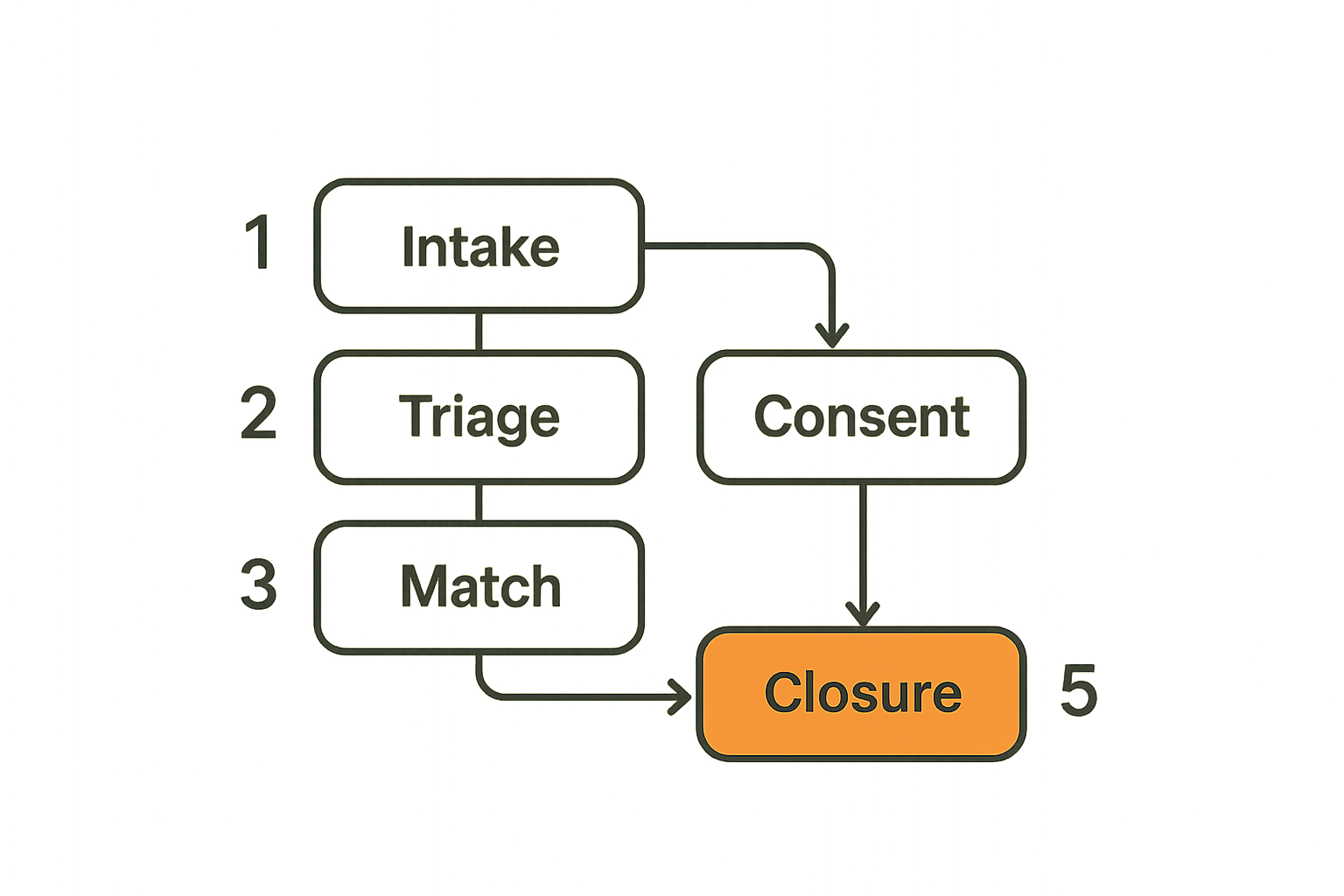
The five-step coordination loop
A bulletin board publishes. A coordination system routes. Peptide asks and offers need a loop:
- Intake the ask or offer with enough structure to route it.
- Triage for urgency, privacy, completeness, and risk.
- Match to a person, group, resource, or pathway.
- Confirm consent and availability on both sides.
- Close the loop with status, outcome, and learning.
This sequence is boring in the best way. It prevents the common failure where everyone sees a need but nobody knows who is handling it.
Human routing still matters
Local networks run on context. A form will not know that a volunteer is burned out, that two organizations have a tense history, or that a public match might embarrass someone who asked privately.
Human routing is not a weakness. It is part of the system. The question is whether the human router has a clear queue, rules, and escalation path.
Good routing roles include:
- Intake reviewer
- Category steward
- Privacy reviewer
- Match confirmer
- Follow-up owner
One person can play several roles in a small network. But the roles should be named.
When automation helps
Automation helps when the rule is clear and the cost of delay is high. It fails when teams use it to avoid judgment.
Good uses:
- Expire asks after a deadline
- Remind owners when status is stale
- Notify a category steward about new entries
- Flag urgent categories for review
- Send confirmation messages after a match
Bad uses:
- Auto-matching vulnerable people without consent
- Broadcasting private asks to broad lists
- Treating keyword similarity as trust
- Closing requests without human review
Automation should reduce coordination load, not erase responsibility.
Use trust boundaries and consent rules
Public, semi-private, and private asks
Not every ask belongs in the same room. A local business offering chairs for events can be public. A parent seeking emergency childcare may need semi-private routing. A person dealing with housing instability may need private intake.
Use three visibility levels:
| Visibility | Best for | Typical access |
|---|---|---|
| Public | Low-risk offers, event resources, general volunteer needs | Whole network |
| Semi-private | Moderately sensitive needs, partner referrals | Trusted members or stewards |
| Private | Vulnerable situations, safeguarding concerns, personal crises | Named coordinators only |
The system should make visibility explicit at submission. Do not make coordinators infer privacy after the fact.
Consent before matching
A match is not complete because a coordinator found two names. It is complete when both sides agree to contact, scope, and next step.
Consent should include:
- Permission to share contact details
- Agreement on what is being shared
- Clear expectation of response time
- Option to decline without explanation
- A way to report problems
Practical rule: Never treat access to a community directory as permission to route someone into another person’s need.
Protect vulnerable participants
Peptide asks and offers can surface real hardship. That is part of their value, but it also creates responsibility. Build escalation paths before you need them.
For networks involving youth, elders, housing insecurity, domestic conflict, immigration stress, health needs, or crisis support, decide in advance:
- Which asks should not be posted publicly
- Which volunteers need screening
- Which situations require partner referral
- Who can see sensitive notes
- How long sensitive records are retained
The practical question is not whether your community is caring. It is whether your process protects people when care becomes operational.
What works in peptide asks and offers
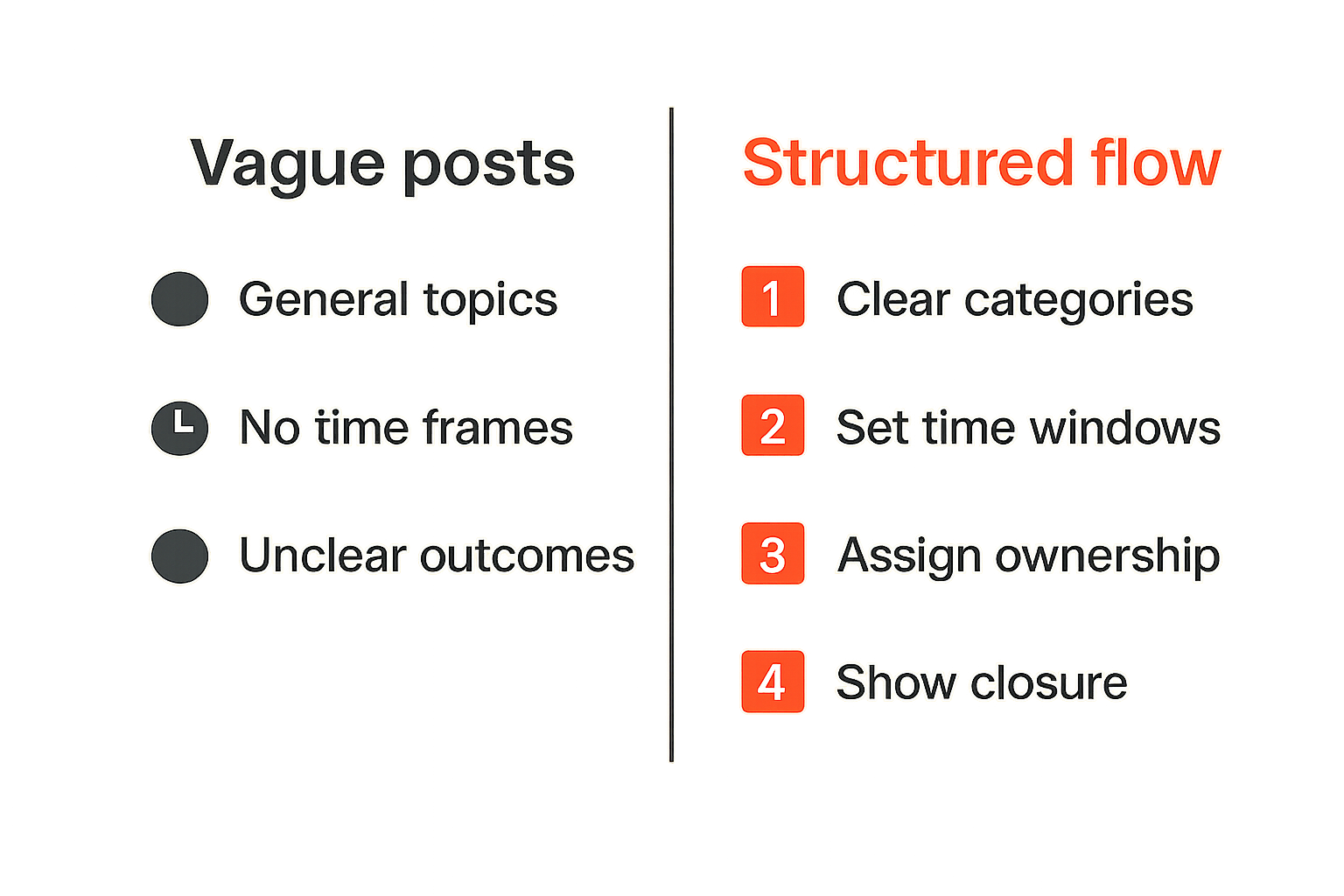
Clear categories beat clever taxonomies
Categories should help people act. They should not impress other system designers.
Good starter categories include:
- Space
- Transport
- Childcare
- Translation
- Food
- Funding
- Skilled advice
- Event support
- Equipment
- Introductions
Avoid categories that are too abstract, such as empowerment, resilience, or ecosystem building. Those might describe your mission. They do not route work.
Short time windows create movement
Open-ended asks rot. Open-ended offers become unreliable. Time windows force the system to refresh reality.
Use defaults:
- Urgent ask: review within 24 hours
- Standard ask: expire in 14 to 30 days
- Event-related offer: expire after event date
- General offer: reconfirm every 60 to 90 days
- Sensitive ask: review by a named steward within one business day
Expiration is not rejection. It is hygiene. People can resubmit or renew. The point is to keep the network from pretending old information is current.
Visible closure builds confidence
Communities trust systems that show completion. They do not need every private detail, but they need evidence that participation matters.
Closure messages can be simple:
- Matched with a volunteer, thank you
- Resource found through partner referral
- Ask expired, no longer active
- Offer used for three events this month
- Need changed, requester paused follow-up
Visible closure creates a feedback loop. People learn what kinds of asks work, what resources are scarce, and where the network has real capacity.
What fails in peptide asks and offers
The everything spreadsheet
The everything spreadsheet starts as a practical move. It becomes a landfill. Columns multiply, rows go stale, permissions get messy, and nobody wants to be responsible for cleanup.
The failure is not that spreadsheets are bad. The failure is using a spreadsheet without workflow rules.
If you use one, define:
- Who reviews new rows
- What statuses mean
- When rows expire
- Who can edit sensitive fields
- How matches are logged
- What gets archived
A spreadsheet with ownership can work. A spreadsheet as shared hope will not.
The performative offer problem
In many communities, offers are social signals. People want to be seen as helpful. That is human. But systems break when performative offers are treated as confirmed capacity.
Examples:
- I can help with anything
- We should collaborate sometime
- Our organization supports this work
- Happy to connect you with people
These may be sincere. They are not yet usable. Convert them into structured offers by asking for scope, time, and conditions.
The coordinator bottleneck
Many asks-and-offers systems secretly depend on one exceptional person. That person remembers everyone, smooths over ambiguity, follows up late at night, and makes the system look better than it is.
Then they leave, burn out, or take a vacation. The network discovers it had a person, not a process.
The fix is not to remove human judgment. The fix is to document routing rules, distribute roles, and make state visible enough that another trusted person can step in.
Metrics that show whether the system works
Track flow, not vanity
Member count does not tell you whether peptide asks and offers are working. Post count does not either. A noisy system can look active while failing the people who need help.
Track operational flow:
| Metric | What it tells you |
|---|---|
| Intake volume | Whether people are using the channel |
| Triage time | Whether the system responds quickly |
| Match rate | Whether the network has relevant capacity |
| Completion rate | Whether matches become outcomes |
| Aging open asks | Whether needs are being neglected |
| Reconfirmed offers | Whether capacity is current |
The numbers do not need to be fancy. They need to change behavior.
Watch the aging queue
The aging queue is where trust dies. An ask that sits unanswered for weeks tells the requester that the network may be friendly but not useful.
Create thresholds. For example:
- 48 hours with no triage: alert steward
- 7 days with no match: escalate or reframe
- 14 days open: check whether still active
- Past deadline: close or archive
This is where many teams resist process because it feels administrative. But administration is what turns care into reliability.
Measure trust through follow-through
Trust is not only sentiment. In coordination systems, trust shows up as follow-through.
Look for:
- People renewing offers without being chased
- Requesters returning with clearer asks
- Partners accepting referrals
- Coordinators closing loops on time
- Members making useful second-degree introductions
These are stronger signals than likes or attendance. They show the network is becoming more legible to itself.
Implementation plan for a local network
Phase one inventory
Start by mapping what already exists. Do not launch a new system until you know where asks and offers currently live.
Inventory:
- Group chats
- Email lists
- Partner referrals
- Staff inboxes
- Event conversations
- Social posts
- Volunteer databases
- Informal broker relationships
Then identify the top five categories that appear most often. You are looking for repeated coordination patterns, not one-off anecdotes.
Phase two pilot
Run a 30-day pilot with a narrow scope. For example, focus only on event support, translation, and space sharing. Or focus only on one neighborhood cluster.
Pilot workflow:
- Define categories, fields, and visibility levels.
- Recruit two to five stewards who can review entries.
- Publish simple instructions for submitting asks and offers.
- Review the queue on a fixed cadence.
- Log every match, decline, expiration, and completion.
- Hold a short retrospective at the end of the pilot.
Keep the pilot small enough that you can see where the workflow breaks.
Phase three operating cadence
After the pilot, move from launch energy to operating rhythm. That is where durable systems are built.
A weekly cadence might include:
- Review new asks and offers
- Check stale statuses
- Escalate urgent or sensitive items
- Confirm pending matches
- Publish safe closure updates
- Update category rules based on patterns
The mistake teams make is treating launch as success. Launch only proves that people will try the system. Cadence proves that the system can carry weight.
Where d0rz.com fits
A home for structured coordination
Peptide asks and offers need a place where structure, trust, and local context can live together. That is the problem d0rz.com is built around: helping community builders think beyond broadcast channels and toward working coordination systems.
For organizers, the value is not another place to post updates. The value is having a shared architecture for what members need, what they can offer, who owns follow-up, and how the network learns from outcomes.
Architecture before volume
If your local network is small, this still matters. Small communities are where habits form. If every ask is vague and every offer is informal at 80 people, the system will be painful at 800.
Start with architecture before volume:
- Define the unit
- Clarify the fields
- Name the stewards
- Set consent rules
- Track status
- Close the loop
That is not bureaucracy. It is the minimum structure required for people to trust the system with real needs.
Closing the loop on peptide asks and offers
The operator checklist
Before you expand peptide asks and offers across a community, check the basics:
- Can a new member submit a clear ask in under five minutes?
- Can a steward identify urgency and visibility quickly?
- Can offers expire or be reconfirmed?
- Can private asks stay private?
- Can a match be accepted, declined, or paused?
- Can someone see which asks are aging?
- Can the community learn from completed matches?
If the answer is no, fix that before recruiting more participants.
The final test
The final test is simple: when someone brings a real need to the network, does the system reduce uncertainty or add to it?
Peptide asks and offers work when they make generosity easier to route and safer to receive. They fail when they become another pile of vague intentions. Build the workflow, protect the trust boundary, measure follow-through, and close the loop.
That is how peptide asks and offers become community infrastructure instead of another busy channel.
Try d0rz.com
d0rz.com helps community builders design practical asks-and-offers systems for real local coordination. Try d0rz.com