

A supreme community sounds like a branding problem until you try to run one on a Tuesday afternoon.
Someone needs a ride. Someone else can offer help, but only after 5 p.m. A local business has a broken intake form. A freelancer can fix it, but needs scope, access, and a safe way to follow up. The group chat is busy. The directory is stale. The organizer is now the help desk.
Teams think the problem is engagement. The real problem is coordination.
That changes the conversation. A supreme community is not the loudest local network, the largest member list, or the most inspirational feed. It is an operating model where asks, offers, trust, routing, and follow-up reliably turn participation into outcomes.
Table of contents
- Supreme community is an operating model, not a status label
- The coordination stack behind a supreme community
- Design the ask-offer workflow before you recruit
- Build trust routing without turning into bureaucracy
- What works and what fails in local network operations
- Implementation sequence for a reliable local community network
- Metrics that actually describe community health
- Common failure modes in a supreme community
- Tooling and governance choices
- Using d0rz.com as practical coordination infrastructure
Supreme community is an operating model, not a status label
The mistake teams make is treating community as audience
The mistake teams make is measuring community like media. More members. More posts. More impressions. More events. Those numbers may matter for reach, but they do not prove that a local network can coordinate work.
A local organizer can have 2,000 people in a group and still fail to find one trustworthy person for a same-day errand. A neighborhood founder can host a great meetup and still have no system for routing follow-up requests. A freelance community leader can know everyone personally and still become the single point of failure.
Audience thinking creates attention. Network operations creates throughput.
The practical definition for operators
A useful way to think about it is this: a supreme community is a local coordination system that can receive a need, identify credible capacity, route the match, support the handoff, and learn from the outcome.
That is not a definition for a landing page. It is a workflow test. If someone posts an ask, what happens next? If someone makes an offer, where does it live? If a match fails, who notices? If trust is uncertain, how is the risk reduced?
Practical rule: If your community cannot explain how an ask becomes a completed outcome, you do not have a coordination model yet. You have a communication channel.
Why this matters in 2026
In 2026, local work is more fragmented. Small businesses use mixed tools. Independent workers juggle platforms, text threads, payment links, and direct referrals. Residents expect quick answers, but trust still comes from local context.
The practical question is not whether people want community. They usually do. The practical question is whether your local network can reduce friction enough that people use it when the need is real.
A supreme community wins because it turns weak signals into useful routing. Not everyone has to know everyone. The system has to know enough to connect the right people at the right moment.
The coordination stack behind a supreme community
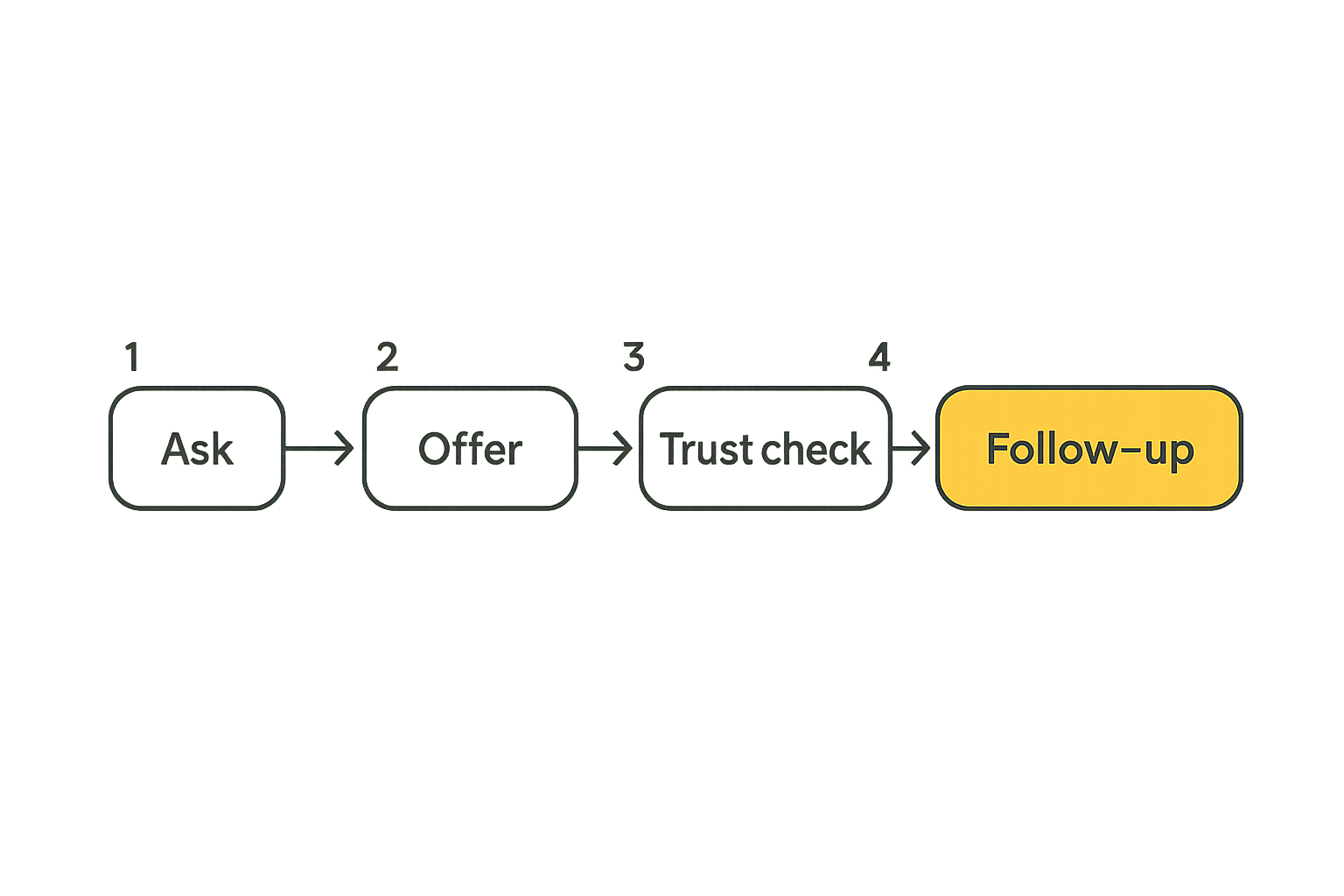
Asks and offers are the base data model
Most communities start with messages. Mature networks start with structured asks and offers.
An ask is not just a post that says help needed. It has scope, location, timing, constraints, urgency, budget, permissions, and preferred contact path. An offer is not just a bio. It has capability, coverage area, price range, availability, proof, boundaries, and response expectations.
When asks and offers are captured as reusable records, the network becomes searchable and routable. When they only exist as chat messages, the network depends on memory.
For example, a local provider offering remote website and automation help is not only selling technical skill. They are publishing a capability that can be routed to local businesses with broken forms, payment-link issues, or automation gaps. That is why an offer such as remote website and automation help for local businesses is operationally useful: it gives the network something specific to match.
Trust is routing metadata
Trust is not a vibe. In operations, trust is metadata that influences routing.
A provider may be verified for small website fixes, but not for entering private financial systems. A driver may be trusted by three families, but unavailable for long trips. A volunteer may be excellent for event setup, but not appropriate for unsupervised access to a home.
The system does not need a heavy scoring regime on day one. It needs a way to remember who has completed what, who can vouch for whom, and what constraints apply.
Follow-up is the reliability layer
Follow-up is where most communities quietly fail. The match is made, then nobody knows whether the work happened. The organizer assumes success. The requester disappears. The provider never gets feedback. The next similar request starts from zero.
A supreme community treats follow-up as part of the job, not an optional courtesy.
The minimum follow-up loop is simple:
- Confirm the requester received a first response.
- Confirm the provider accepted or declined.
- Confirm the work was completed, canceled, or rerouted.
- Capture one useful note for the next match.
This is the difference between a group that feels active and a network that becomes smarter over time.
Design the ask-offer workflow before you recruit
Capture enough context to route
Recruiting more people before the workflow exists usually increases noise. The community gets more possible helpers, but no better way to route work.
For each ask, capture the minimum routing context:
- What is needed?
- Where is it needed?
- When is it needed?
- What is the risk level?
- What budget, trade, or volunteer expectation exists?
- What would count as resolved?
- Who is allowed to see the details?
For each offer, capture the minimum capacity context:
- What can this person or business do?
- Where can they serve?
- When do they respond?
- What do they not do?
- What proof or reference exists?
- What is the best next step?
The goal is not to create a long form. The goal is to prevent the first responder from asking six obvious questions every time.
Make the first response predictable
The first response sets the trust tone. If a person submits a real need and hears nothing, they learn that the network is ornamental. If they receive a clear next step, even if the answer is not immediate, they learn that the network is operated.
A practical first response can be plain:
- We received the ask.
- We are checking fit with two possible providers.
- If nobody accepts by 4 p.m., we will update you.
- Do not share sensitive access until a match is confirmed.
That changes the conversation. The requester does not need to guess whether anyone is paying attention.
Practical rule: A predictable no is better than an invisible maybe. Local trust decays fastest when people cannot tell whether the system is alive.
Close the loop or the network degrades
Unclosed loops create bad data. A provider may look available but actually be overloaded. A requester may look unresolved but already found help elsewhere. An organizer may assume a match worked when it failed privately.
Closing the loop can be lightweight. Use statuses such as new, triaging, matched, in progress, complete, canceled, reroute needed. Do not overcomplicate the lifecycle until the volume requires it.
The important part is that every ask lands somewhere. Unknown is allowed temporarily. Forgotten is not.
Build trust routing without turning into bureaucracy
Use lightweight reputation signals
Trust routing does not require turning your community into a credentialing agency. It requires using the signals you already have with discipline.
Useful signals include:
- Completed local tasks
- Repeat requesters
- Direct references
- Public work examples
- Clear identity and contact path
- Consistent response time
- Known constraints and boundaries
Avoid pretending all signals are equal. A person who is great for public event support is not automatically the right fit for childcare, home access, payment-system work, or private data handling.
Related reading from our network: security teams face a similar operator problem when they build recovery workflows before fatigue breaks response quality; the same systems thinking appears in critical incident stress debriefing for SOC teams.
Separate eligibility from availability
Many teams mix up eligibility and availability. Eligibility means this person is appropriate for the request. Availability means this person can actually do it now.
You need both.
A highly trusted provider who is unavailable creates a delay. An available but unqualified person creates risk. The routing workflow should check these separately:
- Is this provider allowed or appropriate for this category?
- Are they currently taking requests?
- Do they serve this location?
- Can they respond within the needed window?
- Are there conflicts or constraints?
The mistake teams make is routing based on familiarity. The organizer remembers someone helpful and sends everything their way. That works until the trusted helper burns out or accepts work outside their lane.
Know when a human dispatcher is required
Automation can route simple asks. Human judgment is still required when risk, ambiguity, or social context is high.
Use human dispatch for:
- Home access
- Vulnerable populations
- Disputes or refunds
- Medical, legal, or safety-adjacent requests
- Tasks involving credentials, payment systems, or private data
- First-time providers handling sensitive work
The dispatcher does not need to be a full-time employee. In small communities, it may be a rotating operator. What matters is that the role is explicit.
Practical rule: Automate the obvious. Escalate the ambiguous. Never let the tool pretend a risky match is routine.
What works and what fails in local network operations
What works
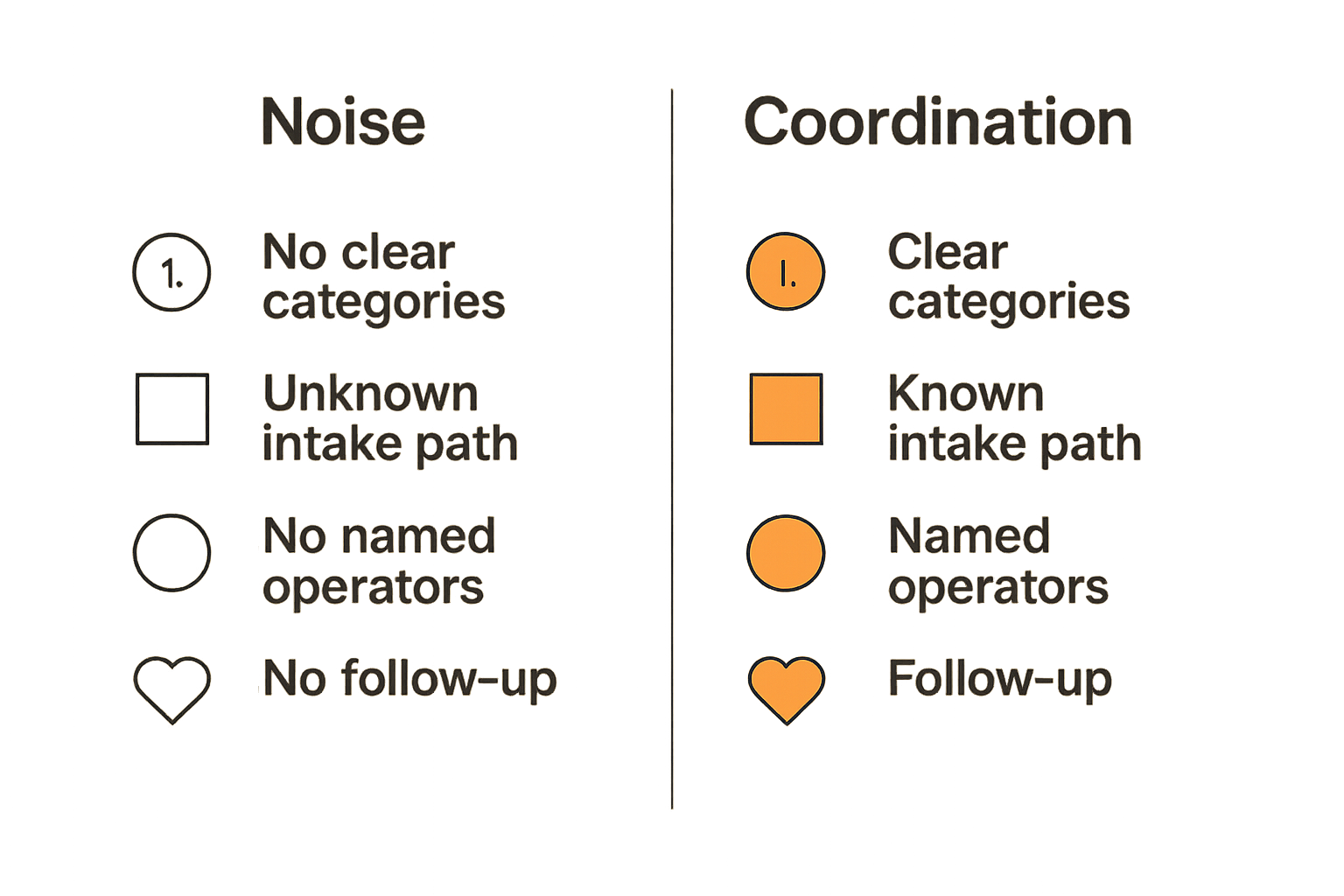
What works is boring, visible, and repeatable.
A good local network has clear categories. It has a known intake path. It has named operators. It has a way to pause offers when people are busy. It has enough trust context to avoid reckless matching. It follows up after the handoff.
It also starts narrower than the founder wants. One lane, such as local business automation, rides, delivery, elder errands, event staffing, or home help, is easier to operate than everything for everyone.
A practical example is a public ask for one workflow to automate. That kind of ask is useful because it narrows the surface area: one non-sensitive workflow, one business context, one visible outcome. A network can route something like seeking one public business workflow to automate far more reliably than a vague request for tech help.
What fails
What fails is usually not lack of goodwill. It is lack of state.
The group chat forgets. The spreadsheet goes stale. The directory has names but no availability. The organizer manually remembers who is good. The community celebrates participation but never records outcomes.
What breaks in practice is the handoff between interest and execution. Five people may like a post. Two may say they can help. Nobody confirms ownership. The requester waits. The organizer nudges. The energy drains.
Related reading from our network: teams working on content and discovery face the same balancing problem between competing goals, which is why multi-objective optimization for AEO is a useful adjacent lens for operators managing tradeoffs.
A comparison table for operators
| Operating choice | What works | What fails |
|---|---|---|
| Intake | Structured asks with scope, time, place, risk, and outcome | Open-ended posts that require manual interpretation |
| Offers | Clear capabilities, constraints, availability, and proof | Bios, slogans, and stale directories |
| Trust | Lightweight routing signals and escalation rules | Everyone is trusted for everything or nobody is trusted at all |
| Handoff | Named owner, next step, and response window | Multiple interested people with no accountable match |
| Follow-up | Status changes and outcome notes | Organizer assumptions and disappearing requesters |
| Growth | Add categories after workflow stability | Recruit broadly before routing works |
This table is not theoretical. It is the difference between a community that can absorb more volume and one that collapses under its own activity.
Implementation sequence for a reliable local community network
Start with one narrow service lane
The first implementation decision is scope. Pick one service lane where demand is real, risk is manageable, and outcomes are easy to verify.
Good starting lanes often include:
- Small business website and form debugging
- Local errands with clear pickup and drop-off
- Event setup and staffing
- Simple home help with defined tasks
- Scheduling, inbox, or data cleanup for freelancers
- Public workflow automation where no sensitive data is exposed
Avoid starting with everything. A supreme community is not supreme because it accepts every request. It is supreme because it handles the requests it accepts with discipline.
Instrument the handoff
Instrumentation does not mean analytics dashboards on day one. It means you can answer basic operational questions.
Use a simple numbered workflow:
- Receive the ask through one known intake path.
- Classify the category, urgency, location, and risk.
- Identify two or three eligible offers.
- Check availability before introducing anyone.
- Send the requester a first response with a time expectation.
- Confirm the provider accepts the handoff.
- Move the ask to matched, in progress, complete, canceled, or reroute needed.
- Record one outcome note.
If you cannot see which step is failing, you cannot improve the system. You will just ask people to try harder.
Review failures weekly
A weekly review should be short and operational. Do not turn it into a community philosophy meeting.
Ask:
- Which asks waited too long?
- Which offers were stale?
- Which matches required manual rescue?
- Which category produced unclear scope?
- Which trust rule was missing?
- Which follow-up did we fail to capture?
Then change one thing. Add a field. Pause a category. Rewrite an intake prompt. Recruit for a missing capability. Remove an unreliable routing path.
The operating model improves through small corrections, not big declarations.
Metrics that actually describe community health
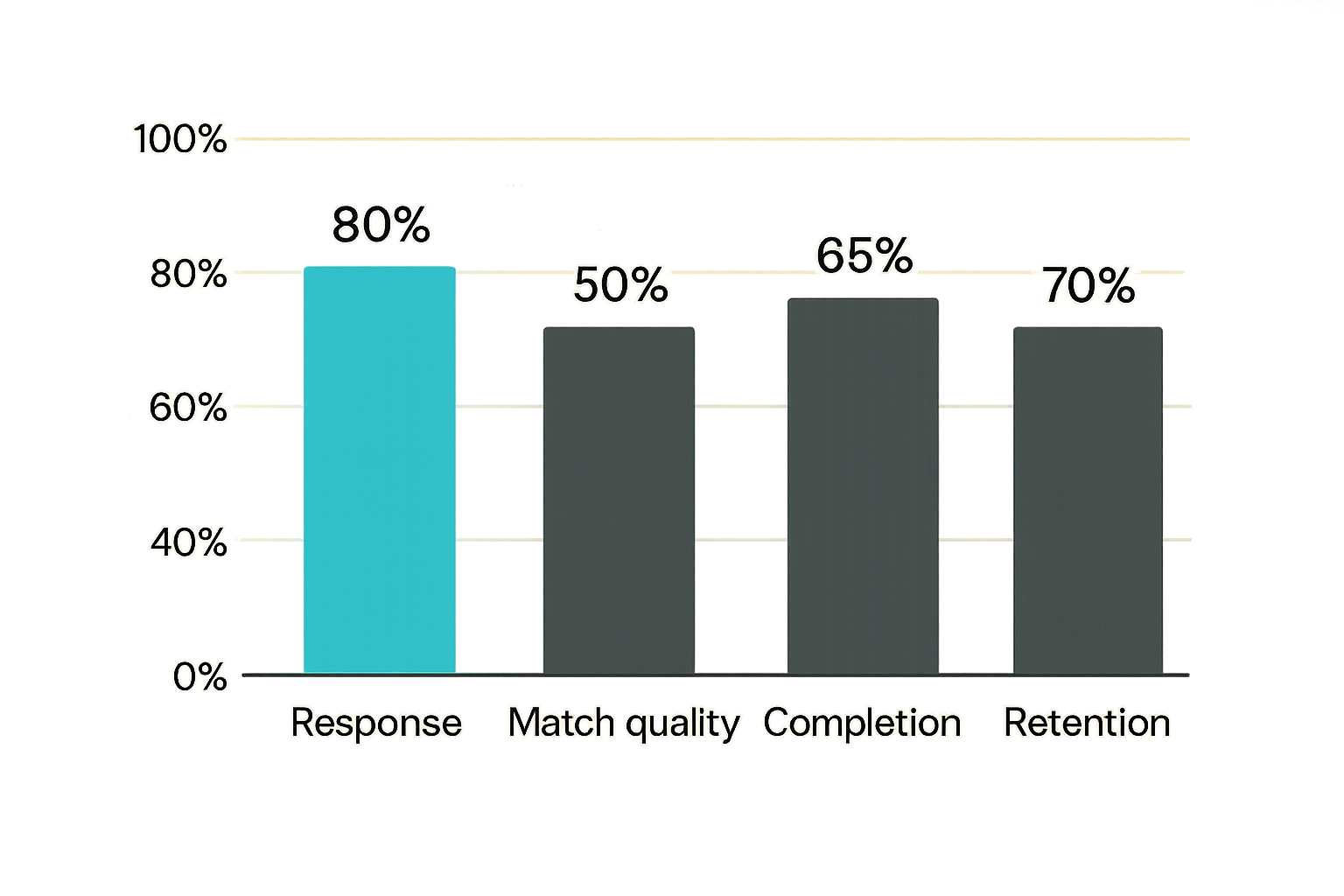
Response time beats member count
Member count is easy to display and easy to misunderstand. A large community with slow response is not operationally strong. A smaller community with fast, accurate routing may be much more useful.
Track response time in plain terms:
- Time to acknowledge the ask
- Time to identify a possible match
- Time to accepted handoff
- Time to completed outcome
Do not hide behind averages. Look at the outliers. A few abandoned urgent asks can damage trust more than dozens of successful low-risk matches can repair.
Match quality beats engagement
Engagement is noisy. People comment, like, react, and disappear. Match quality is harder to fake.
A useful match quality review asks:
- Was the provider appropriate for the ask?
- Did the requester understand the next step?
- Did the provider have enough context?
- Was the outcome completed without operator rescue?
- Would both sides use the network again?
This is where community operations starts to look like service operations. The point is not to maximize chatter. The point is to increase the percentage of requests that reach a useful outcome.
Retention depends on solved problems
People return to local networks that solve real problems. They may enjoy events and conversations, but operational retention comes from reliability.
For requesters, retention means they believe the network is worth asking again. For providers, retention means the network sends clear, appropriate opportunities instead of random interruptions. For operators, retention means the workload does not become impossible as the network grows.
Related reading from our network: remote teams have the same issue when the visible meeting is mistaken for the workflow, and Zoom video chat for remote teams makes that architecture distinction in a different operating environment.
Common failure modes in a supreme community
The ghost marketplace problem
The ghost marketplace happens when a community has listings but no live routing. Offers exist, but nobody knows whether they are current. Asks appear, but nobody owns triage. Members browse, see weak activity, and stop trusting the system.
This often happens after a strong launch. The directory looked good at the start. The initial posts had energy. Then availability changed, response times drifted, and nobody maintained state.
To prevent it, every offer needs a freshness check. This can be manual, automated, or seasonal. The format matters less than the discipline.
Practical rule: A stale offer is worse than no offer when requesters treat it as available capacity.
The over-moderated bottleneck
The opposite failure is the organizer bottleneck. Every ask goes through one person. Every match requires approval. Every provider waits for permission. Quality may be high at first, but the operator becomes the constraint.
This model feels safe because one trusted person sees everything. It is fragile because one trusted person cannot scale everything.
The fix is not to remove human judgment. The fix is to define where judgment is required and where standard routing can proceed. Low-risk requests should move through a repeatable path. High-risk requests should escalate.
The trust gap after the first match
A first match creates a new trust surface. The requester and provider now interact outside the community interface. That is where misunderstandings happen: scope changes, timing slips, payment questions, access issues, or unclear completion standards.
The network does not need to police every conversation. It does need a way to support the match if something goes wrong.
Common support rules:
- Keep the original ask visible to both sides.
- Clarify what was agreed before work begins.
- Provide a contact path for issues.
- Avoid pushing sensitive details into public channels.
- Record disputes or failures as routing context.
If the network disappears after introduction, it is just a referral list. A supreme community maintains enough context to protect the next interaction.
Tooling and governance choices
Spreadsheet, chat, directory, or platform
The tool choice depends on volume, risk, and operator capacity.
A spreadsheet can work for early-stage operations if one person owns updates. Chat can work for alerts and quick coordination, but it is poor as a system of record. A directory can show capacity, but often fails on availability. A platform becomes useful when intake, offers, routing, and follow-up need to live in the same workflow.
The wrong move is pretending the UI is the system. The system is the state machine behind the UI: new ask, triage, eligible match, accepted handoff, in progress, complete, canceled, reroute.
Data ownership and privacy boundaries
Local networks often handle sensitive context before they realize it. Home addresses, schedules, payment details, family needs, business systems, and personal constraints can all appear inside ordinary requests.
Set boundaries early:
- Do not collect sensitive data unless needed.
- Keep public asks separate from private details.
- Limit who can see high-risk information.
- Make it clear when a provider is independent.
- Keep audit notes factual and minimal.
- Do not use trust notes as gossip storage.
Governance is not only about rules. It is about keeping the network usable when something goes wrong.
Automation should assist operators, not replace them
Automation is useful for classification, reminders, stale-offer checks, status updates, and routing suggestions. It is risky when it silently makes trust decisions without review.
A good automation pattern:
- Intake form captures structured fields.
- System suggests eligible providers.
- Operator reviews risk and context.
- Provider confirms availability.
- Requester receives a clear next step.
- Follow-up reminders trigger automatically.
If you are exploring automation as a service lane itself, an ask such as looking for small business automation projects in Winston Salem shows how specific workflow language makes routing easier for both local businesses and builders.
The practical question is not whether automation can do more. It can. The practical question is which decisions should remain visible to humans because trust, safety, or local context matters.
Using d0rz.com as practical coordination infrastructure
Where d0rz.com fits
d0rz.com is built around the operating primitives this article keeps returning to: asks, offers, trust, routing, and follow-up. That matters because local community work usually breaks between the conversation and the handoff.
A supreme community needs a place where needs and capacity can be expressed as operational records, not just announcements. An ask should be routeable. An offer should be discoverable. A provider should be able to state boundaries. A requester should know what happens next.
This is the architecture gap d0rz.com is meant to address. It is not a replacement for local relationships. It is infrastructure for making those relationships easier to activate without forcing the organizer to remember everything.
A simple rollout pattern
Start small. Pick one neighborhood, one category, and one operator. Publish a few credible offers. Collect a few real asks. Route manually before automating. Watch where ambiguity appears.
A workable first month can look like this:
- Choose one service lane with visible demand.
- Add five to ten offers with clear constraints.
- Invite known requesters to submit specific asks.
- Route matches with human review.
- Track time to first response and completed outcome.
- Remove stale offers quickly.
- Write down the trust rules that emerged.
- Expand only after the handoff is stable.
This is not glamorous, but it is how a local network becomes reliable. Supreme community operations are built through repeated solved problems, not abstract belonging.
Try d0rz.com
d0rz.com is for people building practical local networks where asks, offers, trust, routing, and follow-up matter. If you are turning local participation into coordination infrastructure, Try d0rz.com.
A supreme community is not the community with the most noise. It is the one that can receive a real need, route credible help, protect trust, and learn from the outcome.