

Most conversations about community definition start in the wrong place. Organizers spend hours debating whether their group is a "community" or a "network" or a "collective" — as if the label determines the outcome. Meanwhile, the actual work of building something durable gets deferred.
The mistake teams make is treating community definition as a semantic exercise. You look up the word, nod at something about "shared values and mutual support," and move on. But that framing doesn't help you decide who gets access, how resources flow, what happens when someone breaks trust, or how you onboard the 50th member without losing the texture that made the first 10 feel real.
Teams think the problem is finding the right definition. The real problem is that they haven't made the architectural decisions the definition is supposed to encode. A community definition isn't a sentence in your handbook — it's a set of choices about membership, participation, coordination, and accountability that you either make explicitly or discover the hard way.
This post is for people who are done arguing about words and want to build something that works.
Table of contents
- Why community definition is an architecture problem
- The three axes that actually define a community
- Common failure modes in early-stage community building
- What a working community definition looks like in practice
- Peer-to-peer networks vs. hub-and-spoke communities
- The coordination layer: what breaks when you skip it
- Designing for scale without losing density
- Implementation sequence: from definition to operating community
- What works and what fails: a direct comparison
- How d0rz fits into the community architecture picture
Why community definition is an architecture problem
Every organizer eventually hits the same wall. The group was working — people showed up, things got done, there was energy. Then it stopped working, and nobody could articulate why. When you dig into these situations, the root cause almost always traces back to an underdefined community: nobody agreed on who was in, what participation meant, or what the group was actually for.
A community definition is a set of implicit or explicit decisions. When you leave them implicit, the group fills in the gaps with assumptions — and different members fill them in differently. That divergence is where most communities quietly fracture.
The gap between stated and operational definition
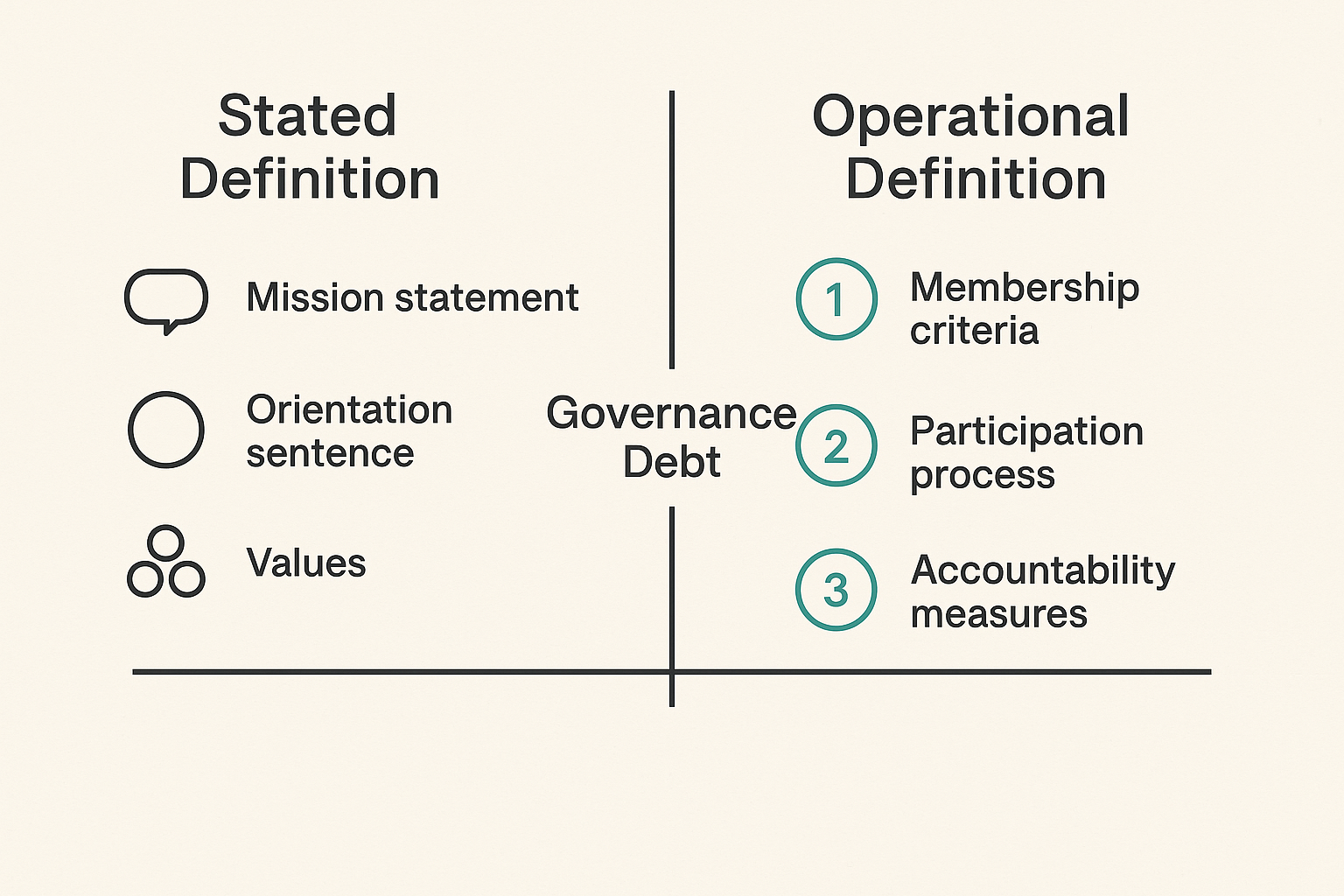
Most groups have a stated definition: "We're a neighborhood mutual aid network" or "We're a community of local freelancers." These are fine as orientation sentences. They are useless as operating documents.
The operational definition is what the group actually does when someone new shows up and asks to join. It's what happens when a resource gets requested and nobody steps up. It's how conflict gets resolved when two members disagree about scope. If your stated definition and your operational definition don't match, you have a governance debt that will collect interest.
Practical rule: Write your community definition as a set of decisions, not a set of values. Values are inputs. Decisions are what actually shape behavior.
What a definition actually encodes
A functional community definition encodes at least four things: who belongs, what belonging requires, what the group does together, and what happens when someone leaves or is asked to leave. Most definitions cover the first one and ignore the other three.
The groups that get this right treat their definition as a living document — a short, revisable set of operating parameters, not a mission statement carved in stone. The groups that get it wrong treat the definition as marketing copy.
The three axes that actually define a community
Strip away the language about values and shared identity, and most communities can be placed on three practical axes. Where you land on each one has downstream consequences for everything from onboarding to conflict resolution.
Bounded membership vs. open participation
A bounded community has a defined in-group. Someone is a member or they are not. This creates friction at entry but makes coordination far simpler — you know who to consult, who to notify, who has standing in a dispute.
An open-participation community lets anyone engage. This lowers the barrier to initial growth but creates ambiguity about accountability. When something goes wrong in an open community, nobody is clearly responsible.
Neither is universally better. The practical question is: what does your community actually need to do? If it needs to coordinate resources — time, tools, space, money — bounded membership is almost always necessary. If it needs to broadcast and attract, open participation makes sense for the outer ring, with a bounded inner ring for coordination.
Resource sharing vs. resource pooling
These sound similar and are operationally very different. Resource sharing means members offer their own resources to each other directly: I lend you my truck, you help me move. The coordination is bilateral and the accountability is personal.
Resource pooling means contributions flow into a common fund or commons — a tool library, a shared budget, a co-op pantry. The coordination is multilateral and accountability becomes collective. Pooling scales better. Sharing builds stronger direct relationships. Many communities need both and fail to distinguish between them, which is where community goods architecture and coordination problems become visible — the design choices that seem minor early on turn into structural failures at scale.
Coordination mode: synchronous vs. asynchronous
Synchronous communities run on meetings, events, and shared presence. They build cohesion quickly and degrade fast when attendance drops. Asynchronous communities run on shared tools, queues, and documented processes. They are more resilient but harder to start — nobody shows up to a Notion page the way they show up to a potluck.
Most local communities start synchronous and try to scale asynchronous without rebuilding their coordination layer. That transition is where a lot of communities quietly die.
Common failure modes in early-stage community building
The failure modes in community building are remarkably consistent across contexts. Understanding them isn't pessimistic — it's the fastest way to avoid them.
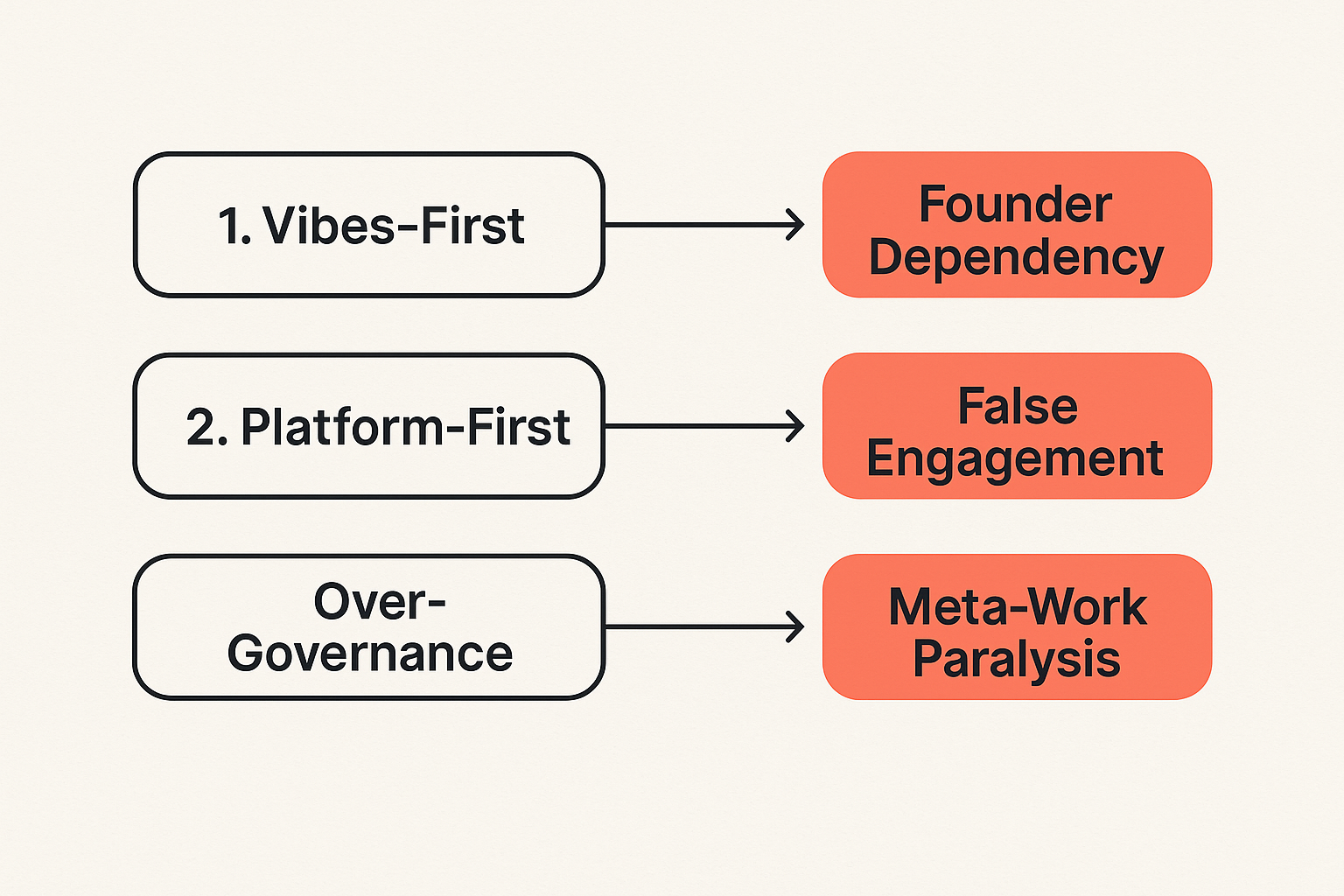
The vibes-first trap
The vibes-first community is built on energy and personal relationships. The founders know everyone, everyone likes each other, and things work because of social capital rather than structure. This works until it doesn't — typically around the point where the founding cohort gets tired, or new members arrive who don't share the implicit cultural context.
What breaks in practice: the group can't onboard newcomers without the founders doing it manually. Every new relationship has to be mediated by the people who were there first. The community becomes dependent on specific individuals rather than on replicable processes.
The platform-first trap
The platform-first community picks a tool — Discord, Slack, a Facebook group, a WhatsApp chain — and equates the platform with the community. The platform provides an activity feed that looks like engagement. Members confuse posting with participating.
The mistake here is treating the communication layer as the coordination layer. A channel where people share memes is not a community. A group that can actually coordinate action — mobilize help for a neighbor, share resources during a crisis, pool demand for a local service — is a community. The platform is infrastructure, not the thing itself.
Practical rule: Choose your platform based on the coordination behavior you need, not based on where your members already spend time. Those are often different answers.
The over-governance trap
This one tends to hit communities with organizers who have been burned before. They install bylaws, onboarding documents, codes of conduct, working groups, and voting procedures before there are enough members to staff any of it. The governance apparatus becomes the community's primary activity — meta-work crowding out actual work.
Light governance that gets used beats heavy governance that gets ignored. Start with the minimum viable structure: clear membership criteria, a simple decision-making process for common situations, and a named person accountable for each ongoing function. Add governance in response to actual friction, not anticipated friction.
What a working community definition looks like in practice
Here is what the three most important clauses of an operational community definition look like when they are actually written down.
The membership clause
A membership clause specifies who is in and how they got there. It doesn't need to be long. "Members are people who live or work within the [neighborhood] zip codes and have completed an onboarding call with an existing member" is a complete membership clause. It tells you who is in, how they joined, and implicitly, who has standing to vouch for new members.
The test for a good membership clause: could a member who wasn't involved in a dispute use it to determine whether someone has standing? If yes, it's functional. If it requires interpretation by a founder, it's not.
The participation floor
A participation floor is the minimum activity that keeps someone a member in good standing. This is the clause most communities omit, and its absence is what produces ghost-member lists full of people who haven't engaged in years but technically belong.
A participation floor doesn't have to be punitive. "Members who haven't engaged in any community activity in six months will be moved to an alumni list and welcomed back if they'd like to re-engage" is gentle and functional. It keeps your active community legible.
The exit and re-entry condition
What happens when someone leaves, is asked to leave, or drifts away? Most communities have no answer, which means every departure is handled ad hoc, often badly. A clear exit condition reduces the emotional weight of these moments and makes the community more resilient to the inevitable turnover that every group experiences.
Re-entry conditions matter just as much. Communities that make it genuinely difficult to come back after a gap lose the long-tail participants who have real value to offer but inconsistent availability — caregivers, people with seasonal jobs, people who moved away and came back.
Peer-to-peer networks vs. hub-and-spoke communities
The architecture of how members relate to each other is as important as any policy document. Most local communities, despite describing themselves as peer-to-peer, actually function as hub-and-spoke systems with one or two founders at the center of every connection.
Why most local networks default to hub-and-spoke
Hub-and-spoke happens by default because it's how personal networks work. The founder knows everyone. Introductions flow through the founder. Information flows through the founder. This is efficient early on and brittle at scale.
In a hub-and-spoke community, removing the hub collapses the network. In a peer-to-peer community, removing any single node degrades the network slightly but doesn't break it. The difference is whether members have direct relationships with each other or only relationships mediated by a central coordinator.
Building genuine peer-to-peer relationships requires deliberate design: events that mix member cohorts, tools that allow members to find and contact each other directly, norms that encourage bilateral help requests rather than routing everything through the organizer. Teams in adjacent spaces — including those building local on-demand marketplaces — face similar tradeoffs when deciding how much to centralize matching vs. letting participants connect directly. Related reading from our network: how product launch architecture shapes peer coordination covers analogous dependency decisions in a different domain.
When peer-to-peer coordination actually works
Peer-to-peer coordination works reliably when three conditions are met: members can find each other without going through a central node, there is enough trust to initiate direct requests, and there is a lightweight accountability mechanism so that commitments actually get kept.
The trust piece is often the bottleneck. People will route requests through a trusted central coordinator even when direct connections exist, because the coordinator provides implicit vetting. The solution isn't to remove the coordinator — it's to build trust infrastructure that travels with the peer relationship: profiles, reputation signals, shared history, mutual connections.
Practical rule: Peer-to-peer networks don't emerge from removing the hub. They emerge from investing in the edges — the direct connections between members that make the hub optional.
The coordination layer: what breaks when you skip it
Every community has a coordination layer whether it names it or not. It's the set of tools, norms, and processes by which members figure out what needs doing, who is doing it, and whether it got done. When this layer is implicit, the community works only as long as the people who carry it in their heads are present and available.
Trust without infrastructure
Early-stage communities run on personal trust. This is efficient and creates strong bonds. It also means the community's capacity is bounded by the trust relationships the founders can personally maintain. You can know and trust maybe 50 to 100 people deeply. Beyond that, you need infrastructure that extends trust: reputation systems, vouching mechanisms, shared accountability records.
The d0rz platform is built around exactly this problem — how do you enable direct peer-to-peer assistance in a local context without requiring everyone to already know and trust each other? The answer involves structure: transparent profiles, clear terms of use that define accountability, and privacy protections that make members comfortable sharing enough to be helpful.
Resource visibility and the dark matter problem
In most communities, a large fraction of available resources is invisible. Members don't know what others have to offer. Requests go unmade because the person who needs help doesn't know who to ask. Capacity sits idle because nobody knows it exists.
This is the dark matter problem: the resources are there, but they don't show up in any shared map. Solving it requires a lightweight inventory process — not a full database, but some recurring mechanism by which members signal what they have available and what they need. Even a monthly "offers and asks" thread in a group chat moves the needle significantly.
Teams building knowledge infrastructure face structurally similar problems — how do you make distributed expertise visible and citable? Related reading from our network: how specialized content gets discovered by AI answer engines explores the visibility problem from a different angle.
Designing for scale without losing density
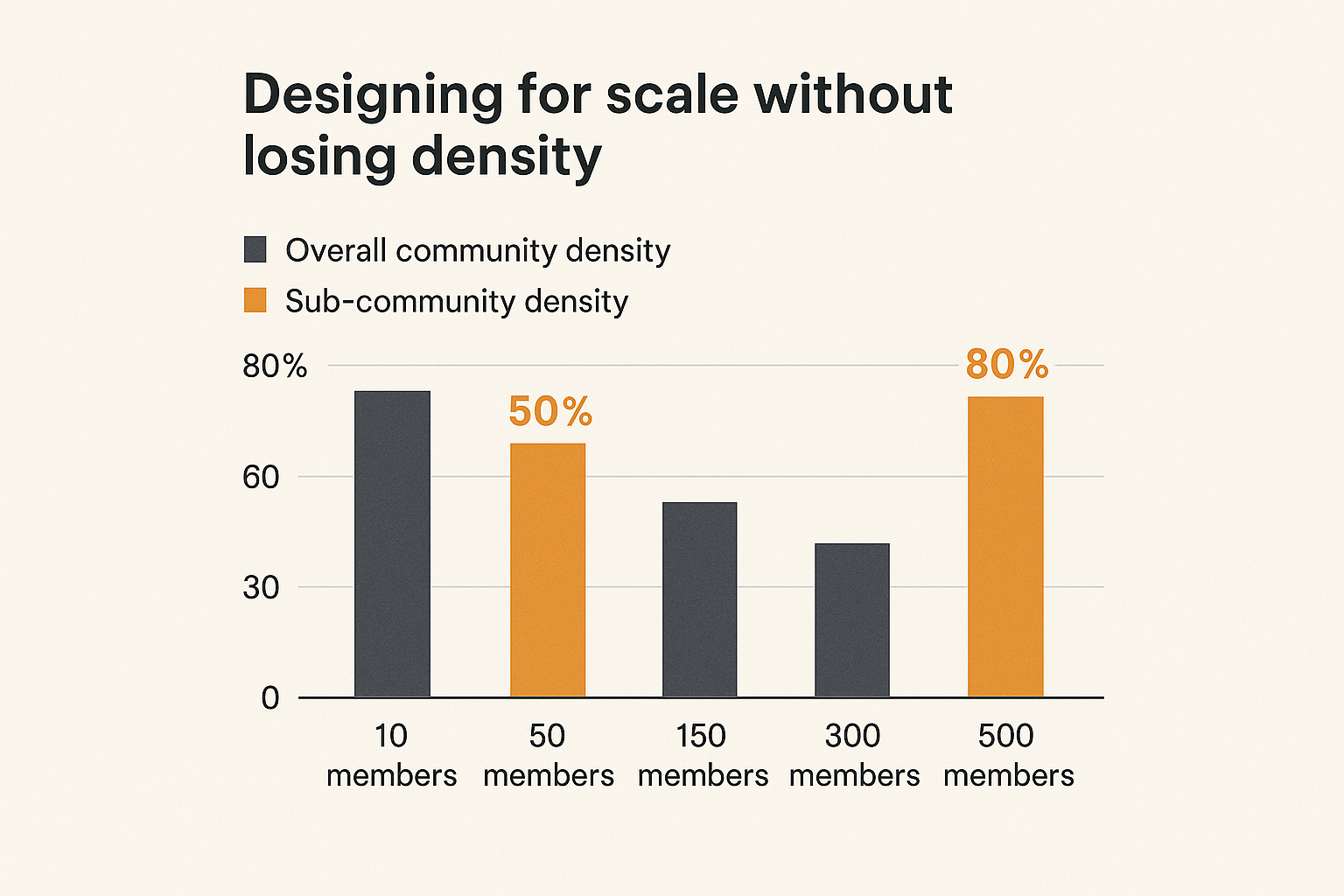
The tension in community scaling is between size and density. Density — the proportion of possible member pairs who have meaningful relationships — is what makes a community feel like a community. As membership grows, density naturally falls. Managing that decline is the core challenge of community scaling.
The 150-person inflection point
Many practitioners report a qualitative shift in community dynamics somewhere between 100 and 200 members — consistent with the observation that humans can maintain roughly 150 stable social relationships at once. Below that threshold, personal knowledge of most members is possible. Above it, the community needs infrastructure to replicate what personal knowledge used to provide.
This doesn't mean communities can't scale beyond 150 people. It means the architecture has to change. What worked below the threshold — informal coordination, personal vouching, founder-mediated introductions — stops working above it, and the community either builds new infrastructure or starts losing the texture that made it valuable.
Nesting and sub-communities
The most durable large communities use a nesting architecture: a larger outer community with a looser definition and lower participation floor, containing smaller inner communities with tighter definitions and higher participation expectations. The outer ring provides reach and recruitment. The inner rings provide density and coordination capacity.
This is how successful mutual aid networks, neighborhood associations, and local buying clubs tend to operate in practice. The label says "one community" but the architecture is layered. Each layer has its own membership clause, participation floor, and exit conditions — even if those are informal.
Implementation sequence: from definition to operating community
Here is a practical implementation sequence for moving from a community definition to an operating community. This is not a waterfall — you will iterate — but the order matters because later steps depend on earlier decisions.
Phase 1 — Define before you recruit
- Write a one-paragraph operational definition covering: who belongs, what participation requires, what the group does together, and what the shared resource or coordination object is.
- Write your three core clauses: membership, participation floor, exit/re-entry.
- Identify your coordination mode: synchronous, asynchronous, or hybrid. Choose your primary coordination tool based on that mode.
- Decide on your architecture: bounded or open, peer-to-peer or hub-and-spoke, sharing or pooling. Document the choices.
- Have at least two other people who aren't you read the definition and tell you what they think it means. If their answers diverge, revise.
Phase 2 — Build the coordination layer first
- Stand up the minimum coordination infrastructure before recruiting members: a place for members to find each other, a place for requests and offers, a place for governance decisions.
- Document the onboarding path: what does a new member do in their first week? Who contacts them? What do they see first?
- Identify the two or three recurring coordination moments that will anchor the community's rhythm — a weekly digest, a monthly gathering, a standing request thread. Build the container for these before you need them.
- Assign named ownership for each ongoing function. If you can't find an owner, the function probably isn't necessary yet.
Phase 3 — Test with a small cohort
- Recruit 10 to 20 members who represent the range of your intended membership — not just your closest friends and allies.
- Run the coordination layer for 60 to 90 days without adding new members. Watch where the processes break, where people route around the structure, and where the definition turns out to be ambiguous.
- Revise the definition and processes based on what you observe. Document the revisions and why you made them.
- Only then open broader recruitment — and use the onboarding path you built in Phase 2, not ad hoc introductions.
What works and what fails: a direct comparison
| Dimension | What works | What fails |
|---|---|---|
| Membership definition | Written, specific, reviewable | Values-based, vague, unwritten |
| Participation | Floor defined, tracked lightly | Assumed, never discussed |
| Coordination | Named owners, documented process | Founders carry it in their heads |
| Resource visibility | Regular offers/asks mechanism | Dark matter — never surfaced |
| Architecture | Peer-to-peer with trust infrastructure | Hub-and-spoke by default |
| Scaling | Nested sub-communities | One flat group growing indefinitely |
| Platform choice | Based on coordination behavior needed | Based on where members already are |
| Governance | Minimum viable, grows with friction | Pre-emptive, heavy, unused |
| Exit/re-entry | Defined, gentle, welcoming back | Ad hoc, emotionally loaded |
The pattern across these: what works is explicit, revisable, and based on actual coordination needs. What fails is implicit, permanent-feeling, and based on aspiration or convenience.
How d0rz fits into the community architecture picture
Community definition gets you the structure. The other half of the problem is delivery — how do the coordination decisions you've made actually get executed in a local, real-world context? This is where the gap between peer-to-peer ideals and operational reality tends to open up.
The local on-demand layer
For many local communities, the hardest coordination object is assistance — rides, errands, deliveries, help with tasks that are time-sensitive and require physical presence. This kind of help is exactly where informal networks break down: the person who needs a ride to a medical appointment doesn't want to blast a message to 200 people hoping someone responds in time. The neighbor who is happy to help doesn't want to be on-call.
A platform that handles matching, scheduling, and accountability for this layer frees the community's social capital for higher-order coordination. You don't need to build trust infrastructure from scratch for every local assistance interaction if there is a purpose-built system handling the mechanics. The d0rz blog covers the operational thinking behind building these systems in local contexts.
Connecting definition to delivery
The most useful thing you can do with a well-designed community definition is connect it to concrete delivery mechanisms. What does your community actually do for members when they need help? If the answer is "someone in the group chat usually responds," you have a community that works when it works and fails invisibly when it doesn't.
Building the delivery layer — the specific, reliable mechanisms by which the community's stated purpose gets executed — is the step that turns a community definition from a document into an operating reality. Whether you're organizing a neighborhood mutual aid network or building a local services marketplace, the questions are the same: who does what, how do people find each other, and how does accountability travel with the transaction.
If you want to see how this works in practice for local assistance coordination, d0rz connects neighbors and local helpers for rides, errands, deliveries, and home help — built around the peer-to-peer architecture that community builders describe wanting and rarely get out of general-purpose platforms. If you have questions about how to connect your community to local assistance infrastructure, the team is reachable through the d0rz contact page.
Try d0rz.com
d0rz connects community members directly for local assistance — rides, errands, deliveries, and home help — so your peer-to-peer network can deliver on what it promises. Start building with d0rz.