

A community operations consultant usually gets called after the group already looks active from the outside. There are events, chats, newsletters, introductions, volunteers, and maybe a few local partners. But inside the operation, the same asks keep getting lost. Offers expire without follow-up. Nobody knows who is allowed to route what to whom.
Teams think the problem is participation. The real problem is operating design.
If you run a neighborhood mutual aid group, local business network, creator circle, professional guild, parent group, civic coalition, or freelance community, you eventually hit the same wall. More people does not automatically create more coordination. It creates more ambiguity unless someone designs the system.
That is where the community operations consultant becomes useful. Not as a generic facilitator. Not as a branding person. The useful version of the role maps how asks, offers, trust, routing, accountability, and follow-up actually move through the network.
Table of contents
- The community operations consultant is an operating role, not a vibe
- Why local networks break without operational design
- The operating map: asks, offers, trust, routing, and follow-up
- Discovery: how a community operations consultant finds real constraints
- Workflow design for matching and routing
- Tooling choices: lightweight systems beat platforms
- Trust, safety, and escalation rules
- Metrics that matter for local network operations
- Implementation sequence for the first 30 days
- Failure modes: what breaks in practice
- Where d0rz.com fits in the operating model
- Closing playbook: hire or become a community operations consultant
The community operations consultant is an operating role, not a vibe

A useful way to think about it is this: a community operations consultant designs the coordination layer between people who need something and people who can provide it.
That changes the conversation. Instead of asking whether the community feels engaged, you ask whether an ask can be captured, qualified, routed, fulfilled, and closed without heroic effort from one overworked organizer.
What the role actually owns
The role owns the operating model. In practical terms, that means:
- How asks enter the network.
- How offers are described, limited, updated, and expired.
- How trust is represented without turning the group into a surveillance system.
- How a match is made and who is allowed to make it.
- How follow-up happens after the first introduction.
- How unresolved items are surfaced before they become resentment.
The mistake teams make is hiring for energy when they need throughput. A charismatic community lead can make people feel welcome. That matters. But if every useful connection still depends on memory, private messages, and manual nudges, the network will not scale beyond the attention span of its most active person.
Practical rule: if only one person knows where the important asks are, you do not have community operations. You have a bottleneck with a friendly face.
What the role should not pretend to own
A community operations consultant is not automatically the executive director, moderator, salesperson, therapist, event producer, grant writer, or product manager. In small networks, one person may wear several of those hats, but the operating role should remain distinct.
The practical question is not who has the title. It is who owns the system of record and the handoffs.
A good consultant will push back on vague assignments like make the community more active. They will ask for recent examples: Which ask failed? Which offer went unused? Which partner expected follow-up and did not get it? Which volunteer burned out because everything flowed through them?
Related reading from our network: teams in security operations face similar ownership problems when response actions are spread across tools and people, as described in fleet response architecture and SOC workflows.
Why local networks break without operational design
Local networks rarely fail because nobody cares. They fail because caring does not define state, priority, permission, or follow-up.
Activity is not the same as coordination
You can have a busy chat, a packed event, and a growing mailing list while still failing operationally. Activity creates signals. Coordination turns those signals into completed work.
Here is the difference:
| Network pattern | Looks healthy because | Breaks because | Operational fix |
|---|---|---|---|
| Busy group chat | Many messages per day | Important asks disappear in scrollback | Capture asks into a visible queue |
| Monthly meetup | People recognize each other | Follow-up is informal and uneven | Create post-event routing and check-ins |
| Volunteer directory | Many names are listed | Availability and scope are stale | Add expiration and confirmation dates |
| Founder circle | Members trust each other | Introductions depend on memory | Tag offers, constraints, and routing owners |
| Local resource list | Lots of links exist | Nobody knows what still works | Assign review cycles and owners |
The community operations consultant should not be impressed by surface activity. They should look for conversion from expression to outcome.
The hidden cost of informal routing
Informal routing feels efficient at first. Someone knows someone. A founder texts a friend. A neighborhood organizer remembers who has a truck. A freelancer forwards a lead in a group chat.
That works until volume increases or trust becomes uneven.
What breaks in practice is not the first introduction. It is the seventh similar request, the second no-show, the third unclear boundary, and the person who stops volunteering because they keep getting mismatched requests.
Informal routing also hides useful learning. If a match fails, the network may never learn whether the ask was unclear, the offer was stale, the timing was wrong, the trust level was too low, or the follow-up owner vanished.
The operating map: asks, offers, trust, routing, and follow-up
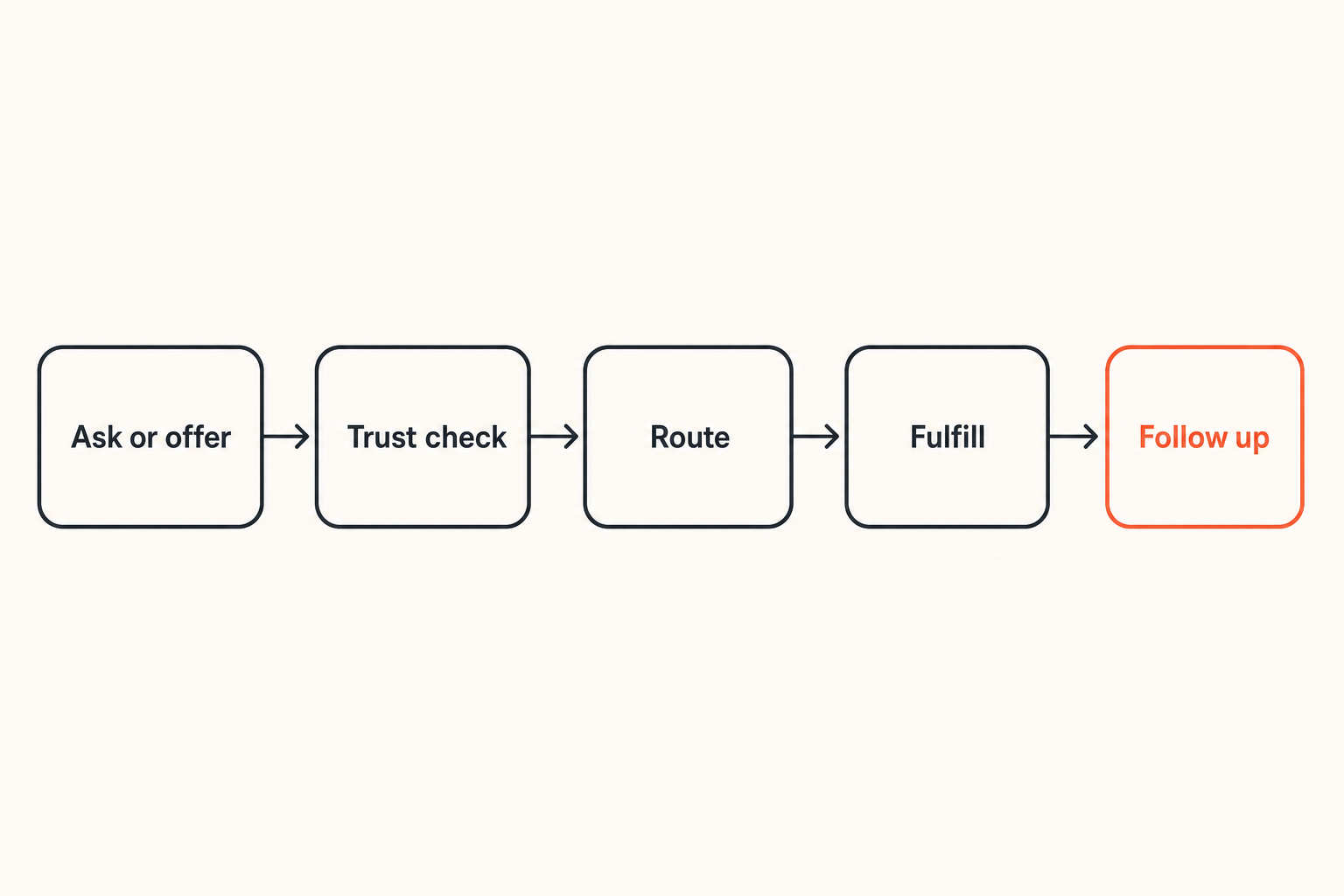
The core architecture is simple, but most groups do not name it. A local network needs five connected layers: asks, offers, trust, routing, and follow-up.
Asks and offers are inventory, not content
An ask is not just a post. An offer is not just a profile update. Both are operational inventory.
Inventory needs fields. At minimum:
- Who is involved.
- What is needed or offered.
- Where it applies.
- When it is valid.
- What constraints matter.
- What trust level is required.
- What follow-up is expected.
- Whether the item is open, routed, waiting, fulfilled, expired, or blocked.
This is why a simple public ask like seeking one public business workflow to automate is more operationally useful than a vague statement like I can help with automation. It gives the network something to route.
Practical rule: every ask and offer should have an expiration condition. If it never expires, it becomes clutter disguised as opportunity.
Trust is a routing constraint
Trust is often discussed as culture. Operators need to treat it as a constraint.
Some offers can be routed broadly: public event help, grocery runs, basic website feedback, venue recommendations. Others require more care: childcare, elder support, financial workflows, keys to a building, private customer data, sensitive conflict mediation.
Trust does not need to be over-engineered. But it does need to be explicit enough that the operator can make better decisions than first person to reply gets the match.
Useful trust labels might include:
- Public: safe to share broadly.
- Known: share with people known to organizers.
- Verified: share after a reference, prior work, or admin review.
- Restricted: route only through a named owner.
- Sensitive: do not route without consent and context.
For a deeper local-network operating frame, the prior d0rz article on community building as a local network operating model is adjacent to this role because it treats participation as infrastructure, not branding.
Discovery: how a community operations consultant finds real constraints
A community operations consultant should spend less time asking what platform the group wants and more time reconstructing how coordination currently fails.
Start with recent misses
Ask for the last ten things that should have worked but did not. Not theories. Actual misses.
Examples:
- A member asked for help and nobody replied.
- Three people replied, but nobody followed through.
- A business offered a discount, but members did not know how to redeem it.
- A volunteer was over-contacted because they were the only visible helper.
- An event produced great conversations but no next steps.
- A sensitive ask was shared too broadly.
- A local provider got a referral that did not match their scope.
Each miss reveals a system gap. Was the ask unclear? Was there no owner? Was the channel wrong? Was the offer stale? Was trust undefined? Was follow-up optional?
Interview the routers, not just the leaders
Every network has informal routers. They may not have titles. They are the people others message when they need a recommendation, introduction, resource, venue, driver, designer, translator, bookkeeper, babysitter, or repair person.
The consultant should interview these routers early because they know the actual system.
Ask them:
- What do people ask you for most often?
- Which requests do you ignore because they are too vague?
- Which offers are reliable?
- Which matches require caution?
- Where do you keep notes?
- What do you wish people knew before asking?
- What follow-up do you never have time to do?
The mistake teams make is interviewing only formal leaders. Leaders know the mission. Routers know the traffic.
Workflow design for matching and routing
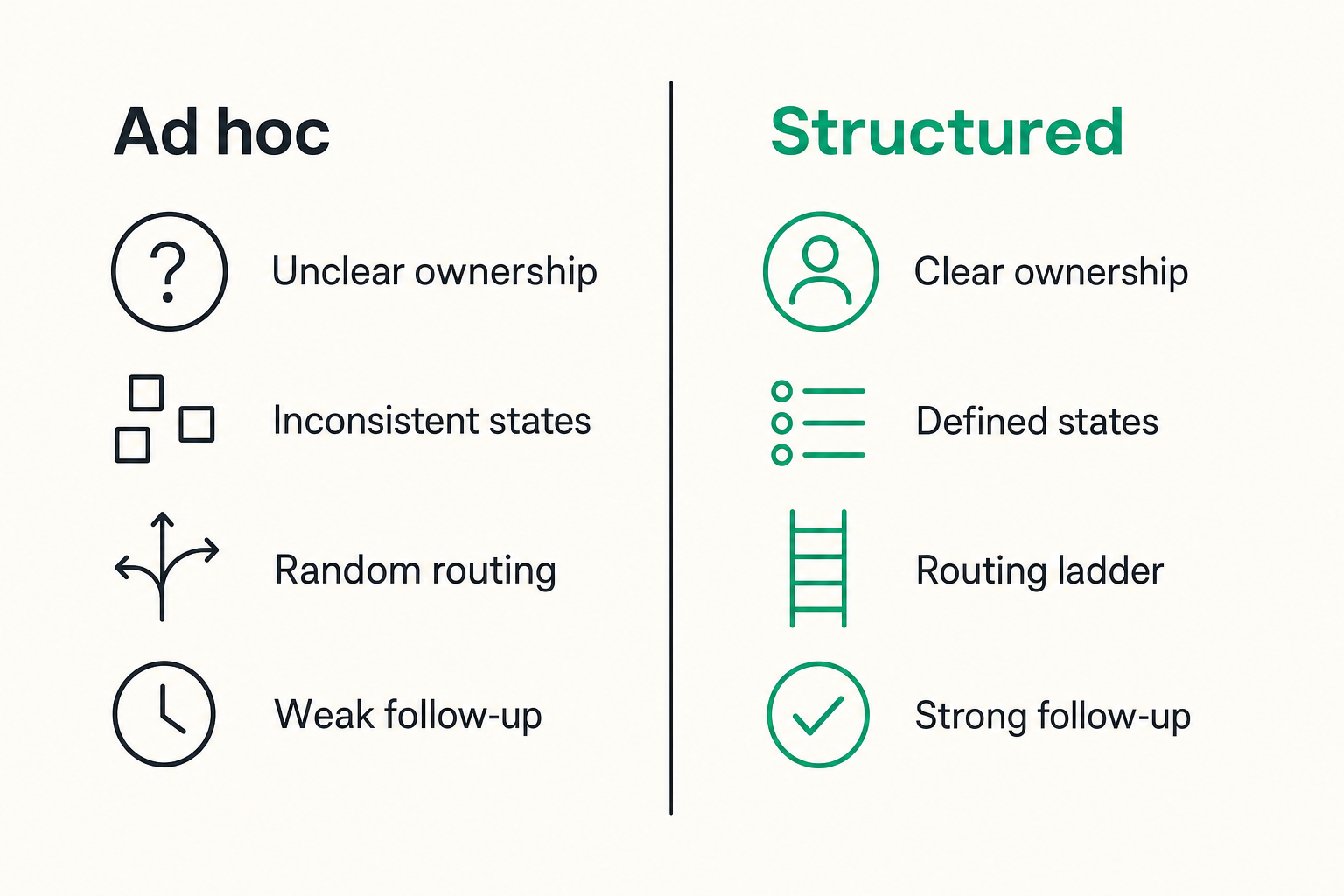
The practical question is how an item moves. If you cannot describe the workflow, you cannot improve it.
Define states before tools
Before choosing software, define the lifecycle. A useful basic state model looks like this:
- Captured: the ask or offer has been recorded.
- Qualified: scope, location, timing, and constraints are clear enough.
- Routed: a person or group has been selected for next action.
- Contacted: the routed person has been notified.
- Waiting: the network is waiting on a response or external action.
- Fulfilled: the item reached a usable outcome.
- Closed: follow-up is complete and the record is archived.
- Expired or blocked: the item is no longer actionable.
This model does not require expensive tooling. It requires discipline. A spreadsheet can hold states. A form can capture new items. A kanban board can show queues. A lightweight directory can expose public offers.
Practical rule: do not automate a workflow until people agree on the states. Automation speeds up confusion when the state model is wrong.
Build the routing ladder
Routing should not be random. A routing ladder defines who sees the item first, what happens if they do not respond, and when escalation occurs.
A simple ladder:
- Direct owner: person responsible for the relevant category.
- Known providers: people who previously accepted similar items.
- Local subgroup: neighborhood, industry, language, or availability segment.
- Broader network: public or semi-public callout.
- External referral: partner organization, paid provider, public resource.
- Close with explanation: no match found, but the asker receives a clear status.
This matters because silence is operationally expensive. When nobody owns the next step, the asker experiences the network as unreliable even if many good people are present.
Related reading from our network: editor-native agent workflows have the same state and permission problem in a different domain, which is why vim tools for operational agent workflows is relevant for operators thinking about schemas and audits.
Tooling choices: lightweight systems beat platforms
The tool conversation usually starts too early. Teams ask whether they need a forum, CRM, Slack, Discord, Airtable, Notion, WhatsApp, a custom app, or a marketplace.
The better question is what work the tool must make visible.
The minimum useful stack
For many local networks, the minimum useful stack is:
- Intake: a form, post type, or simple submission path for asks and offers.
- Directory: a searchable place for active offers and known resources.
- Queue: a view of open items and their states.
- Notes: context that helps routing without exposing private details broadly.
- Reminders: follow-up dates and expiration dates.
- Permissions: basic control over who can see sensitive records.
- Broadcast: a way to notify the right segment, not everyone.
This is not glamorous. It is also enough to outperform many overbuilt community platforms.
If a provider posts same-day website form and workflow debugging, the operational value is not only the listing. It is that the offer has scope, geography, urgency, and a likely routing path for small business operators who need it.
When a tool becomes operational debt
A tool becomes debt when it adds places to check without clarifying ownership.
Common signs:
- Asks arrive in five channels and only one person monitors all of them.
- The directory is public but stale.
- Members can message providers directly, but nobody knows whether the match worked.
- Sensitive notes are mixed with public content.
- Automation sends reminders nobody is responsible for acting on.
- Reporting counts signups but not completed outcomes.
The mistake teams make is confusing centralization with clarity. Putting everything in one app helps only if the workflow is understandable and the ownership model is real.
Trust, safety, and escalation rules
Local networks are trust networks. That is a strength, but it is also where sloppy operations cause damage.
Separate visibility from access
Visibility means someone can see that an ask or offer exists. Access means they can act on it, contact the person, receive private details, or represent the network.
Those are different permissions.
A public post may say a local family needs help moving furniture. The private record may include the address, mobility limitations, landlord timing, and contact number. A good operator separates those layers.
Use tiers:
- Public summary: safe to share widely.
- Member view: enough detail for known participants.
- Operator notes: routing context, risk flags, prior history.
- Restricted details: contact information, private constraints, sensitive context.
Related reading from our network: home media and network troubleshooting may seem far away, but the same practical design issue appears when households manage access, privacy, and reliability across devices; see Lumen Technologies for home media workflows for an adjacent systems view.
Escalation needs an owner before it needs a policy
Policies matter, but policies without owners are decoration.
Escalation rules should answer:
- Who handles safety concerns?
- Who can pause a member, offer, or routing path?
- Who contacts a participant after a bad match?
- Who decides whether an item is too sensitive for the network?
- Who documents the incident and what is visible afterward?
Practical rule: every sensitive workflow needs a named escalation owner and a backup. If nobody is available, the workflow should not be active.
This is especially important for networks that handle errands, care work, housing, financial help, job referrals, or vulnerable participants. The more personal the ask, the more explicit the escalation path must be.
Metrics that matter for local network operations
Metrics are useful only if they change operational behavior. Counting members is easy. Counting reliable coordination is harder and more useful.
Measure flow, not applause
Good community operations metrics include:
- New asks captured per week.
- New offers captured per week.
- Percentage of asks qualified within a target time.
- Median time from captured to routed.
- Median time from routed to first response.
- Fulfillment rate by category.
- Expiration rate by category.
- Repeat provider load.
- Number of unresolved items older than a threshold.
- Follow-up completion rate.
Do not overfit this. A neighborhood group does not need enterprise dashboards. But it does need enough measurement to detect drift.
Use metrics to change behavior
Metrics should trigger decisions.
If many asks expire before routing, intake is probably too vague or nobody owns triage. If routing is fast but fulfillment is low, the offers may be stale or mismatched. If the same three people fulfill everything, the network has a load-balancing problem. If sensitive items take too long, the escalation path may be too narrow.
A simple monthly review can ask:
- Which category is stuck?
- Which provider is overloaded?
- Which channel creates the cleanest asks?
- Which type of offer needs better constraints?
- Which follow-up step is consistently skipped?
That changes the conversation from our community feels quiet to our routing queue is aging in two categories.
Implementation sequence for the first 30 days
A community operations consultant should produce working infrastructure quickly. Not a giant strategy deck. Not a six-month platform migration. A usable operating loop.
Week one: inventory and triage
Start with the current reality.
- Collect the active asks from chats, email, forms, event notes, and private messages.
- Collect the active offers from profiles, posts, spreadsheets, and organizer memory.
- Mark each item as open, unclear, routed, waiting, fulfilled, expired, or sensitive.
- Identify the top five categories by volume or risk.
- Name one owner for triage and one backup.
- Create a visible queue for open items.
- Close obviously stale items instead of preserving them forever.
The win in week one is not perfection. It is shared visibility.
Weeks two through four: route, review, and tighten
Once the queue exists, build rhythm.
Week two: define intake fields and routing categories. Make new submissions cleaner than old ones.
Week three: create follow-up rules. For example, every routed ask gets a check-in after three days, seven days, or after the event date.
Week four: review outcomes. Which items moved? Which stalled? Which required escalation? Which offer generated mismatched asks?
A practical 30-day deliverable set:
- One intake path for asks.
- One intake path for offers.
- One active queue with states.
- One routing ladder.
- One trust-tier model.
- One follow-up schedule.
- One monthly review format.
This is enough to make the network noticeably more reliable.
Failure modes: what breaks in practice
Most community operations failures are predictable. They are not moral failures. They are design failures that look personal because communities are made of people.
What fails
The most common failures:
- The founder remains the hidden router for everything.
- The group rewards posting but not closing loops.
- Offers are accepted without scope or expiration.
- Trust is assumed until something goes wrong.
- Sensitive requests are handled in public channels.
- Tools multiply but ownership does not.
- Volunteers are treated as infinitely available.
- Metrics are performative and do not change decisions.
- Follow-up depends on memory.
- The network says yes to work it cannot safely route.
The painful part is that these failures often appear after growth. The network gets more attention, more requests, and more opportunities. Then the informal system collapses under its own goodwill.
What works
What works is less dramatic:
- Fewer intake paths, clearly watched.
- Asks and offers with fields, status, and expiration.
- Routing categories that match real local behavior.
- Explicit trust tiers.
- Named owners and backups.
- Short follow-up cycles.
- Monthly queue review.
- Public summaries with private operational notes.
- Clear no-match responses instead of silence.
This is operator work. It is not always visible to members, but members feel it when the network becomes easier to use.
Where d0rz.com fits in the operating model
A local coordination system needs places where asks and offers can live long enough to be found, routed, and followed up. That is the product-fit layer for d0rz.com.
Use d0rz as a coordination surface
d0rz is useful when a network needs a practical surface for real asks and offers, not just discussion. A public offer like grocery runs, errands, and local deliveries in the SF Bay Area is not just content. It is a routeable object for a local network.
For a community operations consultant, that matters because the system needs artifacts that can be referenced, updated, shared, and retired. A post in a chat disappears. A structured ask or offer can become part of an operating queue.
The product should not replace judgment. It should reduce ambiguity around who is asking, who is offering, what is in scope, and what can happen next.
Keep the human operator in the loop
The right model is not full automation. Local trust is contextual. A tool can expose inventory, but the operator still makes judgment calls about fit, risk, timing, and escalation.
Use d0rz for:
- Publishing clear asks and offers.
- Giving local participants a place to point people.
- Reducing repeated explanations.
- Supporting routing by category, location, and scope.
- Making follow-up more concrete.
Do not use any tool as an excuse to ignore the operating model. If nobody owns triage, the queue still rots. If offers never expire, the directory still becomes stale. If trust tiers are undefined, the network still routes sensitive items badly.
Closing playbook: hire or become a community operations consultant
A community operations consultant is valuable when the network has enough real demand that informal coordination is starting to fail.
When to hire one
Hire or appoint this role when:
- Members keep asking for help in channels that nobody monitors consistently.
- Good offers exist but are not being matched.
- Local partners expect follow-up and do not get it.
- One founder or organizer is the routing bottleneck.
- Volunteer burnout is increasing.
- Sensitive asks are appearing more often.
- The group is growing but outcomes are not improving.
- You cannot answer what happened to last month’s asks.
The consultant does not need to make the network louder. They need to make it more dependable.
How to evaluate the work
Evaluate the role by operational changes:
- Are asks easier to submit and qualify?
- Are offers clearer and less stale?
- Are routing decisions faster and less dependent on memory?
- Are sensitive workflows safer?
- Are unresolved items visible?
- Are volunteers less overloaded?
- Are members getting clearer yes, no, or not yet responses?
The closing test is simple: if a new ask enters the network tomorrow, can you describe what happens next without naming a single heroic person? If yes, the community operations consultant has done real work.
The topic sounds like a job title, but it is really an architecture decision. A strong community operations consultant turns participation into a repeatable coordination system.
Try d0rz.com
d0rz.com is for people building practical local networks where asks, offers, trust, routing, and follow-up matter. Try d0rz.com.