
Someone joins your local network and says they want to be part of the community. Fine. Then the real work starts.
What are they actually offering? Who can ask them for help? What area do they serve? What do they not do? Can someone vouch for them? If a request is urgent, who routes it? If nobody responds, who follows up?
Teams think the problem is finding better community other words: tribe, circle, hub, collective, neighborhood, mutual aid, network, marketplace, directory, village. The real problem is that most of those words do not tell anyone what to do next.
That changes the conversation. Community other words are not a branding exercise. For local organizers and network operators, they are a workflow design problem. The practical question is not which word sounds warmest. The practical question is which word helps people understand trust, scope, routing, responsibility, and follow-up in production.
Table of contents
- Community other words is an operating vocabulary problem
- Start with the job your community performs
- Common community other words and what they imply
- Build a routing model, not a glossary
- Trust language has to be operational
- What breaks when the words are wrong
- A practical implementation sequence
- What works and what fails
- Measure whether the vocabulary is working
- Where d0rz.com fits
- Closing the loop on community other words
Community other words is an operating vocabulary problem
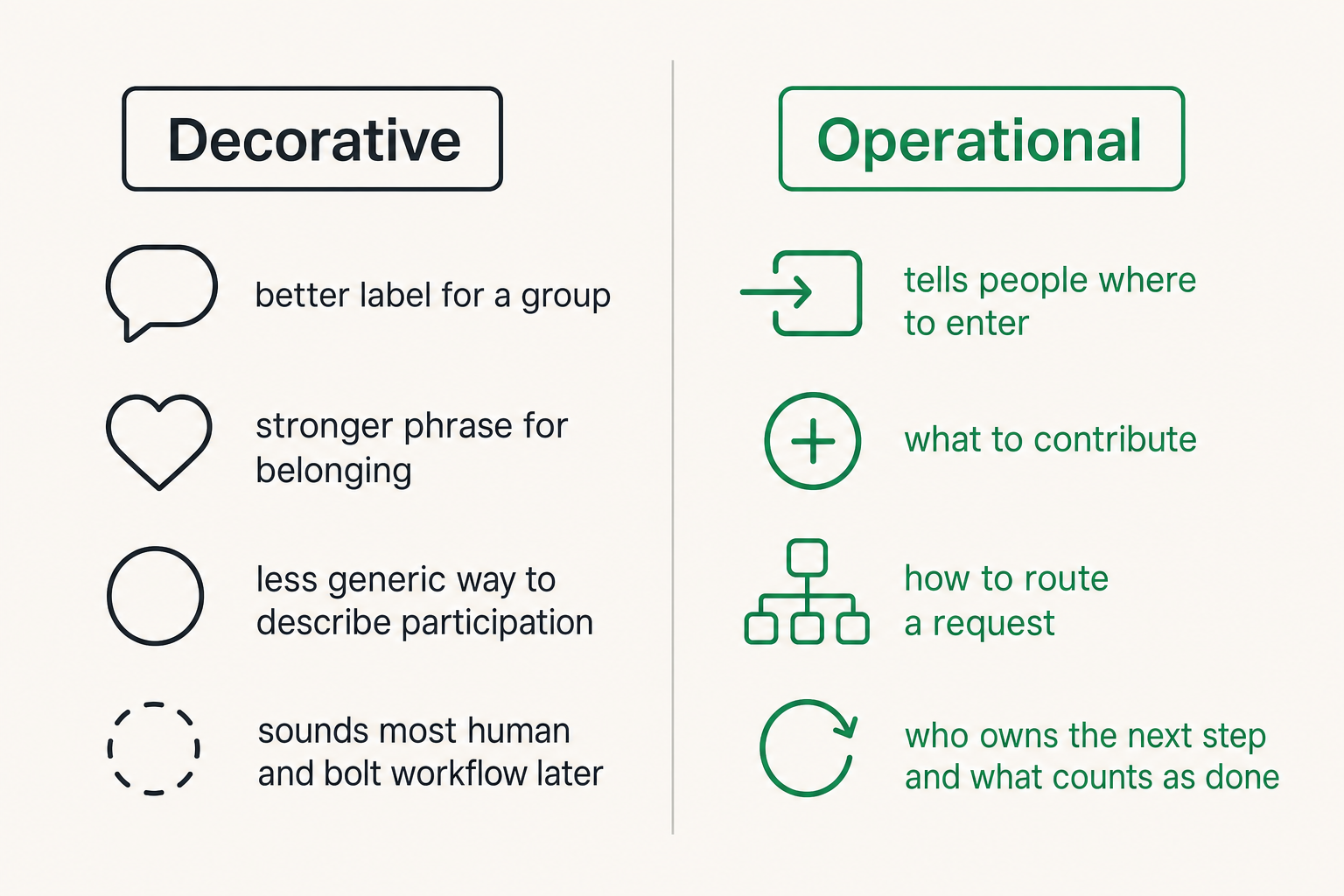
Most teams look for community other words when the current language feels stale. They want a better label for a group, a stronger phrase for belonging, or a less generic way to describe participation.
That is not wrong. Language matters. But in local network operations, language has a job beyond tone. It tells people where to enter, what to contribute, how to route a request, who owns the next step, and what counts as done.
A useful way to think about it is this: every word you use for community creates an implied operating model. If you call it a marketplace, people expect search, comparison, pricing, and completion. If you call it a circle, people expect intimacy, membership, and shared context. If you call it a network, people expect routing across nodes. If you call it mutual aid, people expect need, reciprocity, and care.
Why synonyms fail in local networks
Synonyms fail because they hide differences that matter operationally. A neighborhood group, a referral network, a volunteer collective, and a service marketplace can all be called a community. They do not run the same way.
The mistake teams make is choosing the word that sounds most human and then trying to bolt workflow onto it later. That creates confusion. Members are told they belong, but not how to act. Providers are told they can help, but not how requests reach them. Organizers are told to facilitate, but not what they own.
In production, this shows up as duplicated chats, stalled requests, vague introductions, and organizers manually remembering who does what.
What a better word must carry
A better term should carry at least five pieces of meaning:
- Who participates
- What kind of exchange happens
- How trust is established
- How requests move
- What happens after a match
If the word cannot carry those meanings by itself, your operating notes need to carry them explicitly. There is nothing wrong with using a broad word like community. The failure is pretending it explains the workflow.
Practical rule: use warm words for belonging, but use precise words for routing, responsibility, and follow-up.
The operator test
The operator test is simple. Give the term to someone new and ask them what they would do first.
If they cannot answer, the term is decorative. If they can answer but their answer is wrong, the term is misleading. If they can answer and their next action fits the workflow, the term is useful.
For example, a person entering a local help network should know whether to post an ask, browse offers, message an organizer, join a route, or wait for approval. That first action is the difference between a network that looks active and one that actually coordinates.
Start with the job your community performs
Before choosing community other words, define the job the local network performs. This sounds obvious, but many groups skip it because they already know the people involved. That works until the network grows beyond memory.
The practical question is: what must happen reliably when someone has a need or an offer?
Asks, offers, and routing are the base objects
Most local coordination can be reduced to three base objects:
- An ask: someone needs help, access, information, delivery, labor, advice, a ride, a repair, a contact, or a recommendation.
- An offer: someone can provide time, skill, space, tools, translation, technical help, transport, care, or introductions.
- A route: the path from the ask to one or more suitable offers, with enough trust and context to proceed.
This framing is intentionally plain. It avoids the temptation to over-design community around identity, content, or events. Those things matter, but they are not the core operating substrate.
For example, a local small business owner might not care whether the group is called a hub, circle, or network. They care whether a broken form, payment link, or workflow issue can reach someone who can fix it. A concrete offer such as remote website and automation help for local businesses is more operational than a general claim that the community supports entrepreneurs.
The word should match the coordination pattern
Different coordination patterns need different language.
If people mostly exchange paid services, marketplace may be honest. If people mostly introduce neighbors to trusted helpers, referral network may be clearer. If people work on shared civic goals, collective may fit. If people share immediate practical support, mutual aid network may be accurate.
The problem is not using any one of those words. The problem is mismatch. Calling a paid local services board a mutual aid community creates the wrong expectations. Calling a trust-heavy volunteer network a marketplace can make it feel transactional and unsafe.
Do not let identity language replace operations
Identity language can bring people in. It rarely tells them how to coordinate. Words like creatives, founders, parents, neighbors, operators, builders, or caregivers can describe who is present. They do not explain how work moves.
A local network can use identity language at the edge and operational language in the core. Public copy can say neighbors helping neighbors. The system underneath still needs asks, offers, roles, status, routing, and follow-up.
Related reading from our network: security teams face a similar ownership problem when response language is vague; the incident commander model is useful adjacent reading in Incident Commander: The SOC Operating Role That Keeps Response From Collapsing.
Common community other words and what they imply
There is no universal best word. There are only better and worse fits for the coordination model you run. The useful move is to understand what each term implies before you put it on a page, intake form, or onboarding flow.
Network, hub, circle, collective, and marketplace
Network implies routing. People expect nodes, introductions, pathways, and reach. It is a strong word when the main value is finding who can help through local connections.
Hub implies aggregation. People expect a central place where information, offers, asks, or referrals collect. It is useful when there is a visible operating center.
Circle implies intimacy and shared context. It works for small groups with trust, but can become vague at scale.
Collective implies shared ownership and contribution. It works when members participate in governance or shared production.
Marketplace implies discovery, selection, exchange, and completion. It can be effective for paid services but may understate trust and care work.
Neighborhood, village, cohort, club, and guild
Neighborhood implies place. It is effective when geography determines relevance, travel time, trust, or urgency.
Village implies mutual support and broad care. It can be powerful, but it also carries emotional weight. Use it carefully if the workflow is actually transactional.
Cohort implies time-bounded shared progress. It works for learning, training, or guided participation, not open-ended local support.
Club implies membership and affinity. It can be approachable, but it may exclude people who have urgent practical needs and do not want a social identity.
Guild implies skill, craft, standards, and peer recognition. It works when the network is built around providers or practitioners.
Comparison table for choosing language
| Term | Best when | Implied workflow | Failure mode |
|---|---|---|---|
| Network | Value comes from routing across people | Ask enters, route finds fit, follow-up confirms | Too abstract if no routing owner exists |
| Hub | A central place coordinates activity | Intake, sorting, dispatch, updates | Becomes a bulletin board with no ownership |
| Circle | Trust and shared context are high | Small group discussion, direct help | Does not scale beyond memory |
| Collective | Members share work and governance | Contribution, decision, accountability | Slow if everything needs consensus |
| Marketplace | Offers are searchable and comparable | Browse, request, pay, complete | Trust and edge cases get ignored |
| Mutual aid | Needs and support are reciprocal | Ask, volunteer match, care follow-up | Burnout if demand exceeds capacity |
| Guild | Skill and standards matter | Provider profile, review, referral | Too provider-centric for urgent asks |
Practical rule: if the term creates expectations your workflow cannot satisfy, change the term or change the workflow.
Build a routing model, not a glossary
A glossary helps people understand language. A routing model helps people get help. Local networks need both, but the routing model matters first.
What breaks in practice is that teams rename things without changing the path. A request still lands in a chat. Someone still tags three people. A volunteer still says they might know someone. Then the original asker waits. The new vocabulary did not change the operating result.
Define how requests enter
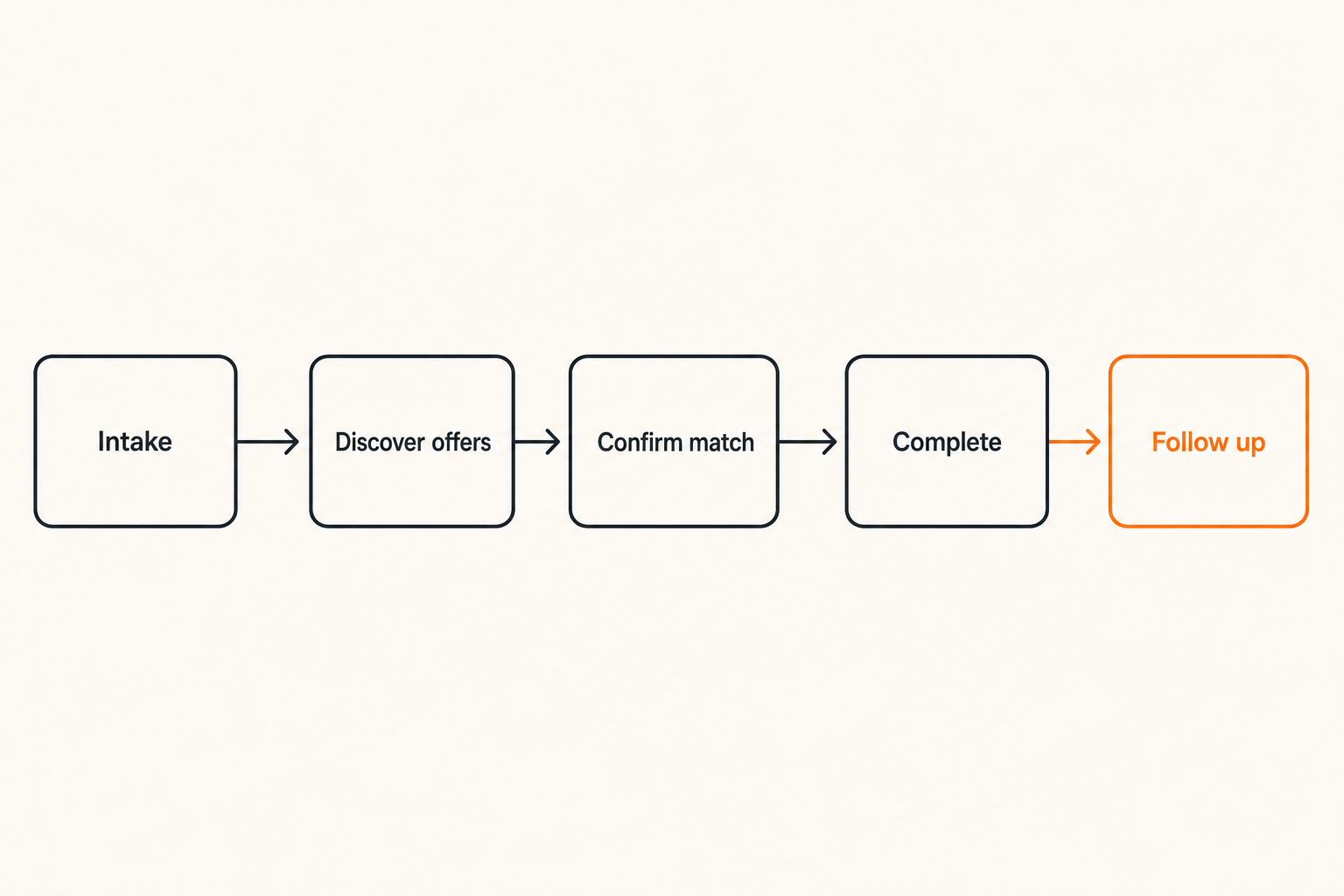
Every network needs a clear intake path. It can be a public form, a post type, a message to a coordinator, a phone number, a table at an event, or a standing office hour. The exact interface matters less than consistency.
A good intake path captures:
- What the person needs
- Where it is needed
- When it is needed
- Whether money is involved
- Any trust or safety constraints
- What has already been tried
- How follow-up should happen
On d0rz, the public asks page is useful because it treats requests as first-class objects rather than loose chat fragments. A browseable surface for customer asks on d0rz makes the operating model more visible: someone needs something, and the network can route around that need.
Define how offers are discovered
Offers need structure too. A generic I can help is kind, but not routable. Operators need enough context to match the offer to future asks.
At minimum, an offer should include:
- The service or help type
- Location or remote availability
- Response time
- Price or volunteer status
- Constraints and exclusions
- Languages, tools, licenses, or qualifications where relevant
- Preferred contact or booking path
This is where community language often fails. A member may be known as helpful, but the system does not know what they do. If the system cannot discover the offer, the organizer becomes the database.
Define how matches are confirmed
Routing is not complete when someone says maybe. It is complete when the asker and helper both understand the next step.
A match confirmation should answer:
- Who is doing what?
- By when?
- Under what terms?
- Through what channel?
- Who follows up if it stalls?
This is the difference between introduction theater and actual coordination. A local network does not need heavy process for every small request, but it does need enough state to know whether the request is open, routed, accepted, completed, or abandoned.
Trust language has to be operational
Trust is one of the most abused words in community work. Everyone wants a trusted community. Fewer teams define what trust changes in the workflow.
Trust should determine access, visibility, routing priority, safety checks, and escalation. If it does not change any of those, it is mostly atmosphere.
Reputation is not the same as access
Reputation means people have signals about someone. Access means the system allows that person to do something. Mixing them creates problems.
Someone may be well known in one context and still not appropriate for a sensitive request. Someone may be new but qualified for a low-risk task. A useful network separates reputation signals from permission decisions.
For example:
- Public offer visible to everyone
- Contact details visible after requester approval
- High-risk asks routed only through known organizers
- New providers allowed on low-risk work first
- Repeat completion increases routing confidence
Vouching needs boundaries
Vouching is useful only when it says what is being vouched for. I know them is not enough. The operator needs to know whether the vouch covers identity, skill, reliability, safety, payment history, or local context.
Practical rule: every vouch should answer, vouched for what, by whom, based on what experience, and for which kind of request.
Without boundaries, vouching turns into social pressure. People overextend trust from one domain into another. A neighbor who is reliable for pet sitting may not be the right person for financial advice. A skilled technician may not be suitable for entering homes alone. The network needs domain-specific trust.
Safety language must trigger action
Words like safe, vetted, verified, trusted, and approved need operational definitions. Otherwise they create liability and false confidence.
A safer pattern is to define what has been checked and what has not. For example:
- Identity confirmed by organizer
- Prior completion in network
- References checked for home access
- Payment terms confirmed before work
- Not background checked
- Not licensed by the network
This is less glamorous than calling everyone verified. It is more honest. It also helps organizers handle disputes because expectations were clear before the match.
What breaks when the words are wrong
Bad vocabulary does not just confuse people. It creates operational debt. Organizers carry hidden state in their heads. Participants use the wrong channels. Providers do not know how to be found. Askers lose confidence after one stalled request.
People ask in the wrong place
If the network calls itself a circle, people may bring every request into a group chat because that feels socially appropriate. If it calls itself a marketplace, they may try to compare providers even when the request needs a trusted referral. If it calls itself a hub, they may assume someone central is watching every post.
The fix is not to police language after the fact. The fix is to design entry points that make the right action obvious.
A request should not have to compete with announcements, event photos, inside jokes, and general discussion. If the ask matters, give it a route.
Offers become invisible
Many local networks have more capacity than they can see. People are willing to help, but their offers are buried in intros, old threads, event conversations, or private messages.
The result is artificial scarcity. Organizers say nobody can help, when the real issue is that the help was never indexed.
This is especially common with freelance community leaders and small providers. Someone can translate documents, debug a booking form, teach a class, drive within a neighborhood, or help with customer follow-up. But unless those offers are captured in a routable format, the network forgets.
Follow-up falls through the cracks
Most networks are decent at initial enthusiasm. They are weaker at follow-up. Someone responds. Someone else says thank you. Then nobody knows whether the task happened.
Follow-up is not admin overhead. It is how the network learns. It tells operators which offers are reliable, which asks are recurring, which routes are slow, and where support is needed.
Related reading from our network: infrastructure teams dealing with decentralized compute face a similar operational lesson: the label matters less than retries, ownership, validation, and workflow, as discussed in Akash Network Alternative in 2026.
A practical implementation sequence
A practical vocabulary rollout should look less like a naming workshop and more like an operations cleanup. Start with real events. Watch how requests move. Then name the objects people already need.
Map the real coordination events
Take the last 20 meaningful interactions in your network. Do not start with mission language. Start with the actual work.
For each event, write down:
- Who needed something?
- How did they ask?
- Who saw it?
- Who routed it?
- Who responded?
- What trust signal mattered?
- Was money involved?
- What was the final state?
- Who followed up?
- What broke or slowed down?
Patterns will appear quickly. You may find that housing requests need organizer routing, but website help can be public. You may find that transport asks need geography first, while translation asks need language first. You may find that urgent asks require a different word and channel than general interest posts.
Rename roles only after the workflow is clear
Do not start by renaming members as stewards, guides, captains, hosts, or connectors. Those words can help, but only if the role exists operationally.
A connector should connect. A steward should maintain something. A host should onboard people into a space. A dispatcher should route asks. A provider should fulfill offers. A requester should own the need and confirm outcome.
If the title does not map to responsibility, it becomes status language. Status language creates confusion and politics.
A cleaner pattern is:
- Define the recurring task.
- Assign a plain role name.
- Write the responsibility in one sentence.
- Test it for two weeks.
- Only then decide whether a warmer term is needed.
Test the vocabulary with new participants
New participants are the best test because they do not share your internal history. Give them a simple scenario and ask what they would do.
Examples:
- You need a ride tomorrow morning across town. Where do you post?
- You can help Spanish-speaking neighbors with forms. How do you list that?
- You found someone who can fix a broken checkout link. How do you mark the ask?
- You are not comfortable with a request. How do you escalate?
If they hesitate, your language or interface is doing too much work in your head and not enough work on the page.
What works and what fails
The best community other words reduce the number of private explanations required. They do not need to be clever. They need to make the next action clearer.
What works
What works is usually boring and specific:
- Use community for belonging, network for routing, and asks/offers for the actual work.
- Separate social discussion from operational intake.
- Give every request a visible state.
- Describe offers in terms of service, scope, location, availability, and constraints.
- Define trust words based on checks or experience.
- Give organizers a small set of routing roles.
- Close the loop after completion.
This is not anti-community. It is what lets community survive contact with real needs.
What fails
What fails is language that sounds good but hides work:
- Calling everything collaboration when nobody owns the next step.
- Calling everyone a member when some people are providers, requesters, hosts, or routers.
- Calling a group a marketplace without payment, dispute, or completion handling.
- Calling a sensitive network safe without defining screening or escalation.
- Calling a directory a community when there is no participation loop.
- Calling a chat channel a hub when nobody is responsible for triage.
The mistake teams make is thinking ambiguity is inclusive. Sometimes it is. But operational ambiguity often benefits insiders and frustrates new people.
Edge cases operators should expect
Local networks have messy edge cases. Vocabulary should make them easier to handle, not harder.
Expect:
- Hybrid asks that include both paid and unpaid help
- Providers who can help remotely but only serve a local audience
- Urgent needs that bypass normal discovery
- Sensitive asks that should not be public
- Offers that expire or change seasonally
- People who want to help but cannot commit reliably
- Requests that need multiple providers
- Disputes about scope, payment, quality, or no-shows
For adjacent reading, payment operators deal with the same state problem in a different domain: checkout language is not enough without settlement, reconciliation, and support workflows, as covered in Solution Peptides Payments.
Measure whether the vocabulary is working
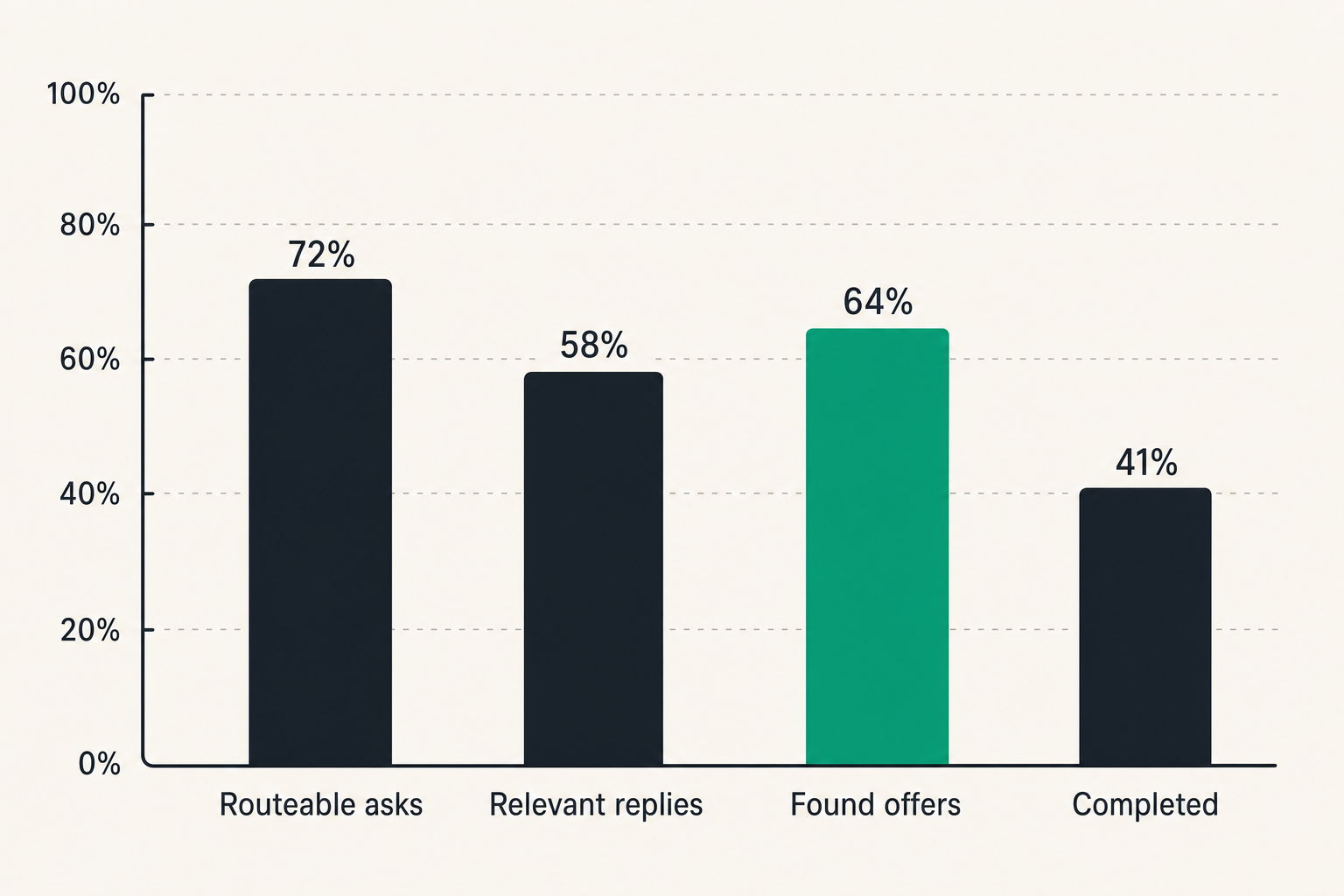
If your language is operational, you can measure whether it works. You do not need fake precision. You need enough signal to see whether requests move better after the vocabulary change.
Track routing quality
Routing quality is not just response speed. A fast wrong match wastes time. Track whether the first route was appropriate.
Useful signals include:
- Percent of asks with enough detail to route
- Percent of asks that receive at least one relevant response
- Percent of offers that are discoverable by category and location
- Number of manual organizer interventions per match
- Time from ask created to first qualified response
- Number of abandoned asks
If manual interventions keep rising, the vocabulary may be hiding complexity rather than reducing it.
Track participation clarity
Participation clarity means people know how to take part without a private orientation from an insider.
You can test this through simple questions:
- Do new participants know where to post an ask?
- Do providers know how to describe an offer?
- Do organizers know when to intervene?
- Do people understand what trusted, verified, or vouched means?
- Do participants know how to mark something done?
A local network does not need enterprise analytics. It does need visibility into confusion.
Track resolution, not vibes
Engagement can mislead. A post with many comments may still fail. A quiet request that gets routed quickly may be a success.
Track resolution states:
- Open
- Needs more detail
- Routed
- Accepted
- Completed
- Could not fulfill
- Withdrawn
- Escalated
Practical rule: measure whether needs get resolved, not whether conversations look lively.
This is where community other words become real. If the words improve resolution, they are doing operational work. If they only improve tone, treat them as copy, not infrastructure.
Where d0rz.com fits
d0rz.com is built around a simple premise: local coordination works better when asks, offers, trust, routing, and follow-up are visible enough to operate.
It is not trying to replace every social channel. Most communities already have chats, events, group texts, bulletin boards, and personal relationships. The gap is that those channels are poor systems of record for practical coordination.
Use asks and offers as the system of record
A useful local network needs a place where needs and capacity can live outside someone’s memory. That is the role of asks and offers.
An ask should be specific enough to route. An offer should be specific enough to discover. Both should carry local context. When the system has those objects, community other words stop floating above the work and start attaching to real workflows.
The operating model in Community Building d0rz: The Local Network Architecture That Actually Holds goes deeper on this idea: community building is not louder engagement; it is local infrastructure for asks, offers, trust, and follow-up.
Keep local context attached to the work
Local context is not a nice-to-have. It changes routing.
A remote automation offer may be perfect for a small business workflow. A ride request may depend on neighborhood, timing, and mobility needs. A translation offer may depend on language pair, document type, comfort level, and meeting place. A home repair ask may require trust constraints that do not apply to public errands.
If the context is lost, the route gets worse. If the route gets worse, people stop trusting the network.
Make follow-up visible
Follow-up is the feedback loop. It tells the network what worked, what failed, and what should be routed differently next time.
For d0rz.com, the product fit is architectural: make practical local asks and offers easier to see, route, and close. The words matter because they shape how people enter the system. But the system matters because it determines whether the words become reliable coordination.
Closing the loop on community other words
Community other words can help. But the best word is not the one that sounds most inspiring. It is the one that lowers coordination cost for the people using the network.
If your local network is small, you can survive on memory and goodwill for a while. As soon as asks increase, offers diversify, or trust becomes domain-specific, vocabulary becomes infrastructure. It either routes people toward the right next step or creates more work for the organizer.
Choose words that reduce coordination cost
Choose network when routing is the job. Choose hub when central coordination is real. Choose marketplace when search, transaction, and completion are supported. Choose circle when intimacy is the constraint. Choose mutual aid when reciprocity and care are the operating basis.
And if community is still the right public word, keep it. Just do not make it carry more than it can.
Write the operating meaning down
For every important term, write one operating sentence:
- An ask is a request for help that needs routing or response.
- An offer is available capacity someone is willing to provide.
- A route is the path from ask to suitable offer.
- A trusted provider has specific trust signals for a specific kind of work.
- A completed ask has been confirmed by the requester or organizer.
That is not bureaucracy. It is how local networks become usable by people who were not in the founding conversation.
Community other words should make coordination easier. If they do not, they are just names.
Try d0rz.com
d0rz.com is for people building practical local networks where asks, offers, trust, routing, and follow-up matter. Try d0rz.com.