
Most local organizers eventually run into the same problem: people say they want community, but nobody agrees what that means in practice.
One person hears mutual aid. Another hears a business referral group. Someone else hears neighborhood chat, a volunteer list, a directory, a social club, or a civic coordination layer. The word sounds warm, but the work underneath is operational: intake, routing, trust, response, and follow-up.
Teams think the problem is finding a better community synonym. The real problem is choosing the word that matches the coordination system you are willing to run.
That changes the conversation. In 2026, local networks are not failing because they lack inspirational language. They fail because the language promises one workflow while the actual system delivers another. A useful community synonym should tell people what kind of participation is expected, what kind of help can move through the network, and who owns the handoff when something matters.
Table of contents
- Why community synonym is an operating decision
- A practical taxonomy of community synonyms
- Match the community synonym to the job your local network performs
- The operating model behind a good community synonym
- Comparison table: words, promises, and operational risk
- Build a naming workflow, not a brainstorming session
- Common failure modes when the word is too broad
- How to use synonyms across asks, offers, and follow-up
- Metrics that tell you whether the language is working
- How d0rz.com fits the community synonym architecture
Why community synonym is an operating decision
A community synonym looks like a copywriting choice. In production, it behaves like an interface contract.
If you call something a community, people expect belonging. If you call it a marketplace, they expect transactions. If you call it a network, they expect introductions and routing. If you call it a neighborhood, they expect locality and accountability. None of these words are neutral.
The mistake teams make is picking the warmest word and then discovering that warmth does not resolve unclear ownership. A good term narrows expectations. A bad term expands them until every unmet need becomes your fault.
The word sets the promise
The word tells a participant what they are entering.
Community says: you belong here, and other people may care about your situation. Network says: there are nodes, paths, and useful connections. Group says: membership matters. Directory says: search first, contact second. Exchange says: offers and needs can be matched.
Those promises drive behavior. Someone entering a community may post a messy life situation. Someone entering a professional network may post a concise request. Someone entering a marketplace may expect pricing, guarantees, and dispute handling.
Practical rule: choose the word that matches the promise you can reliably keep, not the word that sounds most generous.
For local operators, this is not semantics. It is queue design. The wrong promise fills your system with requests you cannot route.
The word sets the workflow
A word implies a workflow even if you never draw one.
If your local network is built around asks, you need intake fields, urgency, location, constraints, and follow-up. If it is built around offers, you need availability, scope, boundaries, and response expectations. If it is built around introductions, you need permission, context, and a clean handoff.
A prior d0rz post on local network architecture makes the same point from the system side: participation only becomes useful when asks, offers, trust, and follow-up are connected. The label should reinforce that architecture, not hide it.
The word sets the failure mode
Every synonym fails in a different way.
Community fails by becoming emotionally overloaded. Marketplace fails by ignoring trust and care. Directory fails by becoming stale. Network fails by overvaluing connections and undervaluing completion. Neighborhood fails when geography is implied but not operationally enforced.
The practical question is not which word is correct. The practical question is which failure mode you are prepared to manage.
A practical taxonomy of community synonyms
You do not need a thesaurus. You need a taxonomy that maps words to operating behaviors.
The most useful community synonyms fall into a few categories. Each can work. Each can also mislead participants if the underlying system does not support the implied behavior.
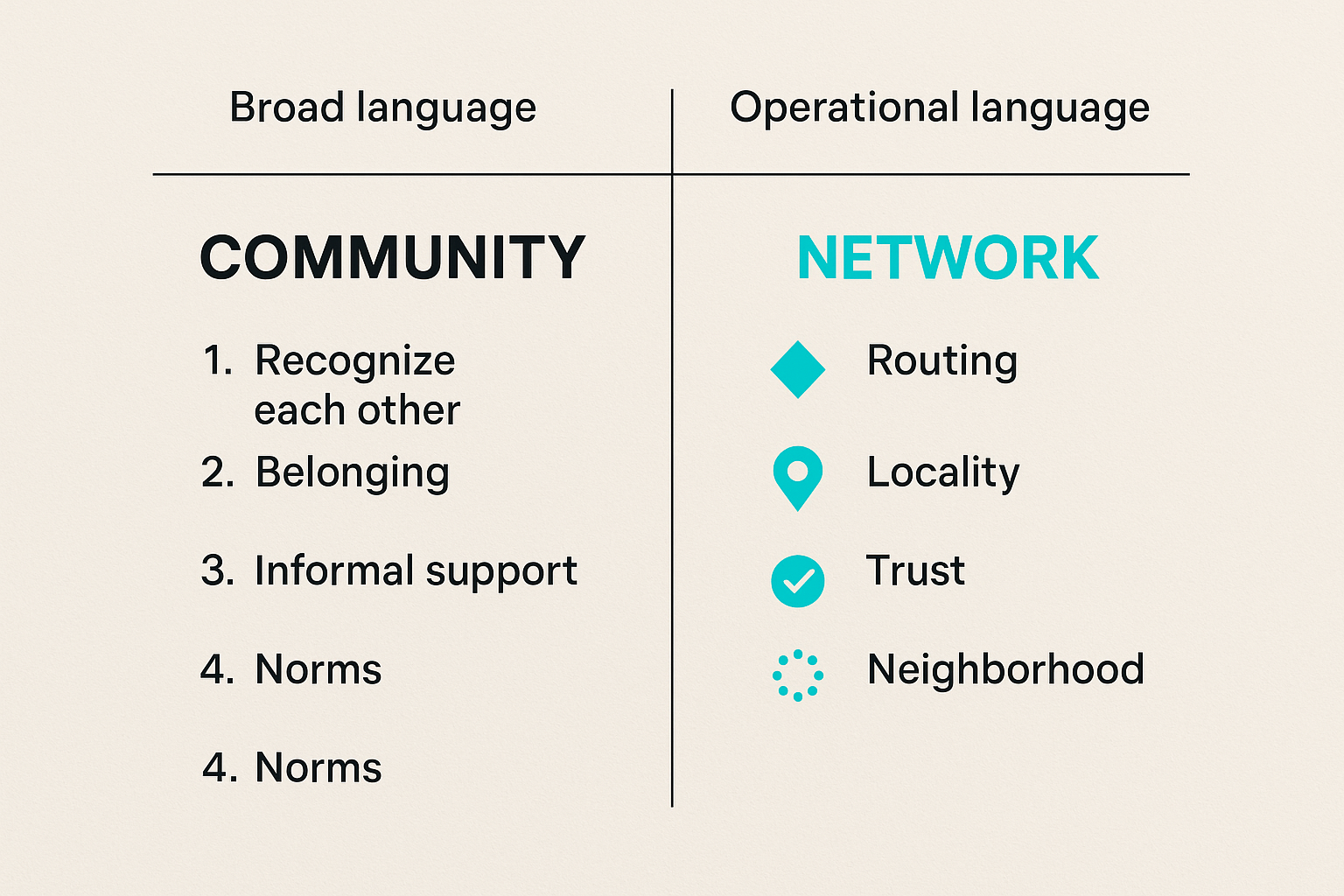
Community
Community is the broadest and most emotionally loaded term. It works when the network is intentionally relational, not just transactional.
Use community when:
- people are expected to recognize each other over time
- belonging is part of the value
- support may be informal, repeated, or contextual
- the network has norms, not just listings
Avoid community when your actual workflow is a thin lead form, a vendor list, or a one-time transaction board. People will bring human complexity to a word that sounds human.
Network
Network is more operational. It suggests nodes, routing, trust paths, and connections.
Use network when:
- the main job is matching people to people
- not every participant knows every other participant
- introductions need context
- local knowledge matters
Network is often the better word for builders who are serious about coordination but do not want to promise emotional belonging in every interaction. It leaves room for structure.
Related reading from our network: teams designing media and home infrastructure face similar architecture tradeoffs between user-facing simplicity and underlying routing complexity in computer systems technology for streaming and home media.
Neighborhood
Neighborhood anchors the system in place. It suggests proximity, local accountability, and practical help.
Use neighborhood when:
- physical location matters
- response time depends on distance
- trust is partly based on shared place
- the work includes errands, home help, rides, local services, or nearby support
The risk is false locality. If participants are spread across multiple cities but the interface says neighborhood, people will expect response patterns you cannot deliver.
Circle and cohort
Circle and cohort are smaller words. They imply limited membership.
Use circle when the group is relational and bounded. Use cohort when people move through a shared process or time period together.
These terms work well for freelance groups, parent networks, recovery groups, local business learning groups, neighborhood pods, or trusted referral circles. They fail when the system needs open discovery and broad participation.
Match the community synonym to the job your local network performs
A strong community synonym should be selected after you know the job of the network.
Many organizers reverse this. They choose the language first, then try to make the operations fit. What breaks in practice is that every participant uses the word differently. The founder thinks community means support infrastructure. Members think it means group chat. Partners think it means distribution channel.
Asks and offers need different language
A network based on asks is not the same as a network based on offers.
An ask starts with need: Can someone help me move a couch? Can someone fix this website form? Can someone watch a dog? Can someone translate a letter? The operator problem is qualification and routing.
An offer starts with capability: I can do same-day debugging. I can translate documents. I can drive locally. I can help with bookkeeping. The operator problem is scope, availability, and trust.
When you publish open requests, the language should make need visible without turning every need into noise. A practical example is the public customer asks flow on d0rz, where the object is not abstract engagement; it is a specific request that can be routed.
Trust level changes the vocabulary
The more trust required, the more careful the synonym should be.
Low-trust interactions can use broader words: board, list, directory, exchange. Higher-trust interactions need words that signal boundary and accountability: circle, trusted network, local referral group, neighborhood help network.
A dog walker, elder care helper, home repair provider, or childcare referral should not be framed like a casual bulletin board unless you are prepared for the support burden when something goes wrong.
Practical rule: if the interaction enters a home, touches money, involves a vulnerable person, or requires private context, your language must signal more than discovery.
Geography is not always the boundary
Local does not always mean close. Sometimes the real boundary is professional identity, language, schedule, trust source, or shared situation.
A Bay Area small business automation helper may serve remotely but still operate in a local trust context. A parent group may be hyperlocal even when some help is virtual. A Spanish-English translation offer may depend more on language and document type than on exact distance.
The mistake teams make is using neighborhood as a synonym for every local network. Geography matters, but it is only one boundary. The right word should match the actual coordination constraint.
The operating model behind a good community synonym
Once you choose the word, the next question is whether the system underneath can honor it.
A useful way to think about it is as a three-part operating model: intake, routing, and follow-up. If any part is missing, your chosen synonym starts to rot.
Intake
Intake is where vague participation becomes actionable signal.
For asks, intake should capture:
- what is needed
- where it applies
- when it is needed
- whether it is urgent
- what constraints matter
- what a successful response looks like
For offers, intake should capture:
- what the person can do
- where or how they can do it
- what they will not do
- expected response time
- price, trade, volunteer, or informal basis
- trust signals or references when appropriate
Without intake, community becomes a comment stream. Comment streams are cheap to start and expensive to operate.
Routing
Routing is the core function of a local network. It is the difference between participation and coordination.
Routing can be manual, automated, or mixed. In a small network, a human operator may know who should see what. In a larger network, tags, categories, location, urgency, and availability help decide the path.
The routing layer needs to answer:
- who should see this first?
- who is qualified to respond?
- who should not see it?
- when should it expire?
- what happens if nobody responds?
Related reading from our network: security teams deal with a similar signal-to-triage problem in AI content threat detection as a SOC workflow, where labels only matter if they feed validation and response.
Follow-up
Follow-up is where trust is built or lost.
Many local networks stop after the match. That is the easy part. The hard part is knowing whether the person was contacted, whether the work happened, whether the request changed, whether there was a problem, and whether either side should be invited back.
Follow-up does not need to be heavy. It can be a simple status change:
- open
- contacted
- scheduled
- completed
- no response
- needs another route
But the status must exist somewhere. Otherwise the operator cannot distinguish a healthy network from a pile of unclosed loops.
Practical rule: if your community synonym implies help, the system must track whether help actually moved.
Comparison table: words, promises, and operational risk
The same local group can be described in several ways. The best term depends on what participants should do next.
| Term | Best used when | Implied promise | Main operational risk |
|---|---|---|---|
| Community | Belonging and repeated support matter | People are part of something relational | Emotional expectations exceed capacity |
| Network | Matching and routing matter | Connections can lead to action | Introductions happen without completion |
| Neighborhood | Place and proximity matter | Local people can help locally | Geography is too loose or inaccurate |
| Circle | Trust and bounded membership matter | People are known or vouched for | Growth is constrained |
| Cohort | A shared process or time window matters | People progress together | Participation drops after the period ends |
| Directory | Search and discovery matter | Users can find relevant people | Listings become stale |
| Exchange | Asks and offers matter | Value can move both ways | Disputes and mismatched expectations appear |
| Marketplace | Paid transactions matter | Buyers and sellers can transact | Support, refunds, and trust become heavier |
What works
What works is alignment.
If you call it a neighborhood help network, then make locality, help type, urgency, and trust visible. If you call it a local business exchange, then make offers, requests, pricing expectations, and completion status visible. If you call it a trusted circle, then make membership rules and introductions explicit.
The label should reduce interpretation work for participants.
A good test: can a new person predict what to post, what not to post, and what happens after they post? If not, the word is too vague or the workflow is underbuilt.
What fails
What fails is aspirational naming without operational constraint.
Examples:
- calling a public directory a community when nobody interacts
- calling an unmoderated chat a trusted network
- calling a regional services board a neighborhood
- calling a referral list a marketplace without payment or dispute processes
- calling a volunteer list mutual aid without reciprocal norms or care practices
This is not pedantry. Wrong language creates wrong tickets. It creates support requests, conflict, disappointment, and silent churn.
Build a naming workflow, not a brainstorming session
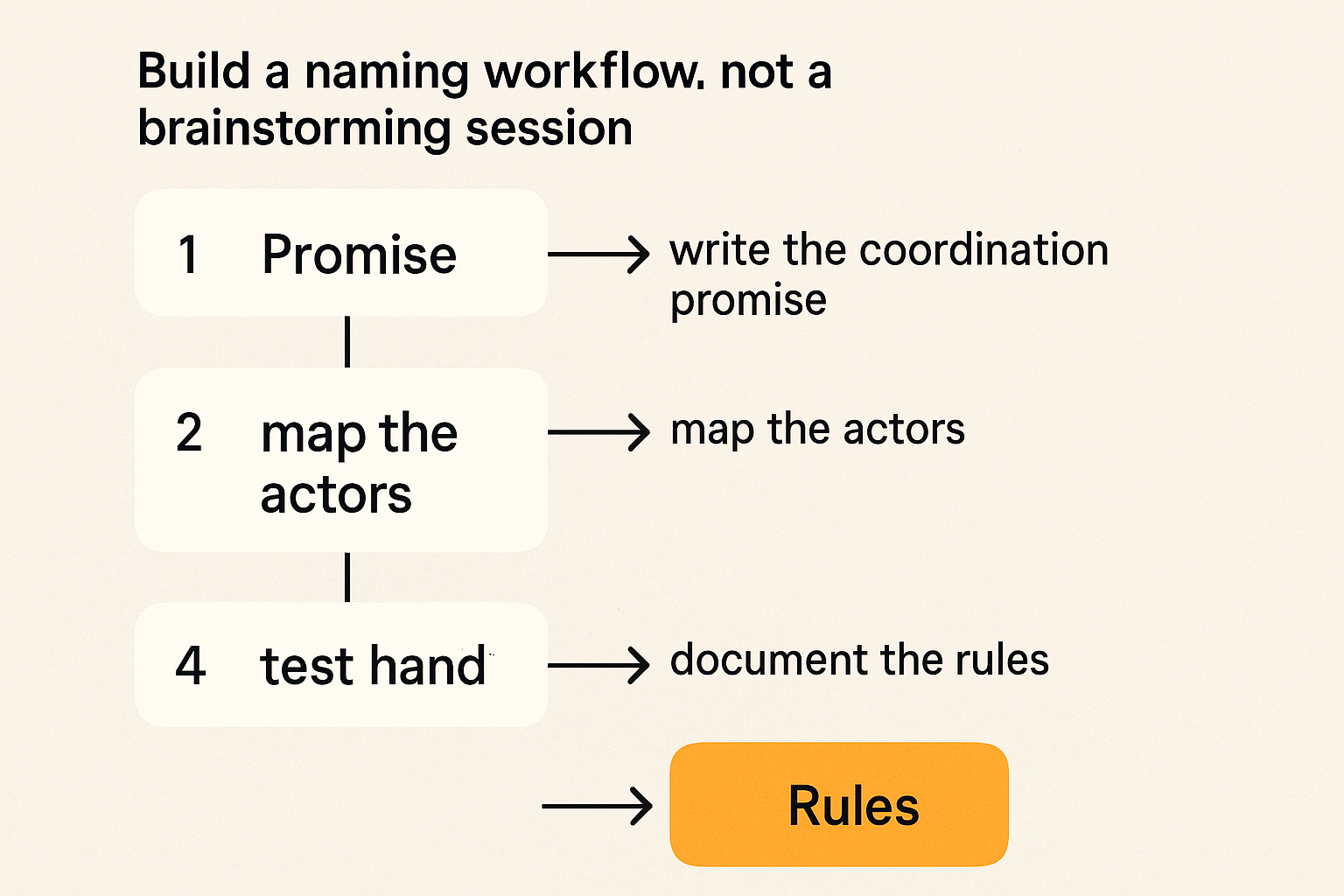
The practical question is not what sounds good in a headline. It is how the word performs when real people use it under imperfect conditions.
Use a short naming workflow. Treat it like product design, not brand therapy.
Step 1: write the coordination promise
Write one sentence in plain language:
- This network helps [who] do [what] with [whom] under [what trust or location constraint].
Examples:
- This network helps neighborhood residents request practical help from nearby people who can respond quickly.
- This network helps local freelancers exchange small business referrals with enough context for a useful introduction.
- This network helps small businesses find operators who can fix broken workflows, forms, and automations.
If the sentence is fuzzy, the synonym will be fuzzy.
Step 2: map the actors
List the actors before naming the system.
Typical actors include:
- requester
- provider
- referrer
- moderator
- local operator
- sponsor
- verifier
- helper
- customer
- neighbor
Each actor changes the best word. If everyone is a neighbor, neighborhood may fit. If some people route and others fulfill, network may be better. If the system includes buyers, sellers, payments, cancellations, and support, marketplace may be more honest.
Step 3: test the handoff
Pick three realistic scenarios and trace the handoff.
Example scenarios:
- A business owner needs a broken contact form fixed before Monday.
- A parent needs a trusted local recommendation for after-school pickup.
- A freelancer offers translation help at a library on specific days.
For each one, ask:
- who receives the ask?
- who is allowed to respond?
- what context is required?
- what status changes after contact?
- what happens if the first route fails?
If the synonym makes the handoff easier to explain, keep it. If it creates more explanation, reject it.
Step 4: document the language rules
Once you choose the word, write usage rules.
A simple language spec can include:
- primary term: local network
- secondary terms: asks, offers, providers, neighbors
- avoid: marketplace unless payment is handled
- avoid: emergency help unless response is staffed
- use neighborhood only when distance matters
- use trusted only when there is a verification or vouching process
This sounds small. It prevents drift. Drift is how a practical network turns into a vague community brand with no operational edge.
Common failure modes when the word is too broad
Broad words attract broad expectations. That is useful at launch and dangerous during operations.
If you choose community because it feels inclusive, you inherit many interpretations. Some people will expect friendship. Some will expect mutual aid. Some will expect promotion. Some will expect customer support. Some will expect moderation of every conflict.
The engagement trap
The engagement trap is optimizing for posts, comments, likes, and attendance while the real coordination work stays unresolved.
A busy group can still be operationally weak. Ten comments on an ask do not matter if nobody takes ownership. A lively thread about local services does not matter if the requester still cannot find help. A member count does not matter if routing quality is poor.
What breaks in practice is that operators confuse visible activity with completed loops.
A better question: what percentage of meaningful asks reach a plausible next step? You do not need a perfect metric at the beginning. You do need to distinguish noise from movement.
The directory trap
The directory trap is assuming that listing people creates a network.
Directories are useful. They are not enough. A stale provider profile, an unanswered message, or an outdated offer creates negative trust. Users do not blame the listing format. They blame the network.
If you operate a directory, you need freshness rules:
- when was the offer last confirmed?
- how fast does the provider usually respond?
- what categories are active?
- who removes unavailable listings?
- what happens when contact fails?
A live example of a concrete offer is remote website and automation help for local businesses, where the scope is narrow enough for a requester to understand what kind of help is actually available.
The moderation trap
The moderation trap is believing that good norms alone can manage operational ambiguity.
Norms matter. But when the system has no clear categories, status, escalation, or ownership, moderation becomes emotional cleanup. Operators end up explaining intent, calming misunderstandings, and manually repairing broken expectations.
Practical rule: moderation should enforce the workflow, not compensate for the absence of one.
If the word says trusted network, define trusted. If the word says local help, define local and help. If the word says exchange, define what can be exchanged and what is out of scope.
How to use synonyms across asks, offers, and follow-up
You do not have to use one word everywhere. In fact, mature local systems usually need a small vocabulary.
The public-facing label can be broad. The operational labels should be precise.
Public labels
Public labels help people orient quickly.
Good public labels include:
- local help network
- neighborhood services exchange
- trusted referral circle
- community ask board
- local provider network
- mutual support circle
The public label should be short enough to repeat and specific enough to filter the wrong behavior.
If people keep posting jobs in a volunteer group, the label may be wrong. If people keep asking for emergency help in an unstaffed network, the label is dangerously wrong.
Operator labels
Operator labels are the internal objects that make the system work.
Examples:
- ask
- offer
- route
- match
- referral
- provider
- requester
- status
- follow-up
- escalation
These words do not need to be warm. They need to be unambiguous. Operators should know whether they are dealing with a new ask, an expired ask, a live offer, a failed route, or a completed match.
Related reading from our network: payment operators face the same hidden-state problem in crypto merchant account architecture, where the checkout page is not the system; settlement, reconciliation, retries, and support are the system.
Support labels
Support labels matter when something goes wrong.
Use clear language for states like:
- no response
- needs more detail
- outside scope
- routed to provider
- awaiting requester
- completed
- disputed
- unsafe or inappropriate
This is where many community tools fail. They provide a place to post but not a way to close the loop. The operator then holds state in memory, spreadsheets, DMs, and guilt.
A synonym cannot fix missing state. But the right vocabulary can force the state model into the open.
Metrics that tell you whether the language is working
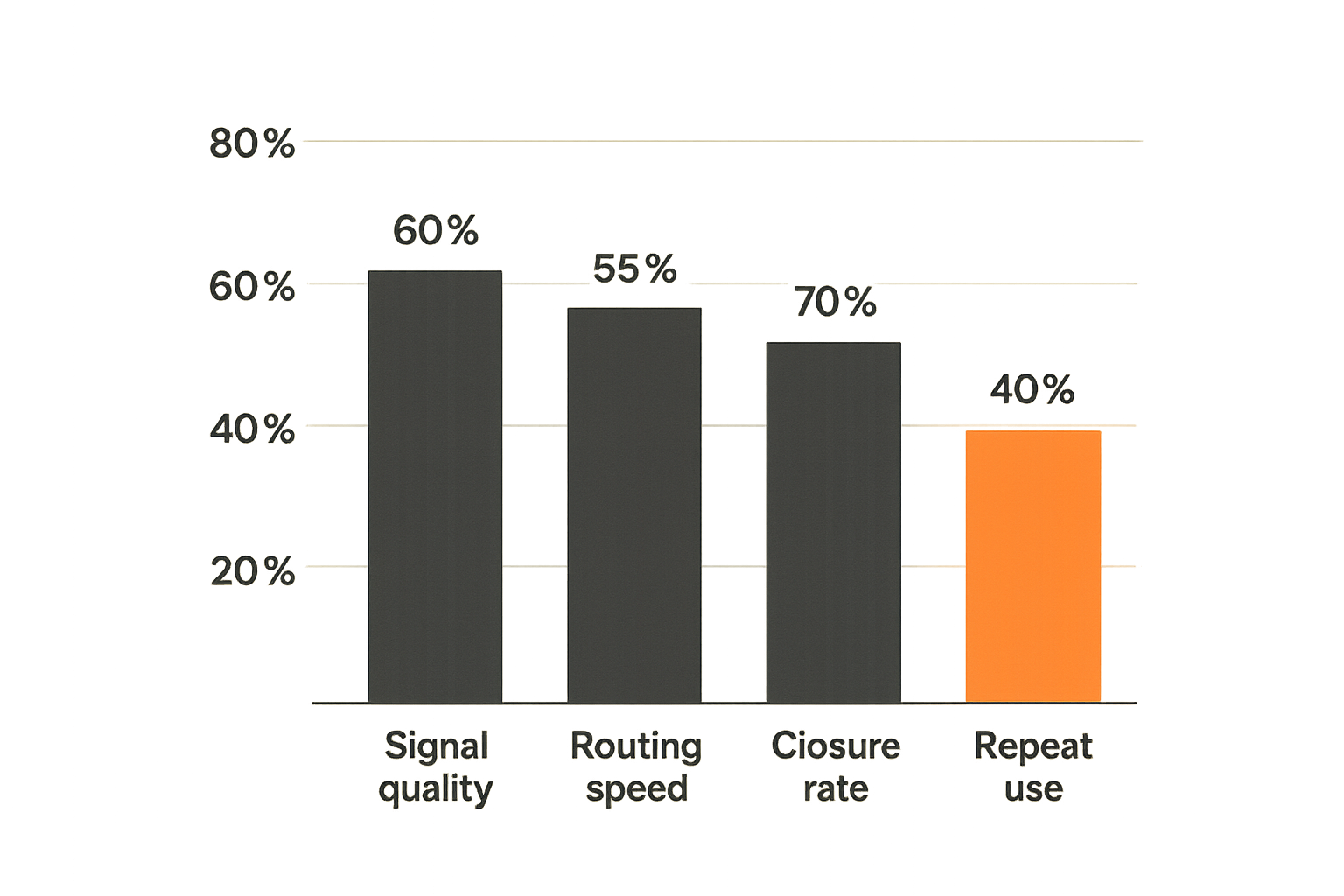
You can measure whether a community synonym is doing its job. Not perfectly, but enough to avoid lying to yourself.
The key is to measure operational clarity, not vanity activity.
Signal quality
Signal quality asks whether incoming posts are understandable and actionable.
Look for:
- fewer vague posts over time
- more complete asks
- more scoped offers
- fewer off-topic submissions
- fewer operator clarifying questions
If your word is working, people arrive with a better mental model. They know what the space is for.
If every ask requires manual interpretation, your language is not carrying enough operational meaning.
Routing speed
Routing speed measures how long it takes for an ask or offer to reach the right next person.
Track simple timestamps:
- submitted
- reviewed
- routed
- first response
- completed or closed
You do not need enterprise analytics. A small spreadsheet can reveal whether the network is actually moving work.
The important distinction is between response and resolution. A fast comment is not the same as a useful route. A useful route is not the same as completion.
Repeat participation
Repeat participation tells you whether the promise is credible enough for people to return.
Watch for:
- requesters who come back with a second ask
- providers who keep offers current
- referrers who send better-fit people
- members who report outcomes without being chased
- operators who can hand off work without heroic memory
If people participate once and disappear, the label may have attracted attention without creating trust. If people return with better-formed asks and offers, the vocabulary is teaching the network how to operate.
How d0rz.com fits the community synonym architecture
The d0rz.com approach is built around a simple assumption: local coordination needs operational objects, not just a nicer word for community.
A community synonym can help people understand the promise. But asks, offers, routing, trust, and follow-up are what make the promise real.
A local network needs operational objects
For practical local networks, the core objects are straightforward:
- an ask is a need that needs routing
- an offer is a capability with scope
- a provider is someone who may fulfill work
- a route is the path between need and capability
- follow-up is the state that prevents silent failure
This model is intentionally plain. It works for small business workflow help, errands, translations, home services, freelance referrals, and many other local coordination problems.
The point is not to force every local network into one rigid category. The point is to make sure the language points to an object that can be acted on.
Product fit without pretending software solves trust
Software does not create trust by itself. It can only make trust easier to express, inspect, and maintain.
That means d0rz.com is most useful for operators who already understand that local networks require care. The product fit is not generic community engagement. It is practical coordination: publishing asks, listing offers, making the work visible, and reducing the number of needs trapped in private messages.
If your current system is a group chat, spreadsheet, inbox, and memory, the first win is not automation hype. The first win is shared structure. That structure makes it easier to see what is open, who can help, what has been tried, and what needs follow-up.
The right community synonym can make the front door clearer. The right operating model makes the back room survivable.
Try d0rz.com
You are writing for people building practical local networks where asks, offers, trust, routing, and follow-up matter.
If you are choosing a community synonym because your local network is becoming harder to operate, start with the workflow: what people ask for, what others can offer, how trust is handled, and how loops get closed.