
Most local organizers eventually run into the same problem: the word community starts doing too much work.
A neighborhood mutual aid group, a freelancer referral circle, a small business support network, a local language-help group, and a civic volunteer base may all call themselves a community. That feels inclusive at first. Then people stop knowing what to post, who owns follow-up, and whether a request is supposed to become action.
Teams think the problem is finding a warmer synonym for community. The real problem is choosing an operating noun that tells people how coordination works.
That changes the conversation. The practical question is not which word sounds best on a homepage. It is which word makes asks visible, offers legible, trust transferable, and follow-up accountable in 2026 local networks.
Table of contents
- What a synonym for community has to do operationally
- The terms operators actually use instead of community
- Community versus network versus marketplace
- Build the vocabulary around asks offers trust and follow up
- A workflow for choosing the right synonym for community
- What breaks when the word is wrong
- What works in production
- Metrics that tell you the name is working
- Implementation details for local organizers
- Where d0rz.com fits in the local network stack
What a synonym for community has to do operationally
The word is a routing decision
A useful way to think about it is this: the main noun for your group becomes the default routing rule.
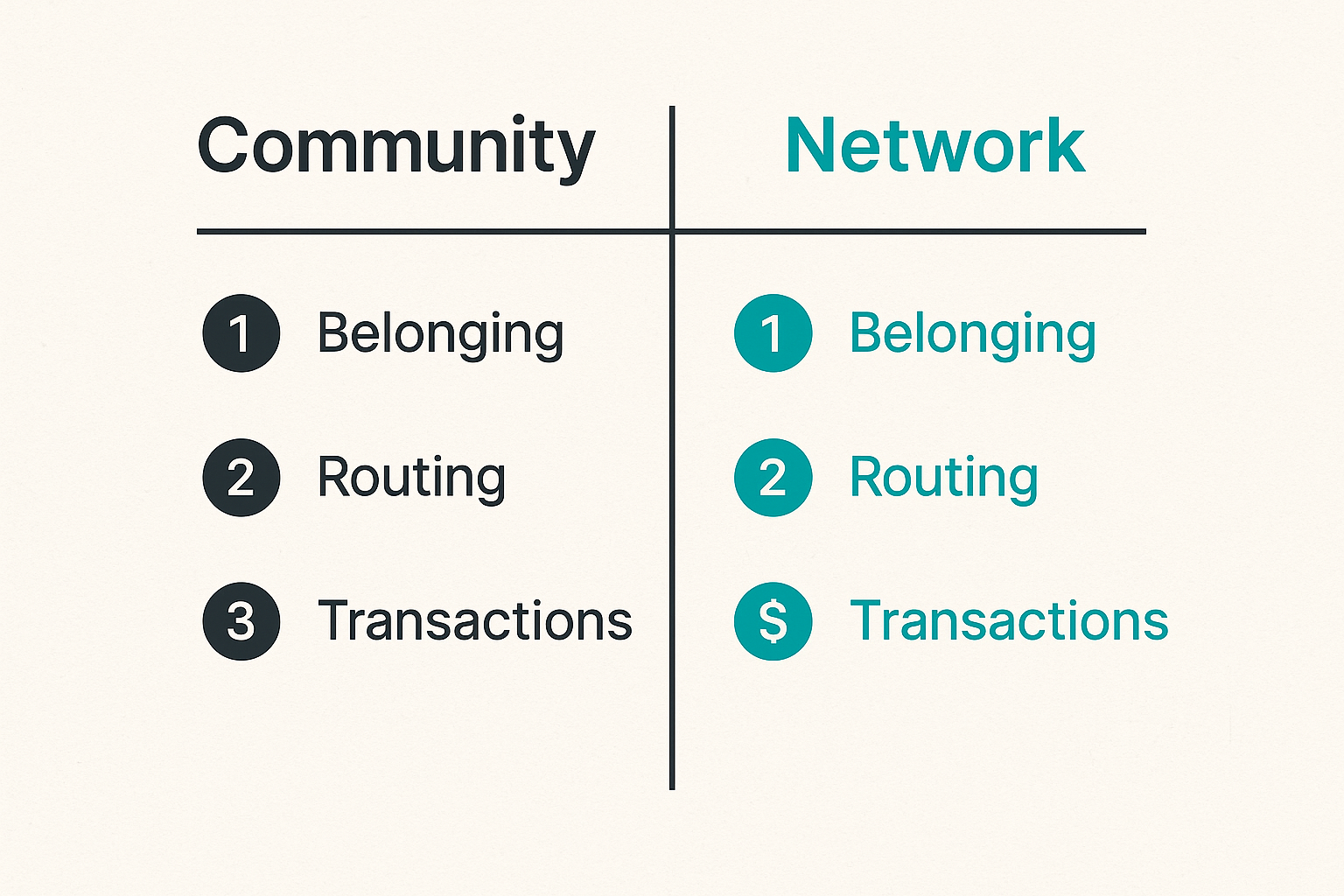
If you call it a community, people expect belonging, conversation, shared identity, and some amount of mutual recognition. If you call it a network, people expect paths, introductions, referrals, and movement. If you call it a marketplace, people expect listings, prices, fulfillment, and support. If you call it a circle, people expect intimacy and limited membership.
None of those words is automatically better. The wrong word is the one that invites behavior your operating model cannot support.
Practical rule: choose the word that matches the next action you want members to take, not the mood you want them to feel.
For a local organizer, this matters because every post creates work. A vague introduction might need interpretation. A request might need triage. An offer might need verification. A referral might need follow-up. The noun you choose should reduce that translation work.
Why the generic label breaks
Community is a broad word. That is why teams like it. It can hold belonging, culture, local identity, mutual aid, learning, business referrals, events, volunteering, and support.
The same flexibility becomes a problem when the group grows beyond the founder's personal context. New members ask: Is this for discussion or action? Can I ask for paid work? Can I offer services? Who is trusted? What counts as spam? What happens after someone says yes?
The mistake teams make is treating those questions as moderation edge cases. They are architecture questions. The label did not define the workflow, so every participant invents a slightly different one.
When language starts to change behavior
Good naming changes what people submit. A group called Local Help Desk gets different posts than a group called Neighborhood Friends. A freelancer network gets different offers than a creator community. A repair exchange gets different follow-up than a general town forum.
The word is not cosmetic. It sets expectations around:
- whether people should ask for help or simply socialize
- whether offers are welcome or considered self-promotion
- whether money can change hands
- whether organizers are responsible for matching people
- whether trust is based on identity, reputation, endorsement, or public contribution
- whether unresolved requests should be chased
If your word does not answer any of those questions, your operators will have to answer them manually every day.
The terms operators actually use instead of community
Network
Network is the strongest alternative when your main job is routing. It tells people there are nodes, paths, introductions, and movement. It works well for local business support, freelancer referrals, mutual aid coordination, ride sharing, errands, care networks, and neighborhood resource mapping.
Network also creates a useful constraint: if nothing moves through it, the network is not working. That forces the operator to look at asks, offers, response time, and completed loops.
For a deeper architecture view of how this plays out in local systems, see the prior d0rz piece on community building as local network architecture. The useful point is simple: a local network is not just a list of people. It is a set of repeatable paths between need and capacity.
Circle
Circle is useful when trust density matters more than scale. It says the space is smaller, more relational, and probably not open to every request. Parent circles, elder care circles, repair circles, language circles, and founder circles can work well because the word implies proximity.
The downside is that circle can discourage useful outsiders. If you need new capacity, specialized skills, or cross-neighborhood routing, circle may feel too closed. Operators then end up privately forwarding requests outside the circle, which means the real network is invisible.
Guild collective and association
Guild works when members share a craft or role. It supports standards, peer learning, apprenticeship, referrals, and reputation. Collective works when members share ownership or contribution. Association works when there is governance, membership, or representation.
These are heavier words. They can help with seriousness, but they also raise expectations. If you call something a guild, members may expect quality bars. If you call it a collective, they may expect voice in decisions. If you call it an association, they may expect process.
What breaks in practice is not that the word is inaccurate. It is that the operating model is not mature enough for the promise the word makes.
Community versus network versus marketplace
The operating difference
Community, network, and marketplace often overlap, but they optimize for different things.
Community optimizes for belonging. Network optimizes for routing. Marketplace optimizes for transactions. A local group may need all three, but one should be primary at any given layer.
If a neighborhood organizer says, we are building a community, the next question should be: what does the community do when someone needs a ride, a translator, a handyman, a client, a place to volunteer, or a trusted person to check on an elder?
If the answer is mostly discussion, community is probably fine. If the answer is matching, routing, and follow-up, network may be a better operating noun.
Comparison table for local builders
| Term | Best for | Primary action | Operator workload | Failure mode |
|---|---|---|---|---|
| Community | Belonging, identity, conversation | Participate | Moderation and culture setting | Warm but vague |
| Network | Referrals, local help, capacity routing | Ask, offer, connect | Matching and follow-up | Too transactional if trust is weak |
| Circle | High-trust small groups | Share and support | Membership care | Too closed to scale capacity |
| Marketplace | Paid services and fulfillment | Buy, sell, complete | Payments, disputes, support | Extractive without local trust |
| Guild | Skilled peers and standards | Practice, refer, improve | Quality control | Over-formal too early |
| Association | Representation and governance | Join, vote, advocate | Administration | Process-heavy |
This table is not a taxonomy exercise. It is a workload map. Each word moves operational burden to a different part of the system.
The mistake is picking the warmest word
The mistake teams make is picking the word that sounds least commercial. That often leads them back to community, even when the actual system is a referral network, help exchange, or service marketplace with human trust layered on top.
There is nothing wrong with warmth. But warmth does not route requests. It does not confirm availability. It does not record who followed up. It does not tell a new member whether posting an offer is helpful or spam.
Practical rule: if the group exists to move help from one person to another, test network before defaulting to community.
Related reading from our network: teams managing security operations face a similar naming problem when vague categories hide ownership, telemetry, and response paths; this practical guide to cloud computing security operations is a useful adjacent comparison.
Build the vocabulary around asks offers trust and follow up
Ask language makes demand visible
The best local networks make asking normal and structured. If people only post polished announcements, operators cannot see real demand.
Ask language should answer:
- What do you need?
- Where does it need to happen?
- When is it needed?
- Is it paid, volunteer, barter, or flexible?
- What would a good response look like?
- Who can safely see this?
This is why a page of live requests is more operationally useful than a vague community wall. On d0rz, the public asks surface is an example of treating local demand as something that can be named, routed, and resolved rather than buried inside chat.
Offer language makes capacity visible
Offers are the other half of the system. Many communities fail because they encourage need but never make capacity easy to declare.
Offer language should answer:
- What can you do?
- Where can you do it?
- When are you available?
- What are your limits?
- What does it cost, if anything?
- What signals make you trustworthy?
A local translation helper, for example, is not just a nice member of the community. The English and Spanish translation offer is a capacity record: what kind of help exists, where it can happen, and how someone might route a real need to it.
Trust language reduces coordination drag
Trust is where generic community language usually collapses. People may feel friendly, but operators still need rules for introductions, referrals, vulnerable requests, paid work, and follow-up.
A local network should be explicit about trust signals. These might include known-by relationships, prior completed help, public offers, host endorsement, identity checks, location familiarity, or shared institution membership.
Do not overbuild trust too early. But do not leave it invisible. Invisible trust becomes private gatekeeping, and private gatekeeping does not scale beyond the few people who know everyone.
Follow up language closes the loop
A request that receives replies but no resolution is not complete. A referral that gets forwarded but never checked is not complete. An offer that is accepted but not fulfilled is not complete.
Follow-up language should include simple states:
- open
- routed
- accepted
- completed
- blocked
- withdrawn
These states sound basic because they are. The point is not to create bureaucracy. The point is to help the network remember what happened.
Related reading from our network: decentralized compute builders face a parallel problem when demand, supply, trust, and settlement are split across actors; see this architecture guide to cloud computing services for the same workflow pattern in a different domain.
A workflow for choosing the right synonym for community
Step one map the coordination job
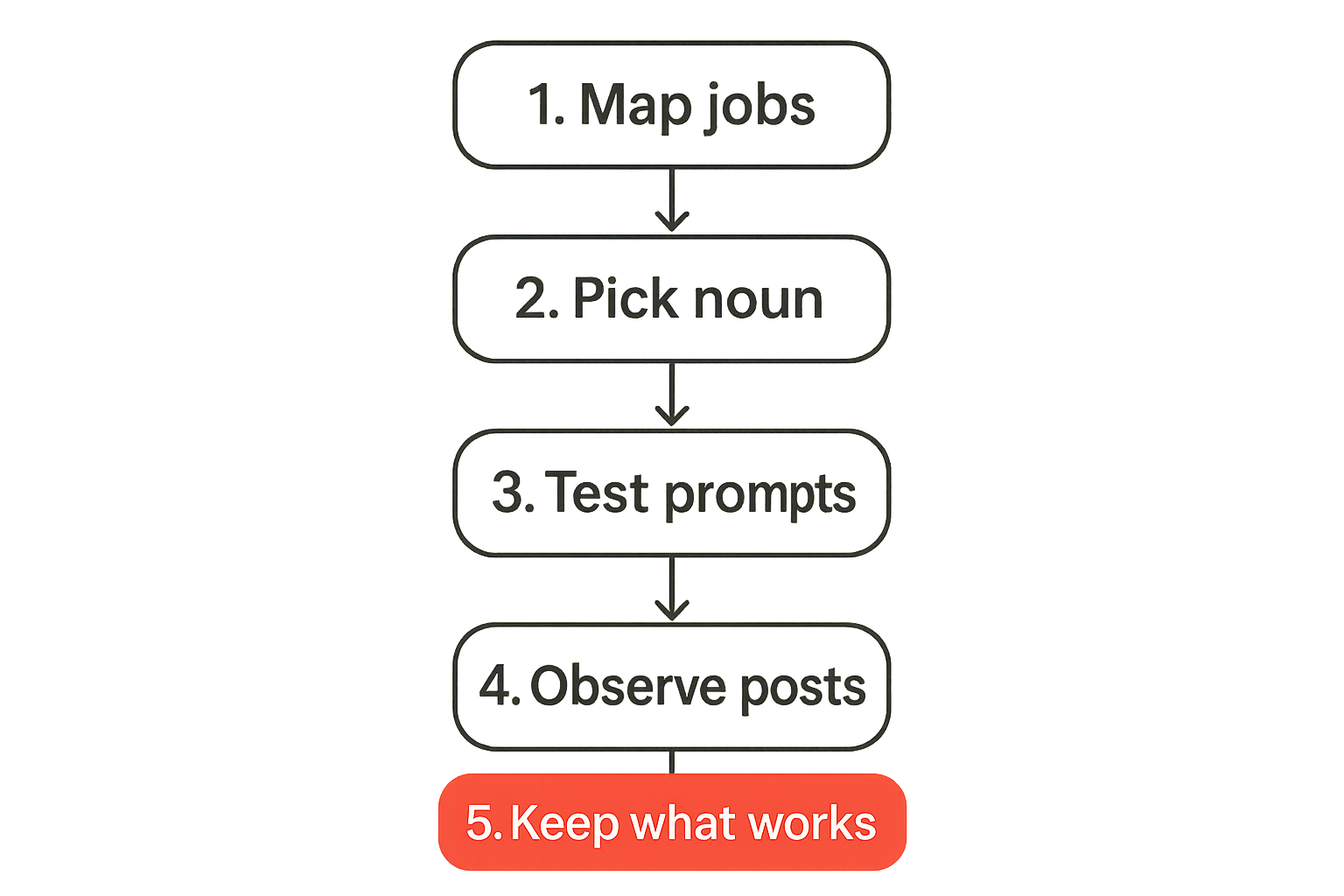
Start with the job, not the word.
Write down the top five things people are trying to do in your group. For a local network, they might be:
- ask for practical help
- offer services or capacity
- find trusted local providers
- route requests to the right person
- confirm that something actually happened
Then identify which of those jobs is most important. If belonging is primary, community may still be the right word. If routing is primary, network is probably more precise. If paid fulfillment is primary, marketplace may be clearer. If care and safety are primary, circle may carry the right signal.
Step two choose the primary noun
Pick one primary noun for the public surface and allow secondary nouns underneath it.
Example:
- Public noun: local network
- Internal surfaces: asks, offers, routes, follow-ups
- Relationship language: trusted neighbors, providers, hosts, helpers
- Optional cultural language: community events, member stories
This lets you preserve warmth without making community carry the whole system.
Practical rule: use community for belonging, network for routing, marketplace for transactions, circle for high-trust proximity, and guild for shared craft.
Step three test it in real interactions
Do not decide in a naming meeting. Test the word in prompts, onboarding, host scripts, and real posts.
A simple implementation sequence works better:
- Take ten recent posts or conversations from your group.
- Label each as ask, offer, discussion, event, referral, or follow-up.
- Rewrite the onboarding sentence using two candidate nouns.
- Ask five real participants what they think they are supposed to do next.
- Track whether their first post becomes more specific.
- Keep the noun that reduces explanation.
The best synonym for community is the one that lowers coordination cost in the first week, not the one that wins a poll.
What breaks when the word is wrong
People do not know what to post
Vague language produces vague participation. People introduce themselves, react to announcements, and wait for permission. That may be fine for a culture space. It is a problem if the goal is practical local coordination.
When the noun is wrong, people hesitate around the highest-value actions:
- asking for help before a crisis
- offering paid services without seeming spammy
- sharing availability
- naming constraints
- referring someone publicly
- reporting that a request was resolved
The operator then has to privately coach people through behavior the system should have made obvious.
Moderators become translators
When posts are ambiguous, moderators become translators. They rewrite asks, clarify offers, chase context, move conversations across channels, and explain norms one person at a time.
That works while the founder is present. It fails when the group spans multiple neighborhoods, languages, hosts, or categories of help.
This is especially visible in multilingual local networks. The issue is not just literal translation. It is operational translation: does this message mean someone needs help, is offering help, is recommending someone, or is closing a loop?
The network cannot remember
Chat threads are poor memory systems. So are comment sections, private DMs, and hallway conversations. If your community language does not create records, the network cannot learn.
It cannot answer:
- Which asks repeat every month?
- Which offers are underused?
- Which neighborhoods have demand but no capacity?
- Which referrals completed successfully?
- Which members create trust by following through?
What breaks in practice is continuity. Every week feels like starting over.
Related reading from our network: home media and local network setups have the same practical lesson that naming a system is not enough if storage, routing, and maintenance are unclear; this piece on computer systems technology is adjacent but useful for thinking about operational layers.
What works in production
Use different words at different layers
You do not need one word to describe everything. In fact, forcing one word onto every layer is often the problem.
A practical local system can use:
- community for the emotional and cultural layer
- network for routing and relationships
- asks for demand
- offers for capacity
- hosts for local stewardship
- providers for people who can fulfill work
- follow-ups for closure
This layered vocabulary helps different participants understand their role without making the public brand sound mechanical.
Make the action nouns obvious
If you want coordination, nouns like ask, offer, route, and follow-up should be visible in the interface and in organizer language.
Instead of saying, engage with the community, say:
- post an ask
- list an offer
- introduce two people
- mark the request as handled
- invite a trusted provider
- check back tomorrow
The practical question is always: what should a reasonable person do next?
Keep the public story simple
Operators often overcorrect. They discover the workflow problem and turn the homepage into a systems diagram. That fails too.
The public story should be short. For example: a local network for finding and offering practical help. That gives people enough context to act without forcing them to learn your internal model.
The deeper vocabulary can appear in forms, prompts, host guides, and follow-up workflows.
Practical rule: put the simple promise on the front door and the precise workflow inside the room.
Metrics that tell you the name is working
Measure routing not sentiment
Do not measure only likes, event attendance, or member count. Those may matter, but they do not prove the word is helping the network coordinate.
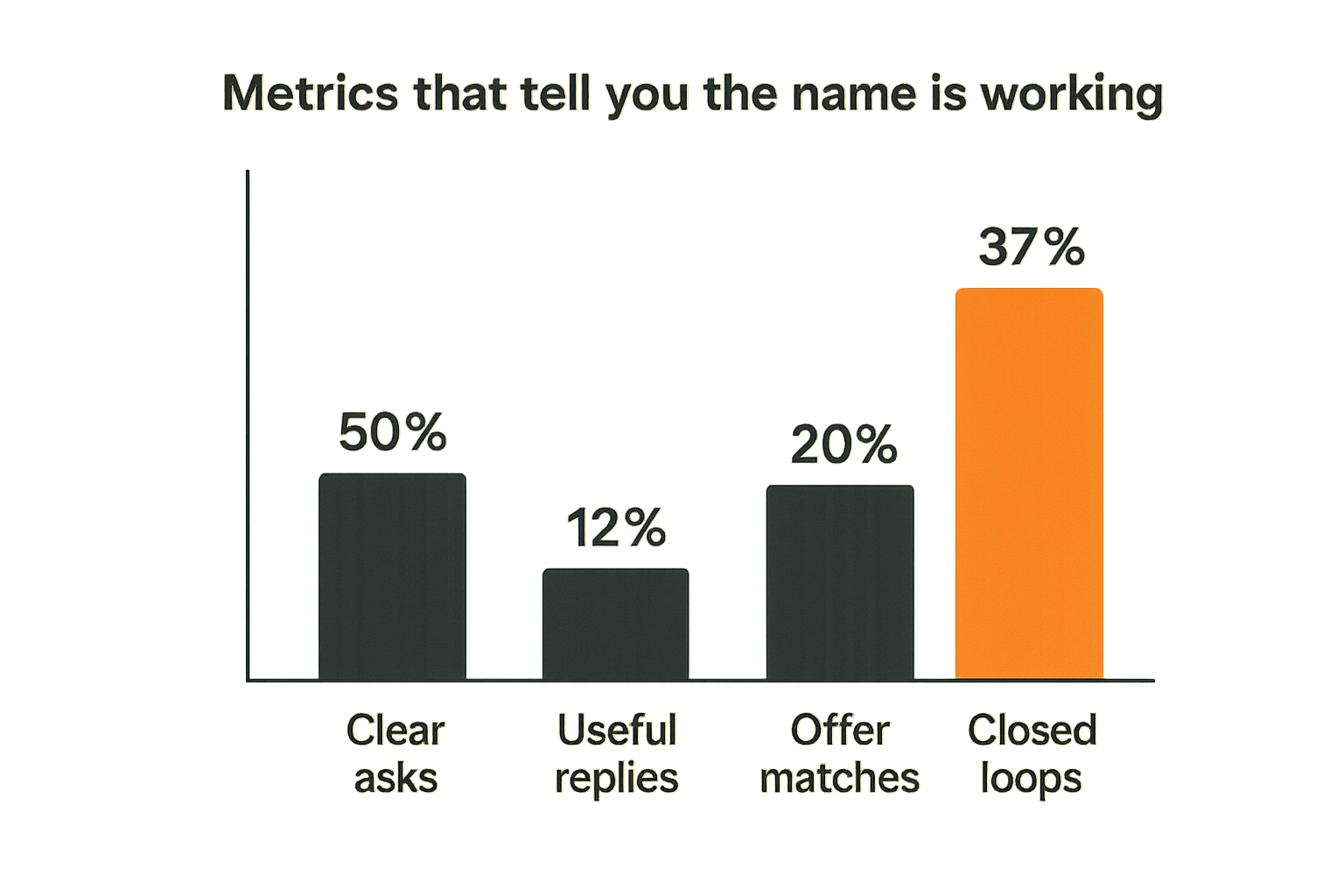
Better metrics include:
- percentage of new posts that are clear asks or offers
- time from ask posted to first useful response
- percentage of offers that receive qualified requests
- number of introductions that lead to action
- number of loops marked completed
- number of posts moderators had to rewrite
If changing from community to network increases clear asks and completed follow-ups, the name is doing operational work.
Watch conversion between roles
Healthy local networks let people move between roles. Someone asks for help this month, offers help next month, hosts a small group later, and refers a neighbor after that.
Role conversion is a stronger signal than passive engagement. Watch for:
- askers becoming offerers
- offerers responding to repeat needs
- hosts routing outside their immediate circle
- providers receiving referrals from people they helped
- members closing loops without organizer prompting
That changes the conversation from audience growth to capacity growth.
Track unresolved loops
Unresolved loops are where trust decays. If people ask and never hear back, they stop asking. If people offer and no one routes them relevant demand, they stop offering. If referrals disappear into DMs, organizers lose visibility.
Track unresolved loops by category and by stage. Is the problem unclear asks, missing capacity, low trust, slow response, or no follow-up? The fix depends on the stage.
A naming change will not solve all of this, but the right vocabulary makes the failure visible sooner.
Implementation details for local organizers
Update prompts forms and intake
The word only matters if it changes the prompts people see.
If you choose network, your intake should not ask people to introduce themselves generically. It should ask what they can offer, what they may need, where they operate, and who can vouch for them. If you choose circle, intake should focus more on relationship, safety, and boundaries. If you choose marketplace, intake needs pricing, availability, fulfillment, and support expectations.
A basic ask prompt might look like this:
- I need help with:
- Location or service area:
- Timing:
- Paid, volunteer, barter, or unsure:
- What I have already tried:
- A good response would be:
- Visibility or safety constraints:
A basic offer prompt might look like this:
- I can help with:
- Where I can help:
- Availability:
- Cost or exchange:
- Limits:
- Trust signals:
- Best next step:
Give hosts scripts not slogans
Hosts need language they can use under pressure. A slogan does not help when someone posts a vague request at 11 p.m. or when a provider is unsure whether they are allowed to promote a service.
Give hosts scripts like:
- Can you turn this into a specific ask with location and timing?
- Is this an offer others can request, or a general announcement?
- Who has done this before and can make a trusted introduction?
- Please update the thread when this is handled so others know the loop is closed.
- This looks like paid work, so please include budget or range.
Scripts create consistency across neighborhoods and hosts. They also reduce the amount of personality required to keep the network functioning.
Create a shared glossary
A glossary sounds boring. It prevents expensive confusion.
Keep it short:
- Ask: a specific request for help, service, information, or introduction
- Offer: a stated capacity someone is willing to provide
- Route: a handoff from an ask to a likely responder
- Trust signal: evidence that makes a handoff safer
- Follow-up: a status update after a response or referral
- Host: a person who helps maintain local flow
- Provider: a person or business able to fulfill a need
Publish the glossary where people actually post. Reuse the same words in prompts, emails, SMS, flyers, and host conversations.
Where d0rz.com fits in the local network stack
From community language to coordination records
d0rz.com is built around a simple operating assumption: local networks need records of asks and offers, not just warmer language.
That does not mean every neighborhood group should become a marketplace or every organizer should automate relationships. It means practical coordination needs visible objects. An ask is an object. An offer is an object. A route is an action. A follow-up is a state change.
Once you see it that way, the synonym for community becomes less abstract. You are not just naming a social space. You are naming the way local need and local capacity move.
Product fit without forcing the model
For some groups, community remains the public word. That is fine. d0rz can still help underneath by giving people a place to express asks and offers more clearly.
For other groups, local network is the better phrase. It tells members that the purpose is not only to belong but to move help, work, services, referrals, and trust through a place.
The product fit is strongest when an organizer is already doing manual routing in texts, spreadsheets, group chats, or private introductions and wants the network to remember more of that work.
Use the word that preserves the workflow
Do not replace community because it is unfashionable. Replace it, qualify it, or layer it when it hides the real work.
If people need belonging, use community. If people need practical paths between asks and offers, use network. If people need trusted paid fulfillment, use marketplace carefully and support it seriously. If people need a smaller trusted container, use circle.
The best synonym for community is the one that makes the next useful action obvious and keeps the loop from disappearing.
Try d0rz.com
d0rz.com is for people building practical local networks where asks, offers, trust, routing, and follow-up matter. If you are turning community participation into coordination infrastructure, Try d0rz.com.