

You can spend weeks looking for another name for community and still not fix the problem people actually feel.
The calendar is full. The group chat is noisy. The same five people carry the work. New people show up once, ask where to plug in, and disappear because nobody knows what to do with their energy.
Teams think the problem is language. The real problem is routing.
The name matters, but only because it changes the operating model. If you call it a community, a network, a circle, a guild, a neighborhood exchange, or a mutual aid group, the practical question is the same: can people find the right help, offer useful capacity, trust the path, and close the loop?
Table of contents
- Why another name for community is an operating question
- Another name for community: choose the label by workflow
- Map the network before you rename it
- Build around asks offers and routing
- Trust is not vibe it is infrastructure
- What breaks when the name outruns the system
- A practical naming workflow for local operators
- Metrics that tell you whether the name is working
- How d0rz.com fits the local network model
- Closing: another name for community should make coordination easier
Why another name for community is an operating question
The word you choose sets the job
Another name for community is not just a synonym. It is a contract with the people who show up.
Call it a club and people expect membership. Call it a marketplace and people expect transactions. Call it a network and people expect paths. Call it a mutual aid group and people expect reciprocal support. Call it a neighborhood exchange and people expect practical local matching.
The mistake teams make is picking the warmest word instead of the most accurate operating promise. Warm language can attract people. It does not tell them how to participate.
Practical rule: If the name does not tell people what kind of action is expected, the name is doing decoration, not operations.
Why this matters in 2026
Local groups now compete with algorithmic feeds, private chats, paid platforms, fragmented calendars, and burnout. People still want nearby help, trusted referrals, shared tools, childcare swaps, rides, freelance leads, elder support, business intros, and practical cooperation. The need did not disappear. The coordination layer got worse.
That changes the conversation. A local organizer is no longer just naming a group. They are designing a lightweight operating system for who can ask, who can offer, who can route, who can verify, and who follows up.
Related reading from our network: teams launching physical or digital products face a similar promise-to-workflow gap in this practical shipping system guide, where the point is not the label but the repeatable operating loop behind it.
The practical question is coordination
A useful way to think about it is this: every local network has a coordination surface.
That surface may be a WhatsApp group, a bulletin board, a church email list, a Discord server, a spreadsheet, a neighborhood association, a Slack workspace, or a purpose-built tool. The label should match what the surface is meant to do.
If the work is introductions, network may be better than community. If the work is recurring practice, guild may be better. If the work is care and mutual support, circle or mutual aid network may be more honest. If the work is matching local needs with local capacity, exchange may fit.
Another name for community: choose the label by workflow
Network when routing matters
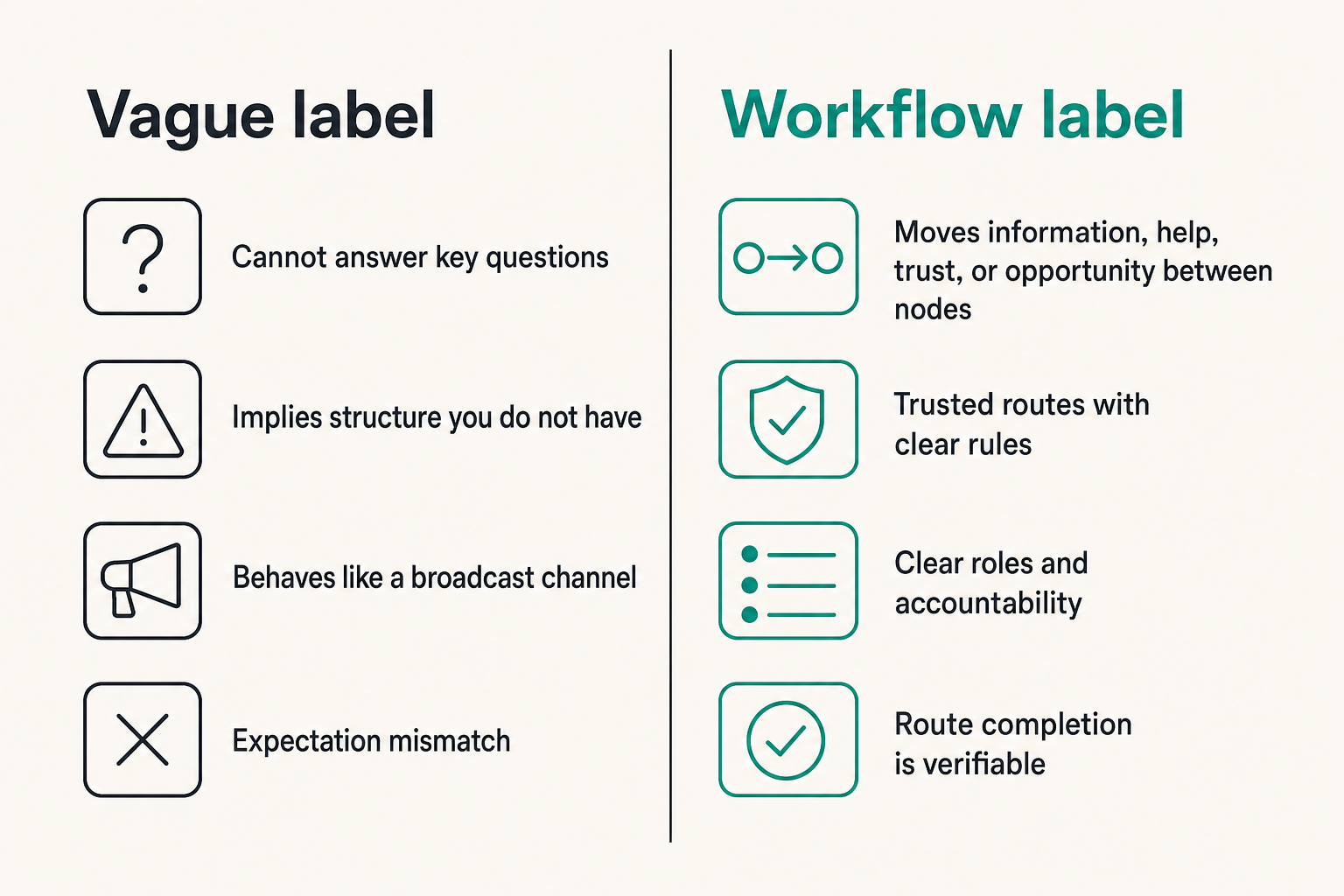
Use network when the core job is moving information, help, trust, or opportunity from one node to another.
A local freelance network is not valuable because everyone feels generally connected. It is valuable because a graphic designer can find a bookkeeper, a restaurant owner can find a same-day website fix, and a parent can find a trusted ride option without broadcasting to strangers.
Network language works when you can answer:
- What moves through the network?
- Who is allowed to route requests?
- What makes a route trusted?
- How do we know a route completed?
If you cannot answer those, network may be too technical as a label. It will imply structure you do not have.
Circle when belonging matters
Use circle when the primary job is safety, continuity, and shared presence. A circle is not optimized for speed. It is optimized for trust and mutual recognition.
This works well for caregiver groups, recovery-oriented groups, parent pods, elder support teams, and identity-based local groups where context matters more than scale.
What breaks in practice is when organizers use circle language but behave like a broadcast channel. People come expecting care and continuity. They get announcements and calls for labor.
Guild when capability matters
Use guild when members share a craft, skill, trade, or professional standard. Guild language raises the bar. It says the group is about practice, peer learning, reputation, referrals, and quality.
A guild needs stronger boundaries than a general community. Who can join? What counts as competence? How are referrals handled? What happens when work quality is poor?
Here is a practical comparison:
| Label | Best when | Operational promise | Common failure |
|---|---|---|---|
| Community | Belonging is central | People can gather and identify with the group | Too vague to drive action |
| Network | Routing is central | People can reach relevant people through trusted paths | No one owns routing |
| Circle | Care is central | People are seen and supported over time | Too slow for urgent asks |
| Guild | Capability is central | People improve, refer, and uphold standards | Gatekeeping without support |
| Exchange | Matching is central | Asks and offers can find each other | Becomes a classifieds board with no trust |
Map the network before you rename it
Inventory the real asks
Before choosing another name for community, collect the actual asks that appear over 30 to 60 days. Do not start with categories. Start with raw demand.
Examples:
- I need someone to look at a broken website form.
- I need a ride to an appointment on Tuesday.
- I need a Spanish-English translation for a school letter.
- I need help finding a reliable handyman.
- I need three volunteers for a Saturday cleanup.
- I need someone to explain a city permit.
The d0rz pattern is intentionally ask-forward; the public customer asks page is a useful example of treating requests as concrete coordination objects rather than vague engagement prompts.
Inventory the real offers
Now map supply. This is where many local groups discover they have more capacity than they thought, but it is poorly expressed.
A bad offer says: happy to help.
A useful offer says: I can review one broken website form remotely this week, I can translate one document at the library, I can drive within a five-mile radius on weekday mornings, or I can introduce local food businesses to two accountants I trust.
Offers need scope, location, timing, conditions, and response expectations. Without those, every offer becomes a negotiation, and every negotiation becomes work for the organizer.
Identify the current routing paths
Most local networks already route through informal operators: the person who knows everyone, the librarian, the pastor, the school secretary, the barber, the WhatsApp admin, the coworking space owner, the volunteer coordinator.
Do not erase those paths with a new name. Map them.
Ask:
- Who currently receives requests first?
- Who knows which people are reliable?
- Where do requests get lost?
- Which asks are sensitive and should not be public?
- Which offers are overused?
For adjacent technical thinking, decentralized compute operators face a similar routing and ownership problem when workloads need scheduling, validation, and retries; related reading from our network: Akash Network alternatives architecture guide.
Build around asks offers and routing
A useful ask is operational
An ask should be shaped so someone can act on it. That does not mean forcing people into rigid forms. It means capturing enough context to reduce back-and-forth.
A practical ask includes:
- What is needed?
- Where is it needed?
- When does it matter?
- Is there a budget, trade, or volunteer expectation?
- Is the ask public, semi-private, or private?
- What would count as resolved?
The mistake teams make is treating asks as content. They are not content. They are open loops.
Practical rule: Every ask should have an owner, a status, and a next action. If it has none of those, it is not an ask. It is noise.
A useful offer has boundaries
Offers are the other side of the system. They need boundaries because generosity without boundaries burns people out.
Good offers specify:
- Service or capability
- Geography or remote availability
- Time window
- Price, free tier, barter, or volunteer condition
- Exclusions
- Preferred contact method
- Maximum load
A local network gets stronger when offers are specific enough to route. It gets weaker when offers require the organizer to interpret everything.
Routing needs ownership
Routing is the operational middle. It is the work between someone asking and someone helping.
In a small group, routing may be one person with a notebook. In a larger network, it may be a rotating triage team. In a mixed local network, it may combine software, public listings, private referrals, and human judgment.
The important part is ownership. Who watches new asks? Who tags them? Who escalates urgent ones? Who checks whether the match worked?
Without routing ownership, the name does not matter. Community, network, circle, exchange: all of them collapse into a feed.
Trust is not vibe it is infrastructure
Trust starts with context
Trust does not mean everyone knows everyone. It means people have enough context to make a reasonable decision.
Context can include locality, mutual connection, prior completion, public offer history, organizer endorsement, shared institution, clear boundaries, or a small first task. The goal is not perfect certainty. The goal is enough confidence to move from interest to action.
A local parent looking for a ride, a shop owner looking for payment help, and a freelancer looking for a referral all need different trust signals. One generic trust badge will not cover it.
Trust improves through small completions
The fastest way to build trust is not a mission statement. It is repeated small completions.
Someone asks for a translation. Someone provides it. The requester confirms it helped. The organizer notes the completion. Next time, the route is easier.
This is why follow-up is not administrative overhead. Follow-up is how the network learns.
Trust fails when follow-up is optional
What breaks in practice is the unresolved loop. A request gets posted. Three people react. One person says they might help. Nobody knows what happened. Two weeks later the requester is embarrassed to ask again, and the helpers assume someone else handled it.
That failure is not emotional. It is structural.
Practical rule: If you cannot tell whether an ask was resolved, your network cannot learn from its own activity.
What breaks when the name outruns the system
The broadcast trap
Many groups rename themselves to sound more alive, then keep operating as a broadcast list. Announcements go out. Events get promoted. Needs get posted. The loudest or most connected people get help. Quiet members fade.
Broadcast is useful for one-to-many updates. It is weak for many-to-many coordination.
If the group promises community but only broadcasts, people feel used. If it promises network but only broadcasts, people feel unsupported. If it promises exchange but only broadcasts, people treat it like classifieds and leave when the feed gets stale.
The volunteer bottleneck
The volunteer bottleneck appears when one or two people become the human API for the whole network.
They remember who has a truck, who speaks Spanish, who can fix a form, who has a spare room, who should not be referred, and who needs a check-in. This works until it does not. Then the network suffers because knowledge was never made operational.
The fix is not to remove human judgment. The fix is to support it with lightweight records, clear intake, shared status, and defined escalation paths.
The vague belonging problem
Belonging is real, but vague belonging is hard to operate.
If people are told they belong but are not given ways to contribute, they become audience members. If they are asked to contribute without boundaries, they burn out. If they are asked to trust without context, they hesitate.
Another name for community should reduce ambiguity. If it increases ambiguity, it is the wrong name or the wrong system.
A practical naming workflow for local operators
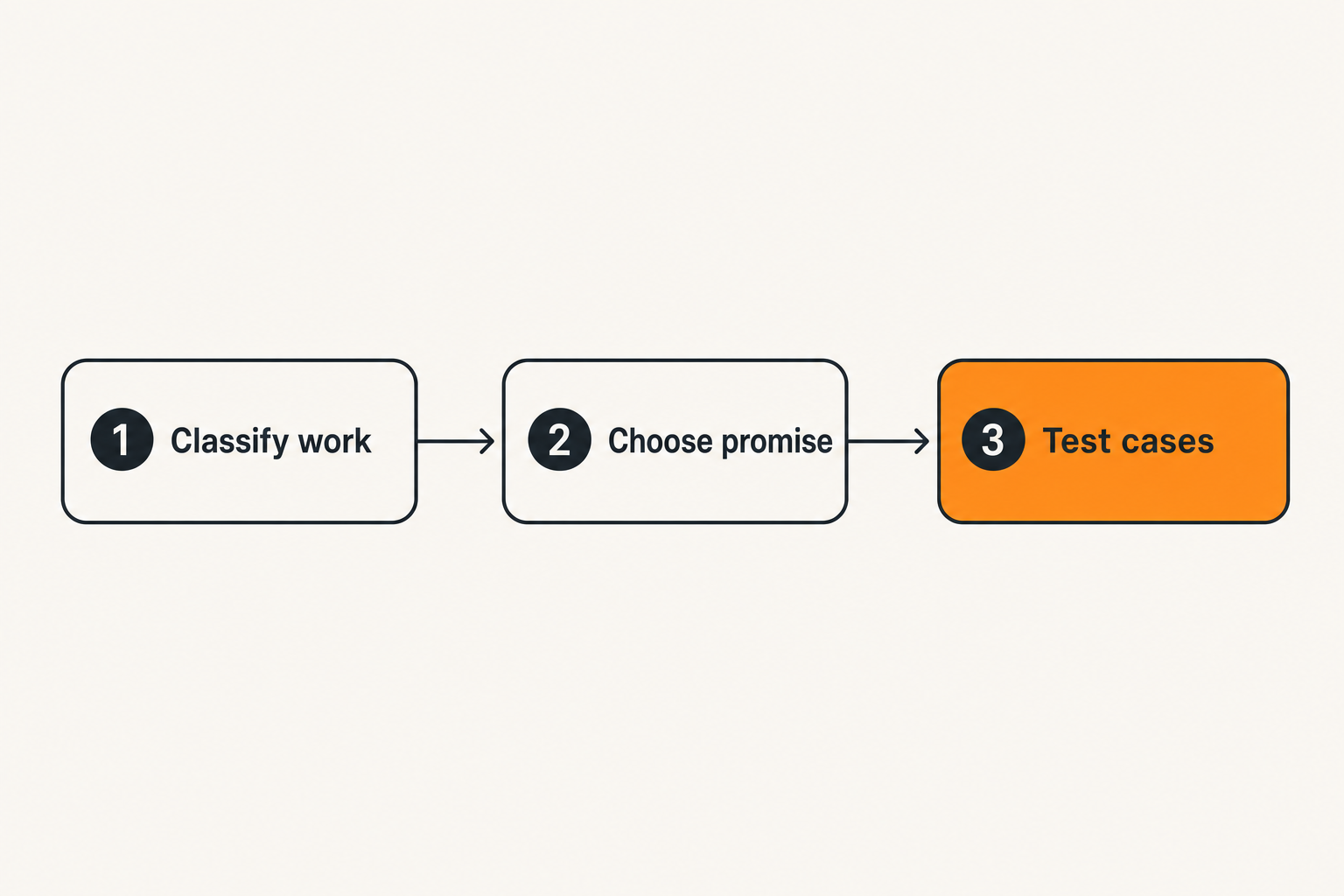
Step 1 classify the work
Start with the dominant work pattern, not the desired feeling.
- Collect the last 25 meaningful interactions in the group.
- Label each one as gathering, routing, care, learning, exchange, advocacy, or response.
- Count which patterns actually appear.
- Note which interactions resolved and which stalled.
- Identify who did the hidden coordination work.
This turns naming into diagnosis. If 70 percent of the actual work is matching people to help, exchange or network may be more honest than community. If most work is emotional support and continuity, circle may be better.
Step 2 choose the operating promise
Now write the operating promise in one sentence.
Examples:
- We help neighbors route practical asks to trusted local offers.
- We are a circle for caregivers who need recurring support and reliable check-ins.
- We are a guild of local freelancers who improve craft quality and share trusted referrals.
- We are a neighborhood exchange for rides, errands, home help, and small business services.
The name should be a shorter version of that promise. If the promise is not clear, the name will do too much work.
Step 3 test the name against real cases
Take five real cases and ask whether the name helps people know what to do.
Case: a small business needs automation help. Would community route that? Maybe. Would local operator network route it better? Probably. Would neighborhood exchange make the transaction clearer? Often yes.
For example, d0rz has prior writing on local network architecture that actually holds, which is useful when the naming decision is really about whether the system can support asks, offers, trust, and follow-up.
Metrics that tell you whether the name is working
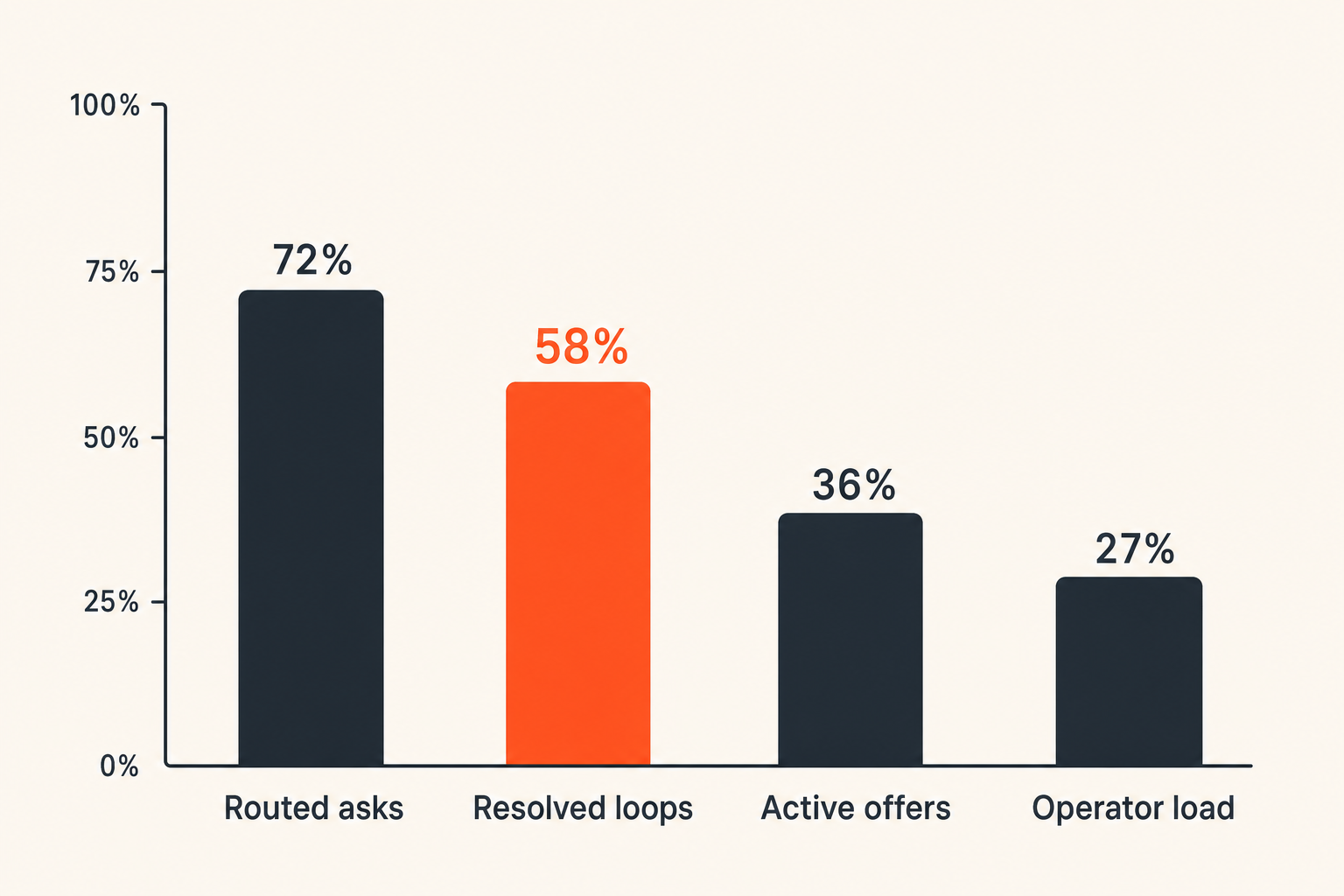
Measure flow not applause
Likes, member count, and event attendance can be useful, but they are not enough. A local network exists to move real-world coordination forward.
Better measures include:
- Number of asks with clear next action
- Time from ask to first useful response
- Percentage of asks routed to a relevant person
- Percentage of routed asks confirmed resolved
- Number of active offers with clear boundaries
- Repeat participation from non-core members
Do not over-instrument a small group. The point is not dashboards. The point is seeing whether the name matches the actual workflow.
Track unresolved loops
Unresolved loops are the hidden tax on trust.
A request that goes nowhere teaches people not to ask. An offer that is never acknowledged teaches people not to offer. A referral that fails silently teaches organizers nothing.
Keep a simple status model:
| Status | Meaning | Operator action |
|---|---|---|
| New | Ask or offer received | Clarify missing context |
| Routed | Sent to a likely helper or path | Watch for response |
| In progress | Someone is acting | Check timing and blockers |
| Resolved | Requester confirms outcome | Record useful context |
| Stalled | No movement after defined window | Re-route or close honestly |
Watch who carries the work
If the same three people route every ask, welcome every newcomer, verify every helper, and follow up every case, the system is fragile.
Track operator load. Not obsessively, but honestly. A strong name should distribute action. A weak name hides labor.
Related reading from our network: checkout and settlement teams in high-risk payments have the same open-loop problem around state, support, and reconciliation; see this crypto checkout architecture piece for an adjacent systems view.
How d0rz.com fits the local network model
Asks and offers are the basic objects
d0rz.com is built around a simple premise: local coordination starts with asks and offers. Not content. Not engagement bait. Not abstract membership.
That matters because asks and offers are operational objects. They can be routed, scoped, followed up, and resolved. A post saying we should support local businesses is sentiment. An ask from a local business that needs one workflow automated is actionable.
The operating model described in community building d0rz as a local network operating model goes deeper on this: community becomes more reliable when the system connects real needs, real offers, trust, support, and sustained participation.
Local context beats generic engagement
Generic platforms reward broad attention. Local networks need context.
A person offering translation at a library, a provider debugging a website form remotely, and a neighbor offering a ride all require different routing logic. Location, timing, trust, scope, and follow-up matter more than reach.
This is why another name for community should be chosen with local context in mind. A global audience may understand community. A local operator may need network, exchange, circle, guild, or mutual aid system because those labels create clearer expectations.
Product fit without turning the network into software theater
Software does not create trust by itself. It can, however, reduce the amount of trust wasted on bad routing.
d0rz.com fits when you are trying to make local asks and offers visible enough to act on, structured enough to route, and grounded enough to follow up. It is not a replacement for organizers. It is a coordination surface for people already doing the hard work.
The practical question is not whether your group uses a tool. The practical question is whether your current tool lets people move from need to match to outcome without everything living in one organizer's head.
Closing: another name for community should make coordination easier
What works
The right name makes action easier.
Use community when shared identity and belonging are the center. Use network when routing is the job. Use circle when continuity and care matter most. Use guild when shared capability and standards matter. Use exchange when asks and offers need to meet in practical ways.
The label should help people understand how to enter, what to ask for, what to offer, who to trust, and what happens next.
What fails
What fails is renaming without redesigning the workflow.
A new label will not fix unclear asks, unbounded offers, missing follow-up, hidden volunteer labor, or trust signals that live only in private memory. Another name for community only works when it sharpens the operating model behind the group.
If the name makes the work clearer, keep it. If the name makes the work fuzzier, it is probably branding debt.
Try d0rz.com
d0rz.com is for people building practical local networks where asks, offers, trust, routing, and follow-up matter. If you are looking for another name for community because the current model is not coordinating real work, start with the workflow and Try d0rz.com.