You search for another word for community when the current word has stopped doing its job.
People say they want community, but the word often hides the actual work. One person means a neighborhood support group. Another means a business referral circle. Another means a mutual aid network, a creator audience, a civic association, a WhatsApp group, or a directory of people who sometimes help each other.
Teams think the problem is vocabulary. The real problem is operating design.
If the word you use does not tell people what to ask for, what to offer, who to trust, how requests move, and what happens after a match, the network gets noisy. Participation drops because the promise is vague. That changes the conversation. The practical question is not just another word for community. It is which word makes coordination easier in production.
Table of contents
- Why another word for community is an operating decision
- Another word for community: choose by workflow, not vibe
- Map the jobs your local network must perform
- Build a vocabulary stack, not a single label
- Routing: where community language becomes infrastructure
- Trust and safety depend on clearer names
- What breaks when teams pick the wrong word
- Implementation workflow for renaming or clarifying your network
- Metrics that tell you the word is working
- Where d0rz.com fits in the local network stack
Why another word for community is an operating decision
The label sets expectations
A useful way to think about it is this: the word on the door tells people what kind of behavior is normal inside.
If you call it a community, people may expect belonging, discussion, identity, events, and long-term participation. If you call it a network, they may expect routing, introductions, practical exchange, and loose ties. If you call it a marketplace, they may expect pricing, availability, dispute handling, and search. If you call it a mutual aid group, they may expect urgency, solidarity, non-commercial help, and high emotional context.
None of these words is automatically better. The mistake teams make is choosing the warmest word instead of the most operationally accurate word.
Practical rule: choose the word that makes the next action obvious, not the word that sounds most inclusive.
For local organizers, this matters because local networks have limited attention. People are busy. They do not want to decode your model. If the name suggests one workflow but the actual system runs another workflow, every participant pays a translation tax.
The word changes who shows up
Language is a filter. A freelancer may respond to a local business network but ignore a neighborhood community. A volunteer may join a mutual aid circle but avoid a marketplace. A retired neighbor may contribute to a local help network but never think of themselves as a provider.
The practical question is not whether your preferred word is accurate in a dictionary. The practical question is whether the right people understand where they fit.
For example, d0rz.com writes for people building practical local networks where asks, offers, trust, routing, and follow-up matter. In that context, community is too broad by itself. The system needs words like ask, offer, route, provider, requester, neighbor, handoff, and completion. Those words carry operational weight.
The wrong word creates support debt
Support debt appears when people keep asking the same clarifying questions:
- Is this free or paid?
- Can businesses participate?
- Who is responsible if something goes wrong?
- Do I post a request, message an admin, or wait for a referral?
- Is this for emergencies or normal errands?
- Is this a directory, a chat group, or a matching system?
Those are not branding questions. They are workflow questions. If the word community causes all of them to remain unresolved, you need a sharper operating vocabulary.
Related reading from our network: teams designing cloud workloads face a similar naming problem when loose language hides routing, identity, and execution boundaries; see cloud computing explained as workload architecture.
Another word for community: choose by workflow, not vibe
A practical synonym table
Another word for community should be selected based on what the group is supposed to do. Here is the operator view, not the thesaurus view.
| Word | Best when the job is | What it implies | Common failure mode |
|---|---|---|---|
| Network | Routing people, requests, and opportunities | Loose ties, introductions, exchange | Too transactional if trust is weak |
| Neighborhood | Place-based help and local familiarity | Proximity, shared context, everyday support | Excludes remote or specialist contributors |
| Circle | Small-group trust and repeated interaction | Intimacy, belonging, limited scale | Hard to grow without losing meaning |
| Association | Formal membership and governance | Rules, dues, representation | Too heavy for lightweight coordination |
| Collective | Shared ownership or shared mission | Contribution, solidarity, co-creation | Ambiguous decision rights |
| Hub | Central place to find resources or routes | Discovery, aggregation, navigation | Organizer becomes bottleneck |
| Guild | Skilled practitioners helping each other | Craft, standards, peer learning | Can feel exclusive or professionalized |
| Marketplace | Paid exchange and service matching | Search, pricing, transactions, support | Trust and disputes become core workload |
| Mutual aid network | Need-based support and solidarity | Urgency, reciprocity, non-extractive help | Burnout if demand exceeds capacity |
| Local exchange | Practical asks, offers, and follow-up | Specific requests, specific responses | Needs strong state tracking |
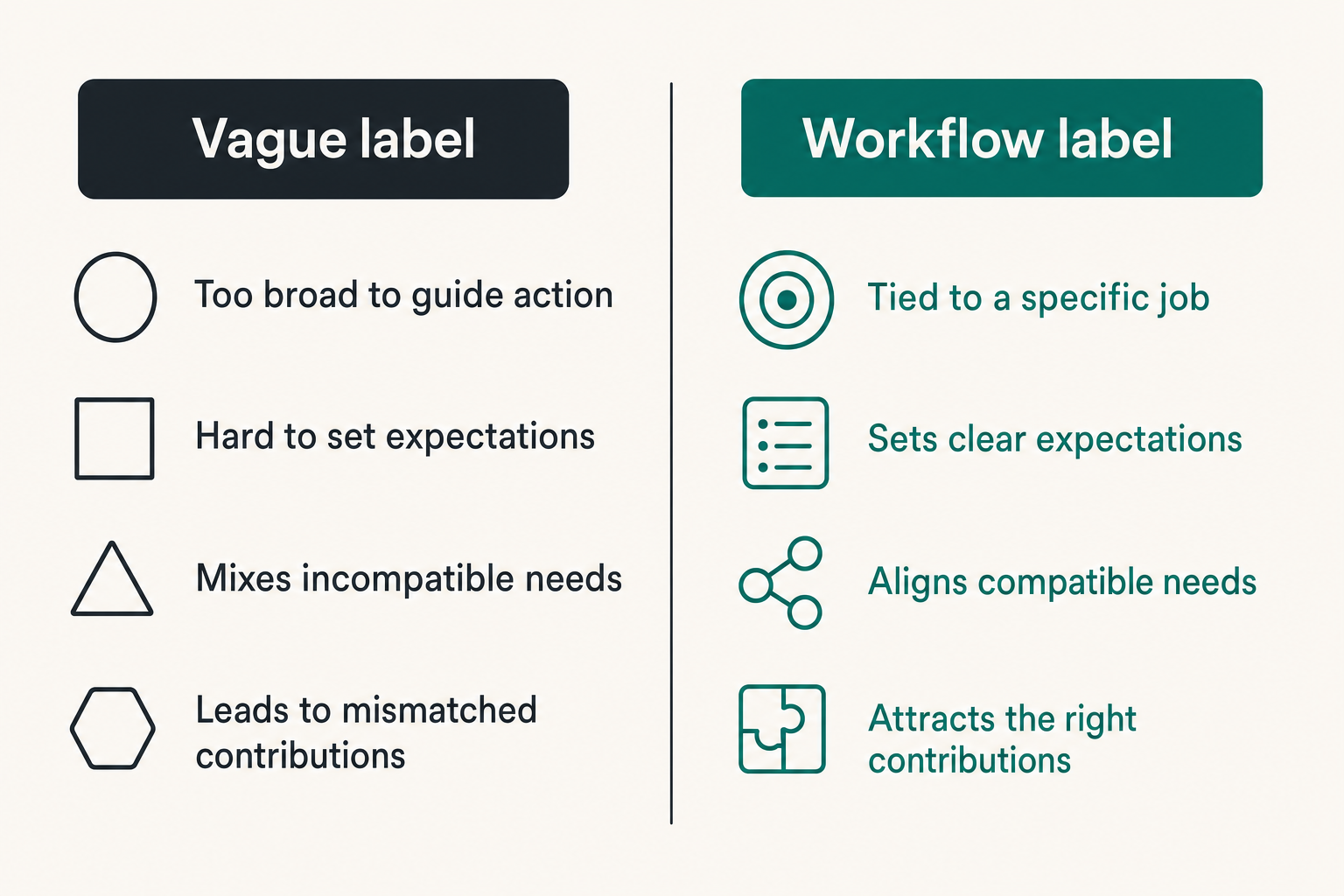
The point is not to retire the word community. The point is to stop asking it to do every job.
What works
What works is naming the coordination model directly.
If the core workflow is help requests, say local help network. If the core workflow is referrals, say referral network. If the core workflow is neighborhood errands, say neighborhood exchange. If the core workflow is shared learning, say peer circle or practitioner guild.
You can still use community in the broader narrative. But on the surfaces where people act, use action-oriented language.
Practical rule: use warm language for belonging, but use precise language for transactions, requests, routing, and responsibility.
What fails
What fails is calling everything a community and then relying on the organizer to interpret every ambiguous post.
A vague post such as I need help with my website could mean a free favor, a paid project, a referral, a volunteer request, or a learning exchange. If the network has not named those lanes, the admin becomes the interpreter. That does not scale.
This is why an ask-and-offer surface matters. A page like the d0rz customer asks board makes the request side explicit instead of burying needs inside chat threads or announcements.
Map the jobs your local network must perform
Asks and offers are the atomic units
A local network is not made of members. It is made of potential matches.
Members matter, but membership alone does not produce coordination. The useful unit is an ask or an offer with enough context to route:
- What is needed?
- Where is it needed?
- When does it matter?
- Is it paid, free, volunteer, barter, or undecided?
- What trust level is required?
- What counts as done?
When a team asks for another word for community, they are often trying to solve a participation problem. But participation improves when the units of work are clearer. People are more willing to help when the ask is specific and the next step is safe.
Routing is the hidden workload
Routing is the work nobody budgets for.
In small groups, the founder or organizer remembers who knows whom. In production, that memory becomes a bottleneck. New requests need to be classified, routed, followed up, and closed. If the network depends on one person remembering every helper, every skill, every boundary, and every past interaction, the system is fragile.
The label network is useful when routing is central. It tells participants that the goal is not endless discussion. The goal is getting the right request to the right person with enough context to act.
Follow-up is where trust compounds
Trust is not created by the word community. Trust is created by completed loops.
A request is posted. Someone responds. The requester confirms. The work happens. The outcome is recorded. Problems are handled. The next request is easier because the system learned something.
What breaks in practice is the last mile. Groups celebrate introductions but do not track outcomes. Then nobody knows whether the network is actually useful. Follow-up is not bureaucracy. It is memory.
Build a vocabulary stack, not a single label
Use different names for different layers
A single word cannot carry the entire operating model. Use a vocabulary stack.
At the top layer, you might say community because it communicates belonging. At the coordination layer, you might say local network because it communicates routing. At the transaction layer, you might say asks and offers because it communicates action. At the support layer, you might say handoff, status, and resolution because it communicates responsibility.
This layered approach reduces argument. People can keep the warm word without losing the operational words.
A practical stack might look like this:
- Public identity: local community for neighbors and providers.
- Operating model: local network for routing help and opportunities.
- Work objects: asks, offers, referrals, events, resources.
- Trust layer: verified history, known relationships, boundaries.
- Follow-up layer: open, matched, in progress, completed, unresolved.
Make the public promise narrower than the internal map
The public promise should be easy to understand. The internal map can be more detailed.
For example, you might publicly say: A local network for practical help. Internally, you may track categories like rides, errands, home help, translation, website fixes, business automation, pet care, and civic support. The public does not need the full taxonomy on day one. Operators do.
This is where many community builders overcomplicate the landing page and underbuild the workflow. They explain values for six paragraphs but do not tell a person how to make a request.
For a deeper architecture view of this problem, the prior d0rz article on local network architecture that actually holds is useful because it treats community building as infrastructure rather than engagement theater.
Routing: where community language becomes infrastructure
Match by context, not category alone
Categories help, but context routes the work.
A request for translation is not just translation. It may involve a legal letter, a school form, a job application, a medical appointment, or a quick text message. Each case has different urgency, privacy, skill, and trust requirements.
The same is true for website help. A broken contact form for a local business is different from a full rebuild. A payment-link problem is different from a design preference. The network needs enough detail to avoid sending the wrong person.
Practical rule: never route a request using category alone when urgency, privacy, location, or money changes the risk.
Design for handoffs
Handoffs are where local networks lose work.
Someone says, Talk to Maria. Maria says, I might know someone. The requester waits. The organizer forgets. Nobody closes the loop. The request becomes social noise.
A handoff should have a minimum record:
- Request summary.
- Person or role receiving the handoff.
- Reason for the handoff.
- Expected next step.
- Time window for response.
- Fallback if no one responds.
This does not require enterprise software. It requires discipline. A spreadsheet can work early. A structured ask-and-offer system works better once volume grows.
Related reading from our network: payment teams deal with the same handoff discipline across checkout, settlement, and reconciliation; see crypto checkout architecture for high-risk merchants for an adjacent systems example.
Keep a visible state machine
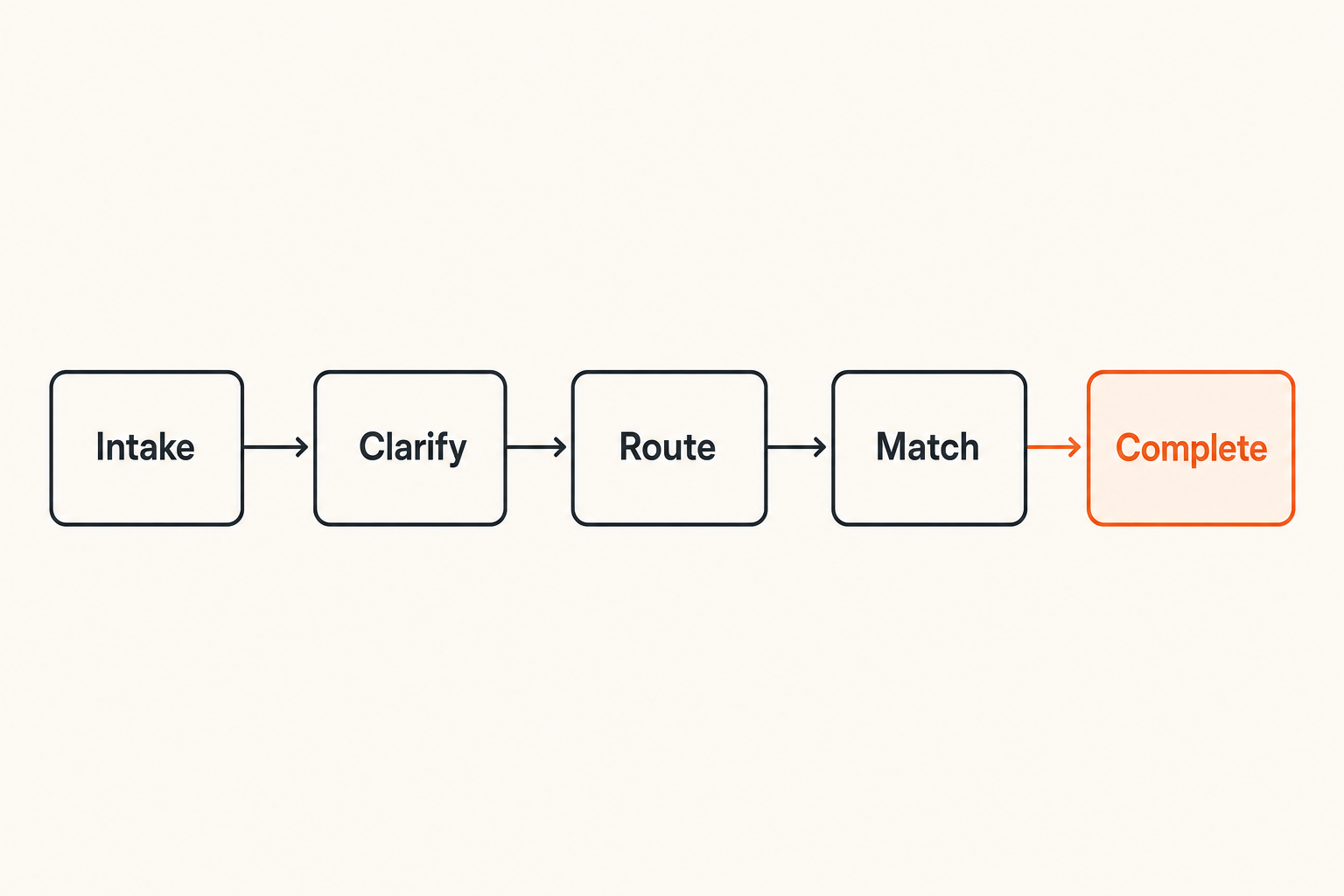
A state machine sounds technical, but the idea is simple. Every request should have a current state.
Common states:
- New.
- Needs clarification.
- Routed.
- Matched.
- In progress.
- Completed.
- Stuck.
- Closed without match.
Without states, organizers rely on vibes. With states, operators can see where the network is breaking. Too many requests in needs clarification means intake is weak. Too many in routed means providers are not responding. Too many closed without match means supply does not match demand.
That changes the conversation from people are not engaged to this part of the workflow is failing.
Trust and safety depend on clearer names
Names define boundaries
Trust starts with boundaries. A mutual aid group, a paid services marketplace, and a neighbor help network can all be good. They should not pretend to have the same rules.
If you call something a community but paid providers are actively selling services, some participants will feel misled. If you call something a marketplace but expect unpaid volunteer labor, others will feel exploited. If you call something a family, you may accidentally pressure people to ignore boundaries.
The cleaner the name, the easier it is to say what is allowed.
Reputation needs an operating surface
Reputation is not just a star rating. In local networks, reputation is contextual.
Someone may be excellent at same-day errands but not a fit for sensitive caregiving. Someone may be trusted for translation at the library but not available for urgent phone calls. Someone may be a great automation helper for small businesses but only works remotely.
A useful reputation surface captures specifics:
- What kind of work was completed.
- Whether timing was reliable.
- Whether communication was clear.
- Whether the person stayed within scope.
- Whether follow-up was needed.
The word community does not capture that. The workflow must.
Support must know what promise was made
When something goes wrong, support needs to know the promise.
Was the network promising a referral only? A completed job? A paid transaction? A volunteer introduction? A vetted provider? A neighborly suggestion?
If the promise is unclear, every dispute becomes philosophical. If the promise is clear, support can respond consistently.
Related reading from our network: software supply chain teams face a similar boundary problem when trust depends on runners, registries, webhooks, and response ownership; see network security for CI/CD and software supply chains.
What breaks when teams pick the wrong word
The group becomes an audience
Many teams say community when they actually run an audience.
An audience broadcasts. A community participates. A network routes. A marketplace transacts. A circle relates. These are different operating modes.
If the organizer posts updates and everyone else reacts, that may be useful, but it is not the same as a functioning local network. The failure mode is predictable: the team starts chasing engagement metrics instead of completed coordination.
What works is being honest. If you run an audience, call it a newsletter, channel, or bulletin. If you want a network, build routing paths.
The directory becomes stale
A directory is not a network unless it has freshness and follow-up.
Local organizers often collect names, skills, phone numbers, and interests. For a few weeks, it feels like progress. Then availability changes. People move. Offers expire. Requests go unanswered. The directory still exists, but operators stop trusting it.
The mistake teams make is treating inventory as capacity. A list of possible helpers is not the same as confirmed availability.
To avoid this, offers need status. Active, paused, remote only, local only, paid, volunteer, limited availability, and referral only are simple but powerful labels.
The organizer becomes the router
The most common scaling failure is organizer-as-router.
At first, this feels good. The organizer knows everyone and can make thoughtful matches. Over time, every request waits for the organizer. The network cannot operate when that person is sick, busy, burned out, or unavailable.
A local network should make the organizer more effective, not more central. The vocabulary should distribute work. Requesters should know how to ask. Providers should know how to offer. Helpers should know when to escalate. Support should know what state a request is in.
Implementation workflow for renaming or clarifying your network
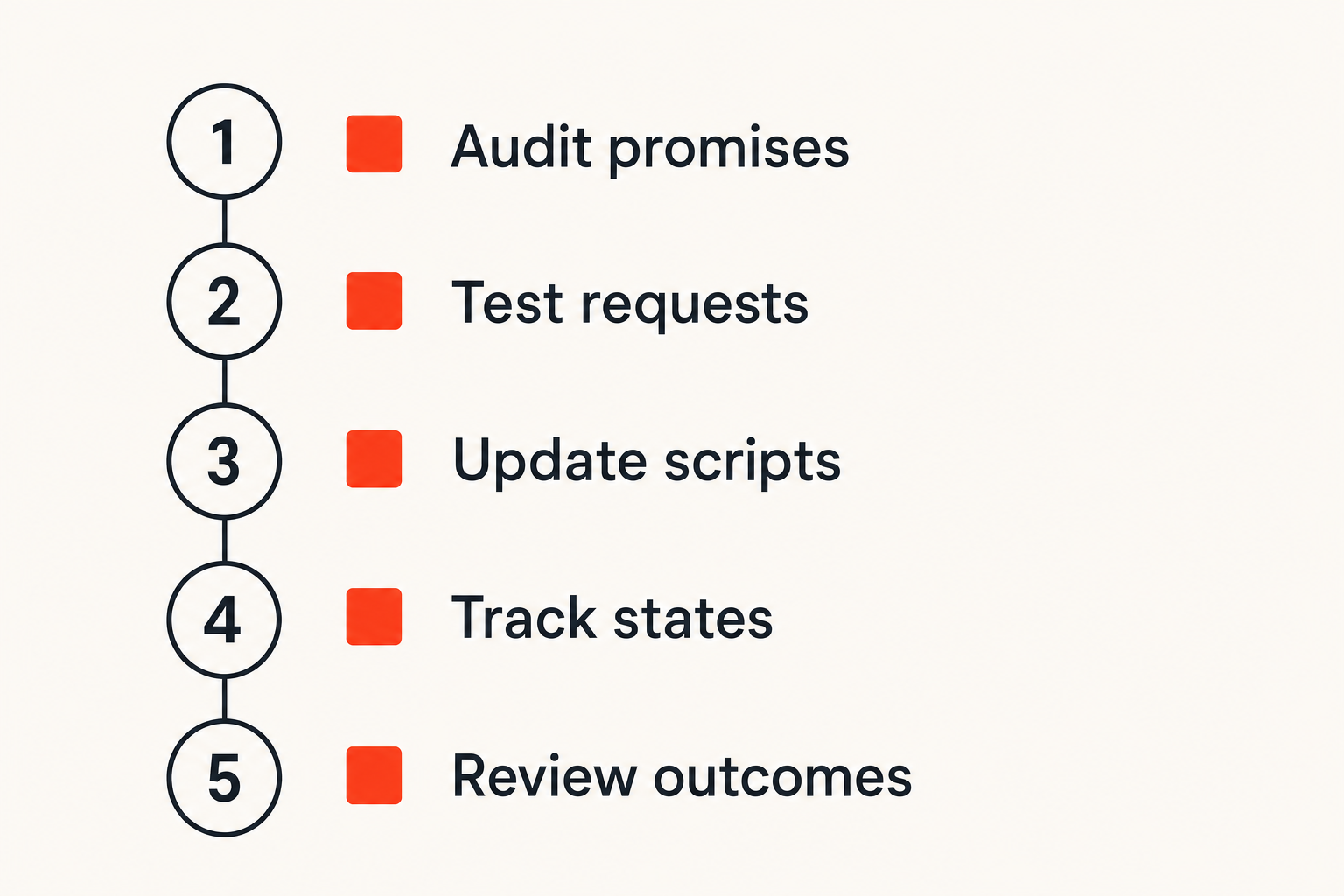
Step 1: inventory the current promises
Do not start with a brainstorming session. Start with an audit.
List every surface where people encounter the network:
- Website homepage.
- Signup form.
- Group description.
- Event intro.
- Onboarding email.
- Volunteer script.
- Provider profile.
- Request form.
- Support response.
- Social bio.
For each surface, write down the promise it implies. Does it imply friendship, help, paid work, advocacy, learning, referrals, discounts, safety, or emergency response?
Then compare that promise to what you can actually operate.
Step 2: test the word against real requests
Use real examples. Abstract naming debates are low-value.
Take ten recent requests and ask:
- Would the current word attract the right responder?
- Would the requester know what details to include?
- Would a new helper know whether this is paid, free, urgent, or sensitive?
- Would support know what outcome is expected?
- Would the network know when the request is done?
If the answer is no, the word is underperforming.
You can test alternatives directly. Would network make the routing clearer? Would exchange make the transaction clearer? Would circle make the trust boundary clearer? Would hub make discovery clearer? The best word is the one that improves behavior.
Step 3: update surfaces and scripts
Once you choose the operating language, update the surfaces that control action first.
A practical rollout sequence:
- Rewrite the intake prompt so people submit specific asks.
- Rewrite the offer prompt so contributors state boundaries and availability.
- Add request states so operators can track progress.
- Update onboarding language to explain the model in one paragraph.
- Update public naming last, once the workflow is stable.
Do not lead with a rebrand. Lead with workflow repair.
For example, a local network may keep community in the headline but change the call to action from join us to post an ask or offer help. That small shift does more than a new logo.
Metrics that tell you the word is working
Measure routing quality
A word is working if it improves routing quality.
Useful signals include:
- Percentage of asks that include enough context on first submission.
- Time from new request to first relevant response.
- Percentage of routed requests that become actual matches.
- Number of requests stuck in clarification.
- Number of requests routed to the wrong person.
Do not invent precision where you do not have it. Early on, a weekly operator review is enough. The point is to see whether language is reducing confusion.
Measure participation clarity
Participation clarity means people understand their role.
Look for fewer messages like how does this work and more messages like I can help with this on Tuesday, remote only, paid, two-hour limit. That is a good sign. It means the network language is teaching people how to participate.
You can also compare offer quality before and after changing the vocabulary. If people move from I am happy to help to I can do Spanish-English document translation at the library on weekends, the operating language is improving.
Measure trust recovery
Every network will have misses. The question is whether the system recovers.
Track:
- Unanswered requests.
- Provider no-shows.
- Scope confusion.
- Complaints about money or expectations.
- Requests reopened after completion.
- Repeat participation after a problem.
A clear word does not eliminate failure. It makes failure diagnosable. If you call it a marketplace, you know pricing and dispute rules matter. If you call it mutual aid, you know burnout and fairness matter. If you call it a network, you know routing and response times matter.
Where d0rz.com fits in the local network stack
Use d0rz.com for concrete asks and offers
The practical use case for d0rz.com is not abstract belonging. It is making local coordination visible enough to act on.
A local organizer can use d0rz.com to separate asks from offers, keep requests specific, and make follow-up easier. That matters when the network includes neighbors, freelancers, local businesses, providers, and people who do not all belong to the same chat group.
The prior d0rz article on the local network operating model goes deeper on this idea: participation becomes more reliable when the operating model handles asks, offers, trust, support, and sustained follow-through.
Product fit: local coordination without pretending the label solves it
d0rz.com fits when you are trying to turn loose community energy into practical network operations.
It does not magically create trust. It does not replace relationships. It does not decide your governance model. What it can do is give operators a clearer surface for the work objects that matter: who needs something, who can offer something, what the context is, and what should happen next.
That is the real answer to another word for community. You may choose network, exchange, hub, circle, neighborhood, or association. But the word only helps if your system can carry the workflow behind it.
Try d0rz.com
d0rz.com is for people building practical local networks where asks, offers, trust, routing, and follow-up matter. If you are looking for another word for community because your current model feels vague, start by making the work visible.