

Most local networks do not fail because people are selfish. They fail because needs and capacity are trapped in chat threads, meeting notes, spreadsheets, and memory.
Someone asks for help finding a bookkeeper. Three people know someone. One reply gets buried. Nobody owns the handoff. Two weeks later the organizer is asked why the network is quiet.
Teams think the problem is engagement. The real problem is coordination architecture.
An asks and offers system is not a nicer bulletin board. It is the operating layer that turns local participation into routed work: requests, available help, trust signals, follow-up, and outcomes. In 2026, that matters because communities are increasingly hybrid, volunteer capacity is fragmented, and local operators are expected to create real value without hiring a full-time dispatch team.
The practical question is not whether people should post asks and offers. The practical question is whether your network can capture them, route them, verify them, close the loop, and learn from what happened.
Table of contents
- Why asks and offers fail as a coordination problem
- What an asks and offers system must do
- Design the intake layer
- Build trust and routing into the system
- Run the workflow from post to resolved outcome
- Use a data model that operators can maintain
- What works and what fails in practice
- Metrics for an asks and offers system
- Operating roles and governance
- Where d0rz.com fits in the workflow
Why asks and offers fail as a coordination problem
Participation is not capacity
A room full of helpful people can still produce zero resolved outcomes. That is the mistake teams make when they treat community energy as operational capacity.
Participation is a signal. Capacity is a commitment. An attendee who says they know a plumber is not the same as a person who can make an introduction this week. A freelancer who likes a post is not the same as someone who can deliver a scoped task by Friday.
A useful way to think about it is this: asks reveal demand, offers reveal possible supply, but the system has to convert both into commitments.
That changes the conversation. Instead of asking whether the community is active, ask whether the network can answer these questions:
- What is being requested?
- Who can realistically help?
- What level of trust is required?
- Who owns the next step?
- How will the outcome be recorded?
If those answers live only in one organizer's head, the system is already fragile.
Matching is not routing
Many local groups say they need better matching. Usually they need better routing.
Matching implies a clean database: one person needs bookkeeping, another person offers bookkeeping, connect them. Routing handles the messy version: the person needs affordable bookkeeping advice for a food truck, only wants local referrals, speaks Spanish at home, and needs someone who can explain sales tax without selling a monthly package.
That is not just a match. It is context-aware routing.
Routing includes relevance, trust, availability, urgency, geography, language, budget, and follow-up responsibility. A basic asks and offers system should expose enough context to route responsibly without forcing people to publish private details.
Related reading from our network: security teams face a similar distinction between raw signals and operational response in this SOC operating model guide, where ownership and workflow matter more than terminology.
Follow-up is the real product
What breaks in practice is not the initial post. It is the silence after the post.
Someone replies. Then nothing. Someone volunteers. Then they get busy. Someone makes an introduction. Then nobody knows whether it helped. Over time, the network feels unreliable even if people are trying.
Practical rule: If the system does not track follow-up, it is not an asks and offers system. It is a suggestion box.
Follow-up turns goodwill into institutional memory. It tells operators what worked, what stalled, who is reliable, which categories need more supply, and where the community keeps seeing demand.
What an asks and offers system must do
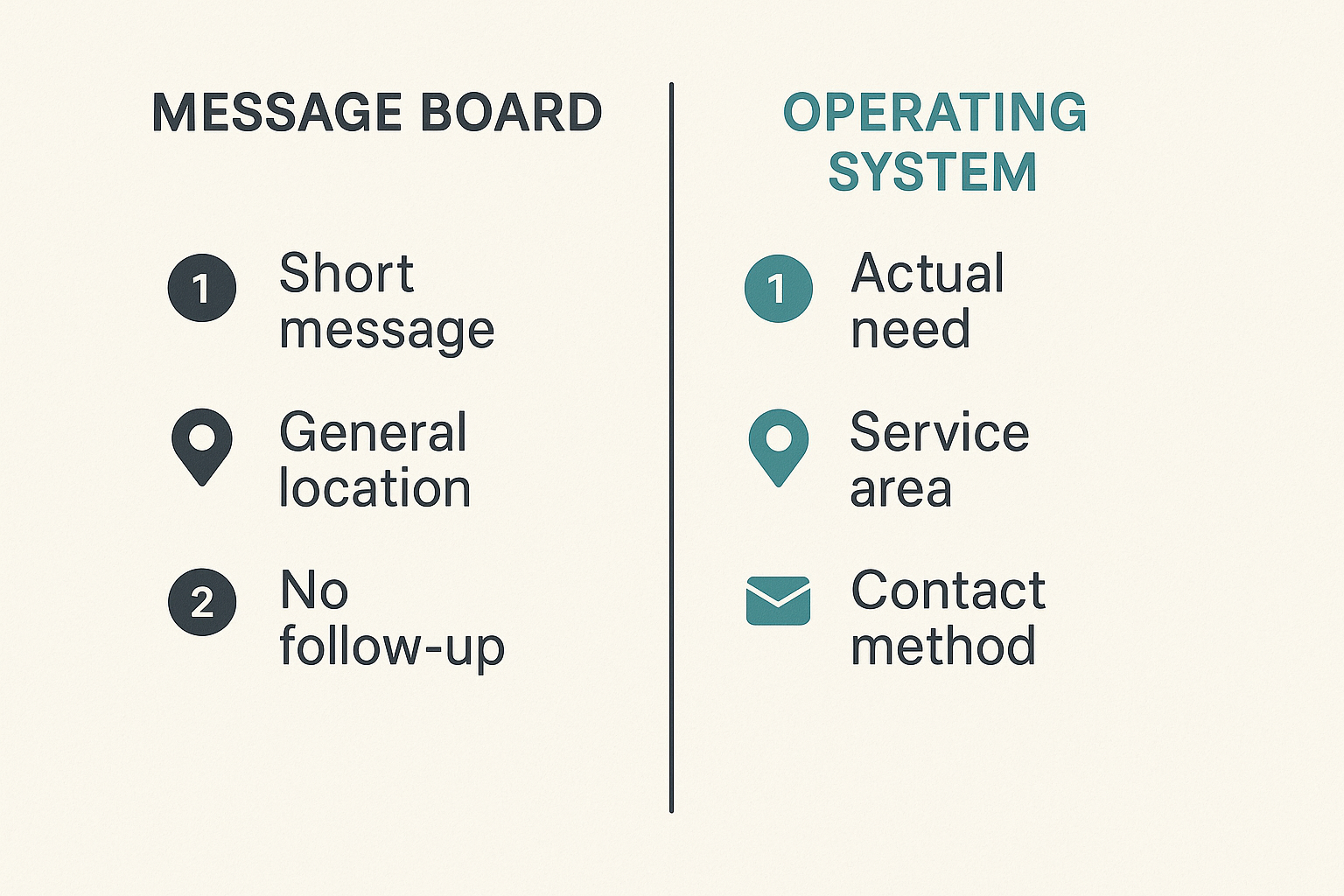
Capture the request without losing context
The first job of an asks and offers system is capture. Not perfect capture. Usable capture.
A good ask record should include:
- The actual need
- Location or service area
- Time sensitivity
- Budget, if relevant
- Preferred contact method
- Privacy level
- What has already been tried
- What a successful outcome looks like
The mistake teams make is asking for too much upfront. Long forms reduce noise but also kill participation. Short forms increase volume but create triage burden. The right intake depends on the maturity of the network.
For a new local group, use a lightweight format:
- I need help with...
- This is for...
- I need it by...
- The next useful step would be...
- Public or private details...
That gives operators enough to route without turning the post into a grant application.
Normalize messy human language
People do not describe needs in database terms. They say things like: my website is broken, I need someone good with forms, or I am trying to get more customers but do not know where to start.
Normalization means translating that into categories operators can use:
- Website issue
- Automation help
- Customer acquisition
- Hiring referral
- Translation support
- Local vendor recommendation
- Emergency support
- Mentorship
This is where many systems become too rigid. Do not force every human need into a taxonomy that only makes sense to the administrator. Use categories as routing aids, not as a wall.
For example, an offer like remote website and automation help for local businesses is useful because it names the service boundary, the audience, and the type of problems it can absorb.
Route to people who can act
Routing is the difference between a visible ask and a useful ask.
Operators should know whether an ask goes to:
- A public board
- A private trusted group
- One known provider
- A moderator for clarification
- A partner organization
- A no-match queue
The practical question is: who is most likely to take the next action without creating more work for the requester?
That is why routing rules matter. Without them, the most socially connected people get overloaded and quiet members never get surfaced.
Close the loop visibly
Every ask should eventually move somewhere: matched, resolved, expired, referred, declined, or needs more information.
Visible closure creates confidence. It also prevents stale asks from making the network feel abandoned.
Practical rule: A closed no-match is better than an open maybe. Unresolved ambiguity destroys trust faster than an honest boundary.
Design the intake layer
Separate asks from general signals
Not every post is an ask. Some posts are updates, complaints, ideas, announcements, or vague interest checks.
The intake layer should separate actionable asks from general community chatter. That does not mean silencing informal conversation. It means giving operators a way to identify what requires action.
Use simple labels:
- Ask: someone needs help
- Offer: someone can help
- Lead: possible opportunity, not yet qualified
- Update: useful information, no action required
- Referral: external person or organization
- Resolved: outcome recorded
This reduces the support load. It also helps members understand how to participate.
Write asks operators can act on
An actionable ask has enough detail for routing. It does not need a perfect scope, but it needs a next step.
Weak ask:
Need help with marketing.
Better ask:
I run a local home cleaning business and need help setting up a simple follow-up email for past customers. I can pay a small project fee. I would like to talk to someone this week.
The second version gives category, requester type, task, budget signal, and timing. Operators can route it.
A prior d0rz article on freelancing asks and offers in local networks goes deeper on how freelance work changes when demand and supply are treated as a repeatable operating system instead of random referrals.
Make offers finite and specific
Offers fail when they are too broad.
I can help with anything tech-related sounds generous, but it creates routing risk. Nobody knows whether that includes websites, payments, devices, automation, data cleanup, cybersecurity, or basic tutoring.
A useful offer has boundaries:
- What problems the person can handle
- What they will not handle
- Whether the work is paid, free, barter, or exploratory
- Location constraints
- Response time
- Required context
Practical rule: A good offer is not a biography. It is a service boundary that makes routing safer.
Build trust and routing into the system
Treat trust as permissions, not vibes
Local networks run on trust, but trust cannot remain invisible if the system is going to scale beyond one organizer.
Trust should affect what someone can see, receive, and act on. That does not require a heavy reputation score. It can be simple:
- Public offers visible to everyone
- Sensitive asks visible only to moderators
- Verified providers eligible for direct routing
- New members allowed to post but not receive private referrals yet
- Repeat no-shows paused from receiving new matches
This is not about gatekeeping for its own sake. It is about reducing harm.
Sensitive asks may involve housing, legal trouble, medical support, family conflict, immigration, debt, or emergency income. A public board is not always the right routing surface.
Use routing rules before heroics
The heroic organizer model works until it does not. One person remembers everyone, makes every connection, and carries the emotional load. Then they burn out or move away.
Routing rules make the system less dependent on heroics.
Example routing rules:
- If the ask involves immediate safety, send to approved emergency resources, not the public board.
- If the ask requires paid professional work, route to providers who accept paid leads.
- If the ask is incomplete, return it for clarification before broadcasting.
- If the requester needs language support, route to bilingual helpers first.
- If no provider is available within seven days, mark no-match and suggest alternatives.
Related reading from our network: payment teams have the same state problem in a different domain; blockchain payment gateway architecture is a useful comparison because checkout is not the system, settlement and reconciliation are.
Handle sensitive edge cases early
Every community eventually sees asks that should not be treated like ordinary marketplace posts.
Examples:
- Requests involving minors
- Domestic violence or safety concerns
- Medical advice
- Legal representation
- Financial distress
- Immigration status
- Housing instability
- Mental health crisis
The mistake teams make is waiting until one of these appears and then improvising in public.
Create a sensitive-routing policy before you need it. It can be short:
- Do not publish sensitive personal details.
- Route to trained organizations when the network is not qualified.
- Keep private notes minimal.
- Limit access to moderators who need to know.
- Record only the operational status, not the full story.
That protects the requester, the helpers, and the network.
Run the workflow from post to resolved outcome
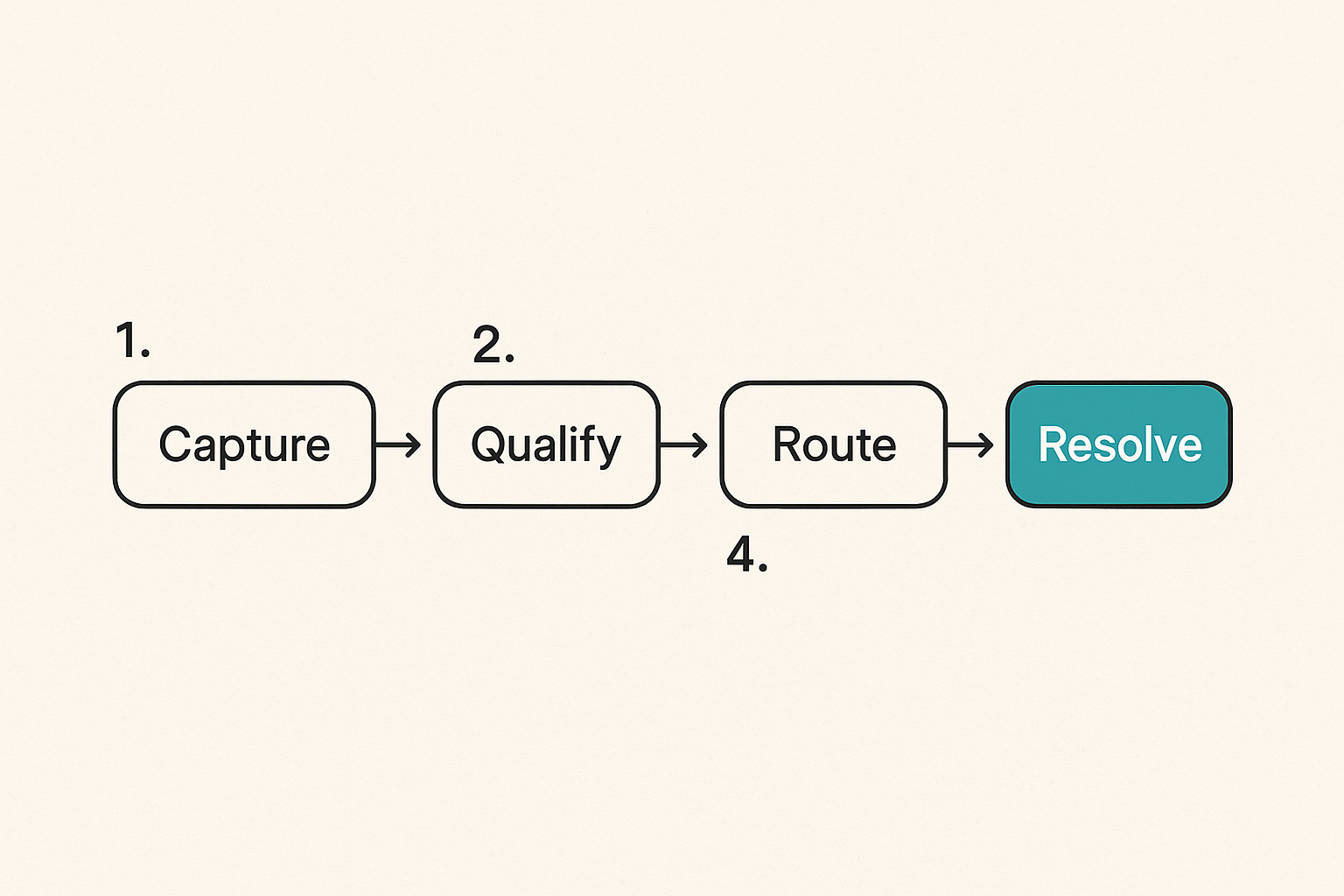
Step one: capture
Capture starts wherever the network already lives: a form, a d0rz post, a community meeting, a WhatsApp message, an email, or a phone call.
The implementation sequence should be boring:
- Receive the ask or offer.
- Create a record with minimum required fields.
- Assign an owner or queue.
- Set an initial status.
- Decide whether it is public, private, or internal-only.
Do not make capture dependent on one channel. People will always bring needs through the channel they trust most. The system should absorb that and normalize later.
Step two: qualify
Qualification is where operators prevent bad matches.
Ask:
- Is the request clear enough to route?
- Is the requester reachable?
- Is this within the network's scope?
- Is there a safety or privacy issue?
- Does the ask require paid, volunteer, or institutional help?
Offer:
- What can this person actually do?
- Are they available now?
- Do they want public inquiries or curated referrals?
- Are there constraints around location, language, price, or schedule?
Qualification should be lightweight but real. Skipping it creates noise downstream.
Step three: route
Routing is the operational handoff.
A simple routing decision tree looks like this:
- If sensitive, send to private moderator queue.
- If incomplete, request clarification.
- If clear and low-risk, publish or match directly.
- If specialized, send to known providers.
- If no match exists, mark no-match and collect the category as unmet demand.
Routing should produce a next action, not just visibility.
A public ask such as looking for small business automation projects in Winston Salem is easier to route because the need, audience, and project type are explicit enough for local operators to understand.
Step four: follow up
Follow-up is where most communities leak value.
Set a default follow-up interval. For most local networks, three to seven days is enough. The point is not to micromanage. The point is to avoid silent failure.
Follow-up questions should be short:
- Did someone respond?
- Did the introduction happen?
- Is the ask still open?
- Was the match useful?
- Should this be closed, rerouted, or escalated?
If the answer is no response, that is useful data. If the answer is wrong fit, that is useful data. If the answer is resolved, that is the outcome the network should remember.
Use a data model that operators can maintain
Core records for asks, offers, and matches
You do not need a complex database to start. You do need consistent records.
Minimum ask record:
- Ask ID
- Requester
- Category
- Description
- Location or service area
- Privacy level
- Urgency
- Status
- Owner
- Created date
- Follow-up date
- Outcome
Minimum offer record:
- Offer ID
- Provider
- Category
- Description
- Availability
- Service boundary
- Trust level
- Contact preference
- Status
Minimum match record:
- Ask ID
- Offer ID or provider
- Routed by
- Routed date
- Current status
- Outcome note
This creates continuity. If a moderator leaves, the work does not disappear.
Status fields that prevent ambiguity
Status fields are underrated. They are the difference between a living system and a pile of posts.
Use plain language:
- New
- Needs clarification
- Ready to route
- Routed
- Waiting on requester
- Waiting on provider
- Resolved
- No match
- Expired
- Reopened
Avoid clever statuses nobody understands. The purpose is operational clarity.
A common failure mode is leaving everything open. Open stops meaning anything. If a request has not moved in two weeks, either follow up, reroute, or expire it.
Integration rules for chat, forms, and spreadsheets
Most local networks already use a mix of tools. The goal is not to replace everything on day one. The goal is to define which tool owns which state.
Example:
- Chat owns conversation.
- Form owns intake.
- d0rz owns public asks and offers.
- Spreadsheet or database owns internal status.
- Calendar owns follow-up reminders.
Do not let every tool become a partial source of truth. That is how operators lose track of who promised what.
Related reading from our network: AI workflow teams face similar integration problems across local tools, credentials, events, and testing; this guide to Mac tools for AI agent builders is adjacent if you are designing lightweight automation around community operations.
What works and what fails in practice
The useful comparison
The difference between a casual board and an operating system is not the interface. It is the workflow behind the interface.
| Area | Casual board | Operational asks and offers system |
|---|---|---|
| Intake | Anyone posts anything | Posts are captured with minimum routing context |
| Categories | Informal tags | Practical categories tied to routing decisions |
| Trust | Assumed socially | Reflected in visibility and handoff rules |
| Ownership | Whoever notices | Named owner or queue |
| Follow-up | Optional | Scheduled and recorded |
| Closure | Posts fade out | Status changes to resolved, no-match, expired, or rerouted |
| Learning | Anecdotal | Unmet demand and reliable supply become visible |
The practical difference shows up after month two. Casual boards look lively at first and then become stale. Operational systems may feel less exciting, but they keep producing usable handoffs.
Common failure modes
What breaks in practice is usually predictable.
Failure mode one: vague asks.
People post broad needs with no next step. Operators spend time clarifying instead of routing.
Failure mode two: infinite offers.
Helpful people say they can help with anything. The network routes too much to them, quality drops, and the helper disappears.
Failure mode three: no status discipline.
Everything remains open, members cannot tell what is active, and organizers lose credibility.
Failure mode four: trust is invisible.
Sensitive asks are routed to whoever replies fastest. That creates risk and makes experienced members reluctant to participate.
Failure mode five: public success hides private workload.
The community sees matches, but not the moderator labor underneath. Eventually the hidden operators burn out.
Recovery tactics when the system gets noisy
If your system is already noisy, do not redesign everything. Stabilize the workflow.
Use a 30-day reset:
- Freeze old open posts and mark them stale unless renewed.
- Define three to five active categories only.
- Require a next step on every new ask.
- Ask providers to restate their offer boundaries.
- Assign one owner for follow-up.
- Publish weekly closure notes: resolved, no-match, still open.
Practical rule: When coordination gets noisy, reduce categories before adding tools.
This reset gives the network a clean baseline without blaming members for using an unclear system.
Metrics for an asks and offers system
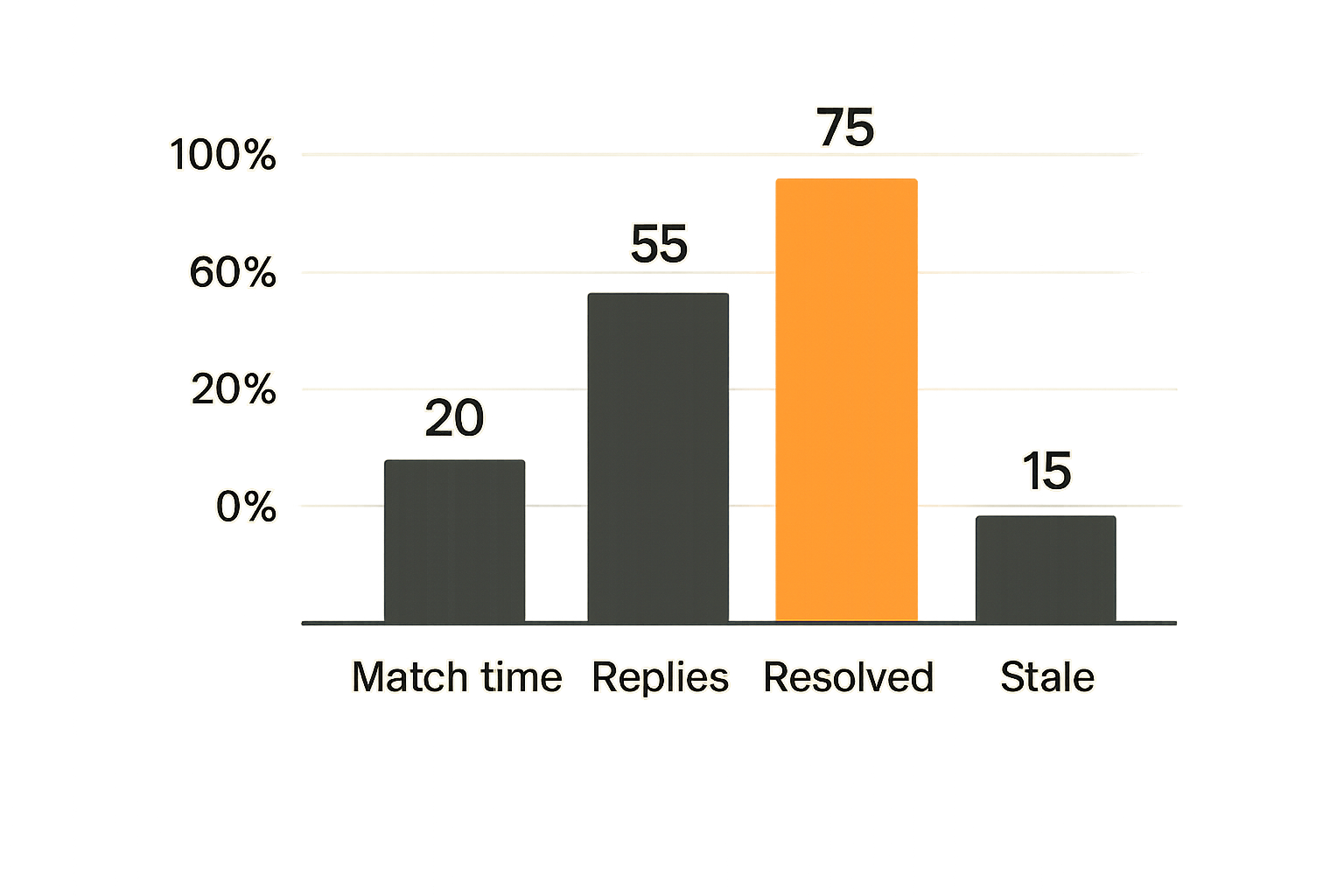
Measure movement, not applause
Most community metrics are too soft to run operations. Likes, comments, attendance, and impressions may indicate awareness, but they do not prove coordination.
Measure movement through the system:
- New asks created
- Offers available by category
- Time to first response
- Time to route
- Match rate
- Resolution rate
- No-match categories
- Reopened asks
- Stale asks
You do not need perfect analytics. A weekly operator review is enough at the beginning.
The goal is to see where work gets stuck. If asks are created but not routed, the issue is operator capacity or qualification. If asks are routed but not resolved, the issue may be provider availability, fit, or follow-up.
Watch bottlenecks by stage
Every system has a bottleneck. Find it before adding features.
Intake bottleneck:
- People do not know how to ask.
- Form is too long.
- Posts lack context.
Qualification bottleneck:
- Too many vague requests.
- No one owns clarification.
- Sensitive asks require judgment.
Routing bottleneck:
- Too few providers.
- Trust levels are unclear.
- Operators rely on memory.
Follow-up bottleneck:
- No reminders.
- No closure status.
- Requesters do not report outcomes.
A good asks and offers system makes bottlenecks visible instead of hiding them inside chat history.
Avoid vanity metrics
The mistake teams make is reporting whatever looks good.
A board with 500 posts may be less useful than a board with 30 active asks and 20 resolved outcomes. A large provider list may be meaningless if half the offers are stale. A busy chat may create the feeling of activity while producing no handoffs.
Use metrics that help decisions:
- Which categories need recruiting?
- Which asks should become standing programs?
- Which offers need verification?
- Which members are overloaded?
- Which routes produce reliable outcomes?
That changes the conversation from community vibes to operating capacity.
Operating roles and governance
Name the owner
Someone has to own the system. Not every match. The system.
The owner is responsible for:
- Intake rules
- Category hygiene
- Status review
- Moderator coordination
- Escalation paths
- Weekly or monthly reporting
- Process changes
Without an owner, the system becomes a shared responsibility, which usually means nobody maintains it.
The owner does not have to be paid at first, but the role must be explicit. If the network depends on this coordination layer, pretending it is free labor forever is not a plan.
Give moderators narrow jobs
Moderators should not be expected to solve every problem. Give them narrow jobs.
Examples:
- Intake moderator: checks clarity and privacy.
- Routing moderator: identifies possible matches.
- Trust moderator: handles sensitive or higher-risk cases.
- Follow-up moderator: checks outcomes and closes stale items.
Small roles are easier to train and replace. They also reduce the risk that one person's judgment controls the whole network.
A broader architecture view is covered in community building d0rz and local network architecture, especially the idea that participation only becomes infrastructure when routing and follow-up are designed intentionally.
Publish norms that reduce support load
Norms are not decoration. They are support deflection.
Useful norms:
- Be specific about what you need.
- Say whether the ask is paid, volunteer, barter, or exploratory.
- Do not publish sensitive personal information.
- Respond when someone offers help.
- Close the loop when the issue is resolved.
- Respect stated offer boundaries.
- Do not pressure volunteers for professional-grade work.
Publish these near the intake point. Repeat them in onboarding. Use them when correcting behavior.
Governance does not need to be heavy. It needs to be visible enough that members understand how the system protects everyone's time.
Where d0rz.com fits in the workflow
Use d0rz.com as a practical coordination layer
d0rz.com is useful when you want asks and offers to be visible, structured, and local without turning the network into a generic social feed.
The product fit is architectural: use the public ask or offer as the coordination object, then attach your operational process around it. That can include moderator review, private follow-up, routing notes, and recurring check-ins.
For local organizers, this means you do not have to start with a heavy CRM. You can start with public coordination records and a disciplined workflow:
- Post clear asks.
- Post bounded offers.
- Route based on context.
- Follow up on outcomes.
- Learn which categories need more supply.
The UI is not the whole system. The value comes from the operating loop around the posts.
Start small before expanding the network
Do not launch with every possible category. Start with a narrow slice where you can actually route.
Good starting scopes:
- Local small business tech help
- Home services referrals
- Freelance project leads
- Translation and document help
- Event support and volunteer coordination
- Neighborhood resource navigation
Run the system for 30 days. Review every ask. Close stale records. Recruit offers only where demand is visible.
If the asks and offers system works at small scale, expansion becomes easier. If it fails at small scale, more members will only create more noise.
Try d0rz.com
You are writing for people building practical local networks where asks, offers, trust, routing, and follow-up matter. Build your asks and offers system around real coordination, not scattered messages.