

If you are searching for circle alternatives for community organizers, the pain is probably not the Circle feature list. The pain is that your community has become harder to operate than it looks from the outside.
People post requests in one place, offers in another, introductions happen in private messages, follow-up disappears, and the organizer becomes the routing layer. The platform looks active, but the real coordination work is still manual.
Teams think the problem is finding a better community app. The real problem is designing a local network workflow that can move from need to match to trust to completion without requiring one heroic admin to remember everything.
That changes the conversation. The practical question is not which Circle alternative has the cleanest feed. It is which operating model helps your community turn participation into reliable coordination infrastructure.
Table of contents
- Why Circle alternatives for community organizers are really an operations decision
- What breaks when community software becomes the operating model
- Evaluation criteria for Circle alternatives in 2026
- The main categories of Circle alternatives
- A practical comparison of platform patterns
- Design the asks and offers layer before picking software
- Trust, safety, and routing are product requirements
- Implementation workflow for moving off a feed-first community
- Common failure modes when choosing Circle alternatives
- Where d0rz.com fits for local community network operators
- Closing checklist for choosing circle alternatives for community organizers
Why Circle alternatives for community organizers are really an operations decision
The feed is not the network
Circle is useful for many membership communities because it gives people a place to post, comment, organize spaces, and consume updates. That is a real job. But local organizers often need a different job done.
A local network is not only a media surface. It is a coordination surface. Someone needs a plumber referral, a ride, a room, a volunteer shift covered, a small business workflow fixed, a childcare lead, a venue contact, or an introduction to a person who has already solved the same problem.
A feed can expose those needs. It does not automatically route them.
The mistake teams make is evaluating Circle alternatives as if the winning tool is the one with the better member directory, course module, event tab, or mobile experience. Those can matter. But if your core work is local coordination, the hard part is state: who asked, who can help, who vouched, what happened, and what needs follow-up.
Practical rule: If the organizer still has to remember the status of every important request, the platform is not operating the network. The organizer is.
A useful way to think about it is this: content communities need publishing infrastructure. Local networks need routing infrastructure.
Local communities need routing more than engagement
Engagement can be a misleading metric. A post with 30 comments may produce no outcome. A quiet introduction between two trusted people may solve a real problem in 20 minutes.
For community builders, the better questions are operational:
- How does a need enter the system?
- How is it categorized?
- Who is allowed to respond?
- How are offers verified or scoped?
- What happens if nobody responds?
- What happens after a match?
- How does the network learn from completed work?
This is why prior thinking about local network architecture that actually holds matters more than another platform comparison. The platform should support the architecture. It should not define it accidentally.
Related reading from our network: teams in security operations face a similar routing problem when signals arrive faster than humans can triage them, and this piece on SOC incident response architecture is useful adjacent reading for organizers thinking in queues, ownership, and escalation.
What breaks when community software becomes the operating model
The admin becomes the memory system
What breaks in practice is not usually the login page. It is the invisible work around the platform.
A member posts: Can anyone recommend someone who can fix a broken booking form? Three people comment. One sends a DM. Another tags a friend. The organizer knows a local provider but forgets to follow up. Two days later the original poster has solved it elsewhere. The thread remains as evidence of activity, but the network failed as infrastructure.
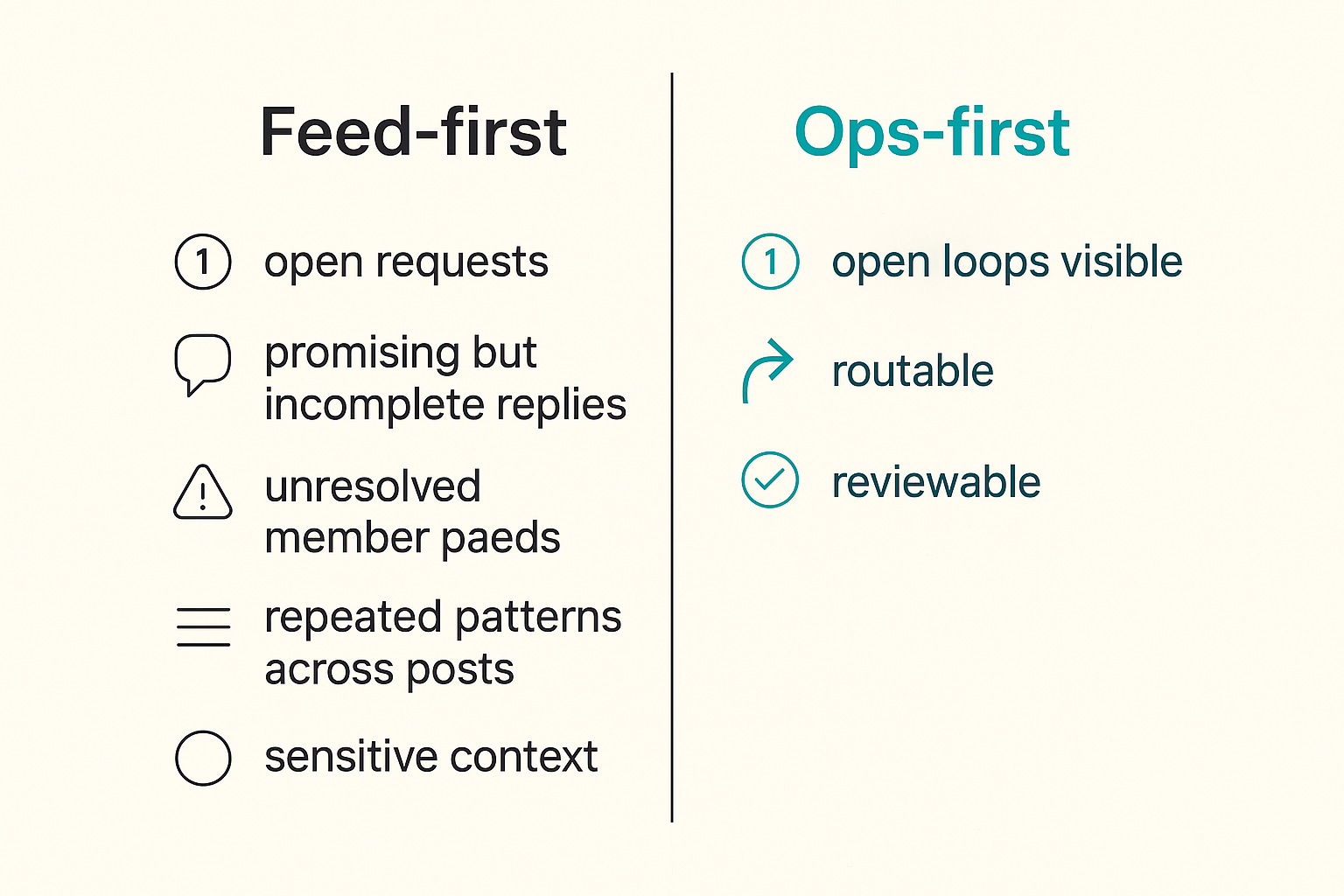
In a feed-first community, the admin becomes the memory system for:
- open requests
- promising but incomplete replies
- unresolved member needs
- repeated patterns across posts
- people who are willing to help but are not visible at the right moment
- sensitive context that should not be public
That does not scale. It also creates a brittle community because members learn that the way to get help is to ping the organizer directly.
A better Circle alternative for community organizers should reduce admin memory load. It should make open loops visible, routeable, and reviewable.
The platform optimizes conversation, not completion
Most community tools are designed to increase participation. They make it easy to create posts, comments, events, direct messages, and groups. Those are useful primitives, but they are not outcomes.
For a local network, completion might mean:
- the business got the website form fixed
- the volunteer shift was covered
- the newcomer got introduced to a trusted landlord
- the freelance designer found a local client
- the eldercare referral was handled by someone vouched for
- the repair person received the right context before showing up
The operational unit is not the post. The operational unit is the coordination loop.
Practical rule: Do not choose a community platform until you know what a completed loop looks like for your network.
If your platform has no clear place for status, owner, next step, and outcome, it will push the community back into chat behavior. Chat is fine for conversation. It is weak for accountability.
Evaluation criteria for Circle alternatives in 2026
Match the tool to the coordination job
There is no universal best alternative. There are only tools that fit or do not fit the job you are actually asking them to do.
For community organizers in 2026, the practical evaluation starts with the dominant coordination pattern:
| Coordination pattern | Example | Platform requirement | Bad fit signal |
|---|---|---|---|
| Content and courses | Paid learning cohort | Posts, lessons, comments, access control | Members need local matching more than content |
| Events and gatherings | Monthly founder meetup | RSVPs, reminders, attendee lists | Event interest does not turn into follow-up |
| Help requests | Local business needs form debugging | Structured asks, routing, status, completion | Requests disappear into comments |
| Provider network | Freelancers offering local services | Offer profiles, trust context, response workflow | Directory exists but nobody knows who is available |
| Mutual aid | Time-sensitive community support | Intake, escalation, privacy, handoff | Sensitive needs appear in public threads |
This table is intentionally boring. That is the point. Platform choice gets clearer when you stop asking what software is exciting and start asking what work needs to be repeatable.
Separate discovery, routing, and accountability
A healthy local network usually has three separate layers:
- Discovery: people can see relevant asks, offers, events, and opportunities.
- Routing: the right people are notified, introduced, or assigned.
- Accountability: someone can see whether the loop closed.
Many tools blend these together in one feed. That is convenient at first and messy later.
The practical question is whether your alternative to Circle lets you keep these layers distinct. Discovery can be public or semi-public. Routing may need to be selective. Accountability may need organizer-only notes, status fields, or follow-up reminders.
A public request for help with a storefront window is different from a private request for emergency housing. Both may belong to the same community. They should not move through the same workflow.
Related reading from our network: naming and categorization are operational decisions too, and the piece on product names as a shipping system is a useful reminder that labels affect routing, support, and launch behavior.
The main categories of Circle alternatives
Community-first platforms
Community-first platforms include tools built around posts, spaces, member profiles, courses, events, and discussions. They can work well when the community is primarily a membership experience.
They are strongest when you need:
- a clean member home base
- paid access or gated spaces
- structured content delivery
- asynchronous discussion
- event promotion
- lightweight member discovery
They are weaker when the work depends on structured intake, local matching, service fulfillment, or multi-step follow-up. You can often bolt those workflows on with forms, spreadsheets, automations, or manual admin habits. But bolted-on workflows become the real system.
The mistake teams make is treating the platform homepage as the community operating model. A beautiful homepage does not answer who owns the next step.
Workflow-first and marketplace-style systems
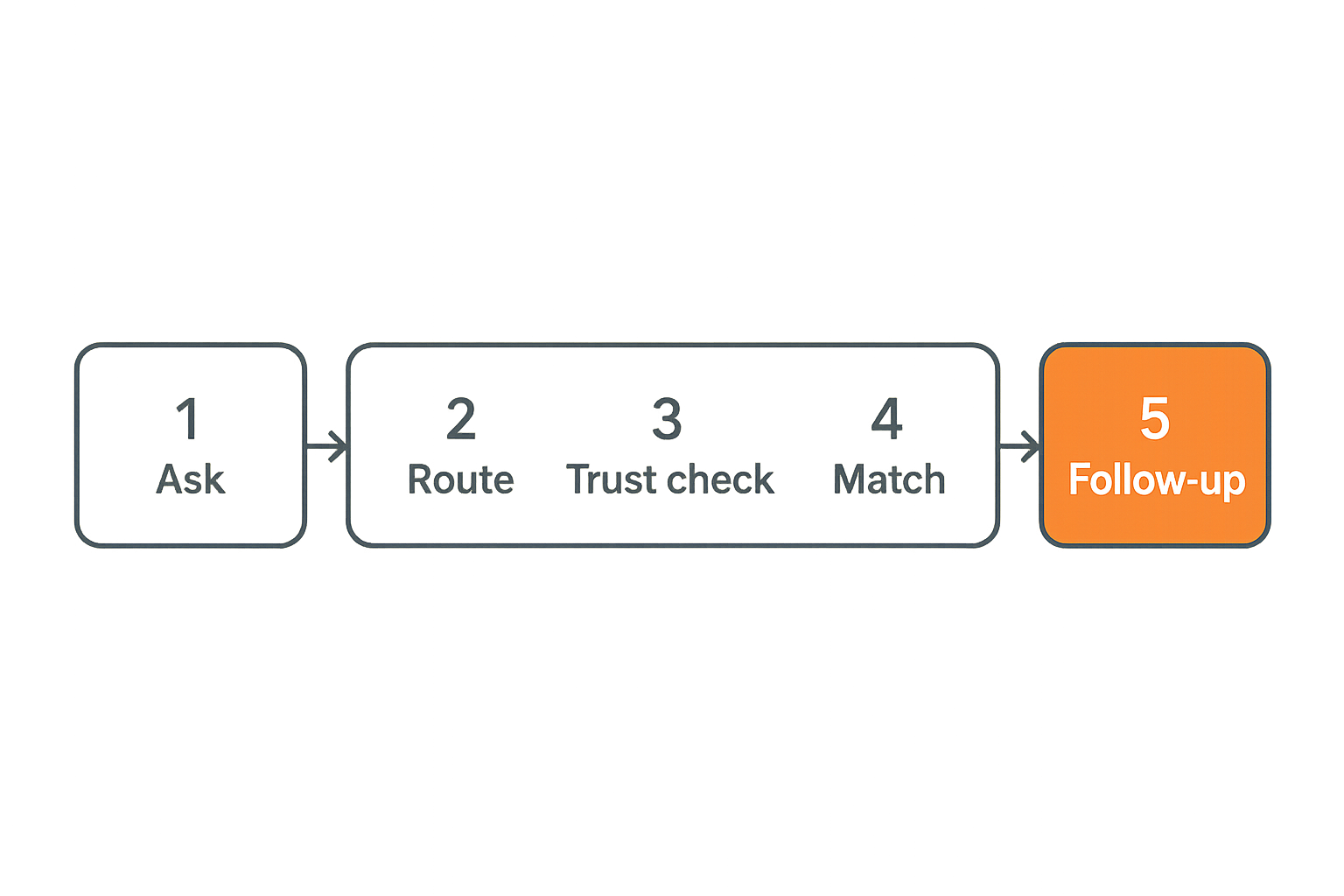
Workflow-first systems start from the transaction or coordination loop. They care less about how lively the feed looks and more about whether an ask can find an offer, whether trust context is visible, and whether the loop can close.
Marketplace-style systems are not only for buying and selling. For local organizers, the marketplace pattern is useful because it forces clarity:
- what is being requested?
- who can provide it?
- what constraints apply?
- what is the expected response time?
- what does completion mean?
- what should be visible to the network afterward?
This does not mean every community should become commercial. It means communities doing practical coordination need sharper objects than posts.
For example, an organizer might point a member toward a public ask such as seeking one public business workflow to automate because the ask is structured enough for routing: who needs help, what kind of workflow, what is in scope, and what would count as a useful response.
A practical comparison of platform patterns
What works for content communities
If your community is built around learning, publishing, coaching, or shared identity, a Circle-style platform or another membership tool may be enough. The feed is valuable because the work is attention and conversation.
What works:
- pinned posts for orientation
- spaces by topic or cohort
- member introductions
- event calendars
- course or resource libraries
- moderated discussion norms
What fails is forcing every local operational need into the same discussion model. A thread titled Need a reliable electrician is not the same as a thread titled Thoughts on neighborhood development. One is a request with urgency, constraints, geography, trust, and completion. The other is a conversation.
Both can belong in a community. They should not be operated identically.
What works for local coordination networks
Local coordination networks need an operating layer that can treat asks and offers as first-class objects.
A workable pattern looks like this:
| Layer | Feed-first community | Coordination-first network |
|---|---|---|
| Need intake | Member writes a post | Member creates a structured ask |
| Offer visibility | People comment or DM | Providers publish scoped offers |
| Trust context | Reputation is informal | Vouches, history, and locality are visible where needed |
| Routing | Admin tags people manually | Rules and categories guide matching |
| Follow-up | Happens in memory or chat | Status and outcome are tracked |
| Learning | Old threads become archive noise | Completed loops improve future routing |
That changes the conversation. You are no longer buying a nicer room for people to talk in. You are building a small coordination engine.
Practical rule: If your community creates real-world obligations, choose tools that can represent obligations, not only conversations.
Design the asks and offers layer before picking software
Define what a good ask contains
A good ask is not a cry into the feed. It is a routable object.
For local organizers, a good ask usually contains:
- location or service area
- category of need
- urgency
- budget or non-monetary constraints, if relevant
- privacy level
- ideal helper profile
- deadline
- current status
- contact preference
- success condition
You do not need a complex form for every request. In fact, over-structuring can reduce participation. But you do need enough structure for someone other than the original organizer to route the ask.
A simple intake schema might look like this:
ask_type: local_business_help
area: bay_area_remote_ok
urgency: this_week
privacy: public_summary_private_details
needs:
  - broken_website_form
  - payment_link_review
  - csv_cleanup
status: open
owner: organizer_pool
success_condition: working_form_or_clear_next_step
The goal is not bureaucracy. The goal is reducing ambiguity. Ambiguity is expensive because it turns every request into a custom investigation.
Define what a useful offer contains
A useful offer is also structured. It should say what someone can do, where they can do it, what constraints apply, and how a good match should happen.
A weak offer says: I can help with tech.
A useful offer says: I can triage one broken website form, payment-link flow, CSV cleanup, or GitHub issue remotely for Bay Area small businesses, with a same-day scope if the problem is non-sensitive and accessible.
That second version can be routed. It gives the organizer enough detail to match the offer to a request without a long discovery conversation. A concrete example is a scoped same-day website form and workflow debugging offer, which is more operationally useful than a vague provider profile.
What works:
- clear service boundaries
- response expectations
- location or remote constraints
- examples of good-fit requests
- examples of bad-fit requests
- trust or verification context
What fails:
- generic bios
- open-ended help offers
- hidden availability
- no follow-up path
- relying on the organizer to translate everything
Trust, safety, and routing are product requirements
Trust is contextual, not global
Trust in a local community is not a single badge. Someone can be trusted to give a restaurant recommendation and not trusted to enter a home. Someone can be vouched for as a web developer but not as a childcare provider. Someone can be excellent in one neighborhood and unknown in another.
This matters when comparing Circle alternatives for community organizers because many community tools treat trust as social familiarity. Local coordination needs more context.
Trust context may include:
- who has worked with this person before
- what kind of work they completed
- whether the work involved money, safety, homes, children, transportation, or sensitive data
- whether the person is currently available
- whether there were unresolved issues
- whether the recommendation is firsthand or secondhand
Do not turn trust into surveillance. Do not create private blacklists without process. But do not pretend a friendly profile is enough for local work with real consequences.
Related reading from our network: privacy-sensitive communities face similar workflow problems, and this guide to secure messaging apps as a privacy workflow is useful when deciding what should be public, private, retained, or deleted.
Routing needs rules before automation
Automation is tempting. Auto-match every ask to every relevant offer. Send notifications. Generate summaries. Create follow-up tasks. Some of that can help.
But automation without routing rules creates noise. Members stop responding if every request feels irrelevant. Providers stop trusting the system if they are routed low-quality leads. Organizers stop using the tool if the automation creates cleanup work.
Before automation, define rules:
- Which categories need human review?
- Which requests can be public by default?
- Which requests require a trusted intermediary?
- Which offers can receive direct inbound requests?
- Which matches require consent from both sides before introduction?
- What is the escalation path when nobody responds?
Practical rule: Automate the boring parts of a known workflow. Do not automate an argument your team has not resolved.
Routing rules are community governance made operational. They tell the system how to behave when the organizer is not personally handling the case.
Implementation workflow for moving off a feed-first community
Start with one high-value coordination loop
Do not migrate the whole community at once. That is how teams turn a platform change into a morale problem.
Start with one loop that is common, painful, and valuable. For example:
- local business tech help
- volunteer shift coverage
- trusted home services referrals
- newcomer housing leads
- small paid gigs for freelancers
- elder support errands
- event staffing and vendor coordination
Then implement the loop end to end.
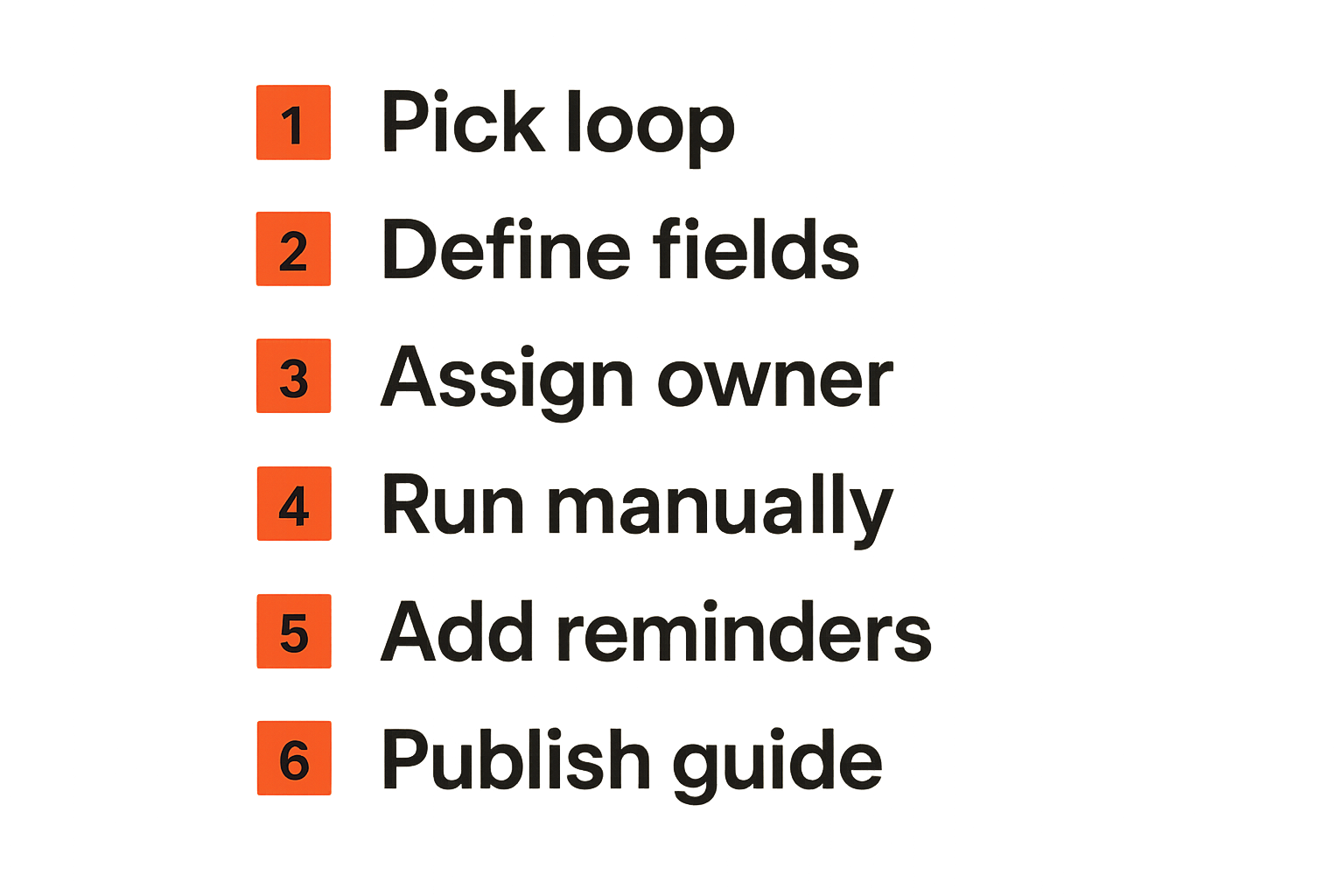
A practical sequence:
- Pick one request type that already appears repeatedly.
- Write the minimum ask fields required to route it.
- Identify the offer types that can satisfy it.
- Define who reviews new asks.
- Define when the request is public, private, or semi-private.
- Create a simple status model: open, routed, matched, completed, expired.
- Run the workflow manually for two weeks.
- Remove fields nobody uses.
- Add reminders only where loops are actually being dropped.
- Publish a short member explanation of how to ask and how to offer.
This is not glamorous work. It is the work that makes the next tool decision less speculative.
Migrate behavior before migrating members
The worst migration plan is announcing a new platform and hoping the community behaves differently inside it.
Behavior has to move first. Members need to learn that practical requests should enter through the new ask flow, not a random thread. Providers need to learn that scoped offers get routed more reliably than vague introductions. Organizers need to stop solving every request in private DMs.
During migration, keep the old feed if needed, but change what happens when a coordination need appears:
- respond with the correct ask path
- convert good comments into structured offers
- close loops publicly when appropriate
- show examples of completed matches
- thank people for usable specificity, not only enthusiasm
This is where an operating model beats a software rollout. The prior post on a local network operating model goes deeper on why matching, support, and sustained participation need explicit ownership.
Common failure modes when choosing Circle alternatives
Buying features without assigning ownership
The feature list is not the operating model. A tool can have tags, groups, custom fields, automations, member profiles, and integrations. None of that matters if nobody owns intake, routing, moderation, follow-up, and review.
Common ownership gaps:
- Nobody reviews new asks daily.
- Nobody cleans up expired offers.
- Nobody follows up after introductions.
- Nobody handles disputes or poor-fit matches.
- Nobody updates categories as the community changes.
- Nobody checks whether the same request is appearing repeatedly.
The result is predictable. The platform gets messy, the best members stop paying attention, and organizers blame the software.
A useful ownership map is simple:
| Function | Owner | Review cadence | Failure signal |
|---|---|---|---|
| Ask intake | Organizer or dispatcher | Daily | Open requests age without response |
| Offer quality | Category lead | Weekly | Offers are too vague to route |
| Trust review | Steward group | As needed | Members bypass the system for safety concerns |
| Follow-up | Loop owner | Twice weekly | Matches happen but outcomes are unknown |
| Category cleanup | Network operator | Monthly | Tags no longer match real demand |
The mistake teams make is assuming community management and network operations are the same job. They overlap, but they are not identical.
Confusing privacy with trust
Private spaces can make people feel safer, but privacy does not automatically create trust. A closed group can still have unclear expectations, weak accountability, and poor routing.
When choosing Circle alternatives, ask what privacy is supposed to protect:
- sensitive personal details
- business information
- vulnerable community members
- location or home access
- payment or identity information
- early-stage ideas or negotiations
Then decide how the workflow should handle that information. Some details should never be posted broadly. Some can be summarized publicly while specifics stay private. Some require organizer mediation.
What fails is a binary public/private model. Local networks need gradients: public discovery, private context, trusted routing, and selective follow-up.
Where d0rz.com fits for local community network operators
A network of doors, not a louder group chat
d0rz.com is built around the idea that local coordination starts with doors: asks, offers, trust, routing, and follow-up. That makes it relevant when you are comparing Circle alternatives for community organizers and realizing that the feed is not the main thing you need.
The point is not to replace every community surface. You may still need a newsletter, a group chat, an event calendar, or a member forum. But if your community regularly handles practical local needs, you need a place where those needs become structured enough to act on.
A feed says: here is what people are talking about.
A coordination layer says: here is what someone needs, here is who can help, here is what has happened, and here is what needs follow-up.
That is the difference between community attention and community operations.
When d0rz is a good fit
d0rz.com is a good fit when your community is becoming a local network with real requests and real offers. It is especially relevant when:
- members ask for help that requires matching, not just advice
- organizers are manually routing requests through DMs
- local providers need clearer ways to publish what they can do
- trust context matters before introductions happen
- completed work should make future routing easier
- you want practical local participation instead of another passive directory
It is not a magic replacement for leadership, norms, or stewardship. No tool is. But it gives organizers a more appropriate object model for local coordination than a generic feed-first community platform.
The soft product test is straightforward: if your community has asks and offers that deserve to be routed, tracked, and followed up, d0rz belongs in the conversation.
Closing checklist for choosing circle alternatives for community organizers
Use this decision filter
Before you compare pricing pages, run the decision through this filter:
- What are the top three coordination loops in the community?
- Which loop creates the most organizer overhead today?
- What does completion look like for that loop?
- What information is needed at intake?
- Who is allowed to see the request?
- Who can respond directly?
- What trust context is required?
- Who owns follow-up?
- What should be learned after completion?
- Which parts need a feed, and which parts need workflow?
If a platform cannot support the answers, it is probably the wrong primary system, even if members like the interface.
Keep the community small enough to operate
The point of evaluating circle alternatives for community organizers is not to chase a bigger tool. It is to make the community more operable.
A small network that reliably routes real needs is more valuable than a large group that produces endless unclosed threads. The practical question is whether your system helps people move from intent to action without forcing the organizer to become the hidden backend.
Choose the platform that fits the workflow. Design the asks and offers layer. Make trust contextual. Track follow-up. Then let conversation happen around a system that can actually carry the work.
Try d0rz.com
d0rz.com is for people building practical local networks where asks, offers, trust, routing, and follow-up matter. Try d0rz.com