

A local network can look healthy from the outside and still fail at the moment someone needs help.
The group chat is active. The newsletter gets replies. People like each other. Then a real ask appears: a small business needs weekend help, a neighbor needs translation, a freelancer needs a warm referral, a nonprofit needs a room by Thursday. Everyone agrees the community should be able to help. Nobody knows who owns the next step.
Teams think the problem is community connections. The real problem is routing, trust, and follow-up.
That changes the conversation. Community connections are not just relationships, introductions, or vibes. In production, they are the operating layer that turns asks and offers into coordinated action. The practical question is not how do we get people to engage more? It is how do we make the network reliable when there is a real need, limited time, and uneven context?
Table of contents
- Community connections are a routing system
- Define the work before you define the community
- Model asks and offers as operational objects
- Build trust routing instead of popularity routing
- Design the matching workflow
- Make follow up non optional
- What breaks when community connections are implemented badly
- Metrics that actually matter
- Governance and consent for local network operators
- Where d0rz.com fits in the community connections stack
Community connections are a routing system
Why relationship density is not enough
Many local networks are rich in relationships and poor in throughput. People know each other. They may even trust each other. But when a specific need shows up, the network cannot convert awareness into action quickly enough.
The mistake teams make is treating relationship density as the goal. Dense networks feel good, but they can still be operationally weak. A room full of warm relationships can fail if nobody knows who can do what, who is available now, who has already been asked, or what happened after the intro.
A useful way to think about it is this: a community connection is only operational when it can carry a request from origin to response with enough context to avoid confusion.
That means a connection has at least four parts:
- The person or group with the need
- The person or group with relevant capacity
- The trust context that makes the route acceptable
- The follow-up loop that confirms what happened
Without those four parts, you do not have coordination infrastructure. You have social proximity.
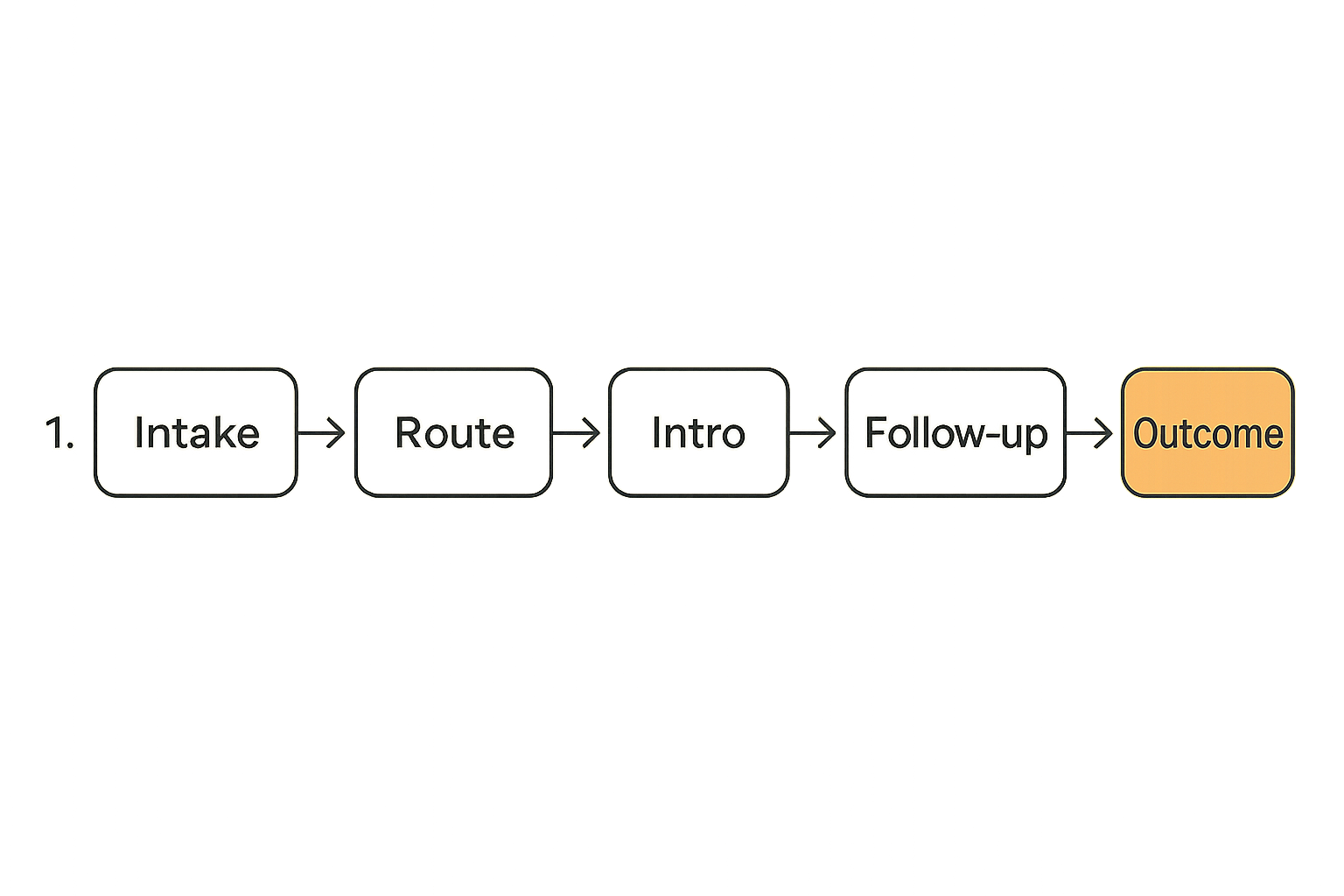
The ask offer follow up loop
The core loop is simple:
- Someone posts or submits an ask.
- The network identifies relevant offers or capable people.
- A trusted route is chosen.
- The introduction or handoff happens.
- Someone records the outcome.
- The network learns from the result.
What breaks in practice is step five. Communities love the introduction moment and neglect the outcome moment. Then the same weak match gets made again, the same reliable person gets overused, and the same unanswered asks disappear into the feed.
Practical rule: If your network does not know whether an introduction produced an outcome, it is not learning. It is guessing.
What changes when you treat connections as infrastructure
When community connections become infrastructure, you stop asking vague engagement questions and start asking operational questions:
- What kinds of asks do we handle?
- Who can receive and triage them?
- What counts as a useful offer?
- When do we route privately versus publicly?
- How do we know a match worked?
- What do we do when nobody responds?
This framing is less romantic, but it is much more useful. It lets local organizers design a repeatable workflow instead of relying on heroic connectors.
For adjacent reading, naming and categorization create similar operational drag in software teams; Related reading from our network: Product Names Are a Shipping System is a useful reminder that labels are not cosmetic when people need to route work.
Define the work before you define the community
Start with recurring local jobs
Before you build a platform, directory, calendar, or chat group, define the work your network is supposed to do. Community is broad. Operations require boundaries.
For a practical local network, recurring jobs often include:
- Finding a local provider for a small service
- Matching volunteers to short-term needs
- Routing business support to people with relevant skills
- Helping residents navigate forms, language, repairs, benefits, or events
- Sharing available space, tools, or equipment
- Finding trusted referrals without spamming everyone
- Coordinating follow-up after an introduction
These are not the same workflow. A translation request, a website debugging offer, and a childcare referral have different urgency, privacy, trust, and handoff requirements. Treating them as one generic community engagement problem creates noise.
The practical question is: which jobs will this network reliably support, and which jobs are out of scope for now?
Separate belonging from coordination
Belonging matters. But belonging is not the same as coordination.
A community event can create belonging. A shared meal can create trust. A neighborhood chat can create awareness. None of those automatically create a reliable path from a need to a capable responder.
When operators confuse belonging with coordination, they build spaces that feel active but do not resolve work. People post, react, and disappear. The network becomes a stream, not a system.
Practical rule: Design belonging spaces for relationship depth. Design coordination spaces for state, ownership, and next actions. Do not expect one format to do both jobs well.
This is why the operating model matters. A previous d0rz article on local network architecture that actually holds goes deeper on the structural side: asks, offers, routing, trust, and follow-up need explicit places to live.
Create a service boundary for the network
A local network needs a service boundary the same way a small team needs a support scope. Otherwise, every need becomes everyone’s problem, and nothing is owned.
A useful boundary answers:
- Geography: Which neighborhoods, towns, or regions are included?
- Participants: Who can post asks? Who can offer help?
- Categories: What kinds of needs are supported?
- Risk: Which topics require moderation or referral to professionals?
- Timing: What response window is realistic?
- Ownership: Who watches the queue and follows up?
This boundary is not bureaucracy. It is what protects trust. People participate more reliably when they understand what the network does and what it does not promise.
Model asks and offers as operational objects
The minimum useful ask
An ask should not be a vague plea. It should be a structured object with enough context to route.
The minimum useful ask includes:
- What is needed
- Where it matters
- By when
- Who can respond
- What constraints apply
- Whether the ask is public or private
- What a successful response looks like
Example of a weak ask:
Can anyone help with my website?
Example of a useful ask:
Local bakery in Oakland needs help debugging a broken order form before Friday. The form submits but no email arrives. Looking for someone who can inspect the form settings, test delivery, and explain the fix. Budget is limited but paid help is possible.
The second version routes. It tells the network what skill is needed, what urgency exists, and what success looks like.
A live example of this pattern is an ask like seeking one public business workflow to automate, where the request is narrow enough that a capable person can evaluate fit without a long discovery thread.
The minimum useful offer
An offer should also be structured. A generic I can help with anything post creates work for the operator. A useful offer defines a lane.
The minimum useful offer includes:
- Skill or resource offered
- Location or remote boundary
- Availability
- Price or free constraints
- Languages or accessibility constraints
- Examples of good-fit requests
- What is not included
Example of a weak offer:
I do tech stuff.
Example of a useful offer:
I can help local service businesses fix website forms, payment links, and simple workflow bugs remotely. Best fit: one broken flow with a clear success condition. Not a fit: full redesigns or urgent security incidents.
That offer is easier to route because it has edges. Edges reduce operator labor.
Comparison table ask driven versus broadcast driven networks
| Design choice | Broadcast driven network | Ask driven network |
|---|---|---|
| Primary unit | Posts and announcements | Structured asks and offers |
| Routing logic | Whoever sees it first | Context, trust, fit, availability |
| Failure mode | Noise and missed needs | Queue backlog if not owned |
| Operator role | Moderator of conversation | Triage and routing owner |
| Follow-up | Rare and informal | Expected part of the workflow |
| Best use | Awareness and events | Coordination and problem solving |
Neither model is wrong. Broadcast channels are useful for events, updates, and general visibility. But if the job is reliable community connections, ask driven workflows win because they preserve state.
Build trust routing instead of popularity routing
Trust is contextual not universal
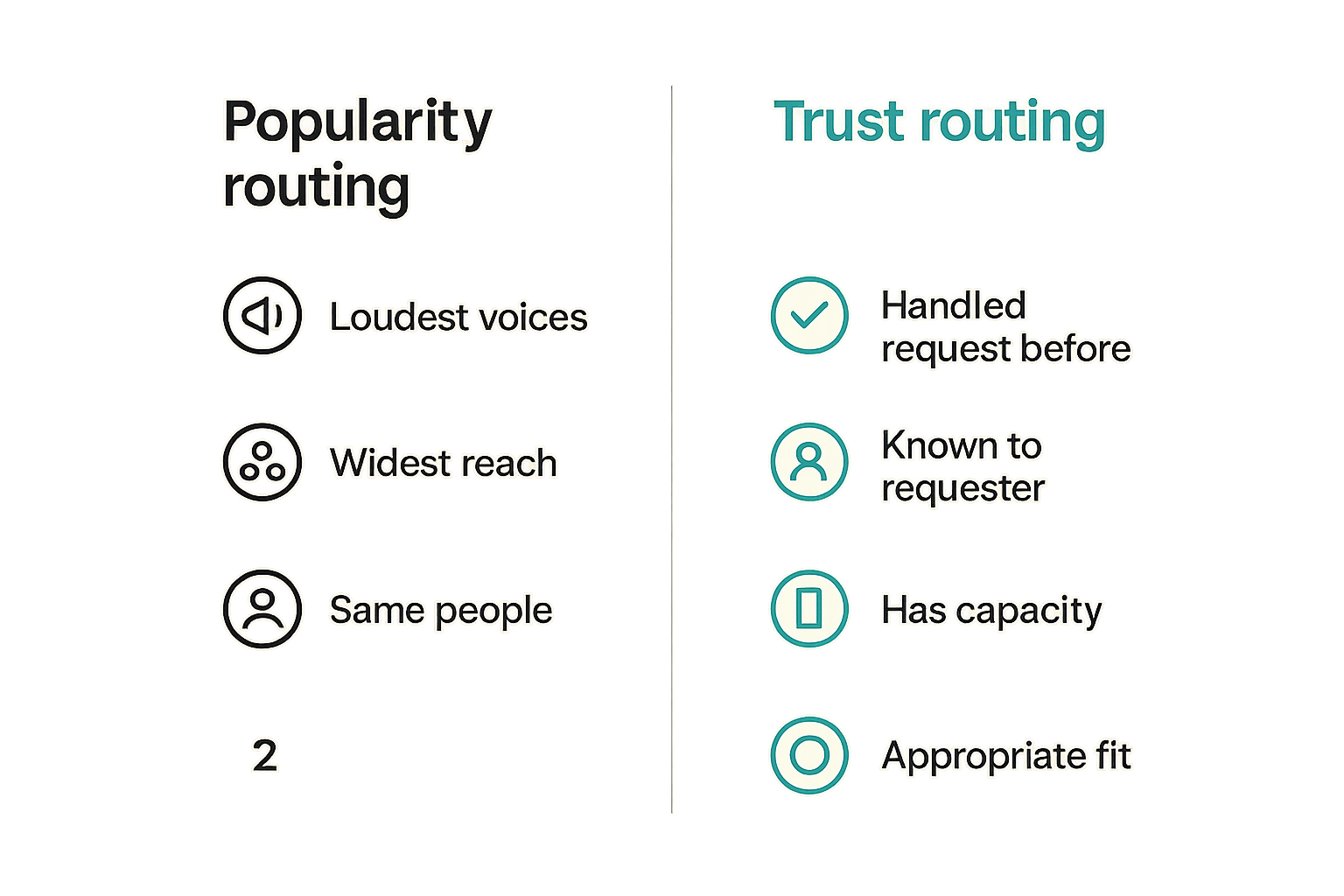
Trust is not a global score. Someone can be trusted to recommend a plumber but not to handle a sensitive housing issue. Someone can be excellent at translation but unreliable for deadline-heavy coordination. Someone can be popular in the community and still be the wrong route for a particular ask.
The mistake teams make is letting popularity become the routing system. The same visible people receive every request. They become overloaded, and quieter but highly capable members remain invisible.
Trust routing asks different questions:
- Who has handled this type of request before?
- Who is known by the asker or by a trusted intermediary?
- Who has capacity right now?
- What level of sensitivity is involved?
- Does the responder need credentials, lived experience, language ability, or local knowledge?
This is slower than blasting a message to everyone, but it produces better matches and fewer social failures.
Use lightweight verification points
Local networks do not need enterprise compliance workflows for every interaction. They do need lightweight verification points appropriate to the risk.
For low-risk requests, verification may be simple:
- Profile history
- Prior completed offers
- Mutual connection
- Clear scope
- Public reply trail
For higher-risk requests, use more care:
- Private intake
- Human review
- Confirmed identity or organization
- Explicit consent before sharing details
- Referral to licensed or accountable providers when needed
Practical rule: Match the verification level to the risk of harm, not to the ego of the operator or the loudness of the request.
Teams in security operations face the same routing problem under different conditions: signals only matter if ownership, escalation, and response are wired correctly. Related reading from our network: Sunstates Security and SOC Architecture is a useful parallel for thinking about physical signals, cyber response, and escalation paths.
Avoid hidden gatekeeping
Trust routing can become gatekeeping if the criteria are invisible. Operators need discretion, but they also need explainable rules.
Hidden gatekeeping looks like:
- Only friends of the organizer get routed
- New members cannot build reputation
- People from outside the dominant social group are ignored
- Offers are judged by status instead of fit
- Sensitive asks are quietly buried because they are uncomfortable
The fix is not to remove judgment. The fix is to make routing criteria explicit enough that people can understand how to participate.
Publish simple rules:
- What makes an ask routable
- What makes an offer routable
- What categories require review
- How new people can become trusted responders
- How disputes or bad matches are handled
That changes the conversation from who does the organizer like? to what does the network require for this route?
Design the matching workflow
A practical matching sequence
A matching workflow does not need to be heavy. It needs to be consistent.
- Intake the ask with required fields.
- Classify it by category, geography, urgency, and sensitivity.
- Search known offers and trusted responders.
- Choose a route: public reply, private intro, referral, or no-match response.
- Confirm consent from both sides when needed.
- Make the introduction with context and clear next step.
- Set a follow-up date.
- Record outcome and notes.
This sequence prevents the classic failure where an organizer makes a warm intro and then loses the thread. It also lets multiple operators share the work without relying on one person’s memory.
When automation helps and when it hurts
Automation helps when the rules are clear and the risk is low. It can classify asks, suggest relevant offers, remind operators to follow up, and detect stale requests.
Automation hurts when it pretends to understand trust. A matching system can suggest candidates, but local trust often depends on context that is not visible in the data. The goal is decision support, not blind assignment.
Good automation:
- Normalizes intake fields
- Tags categories
- Shows similar past asks
- Surfaces offers with matching constraints
- Sends reminders
- Tracks unresolved items
Bad automation:
- Auto-introduces people on sensitive requests
- Optimizes for speed over consent
- Rewards spammy activity
- Hides why matches were suggested
- Treats all skills as interchangeable
A practical operator keeps a human in the loop where trust, safety, money, or reputation are involved.
Escalation paths for stuck requests
Every community connections workflow needs a stuck state. If you do not define it, stuck requests become invisible.
A request can be stuck because:
- No relevant offer exists
- The ask is too vague
- The timeline is unrealistic
- The risk is too high for the network
- The responder did not follow through
- The operator is overloaded
Define what happens next. Maybe the asker gets a clarification request. Maybe the ask is reposted in a narrower category. Maybe it is referred outside the network. Maybe it is closed as no match.
The important part is that no response is still a response. Silence teaches people not to trust the network.
Make follow up non optional
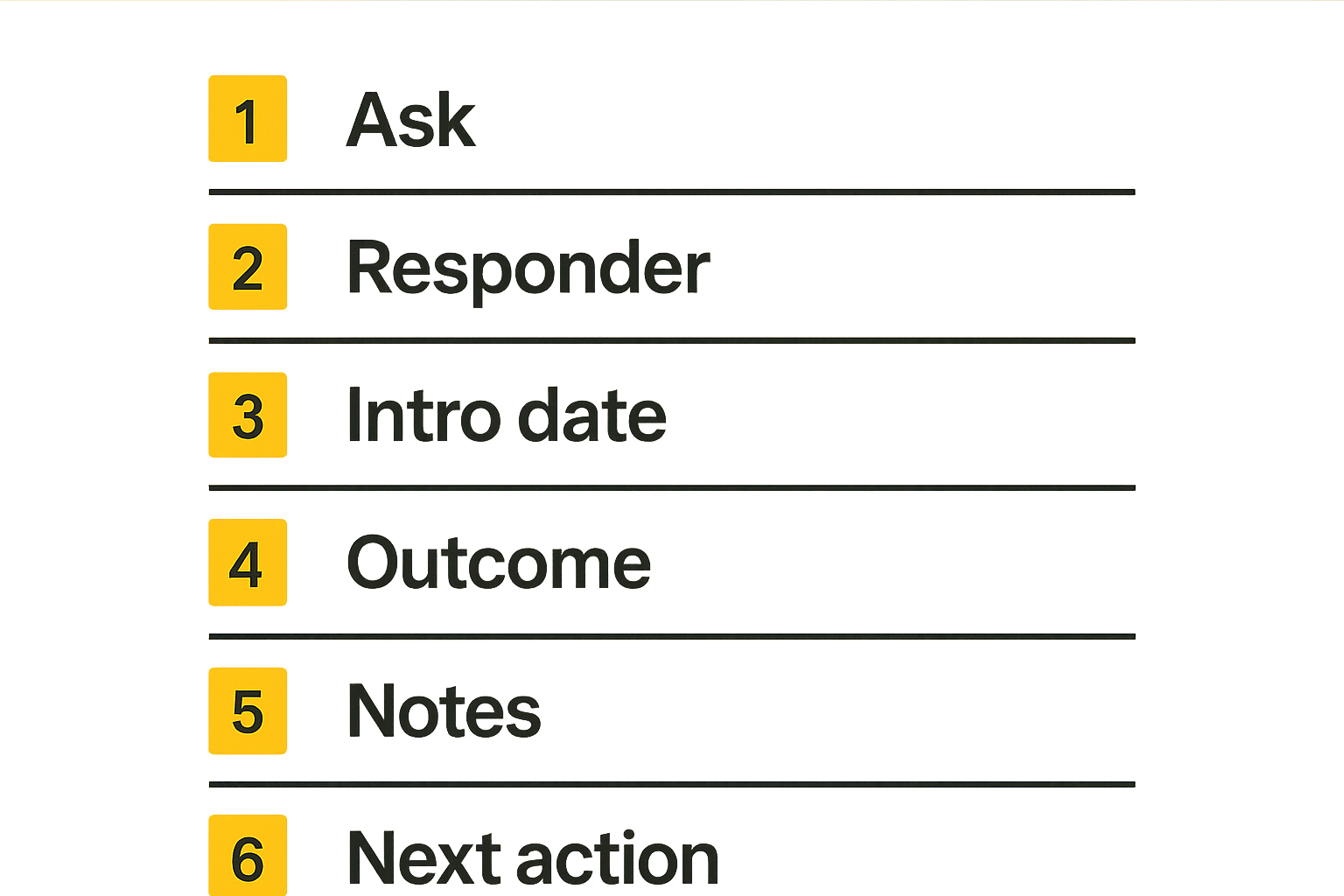
The follow up record is the memory
Follow-up is where community connections become durable. Without it, the network forgets what worked.
A follow-up record can be simple:
- Ask ID or link
- Offer or responder routed
- Date of introduction
- Outcome status
- Notes from asker
- Notes from responder
- Any issue or next action
You do not need a complex CRM on day one. A spreadsheet, shared board, or purpose-built local network tool can work if the fields are consistent. The operational requirement is not sophistication. It is memory.
This matters because local networks often depend on informal knowledge trapped in one organizer’s head. That works until the organizer gets busy, moves away, burns out, or cannot remember which introductions went badly.
Close the loop with outcomes
A useful outcome is more than done or not done. Operators need enough detail to improve routing.
Possible outcomes:
- Matched and completed
- Matched but not completed
- Introduced, waiting
- Ask clarified and rerouted
- No match found
- Referred outside network
- Closed by asker
- Flagged for review
These outcomes create a feedback loop. If many asks in one category end as no match, you need more offers in that lane. If many matches fail after introduction, you may have a trust or expectation problem. If many asks need clarification, your intake form is weak.
Practical rule: Outcome data is not for vanity reporting. It is for deciding what capacity the network needs next.
Support is part of the system
Support is not an afterthought. Any system that routes people to people will create confusion, disappointment, and occasional conflict.
Support questions include:
- Who does the asker contact if nobody replies?
- What happens if the responder flakes?
- Can either side leave feedback?
- How are unsafe or misleading offers handled?
- Who can edit or close an ask?
- How does a person remove themselves from routing?
Ignoring support creates quiet churn. People do not always complain. They just stop asking, stop offering, or warn others privately that the network is not reliable.
For local operators, support can be lightweight, but it must be visible. A simple contact path and a clear owner are better than a polished platform with no one accountable.
What breaks when community connections are implemented badly
The loudest node problem
The loudest node problem happens when the network routes based on visibility. The same few people answer everything. At first this looks efficient. Over time, it creates fragility.
Symptoms include:
- A small group is tagged constantly
- New offers receive little attention
- Asks outside the dominant clique go unanswered
- Burnout appears among reliable responders
- The network becomes socially risky for outsiders
The fix is to route by fit and capacity, not by reflex. Operators should maintain a wider map of capability and deliberately rotate opportunities where appropriate.
The stale directory problem
Directories feel like infrastructure, but many become graveyards. People create profiles once and never update them. Availability changes. Skills evolve. Contact preferences shift. The directory looks complete but lies in small ways.
What fails is assuming a directory is the system. It is only one component. Without active asks, offers, routing, and outcomes, a directory becomes a static artifact.
To keep directories useful:
- Require recent activity signals
- Let people pause offers
- Show availability windows
- Archive stale entries
- Connect profiles to completed outcomes
- Avoid ranking people only by profile polish
A stale directory is worse than no directory because it creates false confidence.
The no owner problem
The no owner problem is the most common failure. Everyone supports the community. Nobody owns the queue.
In practice, ownership means someone is responsible for:
- Watching new asks
- Clarifying weak requests
- Routing to relevant offers
- Following up on stuck items
- Closing loops
- Handling disputes
- Maintaining basic rules
This does not have to be one person forever. In fact, it should not be. But the role must exist. Community connections need operators.
A related d0rz post on the local network operating model makes the same point from another angle: participation only becomes infrastructure when roles, handoffs, and feedback loops are explicit.
Metrics that actually matter
Measure flow not applause
Likes, views, comments, and attendance can be useful, but they do not prove coordination. A post can get attention and still produce no help. An event can be popular and still create no usable routes.
Measure flow instead:
- Number of asks submitted
- Percentage of asks clarified
- Percentage routed
- Time to first useful response
- Time to match
- Completion rate
- No-match categories
- Repeat responders versus new responders
- Follow-up completion rate
These metrics show whether community connections are functioning as a network, not just a media channel.
Useful network health indicators
A healthy local network has balanced flow. Not perfect flow, but visible movement.
Look for:
- Asks are specific enough to route
- Offers have clear boundaries
- New participants can find useful entry points
- Operators can see stuck items
- Sensitive requests get appropriate handling
- Outcomes are recorded often enough to learn
- Reliable responders are not overloaded
- The network can explain what it does
If you want a simple dashboard, start with five numbers:
| Metric | Why it matters | Operator action |
|---|---|---|
| Open asks | Shows current demand | Triage backlog |
| Routed asks | Shows matching throughput | Improve routing lanes |
| Completed outcomes | Shows real value | Reinforce working paths |
| No-match asks | Shows capacity gaps | Recruit specific offers |
| Stale offers | Shows directory decay | Confirm or archive |
This is enough to manage the system without turning the community into a reporting exercise.
What not to measure
Do not over-optimize for volume. More asks are not always better. More offers are not always better. More members are not always better.
A small, reliable network can outperform a large, noisy one because trust and routing costs are lower. Growth is useful only when the operating model can absorb it.
Avoid metrics that reward bad behavior:
- Most posts
- Most replies regardless of quality
- Fastest response without outcome
- Biggest profile
- Most introductions without follow-up
- Most categories covered without capacity
The practical question is not how big is the network? It is what can the network reliably move from need to outcome?
Media and home technology operators face a similar difference between having many tools and having a reliable workflow; Related reading from our network: Information Technology for Streaming, Torrents, IPTV, and Home Media Operations in 2026 is adjacent but useful on troubleshooting and operational state.
Governance and consent for local network operators
Consent before routing
Consent is basic infrastructure. Local communities often move fast because people know each other, but familiarity can cause sloppy routing.
Before sharing someone’s details, ask:
- Did the asker agree to this introduction?
- Did the responder agree to receive this type of request?
- Is any sensitive information being exposed?
- Is the channel appropriate?
- Can either side decline without social penalty?
This matters especially in small towns, immigrant communities, professional circles, and mutual aid contexts where privacy, reputation, or legal exposure may be involved.
Rules for sensitive asks
Not every ask belongs in a public feed. Some need private triage. Some need referral outside the network. Some should not be handled by volunteers at all.
Sensitive categories may include:
- Housing insecurity
- Immigration or legal questions
- Medical needs
- Domestic safety
- Financial distress
- Youth-related requests
- Workplace conflict
- Identity or documentation issues
Operators do not need to solve everything. They need to avoid pretending the network is qualified for work it cannot safely handle.
Practical rule: A responsible no is better than an unsafe yes. Community connections should expand capacity, not hide risk.
Create a policy for sensitive asks before the crisis arrives. The policy can be simple: private intake, named reviewer, referral list, no public reposting without consent, and clear closure notes.
Operator roles and handoffs
As the network grows, the operator role should split into lanes.
Possible roles:
- Intake reviewer
- Category steward
- Trust reviewer
- Matchmaker
- Follow-up owner
- Support contact
- Data maintainer
One person can hold multiple roles early. The key is that the role is named. When roles are unnamed, handoffs fail.
A clean handoff includes:
- What happened so far
- What decision is needed
- Who owns the next action
- When it should be checked again
- What context should not be shared further
This is not corporate overhead. It is how local networks keep promises without exhausting the few people who care enough to coordinate.
Where d0rz.com fits in the community connections stack
A lightweight layer for asks offers and routing
d0rz.com is built for people building practical local networks where asks, offers, trust, routing, and follow-up matter. That makes it a fit when the problem is not content publishing or social engagement, but coordination.
A local operator can use d0rz.com as a lightweight layer to make needs and capacity visible without turning everything into a chaotic feed. The useful unit is not a generic post. It is an ask or an offer with enough context to route.
That is the architectural difference. The UI is not the whole system. The system is the state around the request: who needs what, who can help, what trust context exists, what happened next, and what the operator should do when the item stalls.
For example, an offer like same-day website form and workflow debugging is useful because it gives a network operator a concrete route for a specific class of local business problem.
What works with d0rzcom
What works:
- Publishing specific asks with clear constraints
- Publishing bounded offers that define fit
- Using links as routing objects in messages, newsletters, or private intros
- Keeping local context attached to the need
- Following up manually until the network has enough pattern history
- Recruiting missing capacity based on no-match asks
What fails:
- Treating the site as a dumping ground for vague posts
- Posting offers with no boundaries
- Expecting software to replace trust judgment
- Routing sensitive asks without consent
- Letting stale items accumulate without review
- Measuring success only by traffic
The strongest use case is not replacing every community space. It is giving operators a structured coordination layer that can sit beside events, chats, newsletters, and personal relationships.
If your local network already has energy but loses track of requests, d0rz.com helps make community connections more legible. If your network has no operator, no scope, and no follow-up discipline, no tool will fix that by itself.
Try d0rzcom
d0rz.com is for people building practical local networks where asks, offers, trust, routing, and follow-up matter. If you want community connections that behave more like coordination infrastructure than a noisy feed, Try d0rz.com.