

Most local networks do not fail because people are unfriendly. They fail because nobody can reliably move from need to match to outcome.
A neighbor asks for help. A freelancer offers a skill. A small business needs a workflow fixed. Three people say they know someone. Then the thread goes quiet, the request expires, and the organizer becomes the unpaid router for everything.
Teams think the problem is community first messaging. The real problem is community first operations.
That changes the conversation. In 2026, community first is not a softer brand position. It is an architecture decision: how your network captures asks, publishes offers, routes trust, records follow-up, and learns from what actually happened. If that system is weak, no amount of events, posts, newsletters, or group chats will turn participation into dependable coordination.
Table of contents
- Why community first is an operating model
- The community first coordination architecture
- Design for local context before scale
- Build the intake layer
- Trust is a workflow, not a vibe
- Routing turns participation into coordination
- Follow-up is where community first compounds
- What breaks when community first is implemented badly
- Metrics that matter for community first networks
- Implement community first in 30 days
- Product fit: where d0rz.com belongs
Why community first is an operating model
Teams confuse community first with friendliness
The mistake teams make is treating community first as tone. They write warmer copy, host more meetups, create a chat group, and call that a strategy. None of those things are bad. They are just not enough.
A community can feel welcoming and still be operationally useless. People can like each other and still fail to find a plumber, a designer, a ride, a workshop space, a client, a volunteer, or a person who can debug a payment form before Friday.
A useful way to think about it is this: community first means the network is designed around real participant needs before platform convenience, sponsorship optics, or vanity engagement. That requires operational choices.
The business decision underneath
Community first is a resource allocation decision. You decide what the network will make easy, what it will reject, who is allowed to route requests, how trust is represented, and how outcomes are checked.
If you do not make those decisions, the loudest channel wins. Group chats become ticket queues. Organizers become dispatchers. The same five reliable people get overused. New members watch silently because they cannot tell what is legitimate.
Practical rule: If nobody owns intake, routing, and follow-up, your community first strategy is just a social feed with good intentions.
The practical question
The practical question is not whether your network is community first. The question is whether a person with a specific local need can move through the network without being forced to understand your internal politics.
Can they state the ask clearly? Can providers respond with real availability? Can someone route the request without favoritism? Can the requester know what happens next? Can the network learn whether the match worked?
If the answer is no, you do not have a community first operating model yet. You have participation without coordination.
The community first coordination architecture
Asks are demand signals
An ask is not just a post. It is a demand signal from the local network.
Bad ask: Need help with website stuff.
Useful ask: Local bakery needs checkout form fixed before Monday. Current issue: customers submit orders but confirmation email does not send. Budget: modest. Remote help acceptable. Needs someone who can look at WordPress, forms, and email delivery.
The second version gives the network something to route. It contains category, urgency, constraints, outcome, and context. That is the difference between conversation and coordination.
This is why d0rz.com should treat asks as structured operating objects, not just content. A prior d0rz piece on local network architecture frames the same point well: asks, offers, trust, and follow-up have to be part of the same system, not scattered across tools.
Offers are capacity signals
An offer is a capacity signal. It tells the network what someone can reliably do, under what conditions, and for whom.
Weak offer: I can help with tech.
Useful offer: I can debug one broken website form, payment link, CSV cleanup, or GitHub issue for a Bay Area small business, remote only, same day when available.
That level of specificity reduces noise. It lets organizers route faster. It also protects the provider from becoming a general-purpose volunteer for every vague technical problem.
Routing and follow-up are the system
Most community platforms over-invest in publishing and under-invest in routing. They make it easy to post, react, and comment. They do not make it easy to decide who should handle the request, what context they need, and when the loop is closed.
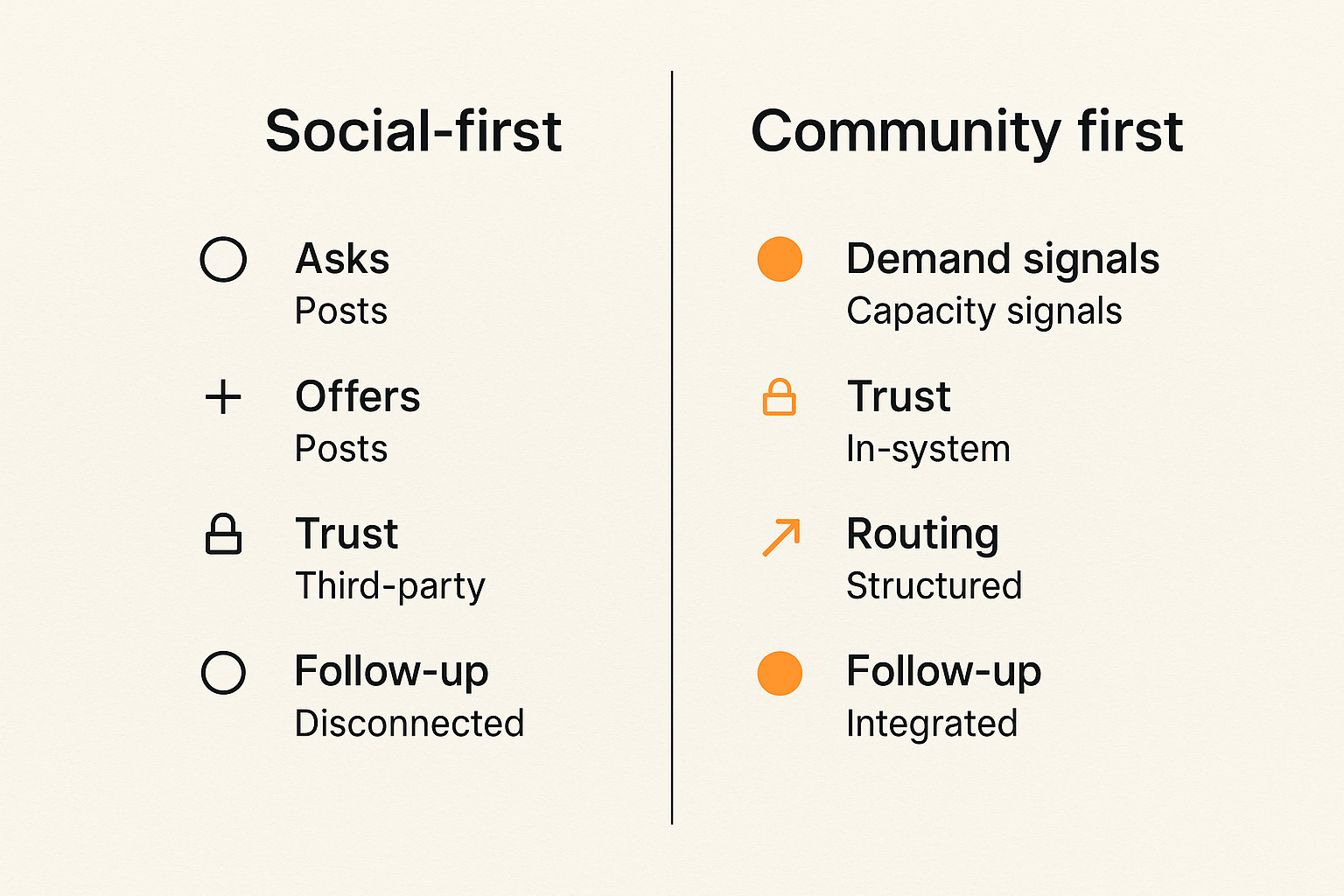
Here is the core comparison:
| Layer | Social-first community | Community first operating model |
|---|---|---|
| Ask | Freeform post | Structured need with urgency, scope, location, and constraints |
| Offer | Profile bio | Serviceable capacity with terms and boundaries |
| Trust | Familiarity and vibes | Evidence, history, references, and escalation paths |
| Routing | Whoever notices | Defined match rules and owner |
| Follow-up | Optional comment | Required outcome state |
| Learning | Anecdotes | Pattern review and rule updates |
That changes the conversation. The community is no longer just where people talk. It becomes a lightweight coordination layer for local work, help, referrals, and problem solving.
Related reading from our network: teams building secure communication systems face a similar issue where the chat app is not the workflow; the routing, identity, metadata, and retention rules are the real system in VA secure messaging in 2026.
Design for local context before scale
Define the operating boundary
Local networks need boundaries. Not walls. Boundaries.
A community first network should know what it is willing to coordinate. Is it focused on a neighborhood, city, professional scene, mutual aid group, local business corridor, freelancer circle, parent network, or service marketplace? Each has different routing rules.
If the network is too broad, matching gets weak. If it is too narrow, capacity dries up. The operating boundary should be based on real transaction patterns, not aspiration.
Practical rule: Start with the smallest geography and category set where successful matches can happen repeatedly.
Make local constraints explicit
Local coordination has constraints that generic platforms ignore:
- Travel time matters.
- Trust travels through relationships.
- Cash flow is uneven.
- People have irregular availability.
- Some work requires being physically present.
- Some work can happen remotely but still needs local context.
- Support expectations are shaped by reputation, not terms of service.
What breaks in practice is pretending these constraints are edge cases. They are not. They are the operating environment.
A community first system should capture constraints early. If a provider is remote only, say that. If an ask requires on-site work, say that. If a requester needs help in Spanish, after hours, or under a fixed budget, do not hide that in a comment thread.
Avoid fake scale
Fake scale is when the network looks big but cannot complete work.
You can have thousands of members and still fail to route a simple ask. You can have a busy Slack and no reliable provider inventory. You can have a beautiful map and no current availability.
The mistake teams make is measuring reach before reliability. Reach is useful after the workflow works. Before that, it creates more unresolved demand.
A useful test: add ten real asks this week. If your network cannot categorize, route, follow up, and record outcomes for those ten, it is not ready for more growth. It is ready for better operations.
Build the intake layer
Structure asks without making them bureaucratic
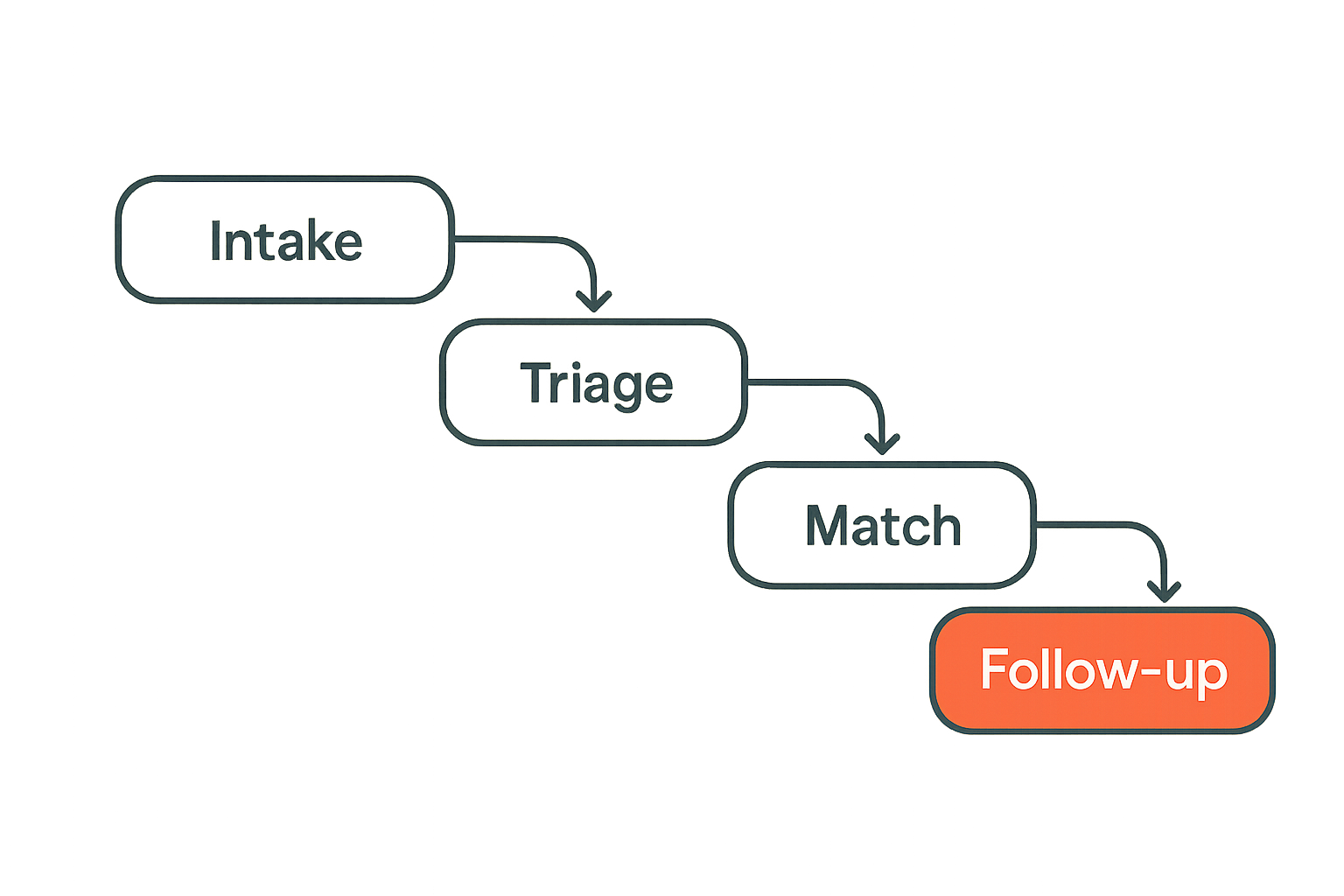
Intake is where community first becomes real or collapses into noise.
The goal is not to force people through enterprise ticketing. The goal is to collect enough information to route the ask without requiring a long interview.
A practical ask intake form needs:
- What do you need done?
- Where is this relevant?
- Is it remote, local, or on-site?
- When do you need it?
- What outcome would count as solved?
- Is there a budget, trade, volunteer expectation, or unknown?
- Is there anything sensitive that should not be public?
Do not ask for twenty fields because your tool allows it. Ask for routing-critical information.
Structure offers around outcomes
Offers should be written around outcomes, not identity.
Instead of letting people describe themselves broadly, ask what they can actually deliver. That may be childcare coverage, food pickup, bookkeeping cleanup, tenant rights translation, website debugging, grant writing, senior transportation, neighborhood security walks, or event setup.
A concrete example is an offer for remote website and automation help for local businesses, where the useful operational detail is not just that someone knows software. It is what kinds of problems they can triage, for whom, and under what conditions.
The best offers answer five questions:
- What outcome can you provide?
- Who is it for?
- What is out of scope?
- What availability or geography applies?
- What does a good handoff require?
Use triage rules before automation
Automation does not fix unclear operations. It accelerates them.
Before you automate matching, define triage rules that a human can follow. For example:
- Reject asks that are unsafe, illegal, abusive, or impossible to scope.
- Mark urgent asks that expire within 72 hours.
- Route paid work separately from volunteer help.
- Route sensitive asks through a trusted coordinator.
- Match by category, location, availability, and trust evidence.
- Require follow-up after the first contact.
Once those rules work manually, automation becomes useful. Until then, software just gives confusion an API.
Related reading from our network: the same build-the-stack-before-the-gear logic shows up in home media operations, where buying devices before designing the workflow creates reliability problems; see first tech for streaming, torrents, IPTV, and home media.
Trust is a workflow, not a vibe
Reputation needs evidence
Trust is often discussed as if it is a feeling. In local networks, trust is operational evidence.
Evidence can include completed work, references, repeat participation, verified affiliation, organizer notes, mutual connections, response reliability, or documented outcomes. Not every network needs the same trust model, but every serious network needs one.
The practical question is: what does a coordinator know before routing an ask to a person?
If the answer is only that the person seems active in chat, the trust model is weak. Activity is not reliability. Charisma is not competence. Familiarity is not safety.
Practical rule: Trust should lower routing risk, not reward the loudest participants.
Escalation needs ownership
Things will go wrong. Someone will not respond. A provider will overpromise. A requester will change the scope. A volunteer will feel exploited. A sensitive ask will be mishandled.
Community first does not mean pretending failure is rare. It means designing escalation before failure becomes drama.
At minimum, define:
- Who handles complaints?
- When does a match get paused?
- What behavior gets a person removed from routing?
- What issues require private handling?
- What gets documented after a failed match?
Without escalation ownership, conflict moves into backchannels. That damages trust faster than a public failure because nobody knows what is being handled.
Privacy is part of trust
Local networks often handle sensitive information before they realize it: immigration status, illness, income stress, housing instability, family conflict, payment issues, business operations, or safety concerns.
A community first workflow should separate public discovery from private coordination. Public posts can describe the category of need. Sensitive details should move through a controlled handoff.
Do not make people overshare to get help. Do not force providers to receive more private information than they need. Do not keep informal spreadsheets full of sensitive notes unless someone owns retention and access.
Security teams have a blunt version of this lesson: more visibility is not always better if there is no workflow for handling what becomes visible. Related reading from our network: cyber security analyst jobs in 2026 explains how signals, ownership, and response workflows matter more than raw alert volume.
Routing turns participation into coordination
Route by fit, not popularity
Routing is the moment where a community first network proves whether it is fair and useful.
Bad routing sends everything to the most visible person. Good routing considers fit:
- Category fit: Can this person do the work?
- Location fit: Are they close enough or remote-compatible?
- Timing fit: Are they available when needed?
- Trust fit: Is the risk appropriate?
- Scope fit: Is the ask sized correctly?
- Relationship fit: Is there a relevant connection?
Popularity is easy to observe. Fit requires structure.
Design handoffs deliberately
A handoff is not just an introduction. It is the transfer of context and responsibility.
A good handoff includes:
- The ask summary.
- The desired outcome.
- Any constraints.
- The next action.
- Who owns follow-up.
- When the network should check back.
For example, do not write: You two should connect.
Write: Maria needs her order confirmation email fixed by Monday. Andre can look at WordPress forms remotely today after 4 p.m. Maria will send admin access through a temporary account. I will check tomorrow morning whether the issue is solved.
That one paragraph reduces ambiguity, speeds response, and protects everyone involved.
Automate the repeatable parts
Automation belongs in routing once the rules are clear.
Good candidates for automation:
- Categorizing asks by type.
- Flagging urgency.
- Suggesting providers based on offer tags.
- Reminding coordinators to follow up.
- Marking stale asks.
- Notifying providers of relevant new asks.
- Recording match outcomes.
Bad candidates for early automation:
- Deciding trust with no evidence.
- Handling sensitive cases with no human review.
- Auto-assigning unpaid labor.
- Ranking providers using engagement metrics.
The mistake teams make is using automation to avoid governance. The better pattern is to use automation to reduce clerical drag after governance exists.
Follow-up is where community first compounds
Close the loop on every serious ask
Follow-up is the most neglected part of community operations.
Most networks celebrate the match and forget the outcome. That creates three problems. First, nobody knows whether the requester was helped. Second, the provider gets no operational credit. Third, the network cannot learn which categories are working.
A serious ask should end in a state:
- Solved.
- Partially solved.
- Referred out.
- Expired.
- Cancelled.
- Failed and needs review.
This does not need to be heavy. It just needs to be consistent.
Capture outcomes, not vanity activity
Comments, likes, and attendance are weak proxies for usefulness. They may show energy, but they do not prove coordination.
Better outcome notes look like this:
- Ask routed to provider within 8 hours.
- Provider responded within 2 hours.
- Work completed same day.
- Requester confirmed the fix.
- Similar asks should be routed to this provider when available.
This is not corporate bureaucracy. It is memory. Without it, the community keeps relearning the same lessons.
The prior d0rz post on the local network operating model is useful here because it treats participation as something that must be converted into repeatable operating capacity, not just engagement.
Repair failed matches
Failed matches are not automatically bad. They are data.
A match can fail because the ask was unclear, the provider was unavailable, the budget was unrealistic, the trust risk was too high, or the timeline changed. Each cause implies a different fix.
If you treat every failure as embarrassment, you lose the lesson. If you treat every failure as normal noise, you lose trust. The right response is structured repair:
- Identify why the match failed.
- Decide whether the ask should be rerouted.
- Update provider availability or scope.
- Adjust intake fields if context was missing.
- Record the outcome without public shaming.
That is how community first compounds. The network gets smarter after each interaction.
What breaks when community first is implemented badly
Noise becomes the default interface
When intake is weak, everything becomes a conversation. People post half-formed requests. Others ask clarifying questions. Someone tags three people. The requester disappears. A week later, the same need resurfaces.
Noise is expensive because it consumes organizer attention and teaches participants that the network is unreliable.
What works:
- Require enough structure to route.
- Give examples of good asks.
- Close stale threads visibly.
- Move sensitive details out of public channels.
What fails:
- Letting every channel become intake.
- Allowing vague asks to remain unresolved.
- Measuring activity instead of completed coordination.
Organizers become hidden infrastructure
Many local networks depend on one or two people who remember everything. They know who is reliable, who is struggling, who should not be routed sensitive work, and which provider is overloaded.
That knowledge is valuable, but if it stays in one person’s head, the network is fragile.
The failure mode is predictable. The organizer gets tired. Response times slip. People assume favoritism. New coordinators cannot help because the workflow is undocumented.
Community first should protect organizers by making the work visible, not by asking them to care harder.
Directories go stale
Directories feel productive because they create an asset. A list of providers. A map of resources. A spreadsheet of volunteers. The problem is that capacity changes constantly.
A stale directory is worse than no directory because it creates false confidence. Requesters contact people who are no longer available. Providers receive irrelevant requests. Coordinators stop trusting the data.
If you maintain a directory, connect it to live offers, recent outcomes, and availability checks. Otherwise, call it an archive, not an operating system.
Metrics that matter for community first networks
Operational health metrics
Metrics should help operators make decisions. They should not exist to impress funders, sponsors, or social media followers.
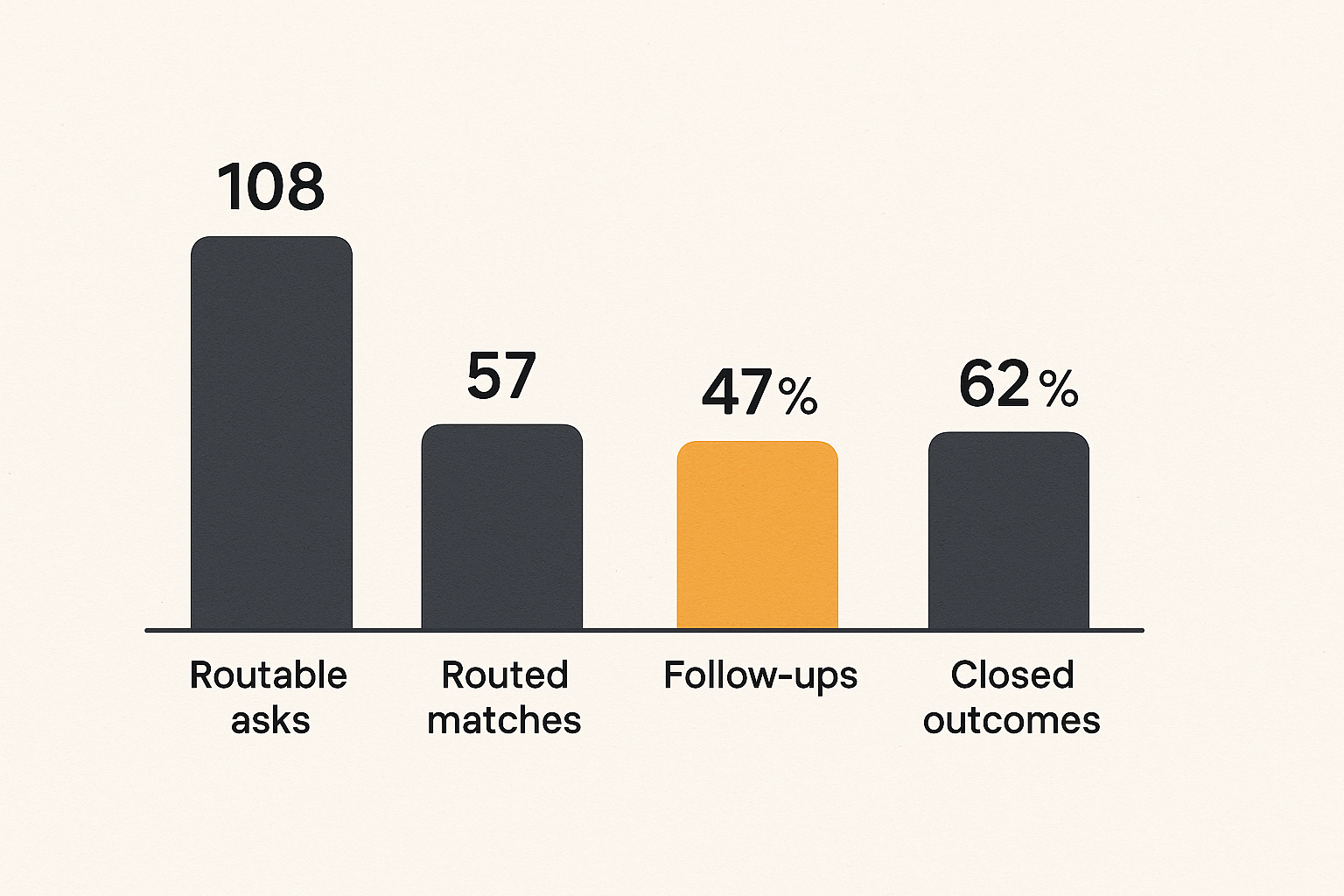
Useful operational metrics include:
- Number of new asks this week.
- Percent of asks with enough information to route.
- Median time from ask to first route.
- Percent of routed asks with follow-up.
- Percent of asks closed with a known outcome.
- Number of active offers by category.
- Number of stale offers requiring review.
You do not need all of these on day one. Start with the few that expose bottlenecks.
Trust and reliability metrics
Community first networks need reliability signals, not just volume signals.
Track patterns such as:
- Providers who respond consistently.
- Categories with repeated unmet demand.
- Coordinators with overloaded queues.
- Matches that fail due to unclear scope.
- Sensitive asks that require private routing.
- Repeat requesters who may need deeper support.
This is where operators must be careful. Metrics should support better routing, not create a punitive scoring system. A provider who declines work honestly may be more reliable than someone who accepts everything and disappears.
The decision rhythm
A metric without a decision rhythm becomes decoration.
Set a simple weekly review:
- Which asks are still open?
- Which categories have more demand than capacity?
- Which providers are overloaded?
- Which failed matches need repair?
- Which intake question should be changed?
- Which offer should be refreshed or retired?
Practical rule: If a metric does not change routing, intake, trust, or follow-up, it is probably not an operating metric.
Implement community first in 30 days
Week 1: inventory real asks and offers
Do not start with a manifesto. Start with inventory.
Collect twenty real asks from the last month. Pull them from texts, DMs, email, meetings, group chats, and memory. Then collect twenty real offers from people who are willing to help, sell, volunteer, teach, repair, deliver, translate, host, or advise.
Normalize them into a simple table:
| Field | Ask example | Offer example |
|---|---|---|
| Category | Website form broken | Website form debugging |
| Location | Local business, Bay Area | Remote only, Bay Area focus |
| Urgency | Before Monday | Same day when available |
| Outcome | Confirmation email fixed | Triage and fix one flow |
| Constraint | Small budget | No long-term maintenance |
| Follow-up owner | Coordinator | Coordinator |
The point is not perfection. The point is to see the real shape of demand and capacity.
Week 2: define routing rules
In week two, write routing rules simple enough for a new coordinator to follow.
Example rule set:
- If the ask is unsafe or abusive, reject it.
- If the ask contains private information, move it to private handling.
- If the ask is urgent, assign a follow-up owner immediately.
- If the ask is paid work, route to providers who accept paid work.
- If the ask is volunteer help, confirm consent before routing.
- If no provider fits, mark the ask as unmet demand.
- If a match happens, schedule outcome follow-up.
This is also a good time to find one low-risk workflow to test in public. For example, d0rz has an ask seeking one public business workflow to automate, which is exactly the kind of scoped, observable request that helps a network learn how routing and follow-up behave.
Week 3-4: route real matches
Now route real work. Not hypothetical personas. Not demo data. Real asks.
Use this numbered workflow:
- Intake the ask with enough routing detail.
- Check whether the ask is public, private, urgent, paid, volunteer, or sensitive.
- Identify two or three possible providers or helpers.
- Confirm availability before making the handoff.
- Send a handoff with context, outcome, and next action.
- Set a follow-up time.
- Record the result.
- Update the ask, offer, or routing rule based on what happened.
Run this for at least ten matches. Ten is enough to expose bad categories, stale offers, unclear ownership, and missing trust rules.
Keep the operating cadence small
The practical question is how little process you need to be reliable.
A small local network does not need a full operations department. It needs a rhythm:
- Daily or every-other-day ask review.
- Weekly stale ask cleanup.
- Weekly offer refresh for active categories.
- Monthly trust and escalation review.
- Monthly category review: what demand is rising?
Keep the cadence visible. If participants know how the network works, they are more likely to use it responsibly.
Product fit: where d0rz.com belongs
Use d0rz.com as a coordination layer
For d0rz.com, the opportunity is not to become another generic community feed. The useful product surface is the coordination layer: structured asks, structured offers, trust context, routing, and follow-up.
That fits the site’s actual premise: people building practical local networks where asks, offers, trust, routing, and follow-up matter.
A community first d0rz workflow should help an operator answer:
- What does this person need?
- Who can actually help?
- What context is safe to share?
- What is the next step?
- Who owns follow-up?
- Did the match work?
If the product makes those questions easier, it becomes infrastructure. If it only makes posting easier, it becomes another place to manage.
What d0rz.com should not replace
d0rz.com should not replace human judgment, local relationships, or organizer accountability.
The product should not pretend every ask can be solved by a marketplace match. Some asks need a trusted person. Some need escalation. Some need a referral outside the network. Some should be declined. Some require care that software cannot provide.
The strong product position is narrower and more useful: make the coordination work visible, structured, and easier to operate.
That is the difference between platform hype and local network infrastructure.
Try d0rz.com
Community first works when asks, offers, trust, routing, and follow-up become a real operating system. d0rz.com is for people building practical local networks where that coordination matters.