

Most local communities do not fail because people are selfish. They fail because the network cannot remember what people need, what people offered, who is trusted to route the request, and what happened after the introduction.
That is where community meaning becomes an operating problem. Teams think the problem is defining the word community better. The real problem is building a workflow where participation turns into useful coordination without burning out the same five people.
In 2026, every organizer has more channels than capacity: group chats, newsletters, event platforms, DMs, spreadsheets, and local directories. The UI is not the community. The community is the repeatable path from ask to offer to trust to follow-up.
The practical question is not What does community mean? The practical question is: what must exist so people can depend on each other locally without the whole system becoming vague, political, or impossible to operate?
Table of contents
- Community meaning is an operating problem
- Define the unit of value before the vibe
- Build a local network map, not a member list
- Design the routing layer for community meaning
- Trust is infrastructure, not sentiment
- What breaks when community meaning is implemented badly
- What works: a practical operating cadence
- Tools matter, but workflow owns the outcome
- Measure community meaning by completed loops
- Putting community meaning into d0rz.com workflows
Community meaning is an operating problem

Meaning has to survive handoffs
Community meaning sounds soft until you watch a real handoff fail.
A cafe owner needs help fixing a broken website form. A neighbor knows someone technical. A local organizer makes an introduction. The provider asks for details. The owner does not respond because the message landed in the wrong channel. Two weeks later, everyone still believes the community is supportive, but nothing got fixed.
The mistake teams make is treating meaning as emotional alignment. Emotional alignment helps, but it does not move the work. Meaning has to survive the operational path: capture the need, qualify it, route it, confirm ownership, follow up, and record the outcome.
Practical rule: if the network cannot answer who needs what, who can help, who owns the next step, and whether it happened, community meaning is still mostly narrative.
That changes the conversation. Instead of asking whether people feel connected, an operator asks whether connection can be used responsibly.
Why this matters in 2026
Local networks are absorbing more practical burden: small business support, mutual aid, freelance referrals, neighborhood safety, childcare coordination, elder support, language help, local services, and informal economic opportunity.
At the same time, attention is fragmented. People are in too many channels, and trust is harder to infer from public identity alone. AI has made it easier to generate messages, offers, and outreach, which also makes it harder to know what is real.
So the useful version of community meaning is not a definition. It is a system design question. How does a local network create enough structure that people can coordinate without turning the group into bureaucracy?
Related reading from our network: SOC teams face a similar routing and escalation problem when safety workflows depend on ownership and response paths. The domain is different, but the operator lesson is familiar: vague responsibility fails under pressure.
Define the unit of value before the vibe
Asks, offers, and promises are the primitives
A useful way to think about it is this: every functioning local network is built from three primitives.
- An ask: someone needs something specific enough to route.
- An offer: someone can provide something specific enough to evaluate.
- A promise: someone agrees to take a next step by a reasonable time.
Without those primitives, the community becomes a mood board. People can post introductions, inspiration, photos, and opinions, but the network cannot reliably do work.
The ask does not need to be dramatic. It might be I need someone to debug a payment link, I need a translator for an employment document, I need a Saturday helper for a market stall, or I need advice before signing a lease. The offer does not need to be professional. It might be two hours of local knowledge, a tool loan, a referral, or a space.
The promise is what prevents the network from becoming performative. A promise can be small: I will call them today, I will send the form by Friday, I will introduce you to Maria, I will test the checkout flow tonight.
Convert belonging into observable commitments
Belonging matters. But belonging alone is hard to operate. Operators need commitments that can be seen, routed, and closed.
A local organizer should be able to look at the network and identify open loops:
- Which asks are waiting for clarification?
- Which offers are available but underused?
- Which matches were made but not confirmed?
- Which people keep taking responsibility quietly?
- Which people need support before they can participate more?
This is not about making community transactional. It is about respecting people enough not to waste their time. When people see that asks are handled, offers are acknowledged, and follow-up happens, the emotional meaning gets stronger because the network proves itself.
Practical rule: do not ask people to believe in the community before the community can perform basic coordination.
For example, the d0rz post about community building as local network architecture frames this as a design problem: a community holds when asks, offers, trust, and follow-up reinforce each other instead of living in disconnected channels.
Build a local network map, not a member list
Member count hides routing failure
The easiest vanity metric in community work is member count. It is also one of the least useful operational signals.
A group can have 4,000 members and still fail to help a restaurant find a bookkeeper, a parent find after-school support, or a freelancer find three reliable local clients. The issue is not reach. The issue is routing.
A member list tells you who is present. A network map tells you how help can move.
A practical local network map includes:
- People and organizations.
- Locations and service areas.
- Skills, resources, constraints, and availability.
- Known relationships and trusted introducers.
- Common ask categories.
- Response patterns and follow-up reliability.
The map does not need to be complex at the start. A spreadsheet can work. A shared board can work. A purpose-built tool can work. What matters is that the map reflects how coordination actually happens.
Context beats category labels
A category label like web developer, translator, accountant, volunteer, elder support, or organizer is useful only as a starting point. In practice, the routing depends on context.
Consider two people labeled web developer. One is great for emergency form debugging. Another is better for a multi-month rebuild. One works remotely. One needs in-person meetings. One is affordable for a microbusiness. One only works with funded teams.
If the network only stores the label, it will make bad matches. If it stores context, it can route responsibly.
Context should answer questions like:
- What kind of help is this person actually willing to provide?
- What scale of work fits them?
- What response time is realistic?
- What languages or accessibility needs matter?
- What trust boundary should not be crossed?
- What has happened in previous matches?
The mistake teams make is flattening people into categories because categories are easy to collect. But local coordination is made of edge cases. A good map keeps enough nuance to prevent avoidable failure.
Design the routing layer for community meaning
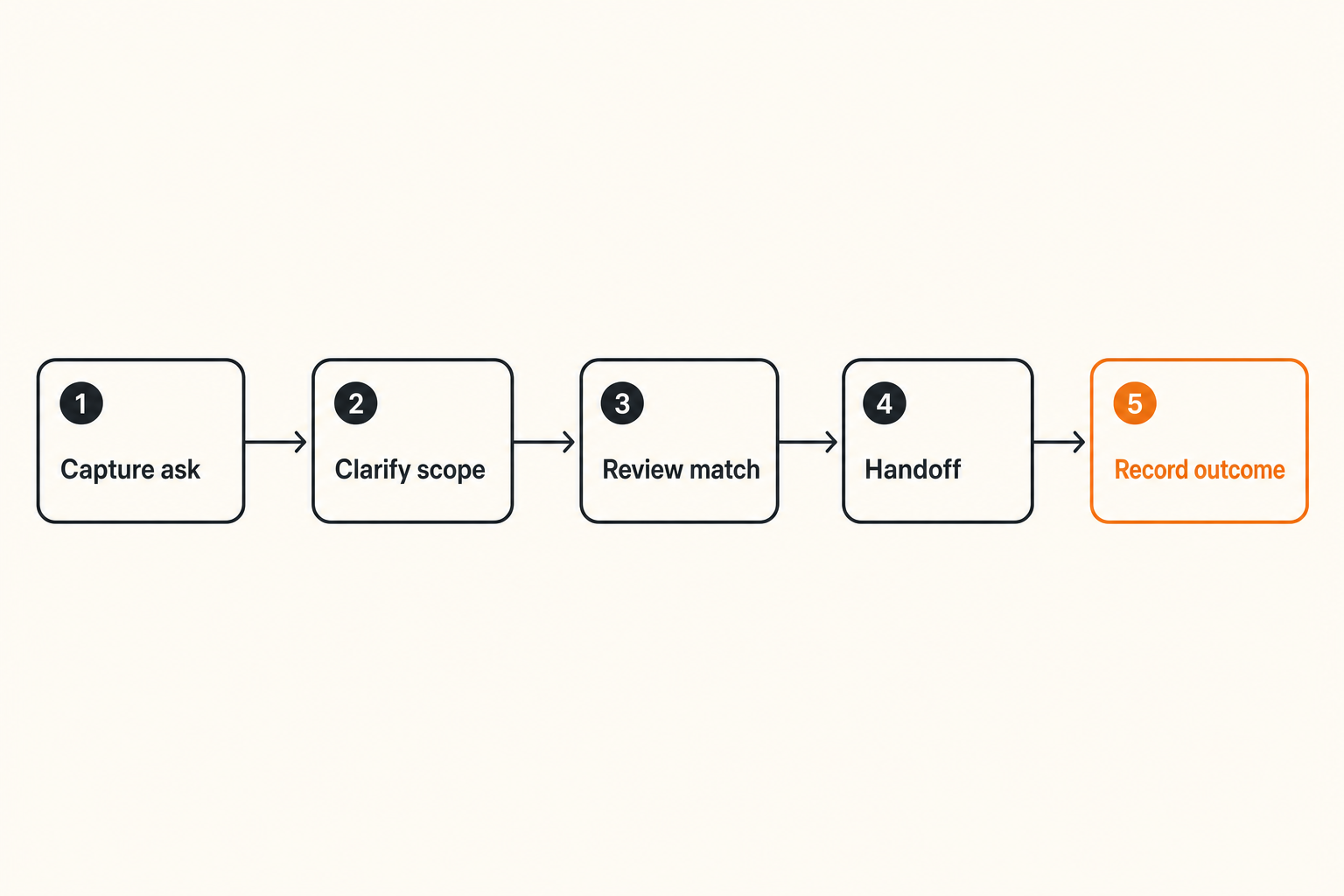
The routing workflow
Community meaning becomes visible in the routing layer. This is where a need becomes a path.
A practical routing workflow looks like this:
- Capture the ask or offer in a structured place.
- Clarify the scope, urgency, location, budget, language, and constraints.
- Identify possible matches from the network map.
- Check trust and fit before making the introduction.
- Assign an owner for the next step.
- Follow up after the expected action.
- Record the outcome and update the network memory.
This does not have to feel heavy. The first version can be a simple intake form, a small operator group, and a weekly review. The point is not software sophistication. The point is not losing the thread.
Practical rule: every ask needs a status, an owner, and a next action. If any of those are missing, the ask is not being operated; it is just being discussed.
The routing layer also protects the people who always help. Without routing discipline, the same trusted connectors get overloaded because everyone knows they know everyone. A real workflow distributes the work and makes invisible labor visible.
Where human judgment belongs
Automation can help capture, sort, remind, and summarize. It should not replace judgment in local trust decisions.
Human judgment belongs at the points where context matters:
- Is this ask safe to route?
- Is the person asking clear enough to receive help?
- Is the provider actually appropriate?
- Does this introduction create a burden, risk, or conflict?
- Does someone need a warm handoff instead of a cold link?
The practical question is how to reserve human attention for those decisions. If operators spend all their time copying messages between platforms, they will not have energy for judgment. If automation blindly matches people, it will produce brittle coordination and trust damage.
Related reading from our network: payment operators deal with a similar state problem in checkout architecture. The surface is different, but the lesson transfers: the visible interface is not the system; state, reconciliation, and support are the system.
Trust is infrastructure, not sentiment
Trust needs scope
Trust is not binary. Someone can be trusted to give a restaurant recommendation but not to handle payroll. Someone can be trusted for a one-hour volunteer shift but not for access to private client data. Someone can be trusted by one subgroup but unknown to another.
Community meaning gets weaker when trust is treated as a warm feeling. It gets stronger when trust is scoped.
Useful trust records are specific:
- Trusted for introductions to local contractors.
- Trusted for Spanish-English document help.
- Trusted for small website fixes under a defined budget.
- Trusted for elder check-ins with an existing relationship.
- New provider, needs first supervised referral.
This is not surveillance. It is responsible routing. Local networks often deal with vulnerable people, small budgets, and personal information. Scope prevents overreach.
Reputation without context breaks quickly
Ratings and testimonials can help, but they are not enough. A five-star reputation in one context can fail in another. A person who is excellent at urgent debugging may be bad at long-term maintenance. A volunteer who is reliable at events may not be reliable for private follow-up.
What breaks in practice is reputation portability. Operators assume a good signal transfers everywhere. Then they make a match that looks good on paper and fails in reality.
A better approach is contextual reputation:
| Signal | Weak version | Useful version |
|---|---|---|
| Skill | Good with websites | Fixed two broken forms for local businesses within one day |
| Reliability | Very helpful | Responds within 24 hours for scoped requests |
| Trust | Known in the group | Referred by two operators for low-risk business support |
| Fit | Nice person | Good for remote debugging, not ongoing marketing work |
| Capacity | Available | Has three hours this week, prefers weekday evenings |
The table looks simple, but it changes the routing quality. It also reduces conflict because expectations are clearer before the introduction happens.
What breaks when community meaning is implemented badly
The loudest people become the system
When there is no routing workflow, the loudest people define the community. That does not always mean bad actors. Sometimes it means extroverts, frequent posters, founders, longtime members, or people with the most flexible schedules.
The problem is operational bias. Quiet but reliable people disappear. New members do not know how to contribute. People with specific needs hesitate to ask because the channel feels performative. Providers get attention based on visibility instead of fit.
This is how local networks become clubs. They may still feel meaningful to insiders, but they stop functioning as coordination infrastructure.
A better system creates multiple participation paths:
- Post a public ask.
- Submit a private ask for operator review.
- Offer a skill with defined boundaries.
- Volunteer as a router or verifier.
- Help with follow-up instead of front-line work.
- Maintain local resource records.
Community meaning has to include people who are not good at public self-promotion. Otherwise the network optimizes for noise.
Events create energy but not memory
Events are useful. They create trust faster than many digital interactions. But events are not the operating system.
What fails is the handoff after the event. People meet, exchange vague interest, and then the network forgets. A business owner mentions a problem. A freelancer says they can help. A volunteer knows someone. Nobody captures it. Two days later, the energy is gone.
The event should feed the network memory:
- What asks surfaced?
- What offers were made?
- Who should be introduced?
- What follow-up is due?
- What new trust signals were observed?
- What resources should be added to the map?
The same applies to online posts. A strong comment thread is not a completed loop. Until someone owns the next action, the network is only generating signals.
What works: a practical operating cadence
Weekly routing review
A weekly routing review is one of the highest-leverage habits for a local network operator. It does not need to be formal. Thirty minutes with the right view can change the entire reliability of the community.
Review these items:
- New asks that need clarification.
- New offers that need boundaries.
- Open matches waiting for confirmation.
- Introductions made but not followed up.
- People who are overused and need relief.
- Categories with demand but no supply.
- Supply that exists but has no visible path to use.
The output should be concrete: assign owners, send clarifying questions, make introductions, close stale items, and update records.
This is also where community meaning becomes less abstract. Operators start seeing patterns. Maybe local businesses keep asking for workflow automation. Maybe bilingual document help is under-supplied. Maybe providers are available but unclear about scope. Maybe one neighborhood is overrepresented and another has no router.
For a concrete example of how a public local need can become a coordination object, an operator could point to an ask like seeking one public business workflow to automate, where the request is specific enough to qualify, route, and follow up.
Monthly network maintenance
Weekly review handles motion. Monthly maintenance handles structure.
A monthly operator session should ask:
- Are our categories still useful?
- Which asks are repeatedly failing to route?
- Which offers need clearer descriptions?
- Which trust policies are missing?
- Which communication channels are creating duplicate work?
- Which people are carrying too much invisible labor?
- Which outcomes should be documented as examples?
The mistake teams make is assuming the network map stays accurate. It does not. People move, burn out, change jobs, change capacity, learn new skills, or stop responding. Local reality changes faster than the directory.
Monthly maintenance is where the network stays honest.
Related reading from our network: content teams face adjacent workflow issues when automation increases volume without review gates. Local networks have the same risk: more activity is not better if the review and follow-up layer cannot absorb it.
Tools matter, but workflow owns the outcome
The comparison that matters
Tools can improve community operations, but only if they support the workflow. A group chat, CRM, spreadsheet, directory, marketplace, or custom platform will all fail if the operating model is unclear.
The useful comparison is not tool A versus tool B. It is unmanaged participation versus operated coordination.
| Area | Unmanaged participation | Operated coordination |
|---|---|---|
| Ask capture | Buried in posts and DMs | Structured enough to route |
| Offer capture | Generic introductions | Specific scope and constraints |
| Matching | Whoever sees the message | Operator-reviewed routing |
| Trust | Assumed from familiarity | Scoped to context and risk |
| Follow-up | Optional and inconsistent | Owned, timed, and recorded |
| Memory | Lives in people’s heads | Updated in shared records |
| Inclusion | Favors visible members | Supports multiple contribution paths |
This table is the core operator shift. The goal is not to make community cold or bureaucratic. The goal is to make participation dependable.
Automation should protect attention
Automation is useful when it removes mechanical drag:
- Intake forms that collect enough detail.
- Notifications for overdue follow-up.
- Tagging asks by category and location.
- Summaries of open loops.
- Duplicate detection across channels.
- Reminders to update stale offers.
Automation fails when it pretends trust is a simple matching problem. It also fails when it creates more work than it removes. If operators have to clean up messy automated suggestions, the system is not helping.
A practical automation boundary is this: automate the queue, not the judgment. Let software help surface what needs attention. Keep humans responsible for sensitive routing decisions.
This is especially important for freelance community leaders. A local network often blends friendship, service, mutual aid, and paid work. A bad match can damage more than one transaction. It can damage the willingness to ask again.
Measure community meaning by completed loops
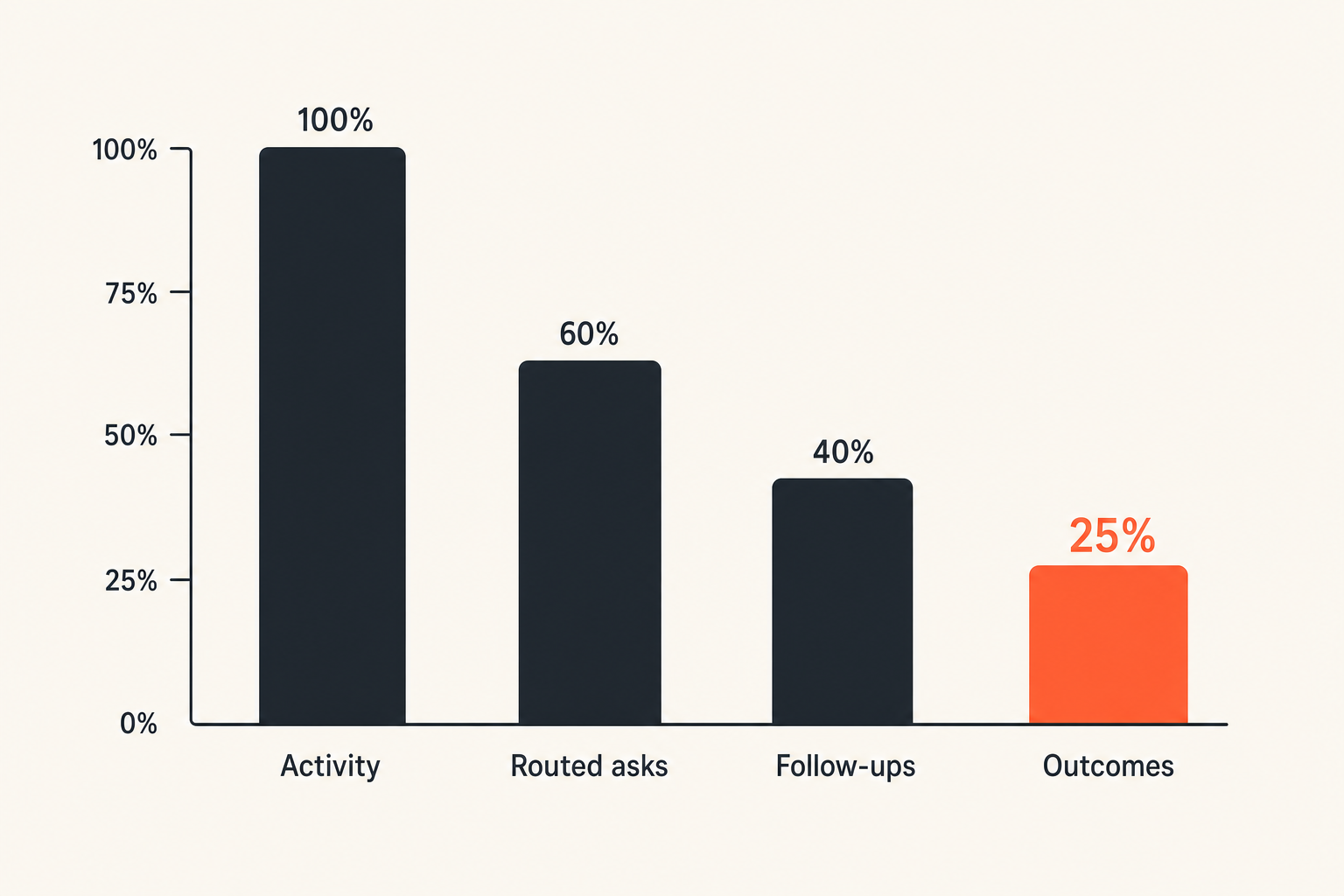
Metrics that operators can use
Community meaning should be measured by completed loops, not just visible activity.
Useful metrics include:
- New asks captured.
- Asks clarified within a reasonable time.
- Asks routed to at least one possible helper.
- Matches accepted by both sides.
- Follow-ups completed.
- Outcomes recorded.
- Repeat participation after a successful match.
- Unresolved asks by category.
- Overloaded routers or providers.
These metrics do not need to become a dashboard on day one. Even a weekly count is useful because it reveals friction.
If many asks are captured but few are clarified, intake is weak. If many are clarified but few are routed, the network lacks supply or mapping. If many are routed but few complete, trust, fit, or follow-up is broken. If outcomes are not recorded, the network cannot learn.
Practical rule: measure the drop-offs between ask, route, match, follow-up, and outcome. The drop-off tells you where community meaning is leaking.
Do not measure only engagement
Engagement metrics are tempting because they are easy. Views, likes, comments, attendance, and signups can indicate attention, but they do not prove coordination.
A high-engagement group can still be operationally weak. A low-volume network can be extremely useful if the right people are connected at the right time with good follow-up.
Operators should separate three layers:
- Attention: who saw or reacted to something.
- Participation: who contributed an ask, offer, or response.
- Coordination: what was routed, completed, and learned.
Most community platforms overemphasize the first layer. Serious local networks need the third.
This is where community meaning becomes durable. People keep participating when the network can remember them, respect their constraints, and help them complete real loops.
Putting community meaning into d0rz.com workflows
A lightweight implementation sequence
If you are starting from scratch, do not begin with a massive community strategy. Begin with one repeatable loop.
A practical implementation sequence:
- Pick one local category, such as small business workflow help, translation support, repair referrals, or freelance services.
- Define the minimum ask fields: what is needed, where, by when, budget or no budget, preferred language, and privacy constraints.
- Define the minimum offer fields: what is offered, service area, availability, price boundary if relevant, and trust notes.
- Assign one operator to review new asks twice per week.
- Route only matches that are clear enough to support.
- Follow up after the expected action date.
- Record the outcome, even if the outcome is no match found.
- Review unresolved patterns monthly and adjust categories.
That is enough to start. The network does not need to solve every local problem immediately. It needs to prove that one class of ask can move through the system reliably.
The d0rz post on the local network operating model is useful here because it treats the network as a set of repeatable responsibilities, not a vague campaign for engagement.
Product fit for local network operators
This is where d0rz.com fits naturally. The product is not trying to replace the human layer of community. It gives local operators a place to make asks and offers more concrete, visible, and routeable.
For people building practical local networks, that matters. A post that says I can help with same-day website form debugging is easier to route than a generic profile. An ask that describes one workflow needing automation is easier to qualify than a vague request for business help. A local offer with boundaries is easier to trust than a slogan.
The operator value is architectural:
- Asks and offers become durable objects instead of disappearing in chat.
- Local context can sit next to the request.
- Matching can happen around concrete needs, not only identities.
- Follow-up becomes easier because the original coordination object still exists.
- The network can learn from what gets routed and what stalls.
This is the difference between a community that feels active and a community that can coordinate.
The closing point is simple: community meaning is not created by naming the group. It is created when people can ask clearly, offer responsibly, route trustfully, and close the loop.
Try d0rz.com
d0rz.com is for people building practical local networks where asks, offers, trust, routing, and follow-up matter. If you want community meaning to become reliable coordination infrastructure, Try d0rz.com.