

A community operations audit usually starts after something small but painful happens.
A member asks for help and nobody responds. A provider offers a useful service but the right people never see it. A local organizer spends three evenings forwarding messages between people who could have been matched in ten minutes. Everyone says the community is active, but the work does not move.
Teams think the problem is engagement. The real problem is operations.
That changes the conversation. A community operations audit is not a survey about whether people feel connected. It is an audit of how asks enter the network, how offers are discovered, how trust is evaluated, how handoffs happen, and whether anyone follows up. In 2026, local networks are expected to coordinate more real-world work with less staff, more fragmented channels, and lower tolerance for wasted attention. The practical question is not whether your community exists. It is whether your community can reliably route useful action.
Table of contents
- Why a community operations audit is an operating system check
- Map the work before you score the community operations audit
- Inventory asks, offers, trust, and follow-up
- Score channels by job, not popularity
- Run the community operations audit as a workflow, not a survey
- Measure what changes operator behavior
- Common failure modes in local community operations
- What works when the audit finds gaps
- Community operations audit checklist for 2026
- Where d0rz.com fits in the operating model
Why a community operations audit is an operating system check
A useful way to think about it is this: a local network is an operating system for coordination. People bring inputs into it. Those inputs need routing, context, permission, trust, and closure. If the system cannot process the inputs, more members will not fix it.
The visible problem is participation
Most communities diagnose weak participation from the surface layer. Low replies. Quiet group chats. Event drop-off. Provider fatigue. Members who lurk but do not contribute.
Those symptoms matter, but they are not specific enough to operate against. Low participation may mean the ask was vague. It may mean the request went to the wrong channel. It may mean members have learned that responding creates unmanaged obligation. It may mean offers are stale, untrusted, or too hard to compare.
The mistake teams make is treating all of that as one engagement problem. Then they add reminders, newsletters, events, or more posts. Sometimes that produces a temporary spike. It rarely fixes the route from need to action.
The real problem is routing
Routing is the missing middle between interest and outcome. It answers four questions:
- Who should see this ask or offer?
- What context do they need before acting?
- Who is responsible for the next step?
- How do we know the loop closed?
If a community cannot answer those questions, it becomes a broadcast layer. Broadcast layers are fine for announcements. They are weak for coordination.
This is why a community operations audit should inspect the movement of work, not just the mood of the group. For adjacent thinking on local network operating models, the prior d0rz post on community building as a practical operating model is useful because it treats matching, trust, and sustained participation as infrastructure rather than branding.
What the audit should prove
A good audit proves whether the network can convert participation into a reliable sequence:
- A real ask or offer appears.
- The network captures enough context to route it.
- The right people are notified or can discover it.
- A match, referral, decline, or escalation happens.
- Someone follows up.
- The outcome improves future routing.
Practical rule: audit the path from signal to outcome. Do not audit sentiment alone and pretend you have inspected operations.
Map the work before you score the community operations audit
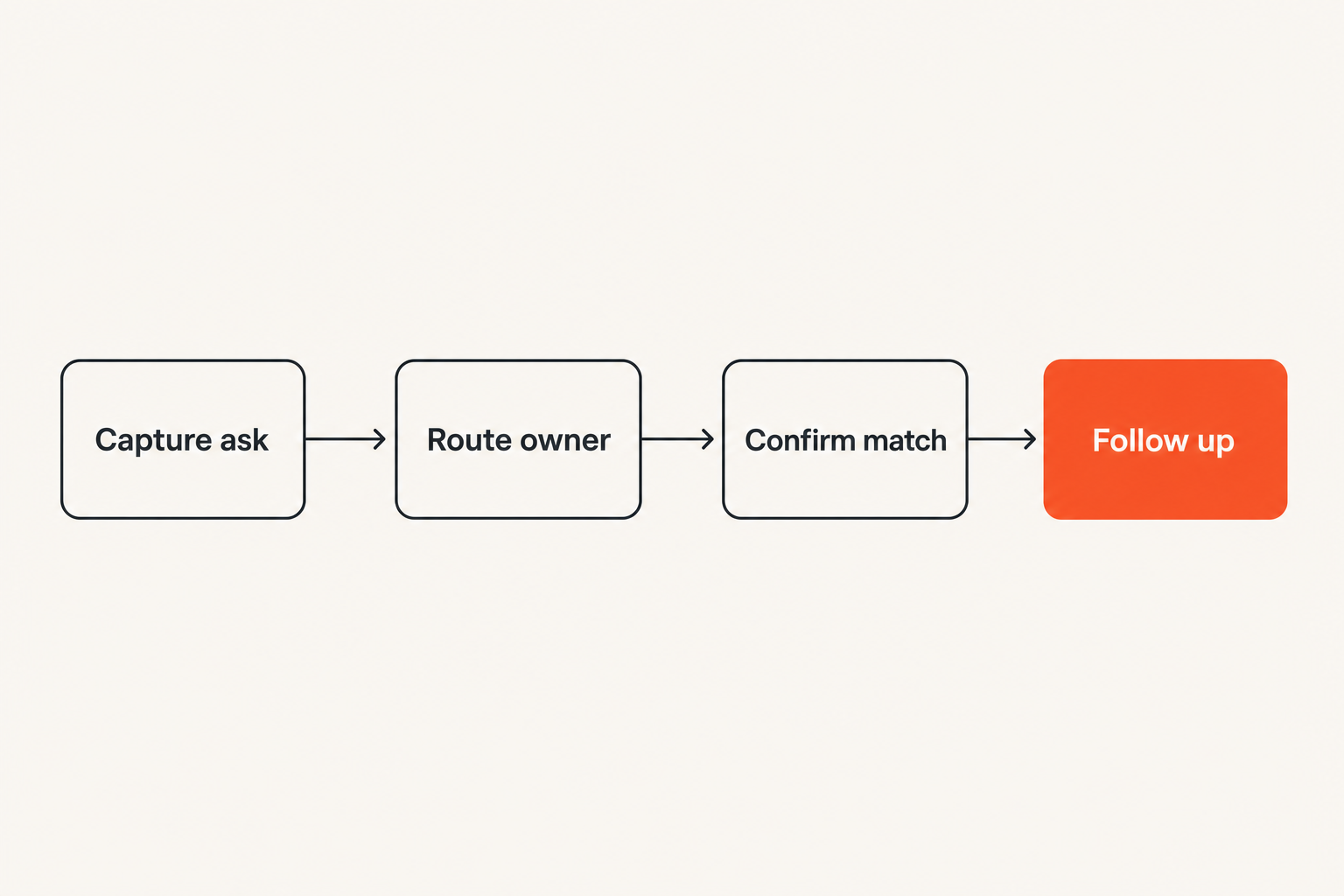
Before you score anything, map the work. Most community audits fail because they start with categories like events, content, membership, and engagement. Those are containers. The better starting point is work entering the network.
What work actually enters the network
List the actual operating events from the last 30 to 90 days. Do not summarize them yet. Capture the raw shape:
- A restaurant needs someone to fix a broken booking form.
- A parent needs a ride route for after-school pickup.
- A freelance designer has two open project slots.
- A mutual aid group needs storage space.
- A local business wants to automate a CSV cleanup.
- A new member asks who can be trusted for home repairs.
These are not content items. They are coordination objects. They have state, urgency, location, trust requirements, and ownership.
If you run a d0rz-style local network, asks and offers are especially important because they reveal operational demand. For example, a public ask such as seeking one public business workflow to automate is not just a post; it is a test of whether the network can route a specific workflow need to a qualified person.
Where requests get lost
Every local network has loss points. The audit should name them plainly.
Common loss points include:
- The request is too vague to route.
- The request is posted in a channel where the right people do not look.
- The coordinator sees it but does not have capacity.
- A possible helper replies privately, so the network loses visibility.
- No one knows whether the request is still open.
- The match happens, but no outcome is recorded.
What breaks in practice is not always willingness. It is state. Nobody can tell whether something is new, in progress, blocked, matched, done, expired, or failed.
Who owns the next action
Ownership is the point where community operations become real. If an ask has no owner, it is just ambient need. If an offer has no maintenance owner, it becomes stale inventory.
During the audit, assign every sampled item a next-action owner. This is not always the person doing the work. It may be the requester, the provider, a moderator, a routing lead, or a local organizer.
The audit question is simple: if this item is not resolved in three days, who notices?
Practical rule: if no one owns the next action, the network is relying on luck, not operations.
Inventory asks, offers, trust, and follow-up
A community operations audit should have four core inventories: asks, offers, trust signals, and follow-up records. If any one is missing, the network will compensate with private memory and coordinator labor.
Asks need state
An ask is not complete when someone posts it. It needs state.
Useful states include:
- New
- Needs clarification
- Routed
- Matched
- In progress
- Blocked
- Done
- Expired
The exact labels can vary. The important part is that operators can see movement. A request for same-day help should not sit next to a vague idea from three months ago with the same visual weight.
Asks also need minimum fields: location, urgency, category, constraints, contact method, and what success looks like. Without that, routing becomes an interview process conducted in public.
Offers need boundaries
Offers fail when they are written like personality statements. Helpful, available, community-minded, and happy to help are not enough.
An operational offer should answer:
- What can this person or business actually do?
- Where do they serve?
- What is excluded?
- What response time is realistic?
- Is the offer paid, volunteer, barter, or referral-based?
- What proof or examples support it?
The difference matters. An offer like local errands, software triage, translation, childcare backup, bookkeeping cleanup, or event setup can only be routed well if the boundaries are clear. A relevant example is a local service listing such as remote website and automation help for local businesses, where the useful operational detail is not the title alone but the scope, limits, and fit.
Trust needs evidence
Trust is not a vibe. In local networks, trust is usually a stack of weak signals that become useful when operators preserve them.
Examples of trust evidence:
- Completed prior work
- Mutual connection
- Public profile history
- Verified business presence
- Repeat participation
- Clear boundaries
- Reliable follow-up
- Known dispute history
Do not overbuild this into a heavy reputation system too early. The mistake teams make is trying to create a perfect score. Scores invite gaming and false confidence. Operators usually need structured notes, clear provenance, and a way to distinguish known, unknown, and risky.
Score channels by job, not popularity
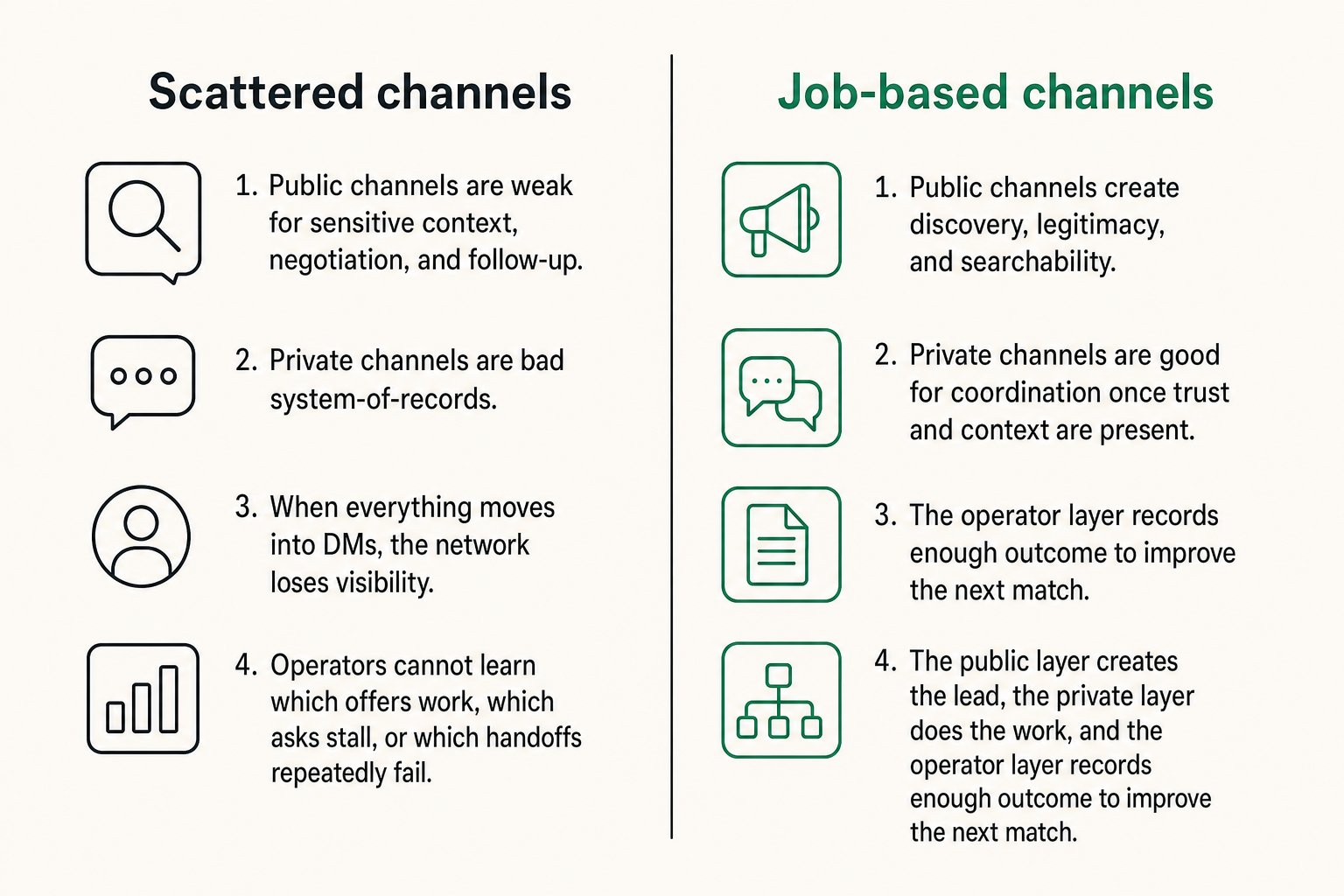
Channel audits often become arguments about where people prefer to talk. That is the wrong frame. Channels should be scored by job.
Public channels create discovery
Public channels are good for discovery, legitimacy, and searchability. A public post helps people understand what exists in the network. It lets a future member see that real requests and real offers move through the system.
But public channels are weak for sensitive context, negotiation, and follow-up. People may not want to disclose budget, personal constraints, addresses, urgency, or failure details.
A public channel should answer: what exists, who might help, and what is the next safe step?
Private channels create action
Private channels are good for coordination once trust and context are present. They support fast clarification, scheduling, and sensitive details.
But private channels are bad system-of-records. When everything moves into DMs, the network loses visibility. Operators cannot learn which offers work, which asks stall, or which handoffs repeatedly fail.
This is the common pattern: the public layer creates the lead, the private layer does the work, and the operator layer records enough outcome to improve the next match.
Related reading from our network: incident command structure for SOC teams is from a security operations context, but the lesson transfers well: when channels multiply, clear ownership and escalation paths matter more than chat volume.
The channel table
Use a table like this during the audit. Keep it practical. Score each channel by the work it should do, not by how much noise it contains.
| Channel type | Best job | What fails | Audit question |
|---|---|---|---|
| Public listings | Discovery of asks and offers | Stale posts, vague scope | Can a stranger understand the next step? |
| Group chat | Fast lightweight coordination | Important items disappear | Is there a capture path for unresolved work? |
| Email newsletter | Periodic awareness | Low urgency, weak routing | Does it drive action or just impressions? |
| Private DM | Clarification and scheduling | No shared state | Does the outcome return to the system? |
| Spreadsheet | Temporary tracking | Manual drift | Who maintains it and how often? |
| CRM or database | Structured operations | Overhead and low adoption | Does it match the community workflow? |
Practical rule: every channel should have a job. If a channel has no job, it becomes another place operators must monitor.
Run the community operations audit as a workflow, not a survey
A community operations audit should be executed like a workflow review. Surveys can be useful, but they often capture opinion after the system has already failed. You need to inspect live objects moving through the network.
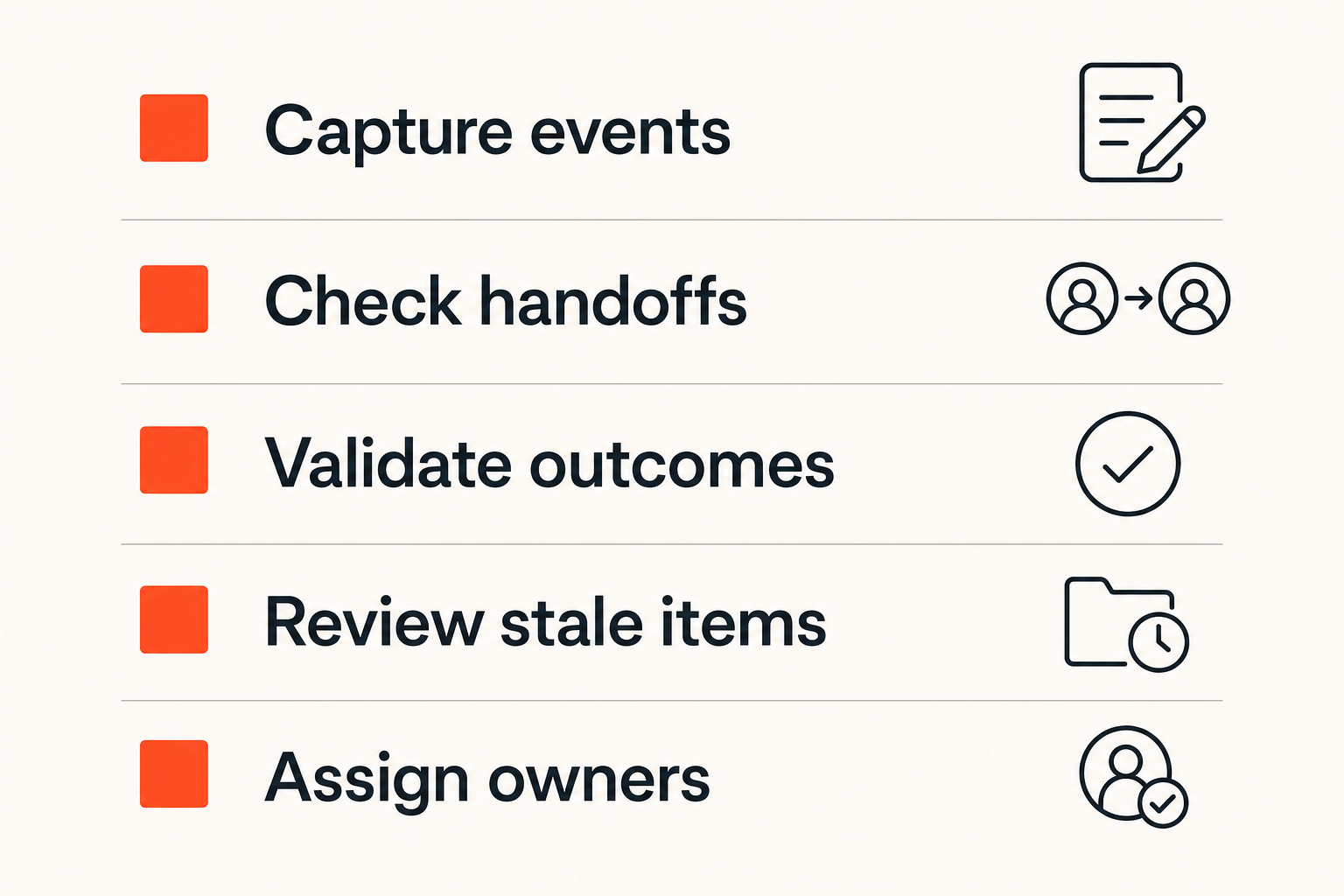
Step 1 capture operating events
Start with a sample of 25 to 100 recent operating events, depending on network size. Include resolved and unresolved items. Do not only sample success stories.
For each item, capture:
- Source channel
- Date created
- Type: ask, offer, referral, event, issue, dispute, resource
- Owner
- Required trust level
- Location or service area
- Current state
- Last action date
- Outcome, if any
This creates the audit dataset. It does not need to be perfect. It needs to be consistent enough to expose where work stalls.
Step 2 normalize the handoff
Next, inspect handoffs. The handoff is where many networks break because one person thinks they introduced two people and another person thinks they assigned responsibility.
A normalized handoff includes:
- The reason for the match.
- What each party is expected to do next.
- Any constraints or risks.
- The communication channel for the next step.
- A follow-up date.
This is not bureaucracy. It is how you prevent social ambiguity from becoming operational failure.
A simple handoff note can look like this:
Matched: Jordan needs a low-cost website form fix. Routed to Priya because she handles small business form debugging. Jordan will send URL and error screenshot by Thursday. Priya will confirm fit or decline within 24 hours. Follow up Friday.
Step 3 validate completion
Completion is not the same as introduction. Completion means the loop reached a useful end state.
Valid outcomes include:
- Completed
- Declined with reason
- Referred elsewhere
- Expired because requester stopped responding
- Blocked by missing information
- Escalated to organizer
The point is not to force every ask into success. The point is to know what happened. A declined request with a clear reason is operationally better than an open request nobody understands.
Measure what changes operator behavior
Metrics are dangerous when they make weak operations look healthy. A network can have many members, many posts, and many reactions while still failing at routing useful work.
Metrics that change behavior
Use metrics that tell operators what to adjust.
Good operating metrics include:
- Median time from ask created to first qualified response
- Percentage of asks with an explicit owner
- Percentage of offers updated in the last 90 days
- Number of unresolved items older than seven days
- Percentage of matches with recorded outcome
- Number of handoffs requiring coordinator intervention
- Repeat successful routes by category
These metrics are useful because they point to action. If qualified response time is high, improve capture and routing. If offer freshness is low, prune or refresh inventory. If outcomes are missing, fix follow-up.
Signals that expose drift
Drift is what happens when the community still looks alive but the operations no longer match reality.
Watch for these signals:
- Members keep asking who can help with the same recurring need.
- Trusted providers are overloaded because no alternatives are visible.
- New offers are announced but never used.
- Organizers remember outcomes, but the system does not.
- Private chats contain most of the actual coordination.
- Members hesitate to respond because expectations are unclear.
Related reading from our network: standards for AI agent systems as workflow is about technical interoperability, but the same principle applies here: definitions are less useful than shared events, identity, audit trails, and workflow ownership.
What not to measure
Do not optimize primarily for vanity metrics:
- Total members
- Total messages
- Likes or reactions
- Event photos
- Newsletter opens without action
- Number of channels
These can be useful context, but they do not prove coordination capacity. A community with 300 people and reliable routing can outperform a community with 10,000 people and no operating model.
Practical rule: if a metric does not tell an operator what to do next, keep it out of the main audit scorecard.
Common failure modes in local community operations
Failure modes are not moral failures. They are design failures. Most local organizers are already doing too much with too little system support. The audit should make the failure visible without blaming the people holding the network together.
The directory trap
The directory trap happens when a community builds a list and assumes it has built a network.
A directory answers who exists. It does not answer who is available, trusted for this kind of work, operating in this area, responsive this week, or already overloaded.
Directories become stale because they lack event pressure. Nobody updates an offer unless the system creates a reason to update it. During the audit, sample directory entries and ask whether each one could be routed today with confidence. If not, it is inventory risk.
The hero coordinator trap
The hero coordinator trap happens when one or two people know how everything works. They remember which plumber helped last time, which volunteer is reliable, which business owner prefers texts, and which member should not be matched without extra care.
This works until it does not. The coordinator gets sick, busy, burned out, or simply becomes the bottleneck. The community thinks it has trust infrastructure. In reality, it has a person with a memory.
The fix is not to remove human judgment. The fix is to preserve enough context that judgment can be shared. For local networks that touch safety, access, or sensitive services, the d0rz article on security operations for local networks is relevant because it frames response, ownership, and access as community operating concerns, not just technical concerns.
The no follow-up trap
No follow-up is the most common and least glamorous failure.
An ask is matched. Everyone feels good. Then nobody checks whether the work happened, whether the provider was reliable, whether the requester got stuck, or whether the match created a new problem.
This destroys learning. The network cannot improve routing because it never records outcomes. It also damages trust quietly. Members stop asking because previous asks disappeared into ambiguity.
What works when the audit finds gaps
The audit is only useful if it produces changes the network can actually run. Do not respond to every finding with a new tool. Often the fix is a smaller operating rule, a clearer owner, or a better state model.
Make ownership visible
Ownership should be visible at the item level. Every open ask, active offer, unresolved issue, and sensitive handoff should have an owner.
This does not mean the owner does all the work. It means the owner is responsible for knowing the next state.
A practical owner field might be:
- Requester owns clarification.
- Provider owns fit confirmation.
- Organizer owns escalation.
- Moderator owns safety review.
- Routing lead owns stale item cleanup.
When ownership is visible, operators can distribute load. When it is invisible, the most conscientious person absorbs it.
Design for small reliable loops
Large community strategies often fail because they depend on big launches. Local network operations improve through small reliable loops.
Examples:
- Every new ask gets clarified within 24 hours.
- Every public offer is refreshed or archived every quarter.
- Every match gets one follow-up note.
- Every unresolved item older than seven days is reviewed weekly.
- Every sensitive request has a private escalation path.
These loops are boring. That is the point. Reliable coordination is mostly boring infrastructure that makes useful action feel easy.
Separate moderation from operations
Moderation and operations overlap, but they are not the same job.
Moderation asks: is this acceptable, safe, on-topic, and within norms?
Operations asks: what is this, who owns it, where should it go, and how will we know what happened?
When the same person does both without distinction, moderation queues become operational queues. Posts get approved, but work does not move. Or work moves, but safety review is skipped because the operator is rushing.
For adjacent reading from another technical context, Akash network alternative workflow evaluation looks at infrastructure through workload, validation, retries, and ownership. Community systems face a softer version of the same issue: the UI is not the system; the workflow behind it is.
Community operations audit checklist for 2026
Use this checklist as a starting point. Adapt it to your network size, risk profile, and local context.
Weekly checks
Weekly checks should focus on live work.
- Review open asks older than seven days.
- Confirm every urgent ask has an owner.
- Check whether new offers have enough scope to route.
- Follow up on recent matches.
- Identify repeated requests that need a standing resource.
- Escalate safety or trust concerns.
This review can be 30 minutes for a small network. The important part is consistency. If the review keeps growing, that is a sign your capture or state model is too loose.
Monthly checks
Monthly checks should focus on patterns.
- Which categories are generating the most asks?
- Which offers are actually being used?
- Which channels produce qualified responses?
- Which handoffs require coordinator rescue?
- Which trust questions keep repeating?
- Which members are overloaded?
Monthly review is where you decide whether to create a new resource, recruit new providers, retire stale inventory, or change channel rules.
Quarterly checks
Quarterly checks should focus on system design.
- Archive stale offers.
- Reconfirm key providers.
- Review safety and escalation rules.
- Inspect whether private coordination is returning outcomes to the system.
- Update category definitions.
- Review whether the network is serving the local area it claims to serve.
Quarterly is also when you should ask whether your tooling still fits. If the network has grown from casual introductions to real operational dependency, chat threads and memory will not be enough.
Where d0rz.com fits in the operating model
A community operations audit should make your tooling decisions clearer. You do not need software for every community interaction. You do need a reliable place for asks, offers, routing context, and follow-up when the network is expected to coordinate real help.
When a lightweight network layer helps
A lightweight network layer helps when:
- Asks and offers are scattered across too many channels.
- Members need to discover local capacity without waiting for a coordinator.
- Operators need public context plus private follow-up.
- Trust depends on prior activity and clear boundaries.
- Local providers need a way to be found for specific work.
- The network needs memory without becoming a heavy CRM project.
The point is not to replace relationships. The point is to stop making relationships carry all the operational state.
Use the audit to decide what belongs there
After the audit, decide what should become structured and visible.
Good candidates include recurring asks, concrete offers, local service capacity, workflow help, volunteer availability, and public coordination needs. Poor candidates include sensitive personal details, unresolved disputes, private addresses, and anything that requires careful consent before sharing.
That boundary matters. Local networks work when they preserve enough public structure to route action while protecting the private context that should not become searchable inventory.
A practical rule for d0rz.com-style networks: publish the coordination object, not every detail of the relationship. The ask or offer should make the next step possible. It should not expose more than the network needs.
Try d0rz.com
A community operations audit is how you find the gaps. d0rz.com is for people building practical local networks where asks, offers, trust, routing, and follow-up matter.