

Most first community projects fail quietly. The group chat gets busy, the launch post gets polite reactions, and a few people say they are excited. Then someone asks for help, nobody owns the route, the follow-up disappears, and the organizer becomes the manual switchboard.
Teams think the problem is getting enough people into the first community. The real problem is designing a coordination system that can move a specific ask to a capable offer with enough trust, context, and follow-up to produce an outcome.
That changes the conversation. You are not building a vibe. You are building the first small network where participation can be operationally useful.
The practical question is not, "How do we get engagement?" It is, "Can this group reliably help one person get one thing done without burning out the operator?"
Table of contents
- Why the first community is an operating decision
- The first community is an operating system, not an audience
- Define the work before you recruit people
- Build the routing layer for asks, offers, and trust
- Design trust as a workflow
- Run the first community like a service desk
- Tooling choices for a first community in 2026
- Measure coordination, not attention
- Failure modes that kill the first community
- Where d0rz.com fits for first community operators
Why the first community is an operating decision
What the phrase should mean
A useful way to think about the first community is this: it is the smallest network where your coordination assumptions are tested against real behavior.
Not the biggest mailing list. Not the broadest neighborhood group. Not the prettiest launch event.
It is the first set of people who can produce useful movement around a narrow category of work. A tenant needs a repair referral. A local shop needs help debugging a form. A freelancer needs one warm introduction. A parent needs a reliable after-school ride option. A mutual aid group needs delivery coverage for a specific block.
The mistake teams make is treating the first community as a branding asset. They name it, announce it, invite everyone, and then discover that nobody knows what to do with it. Participation has no shape, so the operator supplies all the shape manually.
Your first community should answer three questions:
- What kinds of asks belong here?
- What kinds of offers can respond?
- Who owns the route between them?
If you cannot answer those questions, you do not have a community operating model. You have a room.
Why now is different
In 2026, local networks have more tools than ever and less operational patience. People already live inside overloaded channels: group chats, neighborhood apps, Discord servers, mailing lists, forms, directories, and marketplaces. Adding another place to talk is not enough.
What people need is lower-friction coordination. They need to know where to put an ask, what information to include, who will see it, what happens next, and when they can stop waiting.
That is why the first community should be designed as workflow infrastructure from the beginning. The UI is not the system. The system is the set of states, owners, trust checks, retries, and follow-up loops that make help reliable.
Practical rule: If your first community cannot route one concrete ask without the founder personally interpreting every message, the design is not ready to scale.
This is also where many local organizers underestimate the work. They assume goodwill will cover the gaps. Goodwill helps, but it does not replace intake, routing, accountability, or closure.
The first community is an operating system, not an audience
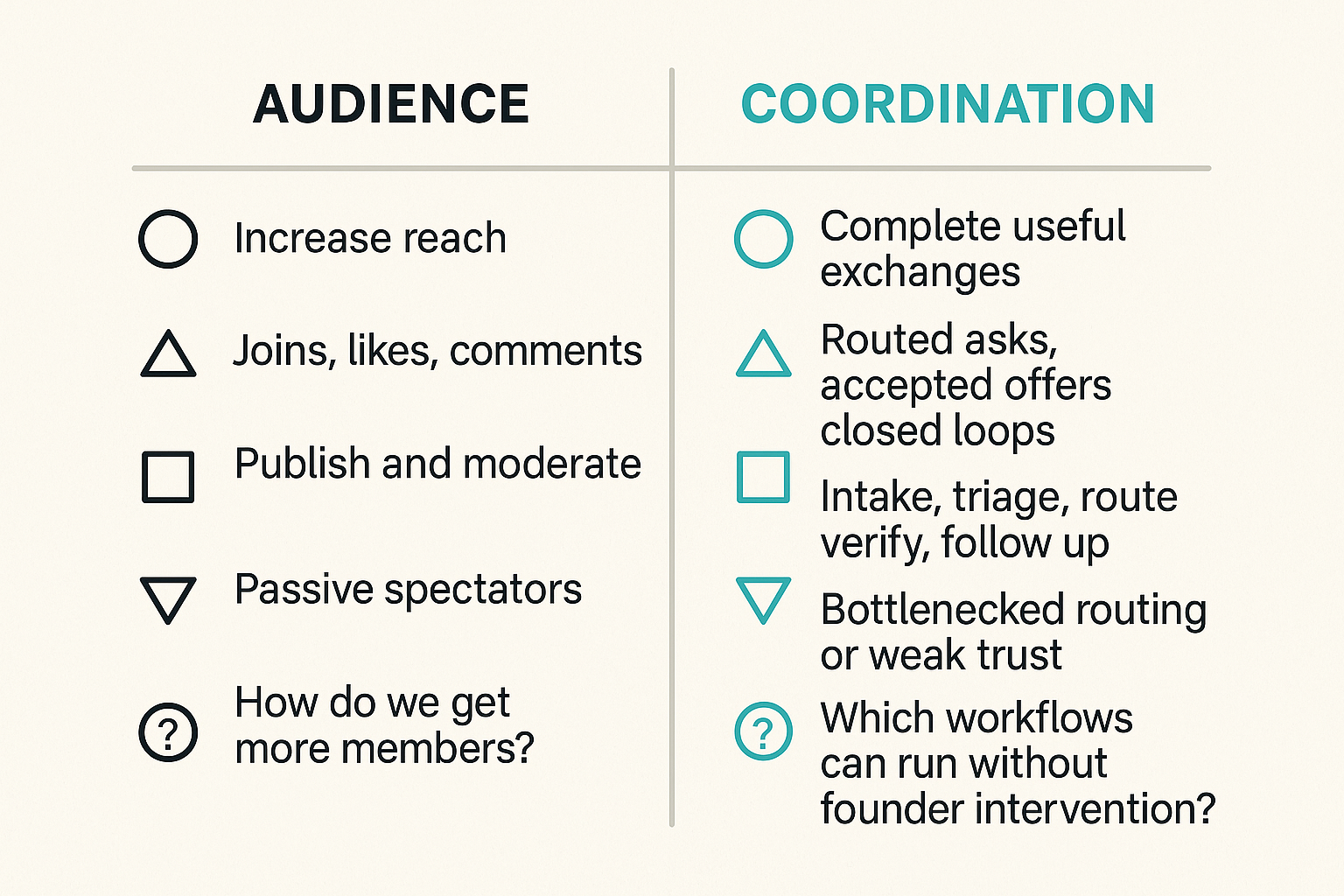
Audience metrics create false confidence
Audience metrics are seductive because they move quickly. Members joined. Posts were viewed. Comments appeared. The launch had energy.
But those numbers rarely tell you whether the first community can coordinate anything useful.
A local network with 80 people and clear routing can outperform a group with 5,000 passive members. The smaller group knows what belongs, who can help, how trust is established, and what counts as done. The larger group may generate more noise but less movement.
Here is the operator distinction:
| Lens | Audience-first community | Coordination-first community |
|---|---|---|
| Primary goal | Increase reach | Complete useful exchanges |
| Main signal | Joins, likes, comments | Routed asks, accepted offers, closed loops |
| Operator role | Publish and moderate | Intake, triage, route, verify, follow up |
| Failure mode | Passive spectators | Bottlenecked routing or weak trust |
| Scaling question | How do we get more members? | Which workflows can run without founder intervention? |
The second column is harder. It is also the only one that tells you whether the network is becoming infrastructure.
Related reading from our network: security teams face a similar mistake when they treat incidents as documents instead of operating models; the incident-command framing in The Incident Command System ICS Is a SOC Operating Model is useful if you want a parallel for roles, handoffs, and ownership under pressure.
Coordination metrics change behavior
When you measure coordination, people behave differently. They stop optimizing for announcement volume and start optimizing for completed work.
A first community should track practical states:
- New ask received
- Ask clarified
- Candidate offer identified
- Offer accepted
- Work in progress
- Completed
- Follow-up needed
- Closed
These states sound basic because they are basic. What breaks in practice is that most communities never define them. Every ask becomes a unique exception. Every helper gets a custom explanation. Every unresolved issue lives in the organizer's memory.
That does not scale past a few dozen active relationships.
Practical rule: A community state that exists only in the organizer's head is not an operational state. Write it down, expose it, and review it.
Define the work before you recruit people
Start with asks and offers
Before recruiting, define the work surface. A first community needs a narrow enough surface that people can recognize whether they belong.
For d0rz-style local networks, the basic primitives are asks and offers:
- An ask is a request for help, service, information, access, or coordination.
- An offer is a capability, availability, asset, service, route, or willingness to help.
The system gets stronger when asks and offers are specific. A vague ask creates interpretation labor. A specific ask creates routing options.
Weak ask: "I need help with my business."
Operational ask: "I run a small bakery in Winston Salem and need someone to automate email sorting for catering inquiries before next Friday."
That second version can be routed. It has location, category, deadline, work type, and likely provider profile. It also sets the basis for trust and follow-up.
This is why a live ask such as looking for small business automation projects in Winston Salem is more useful to a network operator than a generic call for collaboration. It gives the network something to match against.
Make participation specific
People participate more reliably when the expected action is small and clear. The first community should not ask members to "be active." It should ask them to do defined things.
Examples:
- Submit one local ask with enough detail to route.
- List one offer with scope, location, availability, and constraints.
- Vouch for one provider you have actually used.
- Close the loop when an introduction works or fails.
- Flag a request that is unsafe, unclear, or out of scope.
The mistake teams make is inviting people into an undefined social obligation. Most members do not know whether they should post, reply, refer, promote, or wait. The result is passive goodwill.
Specific participation reduces social ambiguity. It also lets the operator build repeatable workflows.
Build the routing layer for asks, offers, and trust
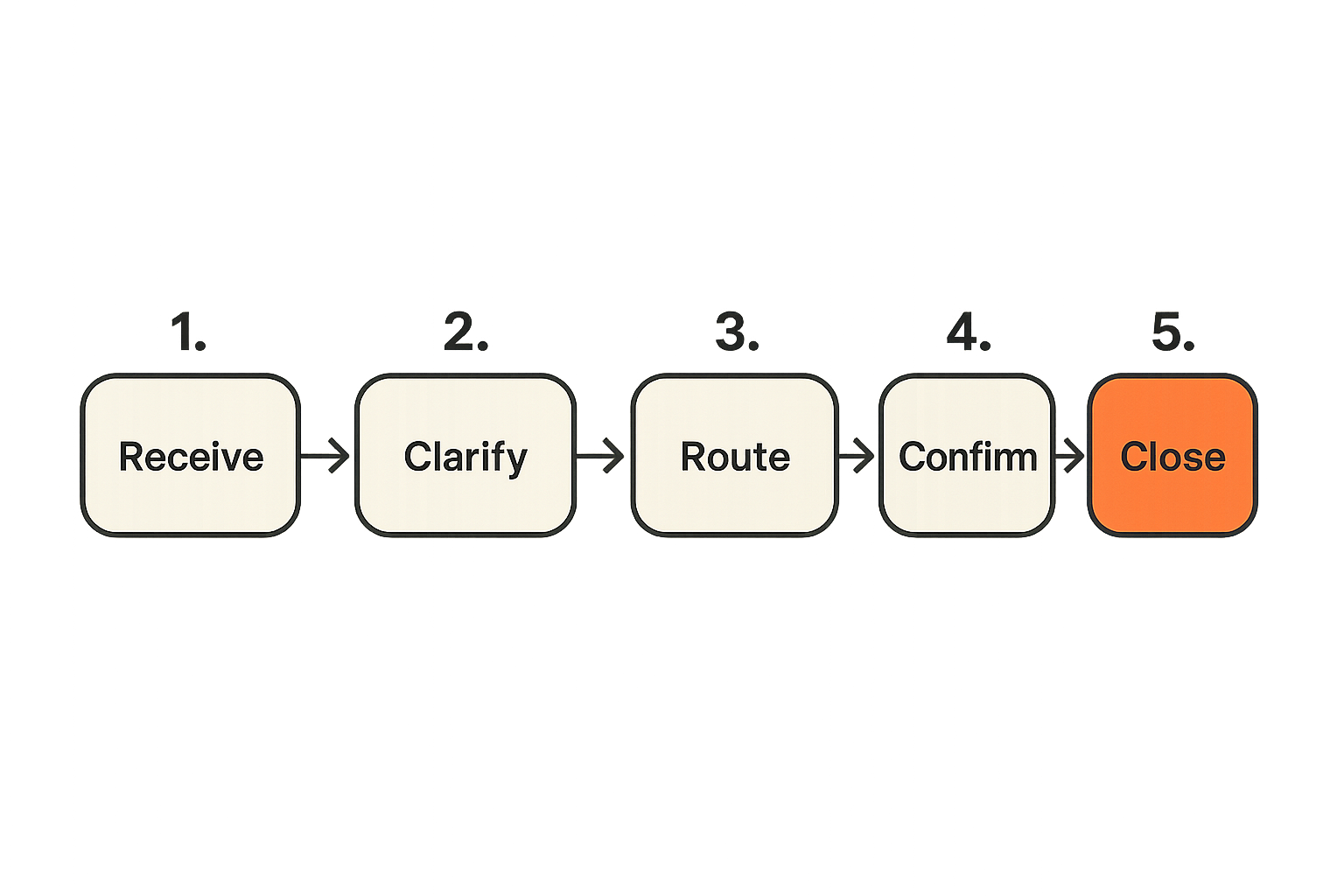
Intake should normalize the request
Routing starts before matching. It starts with intake.
Bad intake collects whatever the requester happens to write. Good intake normalizes the request enough that another person can act on it.
For a first community, intake should capture:
- What is needed?
- Where does it need to happen?
- When is it needed?
- What category of help is required?
- What constraints matter? Budget, access, language, mobility, schedule, tools.
- What would a good outcome look like?
- Is this public, semi-private, or sensitive?
You do not need a complicated form on day one. You do need a consistent shape. Even a short template in chat is better than free-form chaos.
A simple intake template can look like this:
ASK:
Location:
Deadline:
Category:
Budget or exchange terms:
Constraints:
Good outcome:
Visibility: public / trusted members / operator only
The practical question is whether a second operator could read the intake and know what to do next.
Routing needs ownership, not vibes
Routing is where many first community projects become founder-dependent. Someone posts an ask. The founder remembers three possible helpers. The founder sends two DMs. One person replies. The founder forgets to update the requester. The request goes stale.
That is not a routing system. That is memory-driven dispatch.
A routing layer needs explicit ownership:
- Receive the ask.
- Clarify missing fields.
- Identify candidate offers or people.
- Send the route with context.
- Record who accepted or declined.
- Follow up by a defined time.
- Mark the outcome.
This sequence can be manual at first. Manual is fine. Invisible is not.
For local networks, routing also needs boundaries. Some requests should be posted broadly. Some should go only to trusted providers. Some should be declined because they are unsafe, illegal, too vague, or outside the network's purpose.
A prior d0rz note on community building as local network architecture goes deeper on why asks, offers, trust, and follow-up should be treated as infrastructure rather than engagement theater.
Design trust as a workflow
Trust signals should be lightweight
Trust is not a slogan. It is a workflow that reduces uncertainty enough for people to act.
In a first community, trust does not need to start with heavy verification. It can start with lightweight signals:
- Known local relationship
- Prior completed exchange
- Vouch from a trusted member
- Public business presence
- Clear scope and terms
- Consistent response history
- Low-risk first task
The goal is not to make every interaction risk-free. That is impossible. The goal is to match the trust requirement to the risk of the exchange.
A ride for a child, access to a home, handling money, and debugging a public website form do not have the same trust profile. Treating them the same is lazy architecture.
Practical rule: Trust should be proportional to the risk of the ask. Low-risk tasks need speed. High-risk tasks need stronger signals, narrower routing, and clearer escalation.
Escalation protects the network
Escalation is not only for disasters. It is how you protect the network from ambiguity.
A first community should define when an operator steps in:
- A requester gives incomplete or conflicting details.
- A provider accepts and then disappears.
- A member reports unsafe behavior.
- Payment terms are unclear.
- A task expands beyond the original scope.
- A dispute appears after completion.
Without escalation, members learn that participation is risky. They may not complain publicly. They just stop using the network.
Escalation can be simple:
If no provider response in 24 hours: reroute or close.
If requester changes scope: reconfirm terms.
If safety concern appears: pause routing and review manually.
If outcome is disputed: collect both sides and mark unresolved.
The important part is that operators do not improvise every time.
Related reading from our network: home media operators deal with a different domain, but the workflow lesson is similar; the practical architecture notes in Information Technology for Streaming, Torrents, IPTV, and Home Media Operations in 2026 are a useful reminder that routing, troubleshooting, and support matter more than the visible interface.
Run the first community like a service desk
Triage, assign, resolve, follow up
This sounds unromantic, but it works: run the first community like a lightweight service desk.
A service desk does not mean corporate bureaucracy. It means every request has a status, an owner, and a next action.
A practical first community workflow:
- Capture the ask or offer in a standard format.
- Classify it by category, location, urgency, and risk.
- Clarify missing details before routing.
- Route to one or more qualified people or pools.
- Confirm whether someone accepted responsibility.
- Track the request until completion, decline, or timeout.
- Follow up with both sides.
- Record the outcome and trust signal.
The operator should be able to look at the system and answer: what is open, what is blocked, what is aging, and what needs human judgment?
This is where community work becomes operationally honest. If all open work lives in DMs, the network cannot learn.
What breaks without status
Without status, everything degrades into social guesswork.
The requester does not know if anyone saw the ask. The helper does not know if they are the only person responding. The operator does not know whether the issue is solved. The community sees activity but cannot tell whether it produced value.
Common status failures:
- An ask is posted but never acknowledged.
- Multiple helpers respond privately and duplicate effort.
- A provider thinks a task is exploratory while the requester thinks it is committed.
- The organizer assumes someone followed up, but nobody did.
- A resolved request stays visible and keeps attracting replies.
The fix is not more enthusiasm. The fix is state management.
For small networks, even four states are enough:
| State | Meaning | Operator action |
|---|---|---|
| New | Received but not reviewed | Clarify or classify |
| Routed | Sent to possible helper | Wait, nudge, or reroute |
| Active | Someone accepted | Track progress and risk |
| Closed | Done, declined, expired, or unresolved | Record outcome |
That simple model prevents a surprising amount of drift.
Tooling choices for a first community in 2026
Spreadsheet, chat, directory, marketplace
The tool stack should match the maturity of the workflow. Buying software before defining states usually creates a prettier mess.
A first community can start with lightweight tools:
- Chat for conversation and quick context
- Form for structured intake
- Spreadsheet or database for status tracking
- Directory for offers and provider profiles
- Calendar for time-bound availability
- Marketplace layer when requests, trust, and transactions become repeatable
Each tool has a job. Chat is not a database. A spreadsheet is not a trust layer. A directory is not follow-up. A marketplace is not a substitute for operations.
The mistake teams make is expecting one interface to solve the entire coordination problem. What breaks in practice is the handoff between tools.
For example, if an ask enters through chat, gets copied into a spreadsheet, routed by DM, completed offline, and never updated, the system loses the outcome. That outcome is the learning asset.
What works and what fails
Here is a practical tooling view:
| Approach | What works | What fails |
|---|---|---|
| Group chat only | Fast launch, low friction, social context | No durable status, hard search, private routing chaos |
| Form plus spreadsheet | Structured intake, visible backlog, easy review | Manual updates, weak member discovery |
| Public directory | Clear offers, easier matching | Stale profiles, no request lifecycle |
| Ticket-style workflow | Ownership, states, follow-up | Can feel heavy if categories are too broad |
| Marketplace layer | Repeatable asks, trust signals, transaction support | Fails if community norms and supply are weak |
The best early stack is usually boring: structured intake, visible routing, clear ownership, and a simple place for offers to live.
A concrete offer such as remote website and automation help for local businesses is useful because it gives operators a routable supply node: scope, audience, constraints, and likely fit are visible enough to match against incoming asks.
Related reading from our network: content teams have their own version of this architecture problem; Charles Babbage Analytical Engine: What AEO Teams Can Learn From the First Computing Architecture is an adjacent look at why inputs, processing, memory, and outputs matter when a system needs to produce reliable answers.
Measure coordination, not attention
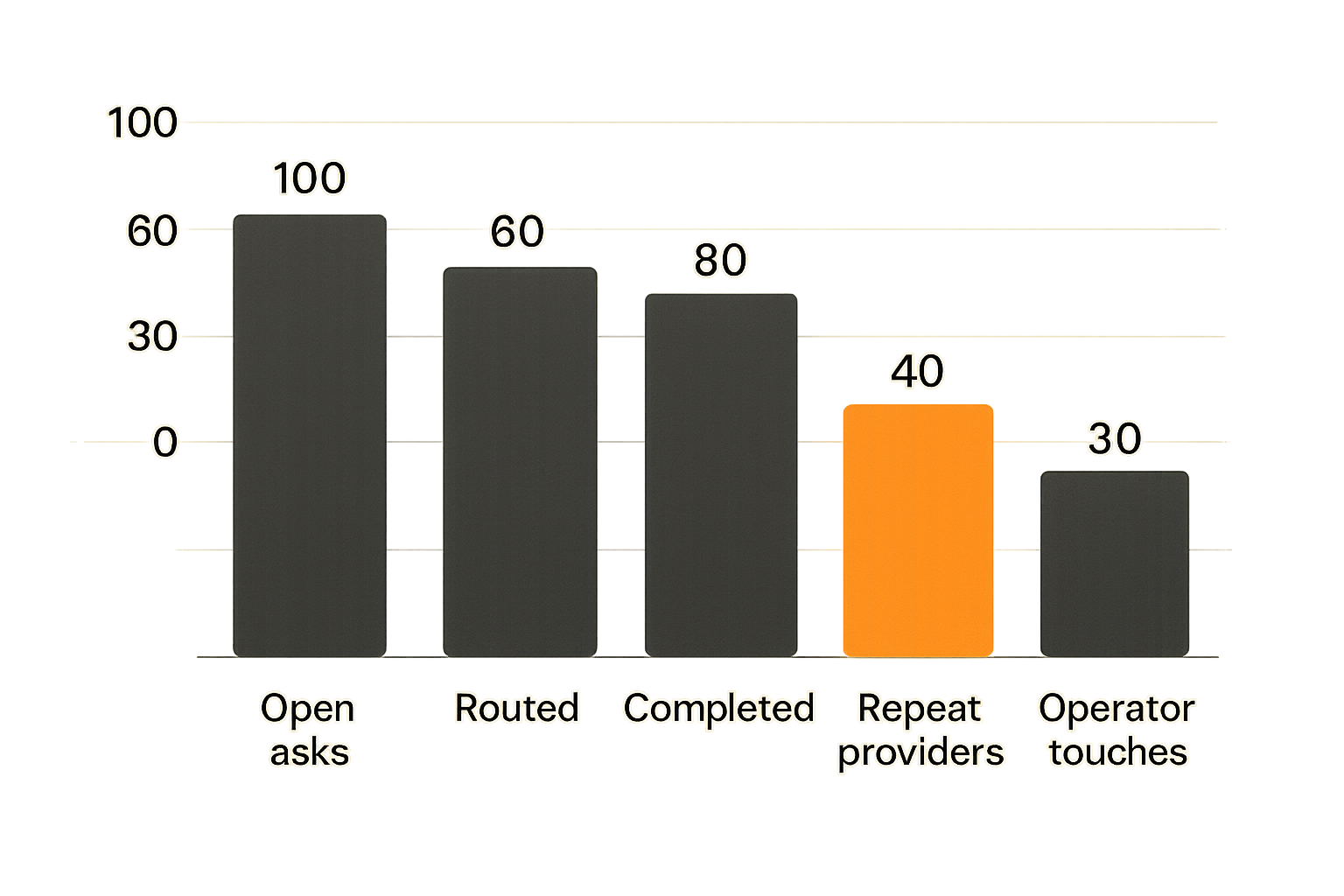
Metrics that tell operators the truth
A first community should measure whether coordination is improving. Attention can be useful, but only if it produces movement.
Track metrics that expose operational reality:
- Number of qualified asks submitted
- Percentage of asks clarified within a target window
- Percentage of asks routed
- Time from ask to first qualified response
- Offer acceptance rate
- Completion rate
- Expired or unresolved requests
- Repeat participation from requesters and providers
- Number of useful trust signals added
- Operator interventions per completed exchange
Do not over-instrument too early. Pick five numbers that change decisions.
A useful starter dashboard:
| Metric | Why it matters | Bad smell |
|---|---|---|
| Open asks by age | Shows backlog and neglect | Old asks with no decision |
| Routed but unaccepted | Shows supply mismatch | Many routes, few accepts |
| Completed exchanges | Shows real utility | Activity without closure |
| Repeat providers | Shows supply reliability | One-off helper dependence |
| Operator touches per ask | Shows scalability | Every exchange needs founder handling |
That last metric is uncomfortable and important. If every successful exchange requires ten founder touches, the community may be valuable but not yet scalable.
Review cadence matters
Metrics only help if reviewed on a cadence.
For a first community, a weekly operating review is enough:
- Which asks are still open?
- Which asks aged out and why?
- Which offers were used?
- Which categories had demand but no supply?
- Which trust issues appeared?
- Which routing decisions should become rules?
- Which members should be thanked, reactivated, or protected from overload?
The review should produce changes to the operating model. Add an intake field. Split a category. Retire a stale offer. Create a trusted provider pool. Adjust response expectations.
This is how the community learns. Not through abstract sentiment, but through observed coordination failures.
Practical rule: If your review meeting does not change routing rules, intake fields, or ownership, you are reporting activity instead of operating the network.
Failure modes that kill the first community
Over-broad missions
The fastest way to weaken a first community is to make it about everything.
"Local help for everyone" sounds inclusive, but it creates operational ambiguity. Does the network handle childcare, errands, business services, elder care, rides, emergency needs, barter, recommendations, jobs, housing, and events? Maybe one day. Not on day one.
A sharper starting surface is more useful:
- Website and automation help for local businesses
- Errand coverage for a specific neighborhood
- Trusted referrals for home services
- Volunteer delivery for a defined mutual aid group
- Local freelance overflow work
- Event setup and teardown crew matching
Narrow does not mean small forever. It means legible now.
When the mission is too broad, routing becomes interpretation. Trust policies become inconsistent. Members do not know which asks are appropriate. Operators hesitate to say no.
The practical question is: what category can you route well enough that people will trust the network again next week?
No closure loop
The second major failure mode is no closure loop.
Many first communities can generate introductions. Fewer can confirm whether anything happened. That matters because closure is where the network earns memory.
Without closure, you lose:
- Which providers were reliable
- Which asks were poorly scoped
- Which categories lack supply
- Which members create risk
- Which outcomes are worth promoting
- Which workflows should be automated
Closure does not need to be complicated. Ask both sides:
Did this get resolved?
Who helped?
Was the scope accurate?
Would you route this person again?
What should we change next time?
The mistake teams make is feeling awkward about follow-up. But no follow-up is worse. It signals that the network cares about matching more than outcomes.
For adjacent operating-model thinking, the d0rz post on community building as a local network operating model is directly relevant: the work is not just gathering people, but sustaining the loops that make participation reliable.
Where d0rz.com fits for first community operators
Product fit without pretending software does the job
Software does not build trust by itself. It does not replace local judgment, relationship history, or operator discipline.
But the right software can make the operating model visible.
For first community operators, d0rz.com is useful when you want asks and offers to stop living only in scattered chats and private memory. The point is not to create another feed. The point is to make local coordination more routable:
- Asks can be expressed as concrete demand.
- Offers can be expressed as concrete supply.
- Operators can see what belongs in the network.
- Members can discover opportunities without waiting for a founder DM.
- Follow-up can become part of the workflow instead of an afterthought.
That matters most in the transition from founder-led coordination to network-led coordination. Early on, the founder knows everyone. Later, the network needs enough structure that other people can route intelligently too.
A useful implementation sequence looks like this:
- Pick one narrow coordination category.
- Publish three to five specific offers or asks.
- Route every incoming request through a standard intake shape.
- Track status manually until the states are stable.
- Record outcomes and trust signals.
- Promote the workflows that close reliably.
- Expand only when routing quality holds.
The first community is a proving ground. If it cannot complete useful exchanges at small scale, growth will mostly multiply ambiguity.
Try d0rz.com
d0rz.com is for people building practical local networks where asks, offers, trust, routing, and follow-up matter. If you are building your first community as coordination infrastructure, Try d0rz.com.