
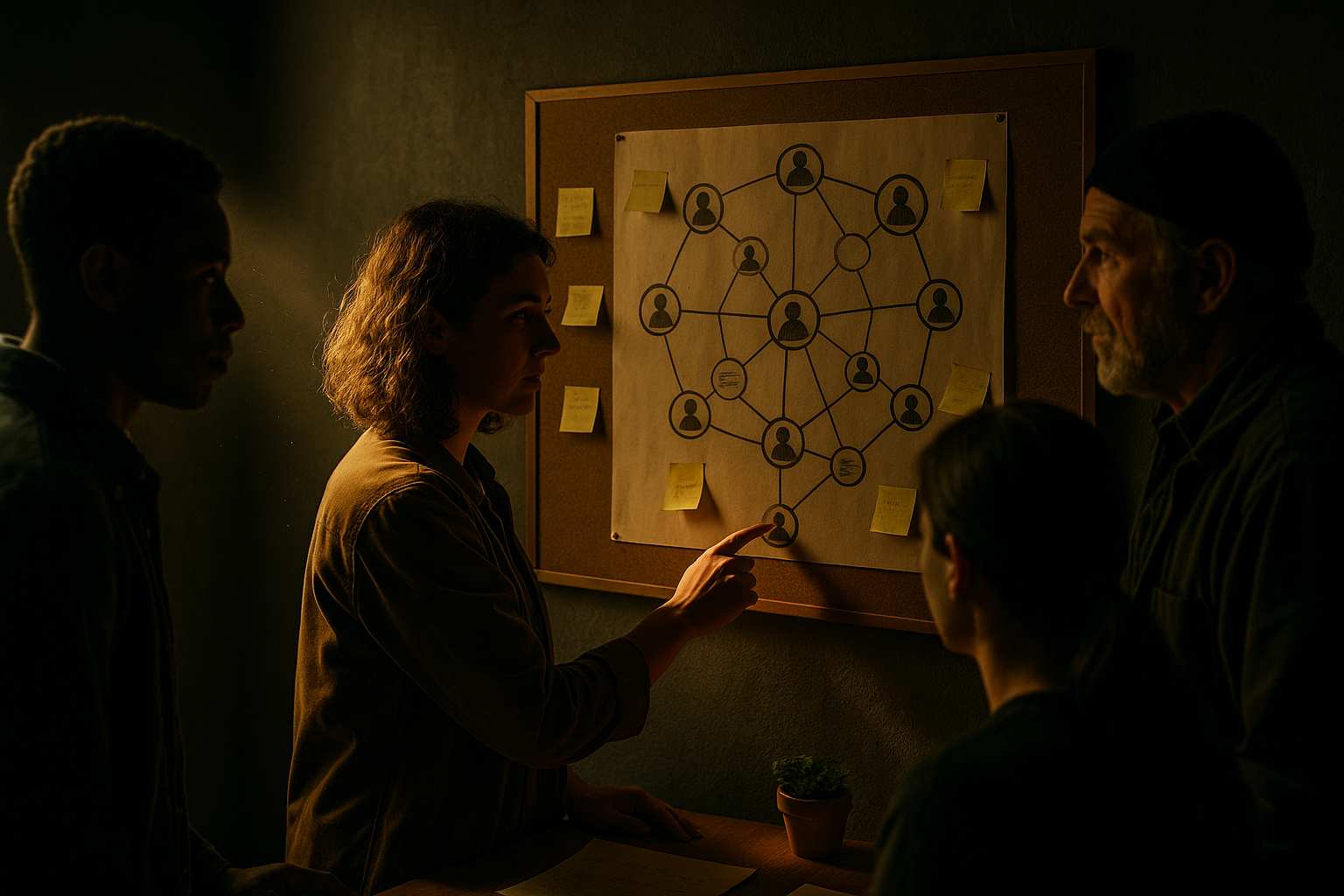
Most community projects do not fail because nobody cares. They fail because the first community is treated like an audience, not an operating system.
A few dozen people join a group chat, a newsletter, a directory, or an event series. People introduce themselves. Someone posts an ask. Someone else says they can help. Then the thread goes quiet, the organizer manually follows up, and nobody knows whether the connection worked.
Teams think the problem is growth. The real problem is coordination. If the first community cannot reliably move one ask to one trusted offer to one completed outcome, adding more members only creates more noise.
That changes the conversation. The practical question is not how do we get everyone in town to join? It is: what is the smallest local network where asks, offers, trust, routing, and follow-up can run without the founder holding every thread together?
Table of contents
- First community is an operating system, not a launch campaign
- Design the first community around real local transactions
- Choose a narrow service area before broad membership
- Build trust as workflow data
- Create intake, routing, and follow-up loops
- What works and what fails in first community operations
- Metrics that tell you whether coordination is happening
- Roles and ownership for the first community
- Implementation sequence for the first 90 days
- Product fit how d0rz.com supports first community coordination
First community is an operating system, not a launch campaign
The audience trap
The mistake teams make is starting with attention. They create a brand, open a Discord, announce a meetup, collect emails, and hope belonging appears from density.
That can look like progress for a few weeks. The room gets bigger. The introductions feel warm. The calendar has events. But when someone asks for a bookkeeper, a ride, a website fix, a childcare referral, a spare commercial kitchen hour, or a local partner for a grant application, the system often depends on one person remembering who might help.
That is not a community operating model. That is organizer memory with a nicer interface.
A first community has to do something repeatable. It should make local coordination easier than texting five friends, posting into a noisy feed, or waiting for a platform algorithm to surface the right person.
Related reading from our network: teams in security operations face a similar problem when they confuse response energy with durable workflow, which is why this piece on critical incident stress debriefing as an operational workflow is useful even outside the SOC context.
Why local networks break early
Local networks break because early participation hides missing infrastructure. People are patient at the beginning. They forgive slow replies. They tolerate manual matching. They accept vague asks because they want the thing to exist.
Then the founder gets busier. More people arrive. The same questions repeat. A few requests get dropped. The best providers stop checking the channel because too many opportunities are unclear. The most valuable members become invisible because they do not post often.
What breaks in practice is not enthusiasm. It is state. Nobody can answer basic operational questions:
- Which asks are still open?
- Which offers are available now?
- Who has been introduced to whom?
- Which matches were completed?
- Which participants are reliable?
- Which requests need escalation?
- Which categories are underserved?
If the first community cannot answer those questions, it is flying blind.
The useful definition
A useful way to think about it is this: your first community is the first repeatable coordination loop in a bounded local network.
It is not the total addressable market. It is not everyone who likes the mission. It is the smallest group where a real need can be captured, routed, trusted, fulfilled, and reviewed.
Practical rule: Do not call it a community until at least one real ask can move through the network without the organizer inventing the process from scratch.
For a deeper architecture view of this problem, the prior d0rz article on local network architecture that actually holds frames community building as infrastructure rather than engagement theater.
Design the first community around real local transactions
Start with asks and offers
The first community should begin with a practical inventory, not a manifesto. What do people need? What can people provide? What is local enough that proximity, trust, timing, and context matter?
In local community network operations, asks and offers are the base objects. Events, content, introductions, and social rituals matter, but they should support the transaction layer rather than replace it.
Examples of usable asks:
- Need a local electrician who can inspect a small commercial unit this week.
- Looking for one public business workflow to automate for a demo.
- Need weekend help moving market supplies across town.
- Looking for a trusted person to explain city permitting basics.
- Need a venue that can host 20 people on a weekday evening.
Examples of usable offers:
- I can debug website forms for small businesses remotely.
- I can make local deliveries after 5 p.m. on weekdays.
- I know three venue managers and can route requests.
- I can review a grant draft for neighborhood nonprofits.
- I can help seniors set up appointment reminders.
Notice the difference between I love helping and I can do X, for Y type of person, under Z conditions. The second one can be routed.
Map the route before the people arrive
Every ask needs a route. If the route is unclear, the community becomes a bulletin board and the operator becomes the search engine.
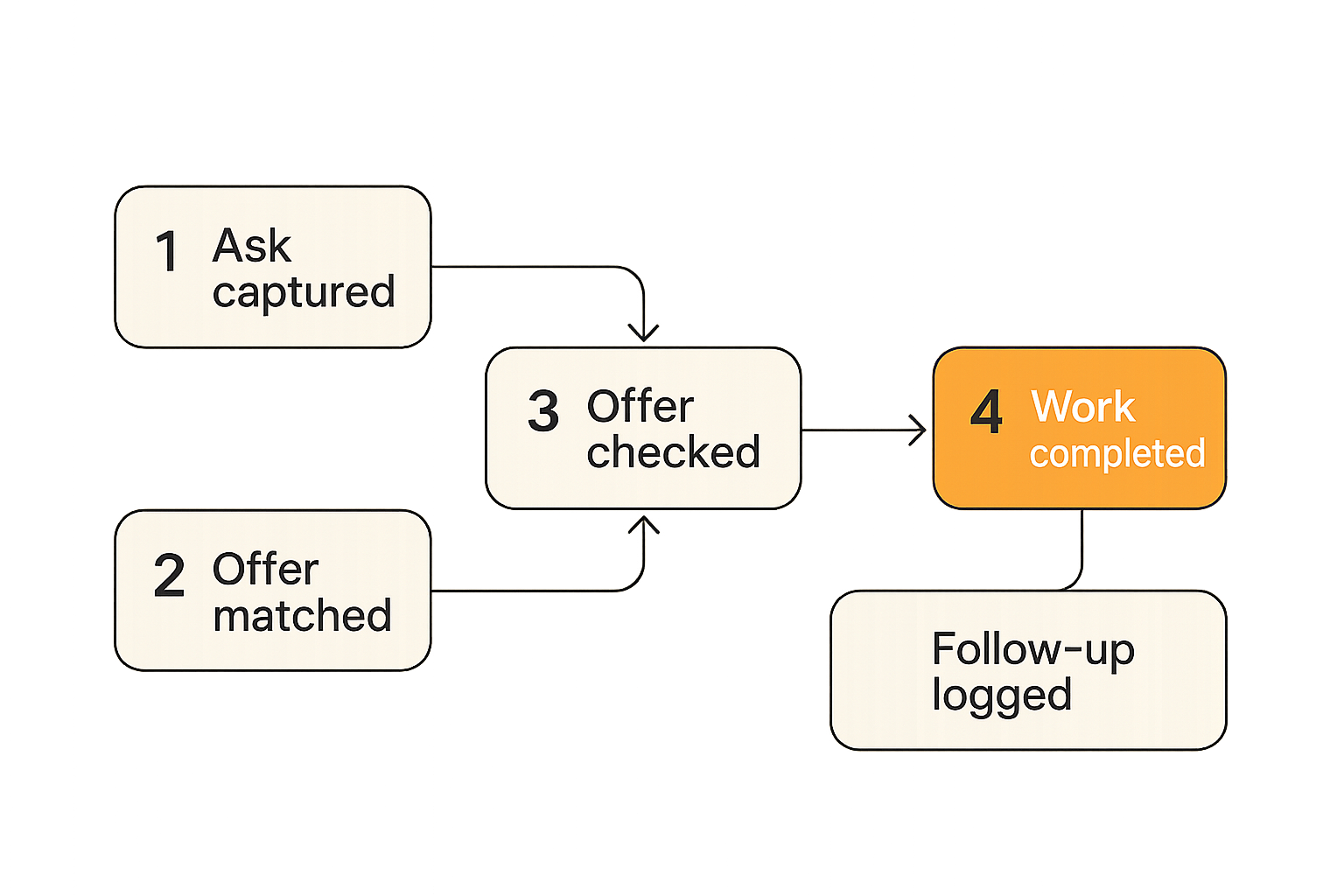
A simple route has five states:
- Submitted: the ask or offer is captured with enough detail.
- Qualified: the operator checks scope, urgency, location, and safety concerns.
- Routed: the item is sent to a relevant provider, connector, or subgroup.
- Accepted: someone takes responsibility for the next step.
- Closed: the outcome is recorded as completed, declined, expired, or unresolved.
That route can be lightweight. It can start in a spreadsheet, Airtable, Notion, a form, or a purpose-built network tool. The important part is that the route exists and that participants learn what happens after they submit something.
The practical question is not whether the first version is elegant. It is whether everyone knows where an ask goes next.
Define completion, not participation
Participation is easy to inflate. Completion is harder to fake.
If someone posts an ask and gets three likes, nothing has necessarily happened. If someone is introduced to a provider but never schedules the work, the loop is still open. If a provider replies but the requester disappears, the system needs to know that too.
Define completion by category:
| Category | Completion signal | Failure signal |
|---|---|---|
| Referral | Requester confirms contact was useful | No response after introduction |
| Service help | Provider confirms work was delivered or scheduled | Scope unclear or provider unavailable |
| Resource share | Item, venue, document, or contact exchanged | Owner cannot verify handoff |
| Volunteer task | Task owner confirms task is done | No owner assigned |
| Learning request | Session completed or answer delivered | Question remains unresolved |
This matters because completion data tells you what the network can actually do. A first community with 40 people and 18 completed local matches is healthier than a 900-person group with unread posts.
Choose a narrow service area before broad membership
Pick a boundary that operators can see
The mistake teams make is defining the first community by identity alone: founders, creatives, parents, freelancers, small businesses, neighbors, builders. Those labels are useful, but they are too broad for operations.
A better boundary includes a who, a where, and a job-to-be-done:
- Independent service providers within one metro area who can respond to small business operational asks.
- Neighborhood parents who can exchange verified after-school resources.
- Local merchants who need same-week help with forms, payments, scheduling, and simple automations.
- Freelancers who can fulfill small tasks for nonprofits within a defined city.
The boundary should help the operator make routing decisions. If a new ask comes in, can you quickly decide whether it belongs? If not, the boundary is too vague.
Avoid segments that only sound strategic
Some segments are attractive because they sound large or fundable. Local commerce. Mutual aid. Creator economy. AI for small business. Neighborhood services. These phrases can be useful for positioning, but they do not route an ask.
A first community needs operational specificity. For example, a request like small business automation becomes clearer when attached to a real local ask, such as someone looking for small business automation projects in Winston Salem where the work involves scheduling, email sorting, customer response handling, or data entry.
That level of detail tells the network what kind of provider should see the request, what questions to ask, and what a completed outcome might look like.
Know when the boundary can expand
Do not expand because people are interested. Expand because the operating loop is stable.
Good expansion signals include:
- Most asks are categorized without debate.
- Routing decisions are fast and repeatable.
- Providers understand what information they need before accepting work.
- Follow-up happens without heroic effort.
- The operator can identify which category is constrained.
Bad expansion signals include:
- The group chat feels quiet.
- A funder or sponsor wants a bigger story.
- Members ask for more channels.
- The organizer is bored with the first niche.
- The current process still depends on private messages.
Practical rule: Expand the first community only after the current boundary produces reliable completed loops, not after it produces attention.
Build trust as workflow data
Trust is not a vibe
Local community builders often talk about trust as culture. Culture matters, but trust has to show up in the workflow.
Trust answers operational questions:
- Is this requester real?
- Is this provider available?
- Has this person delivered before?
- Does this ask involve money, access, homes, children, transport, or sensitive information?
- Should this be public, private, moderated, or declined?
In a first community, trust does not need to become a heavy compliance system. But it does need structure. Otherwise the operator becomes the informal risk engine, and every uncomfortable case becomes personal judgment.
Use trust levels instead of binary access
Binary membership creates problems. Either someone is in or out. Either they can see everything or nothing. That is rarely how local trust works.
Use levels:
- Public: visible asks and offers with low risk.
- Registered: people with a basic profile and contact path.
- Verified locally: known by an organizer, connector, or trusted member.
- Proven provider: completed work or fulfilled commitments.
- Sensitive access: allowed to handle higher-trust categories after review.
This lets the network grow without pretending every participant is equally known. It also protects valuable providers from noisy or unsafe requests.
Make safety boundaries explicit
The first community should have rules for requests it will not route, at least not without review. This is not bureaucracy. It is operator protection.
Examples:
- No emergency medical, legal, or safety-critical routing unless the network is built for it.
- No unsupervised childcare matching without a proper verification process.
- No high-value financial handling without clear accountability.
- No home access requests without identity checks and follow-up.
- No anonymous accusations or reputation claims in public channels.
Related reading from our network: remote teams also learn that the tool is not the workflow, and this guide to Zoom video chat inside remote team operations is a useful parallel for separating the meeting surface from the coordination system around it.
Practical rule: If a category creates risk, define the review path before the first urgent request arrives.
Create intake, routing, and follow-up loops
Intake captures the shape of the need
Good intake is not a long form. It is the minimum information needed to route responsibly.
For an ask, capture:
- Request title.
- Location or service area.
- Deadline or urgency.
- Category.
- Budget or exchange terms if relevant.
- Visibility preference.
- Trust or safety concerns.
- What has already been tried.
- Best contact path.
For an offer, capture:
- What the person can do.
- Who they can help.
- Availability.
- Service area.
- Constraints.
- Pricing or exchange model.
- Proof, references, or prior work if relevant.
- Preferred types of requests.
The goal is not to interrogate people. The goal is to prevent low-quality routing. A vague ask wastes provider attention. A vague offer creates false capacity.
Routing decides who should see it
Routing is where the first community becomes useful. Without routing, people have to monitor everything. With routing, the network sends relevant opportunities to the right people.
Routing can be manual at first. The operator tags the ask, checks trust level, and forwards it to two or three relevant providers or connectors. But the decision rules should be written down:
- Which category is this?
- Is it local, remote, or hybrid?
- Is it urgent?
- Does it require verified providers?
- Should it go to a public board, a private list, or a specific person?
- What happens if nobody accepts within 24 or 48 hours?
A live offer can also clarify capacity. For example, an offer for same-day website form and workflow debugging is much easier to route than a generic I do tech help profile because the scope, timing, and likely requester are visible.
Follow-up closes the loop
Follow-up is usually where first communities leak value. The introduction happened, so the organizer mentally marks it done. But the network has not learned anything yet.
Follow-up should answer:
- Did the requester get a response?
- Did the provider accept, decline, or ask for clarification?
- Was the work completed?
- Was the match useful?
- Should this provider see more requests like this?
- Should the category, intake, or routing rule change?
A simple follow-up message can do the job:
- Did this connection resolve the ask?
- If not, what is the next blocker?
- Should we keep this open, reroute it, or close it?
The point is not customer success theater. It is state management.
What works and what fails in first community operations
The comparison operators should use
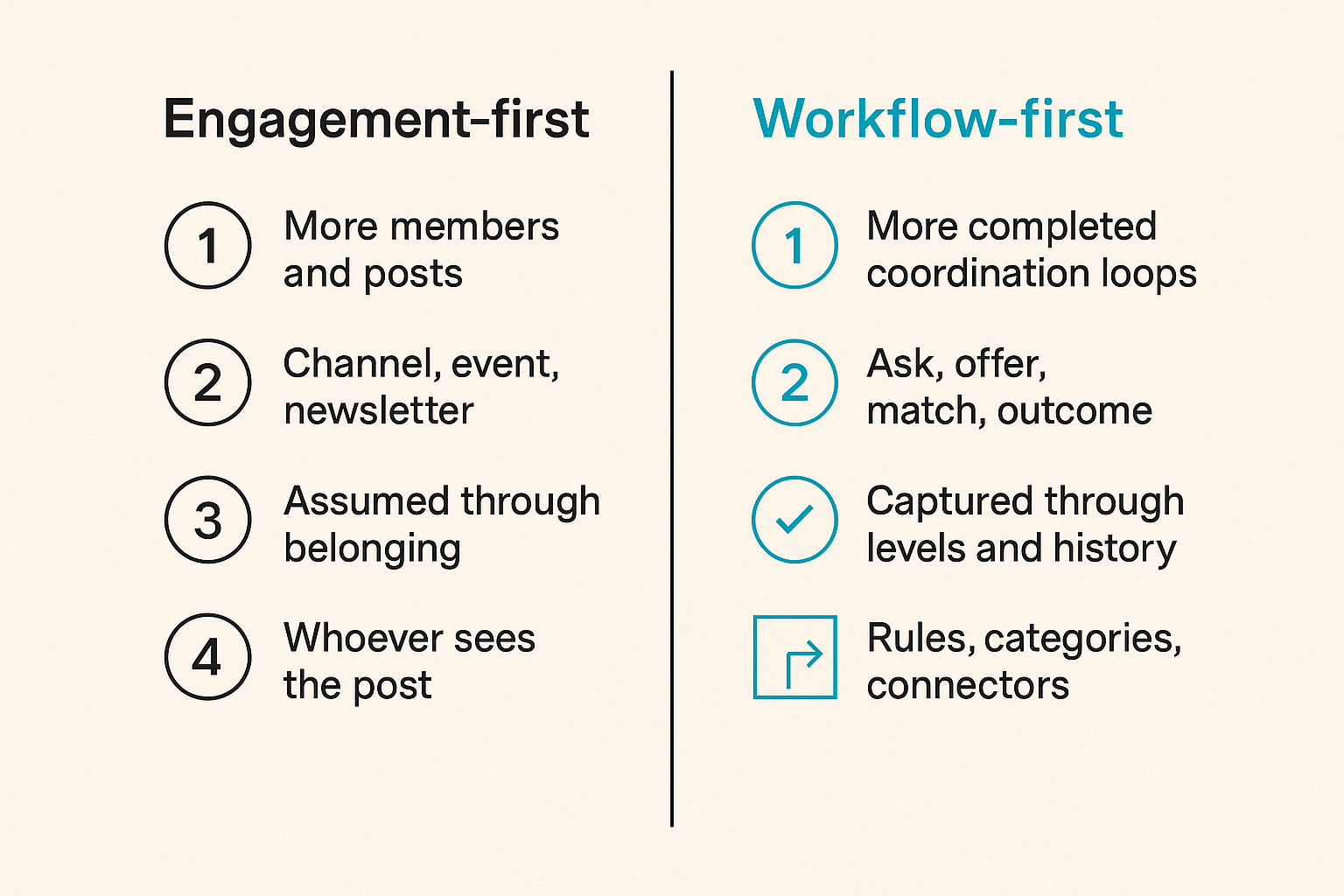
The difference between a fragile first community and a useful one is usually not charisma. It is whether the operator has designed for throughput, trust, and closure.
| Operating choice | Engagement-first community | Workflow-first community |
|---|---|---|
| Primary goal | More members and posts | More completed coordination loops |
| Core object | Channel, event, newsletter | Ask, offer, match, outcome |
| Trust model | Assumed through belonging | Captured through levels and history |
| Routing | Whoever sees the post | Rules, categories, connectors |
| Follow-up | Optional and manual | Built into the loop |
| Success signal | Attendance, likes, signups | Open-to-closed rate and repeat use |
| Failure mode | Noise and organizer burnout | Bottlenecks that can be fixed |
That changes the conversation. A workflow-first first community can be improved because it exposes failure points. An engagement-first community often only tells you that people are quieter than you want.
What works
What works is boring in the right way:
- A small number of clear categories.
- Reusable intake prompts.
- Visible status for open asks.
- Known connectors who can route edge cases.
- Provider constraints captured upfront.
- Follow-up messages sent on a schedule.
- A weekly review of unresolved loops.
- Public examples of successful matches, with permission.
The operator should be able to say: here is how a request enters, here is who sees it, here is how it closes, and here is what we learned.
This is also where documentation helps. Not a 40-page playbook. A short operating note that says what belongs in the network, what does not, and how routing works.
What fails
What fails is usually attractive at first:
- Opening too many channels.
- Recruiting everyone who is enthusiastic.
- Letting all requests stay public by default.
- Treating introductions as completed outcomes.
- Relying on the founder to remember provider capacity.
- Creating events without connecting them to active asks.
- Celebrating activity without reviewing unresolved cases.
The most dangerous failure mode is hidden manual labor. The community appears healthy because the organizer is quietly patching every gap. Then the organizer gets sick, busy, or bored, and the whole network slows down.
Practical rule: If the first community only works when one person reads every message, the system is not ready to scale.
Metrics that tell you whether coordination is happening
Do not mistake activity for throughput
Vanity metrics are not useless, but they are incomplete. Member count, event attendance, email opens, and post volume can tell you whether people are paying attention. They do not tell you whether the network can coordinate.
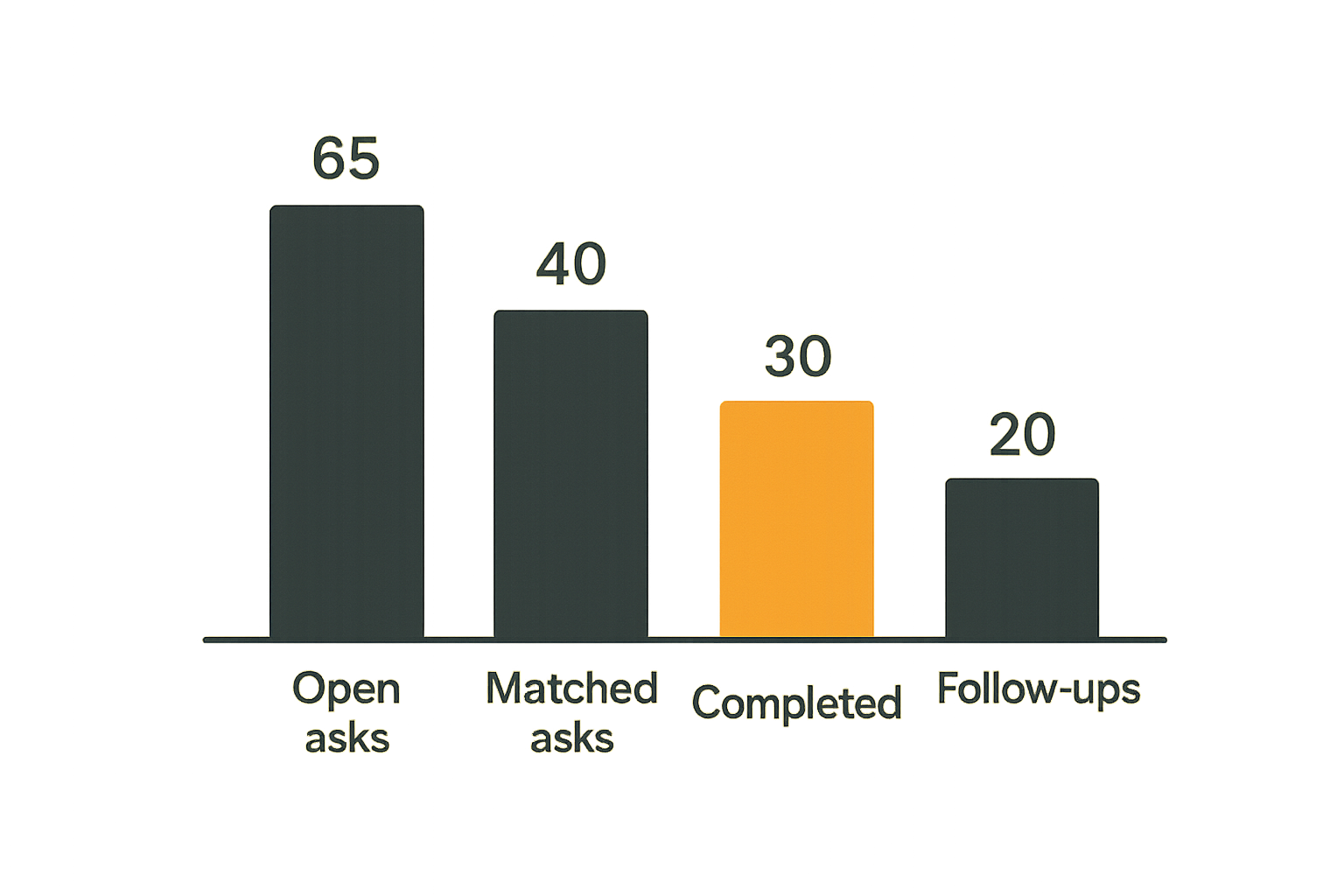
For a first community, the better question is: how many useful loops moved from open to closed, and where did the rest get stuck?
Track a few numbers:
- New asks submitted.
- New offers available.
- Asks qualified.
- Asks routed.
- Matches accepted.
- Outcomes completed.
- Requests unresolved after a time limit.
- Repeat requesters.
- Repeat providers.
Do not overbuild analytics early. A weekly spreadsheet can be enough. The value is in the review, not the dashboard polish.
Use a small operational dashboard
A useful dashboard for a first community should fit on one screen:
| Metric | Why it matters | Operator action |
|---|---|---|
| Open asks by category | Shows demand | Recruit providers or narrow scope |
| Offers by availability | Shows usable supply | Remove stale capacity |
| Time to first response | Shows routing speed | Improve intake or routing rules |
| Accepted matches | Shows provider confidence | Clarify scope or trust requirements |
| Completed outcomes | Shows real throughput | Publish examples and reinforce categories |
| Unresolved asks | Shows system gaps | Review blockers weekly |
| Repeat participants | Shows durable value | Invite them into connector roles |
The dashboard should create decisions. If a metric does not change what the operator does, remove it.
Related reading from our network: search and content teams face similar tradeoffs when balancing multiple objectives, and this piece on multi-objective optimization for AEO is an adjacent example of choosing metrics that drive operations instead of vanity reporting.
Review the misses, not just the wins
Wins are useful for morale and storytelling. Misses are useful for system design.
Review unresolved asks every week:
- Was the ask unclear?
- Was the category wrong?
- Was there no provider capacity?
- Did trust requirements block routing?
- Did the requester disappear?
- Did the provider decline because the scope was too risky?
- Did the operator fail to follow up?
This is where the first community becomes smarter. You learn which intake questions are missing. You learn which categories need better providers. You learn which promises should not be made.
A network that reviews misses gets more reliable. A network that only posts success stories gets more fragile.
Roles and ownership for the first community
The operator owns the system
The operator is not just a host. The operator owns the workflow.
That means:
- Defining what belongs in the network.
- Maintaining intake and routing rules.
- Watching unresolved asks.
- Protecting provider attention.
- Handling sensitive cases.
- Reviewing metrics.
- Updating the operating model as the network learns.
This role can be a founder, organizer, community manager, local lead, or freelance community operator. The title matters less than the accountability.
If nobody owns the system, the loudest participants define it by accident.
Connectors own local context
Connectors are not moderators in the generic sense. They are people who know part of the local graph.
A connector might know:
- Which providers are reliable but quiet.
- Which venues are flexible.
- Which neighborhood groups already exist.
- Which requests are politically sensitive.
- Which local businesses need help but will not post publicly.
- Which people should not be routed into certain situations.
The first community should identify connectors early. They reduce routing load and add local judgment that software cannot infer from a profile.
The prior d0rz article on the operating model for local networks that actually work goes deeper on ownership across matching, trust, support, and sustained participation.
Providers own delivery and updates
Providers are the people or organizations that fulfill offers. They might be freelancers, neighbors, businesses, volunteers, nonprofits, or local agencies.
Providers need clear expectations:
- Keep availability current.
- Decline quickly when the fit is wrong.
- Ask clarifying questions before accepting.
- Confirm when work is scheduled or completed.
- Report unsafe, vague, or abusive requests.
- Tell the operator which categories are worth seeing.
The first community should protect good providers. If they receive too many irrelevant requests, they stop responding. If they are asked to do unpaid emotional labor, they disappear. If they never hear whether their help mattered, they do not build attachment to the network.
Provider retention is not about praise. It is about routing quality.
Implementation sequence for the first 90 days
Days 1-14 instrument before you recruit
In the first two weeks, do not chase scale. Build the minimal operating surface.
- Choose one local boundary and three to five categories.
- Write the intake prompts for asks and offers.
- Create a simple status tracker with open, routed, accepted, closed, and unresolved.
- Identify 10 to 20 known participants across requester, provider, and connector roles.
- Define trust levels and safety categories.
- Draft the follow-up messages.
- Decide the weekly review time.
This phase feels slow because it is not public-facing. That is the point. You are building the rails before traffic arrives.
A first community does not need a complex platform on day one. It needs a way to prevent requests from disappearing.
Days 15-45 run narrow loops
Now run live loops. Invite a small group into a clear operating promise.
For example: for the next 30 days, this network will help local small businesses and independent providers route simple operational asks around websites, forms, scheduling, payment links, customer response, and lightweight automation.
Then operate the loop:
- Collect asks and offers.
- Qualify each item within a defined time window.
- Route to a small number of relevant people.
- Track acceptance or decline.
- Follow up until the item closes or expires.
- Review unresolved cases weekly.
- Adjust categories, prompts, and provider lists.
Keep the promise narrow enough that members can understand what the network is for. If people submit off-scope requests, do not shame them. Use those requests as data. Either the boundary is unclear, or there is demand for a future category.
Days 46-90 standardize what repeats
By day 45, patterns should be visible. Some categories will produce clean matches. Some will create confusion. Some providers will respond quickly. Some will be stale. Some requesters will submit clear asks. Others will need help shaping the request.
Standardize the parts that repeat:
- Turn common intake clarifications into form fields.
- Convert repeated routing decisions into rules.
- Promote reliable participants into connector roles.
- Archive stale offers.
- Publish anonymized examples of successful loops.
- Create escalation paths for sensitive requests.
- Decide which category to add, pause, or remove.
This is also when you can consider adding more tooling. Not because tools create community, but because repeated manual actions now have enough structure to automate.
The mistake teams make is automating before they understand the workflow. In a first community, the workflow should earn automation.
Product fit how d0rz.com supports first community coordination
Use d0rz.com as a coordination layer
d0rz.com is built for people building practical local networks where asks, offers, trust, routing, and follow-up matter.
That means it fits best when the community is not just trying to broadcast announcements. It fits when operators need to make local demand and supply visible, route requests, and keep track of who can help with what.
A first community can use d0rz.com as a coordination layer for:
- Publishing specific asks and offers.
- Making local capacity easier to discover.
- Giving providers clearer scope before they respond.
- Helping organizers point members to live opportunities instead of vague channels.
- Building a shared record of practical local coordination.
The product does not remove the need for judgment. Local trust still requires operators, connectors, and follow-up. But a better coordination surface reduces the amount of work trapped in private messages and founder memory.
When it is not the right fit
d0rz.com is not a magic community generator. If there is no defined local boundary, no real asks, no available offers, and no operator willing to review outcomes, a tool will not fix the system.
It is also not the first answer for communities that are purely content-driven, purely social, or intentionally anonymous. Those networks have different operating needs.
The best fit is a first community where the operator can say: we know the people we are trying to serve, we know the kinds of requests that matter, and we need a more reliable way to expose, route, and close them.
That is the practical version of community infrastructure. Not hype. Not endless engagement. A local network that can do useful work.
Try d0rz.com
d0rz.com is for people building practical local networks where asks, offers, trust, routing, and follow-up matter.
Try d0rz.com and start turning your first community into a working coordination loop.