

Most local networks do not fail because people are selfish. They fail because coordination is messy, requests are vague, helpers are invisible, and nobody owns follow-up.
That is the real problem behind how to run a local community network in 2026. The group chat looks active. The event calendar looks full. The volunteer list exists somewhere. But when a neighbor needs a ride, a freelancer needs a referral, or a small business needs same-day help, the network cannot reliably route the need to the right person.
Teams think the problem is engagement. The real problem is operating design.
A local community network is not just a social space. It is a lightweight coordination system for asks, offers, trust, routing, and follow-up. Once you see it that way, the practical question changes from how do we get people talking to how do we make useful local action repeatable.
Table of contents
- How to run a local community network as an operating system
- Define the local job before you recruit people
- Build the ask and offer intake layer
- Create routing rules before volume arrives
- Design trust and safety as workflow
- Run cadence like operations, not events
- What breaks when local community networks are run badly
- A practical implementation sequence for 2026
- Tools, roles, and data you actually need
- How to run a local community network with d0rz.com
How to run a local community network as an operating system
The network is not the group chat
The mistake teams make is treating the channel as the network. A WhatsApp group, Discord server, Facebook group, email list, or Slack workspace can help people communicate. It does not automatically create coordination.
Coordination means a request can move from unclear need to matched helper to completed outcome without depending on one heroic organizer remembering everything. That changes the conversation. You are not asking whether people are posting enough. You are asking whether the network can process real local demand.
A useful way to think about it is this: every local network has an invisible queue. The queue contains errands, introductions, small jobs, ride requests, business referrals, child care needs, technical help, repair questions, and neighbor-to-neighbor offers. If the queue is not visible, routed, and closed, people assume the community is inactive even when the opposite is true.
For a deeper framing of this operating view, the earlier d0rz piece on local networks that actually work is worth reading alongside this guide.
The minimum viable operating model
You do not need a complex platform on day one. You need a small system that can answer five questions:
- What is being requested?
- Who can help?
- Is this safe and appropriate to route?
- Who owns the next step?
- Did it get resolved?
If you cannot answer those questions, growth makes the network worse. More members create more ambiguity. More messages create more missed opportunities. More events create more social energy without better execution.
Practical rule: Do not grow the audience faster than you grow the network's ability to route and close real asks.
The minimum viable operating model is intake, routing, trust, follow-up, and review. Everything else is secondary.
The decision that changes everything
The key decision is whether your community is mainly a broadcast audience or a coordination network. Both can be useful, but they require different management.
A broadcast audience needs content, announcements, moderation, and events. A coordination network needs structured asks, structured offers, operators, escalation paths, and a record of outcomes.
If you are trying to run a local community network, choose the second model deliberately. You can still host events and publish updates, but those activities support the operating system. They are not the operating system.
Define the local job before you recruit people
Pick one coordination problem
Most communities start too wide. They say they are for neighbors, local business owners, freelancers, parents, creators, or mutual aid. That sounds inclusive, but it is hard to operate.
Start with one coordination problem that is painful enough to matter. Examples:
- Local errands and deliveries for people who cannot easily leave home
- Referrals between freelancers and small businesses
- Short-notice help for broken forms, websites, payments, or admin tasks
- Neighborhood ride coordination for appointments and events
- Practical mutual aid where requests need routing, not just amplification
The narrower the first job, the easier it is to design intake. You can always expand later. What breaks in practice is the vague network that accepts every type of request but has no process for any of them.
Draw the boundary of the neighborhood
Local is not a vibe. It is an operating constraint.
Define the geography you can actually serve. That might be a few blocks, a city district, a metro area, a campus, a business corridor, or a distributed but identity-based local group. The boundary affects response time, trust, pricing, transport, expectations, and safety.
For physical tasks, distance is operationally expensive. For remote help, the boundary might be cultural or commercial rather than geographic. A Bay Area provider who can fix a website form remotely is still part of a local business network if the buyers and referrals are local.
The practical question is not how big can the map be. It is what radius lets you make reliable promises.
Name the promise you can keep
A community promise is not a slogan. It is an expectation you can operationalize.
Weak promise: We help each other.
Better promise: Post a local errand request by 10 AM and an operator will try to route it to available helpers by noon.
Weak promise: We support small businesses.
Better promise: Local business owners can post one concrete workflow problem, and the network will surface available providers or say clearly when there is no match.
This matters because trust is built when expectations are clear and repeatedly met. If you cannot keep the promise yet, reduce the promise.
Build the ask and offer intake layer
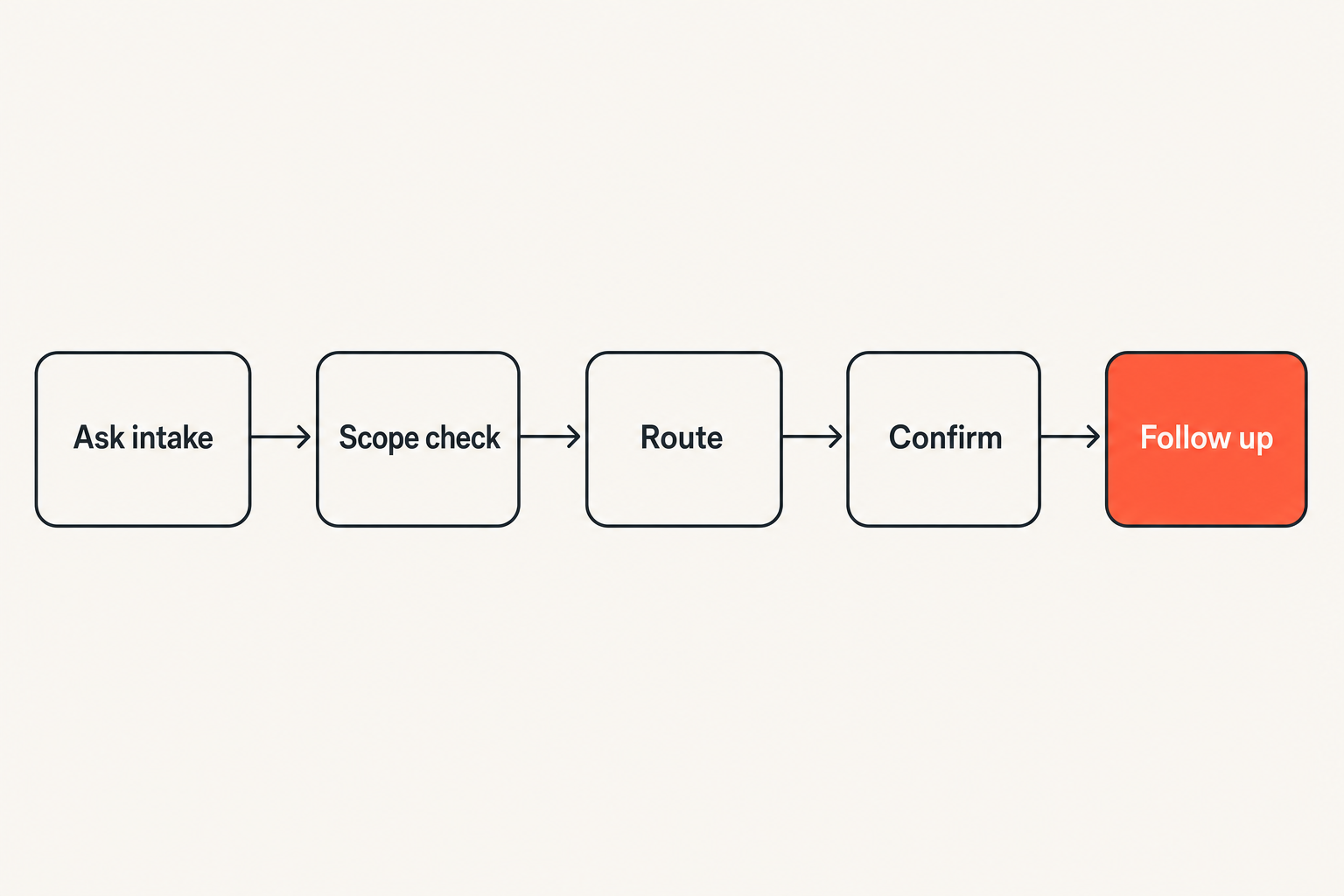
Make asks routable
An ask is not routable until it has enough structure. The classic failure mode is a post like can anyone help with my website or does anyone know a driver. People may care, but they cannot act quickly.
Use a simple intake format:
| Field | Why it matters | Example |
|---|---|---|
| Need | Defines the task | Grocery pickup, broken checkout form, airport ride |
| Location | Determines feasibility | Mission District, Winston-Salem, remote only |
| Timing | Controls urgency | Today after 4 PM, this week, flexible |
| Budget or exchange | Avoids awkward negotiation | Paid, volunteer, trade, referral |
| Risk level | Informs trust checks | Home access, payment handling, public errand |
| Contact preference | Speeds handoff | Text, email, in-platform reply |
This does not need to feel bureaucratic. It can be a form, a template, a pinned post, or a structured marketplace entry. The point is to make the request routeable without the organizer interviewing the requester every time.
Make offers specific
Offers need the same discipline. I can help with anything is generous but operationally weak. Good offers are specific enough to match.
A strong offer includes:
- What the person can do
- Where they can do it
- When they are usually available
- What they do not do
- Whether it is paid, volunteer, trade, or referral-based
- Any safety or access constraints
For example, a concrete listing like offering grocery runs, errands, and local deliveries in the SF Bay Area is easier to route than a generic helper profile. It has a service shape, a geography, and an implied use case.
Practical rule: A useful offer should reduce the number of follow-up questions required before routing.
Keep public and private data separate
Local networks collect sensitive context quickly. People reveal addresses, availability, health constraints, financial stress, childcare needs, business problems, and sometimes conflict. If you put all of that into a public thread, people will stop trusting the network.
Separate the public signal from the private detail. The public layer can say: local delivery help needed in Outer Sunset this afternoon. The private layer can contain the exact address, phone number, access instructions, or payment details.
This is not just privacy hygiene. It also improves routing. Operators can scan public demand without exposing personal information, then move qualified matches into a private handoff.
Create routing rules before volume arrives
Use triage, not heroics
Routing is where many local communities become dependent on one founder, one moderator, or one volunteer who knows everyone. That works until it does not.
Triage means requests are sorted by type, urgency, risk, and likely supply. You do not need a formal dispatch center. You do need rules that prevent every request from becoming a custom emotional decision.
A simple routing workflow looks like this:
- Confirm the ask is clear enough to route.
- Check whether it fits the community scope.
- Assign a category and urgency level.
- Identify two or three possible helpers or channels.
- Send the handoff with context and expectations.
- Track whether the requester got a response.
- Close, escalate, or mark stale.
Related reading from our network: teams running product launches face the same problem of turning activity into ownership, and the sh1pt guide to product operations shipping systems is a useful adjacent comparison.
Assign owners and backup paths
Every routed item needs an owner. The owner is not always the helper. Often the owner is the operator responsible for making sure the next step happens.
For example:
- Requester posts a ride need.
- Operator checks location, timing, and risk.
- Operator tags two eligible drivers.
- Driver accepts.
- Operator confirms both sides connected.
- Request is marked matched.
- After the ride, operator records completed or unresolved.
If the driver does not respond, the backup path is already defined. Maybe the request moves to a broader helper pool, gets escalated to a partner organization, or is marked unable to fulfill with a clear explanation.
Know when to say no
Healthy networks reject bad-fit requests. That sounds harsh, but unclear boundaries create worse outcomes.
Say no when the request is unsafe, illegal, outside geography, beyond available trust, too urgent for the network to handle, or better served by a professional provider or emergency service. Say not here when the request is valid but not aligned with the community's operating model.
Practical rule: A local network that cannot say no will eventually disappoint the people it most wants to help.
No is also data. If many people ask for something you cannot serve, that may reveal a future program, partnership, or paid service category. But do not quietly absorb demand you are not built to handle.
Design trust and safety as workflow
Trust starts with scope
Trust is not a single badge. It is a set of decisions about what people are allowed to do in which contexts.
Someone can be trusted to deliver groceries but not to enter a home. Someone can be trusted for public coffee introductions but not for childcare. Someone can be trusted for a paid website fix but not to handle customer payment credentials. Scope matters.
The mistake teams make is trying to create one universal trust level. Local networks work better when trust is tied to task type and risk. Low-risk public tasks need lighter checks. High-risk access tasks need stronger process.
Related reading from our network: security teams use similar severity and ownership thinking when incidents move from signal to response, as described in this SOC architecture guide to a critical incident approach.
Verification should match risk
Verification can include identity confirmation, local references, previous successful tasks, organizer review, business presence, license checks, insurance, or platform history. The right level depends on the task.
Use a risk ladder:
| Task type | Example | Verification level |
|---|---|---|
| Low risk | Public referral, event invite | Basic profile and community context |
| Medium risk | Paid remote admin help | Work sample, references, clear scope |
| Higher risk | Home access, rides, childcare | Stronger identity, references, explicit safety rules |
| Specialized risk | Legal, medical, financial advice | Professional credentials or referral out |
Do not over-verify everything. It slows the network and creates false confidence. Do not under-verify high-risk tasks. It puts people in bad situations and destroys trust quickly.
Record outcomes without creating a surveillance file
You need operational memory. You do not need to collect every detail forever.
Record the minimum useful outcome: matched, completed, no response, cancelled, escalated, issue reported. Add notes only when they help future routing or safety. Avoid storing unnecessary personal details, gossip, or private conflict in shared documents.
The goal is accountability, not surveillance. People should understand what is recorded and why. If your operators cannot explain the data policy in plain language, simplify it.
Run cadence like operations, not events
Weekly review beats constant noise
Many organizers confuse urgency with responsiveness. They check messages all day, interrupt themselves constantly, and still miss the important asks. That is not operations. That is exhaustion.
A weekly review creates rhythm. Review open asks, unmatched offers, stale threads, repeat request types, new helpers, trust concerns, and closed outcomes. For high-volume networks, do this daily. For early networks, weekly is enough.
The point is to move from reactive scrolling to intentional queue management. Once the queue is visible, you can make better decisions about recruiting supply, tightening intake, or changing the network promise.
Close the loop publicly when appropriate
Public closure reinforces that the network works. Not every detail belongs in public, but visible outcomes matter.
Examples:
- Matched: a neighbor found a Saturday delivery helper.
- Closed: three local businesses got website form debugging leads this week.
- Still needed: two weekday drivers are needed for medical appointment rides.
- Not served: emergency housing requests are being referred to partner organizations.
This gives members a reason to keep participating. It also teaches the network what kinds of asks and offers are welcome.
Related reading from our network: if your community depends on being discoverable beyond the local group, the crawlproof piece on AEO architecture for sites that want to be cited is an adjacent look at structuring information so it can be found and reused.
Use metrics that reveal coordination quality
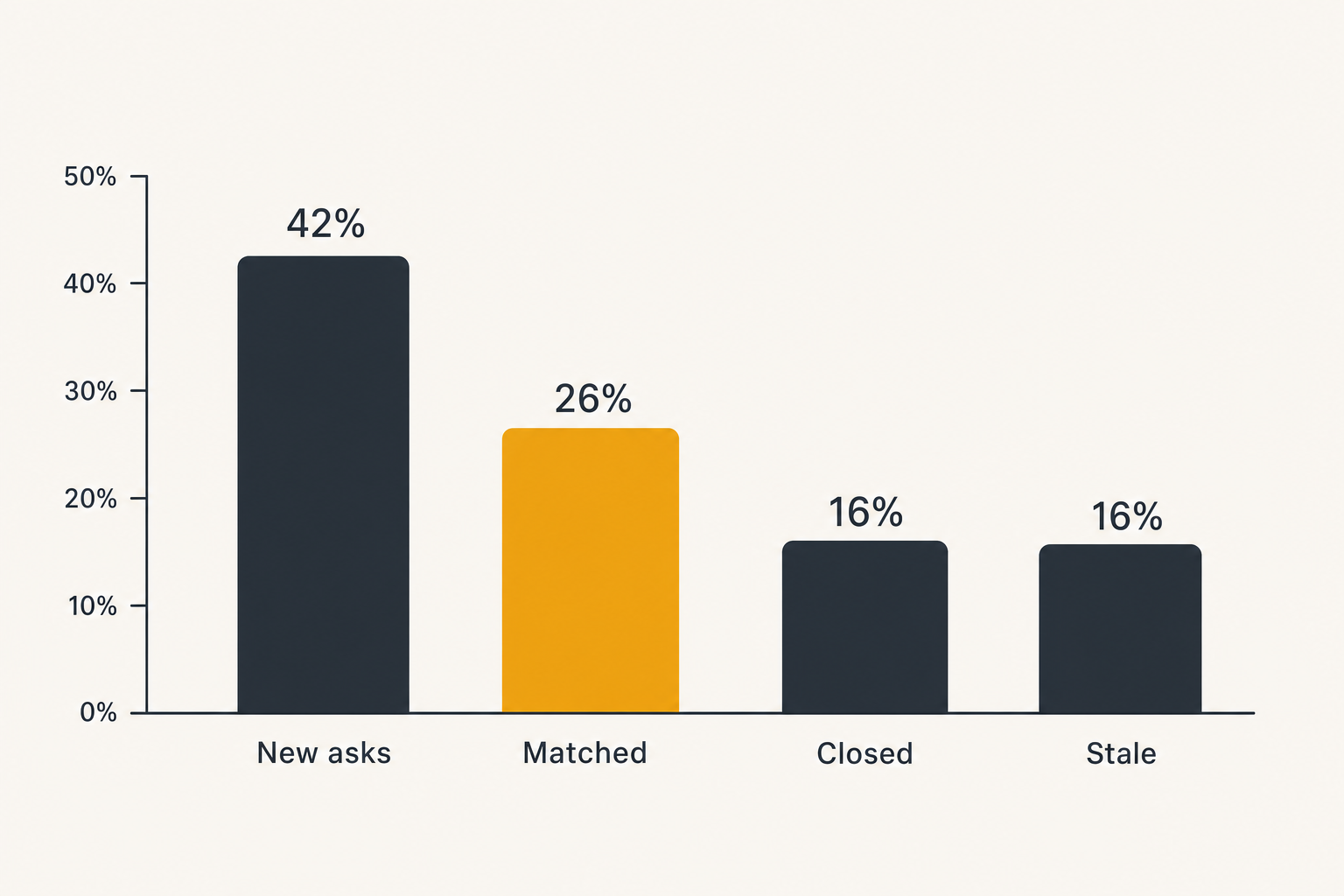
Do not measure only members, posts, or event RSVPs. Those are activity metrics. They can go up while the network gets less useful.
Track operating metrics:
- Number of new asks
- Number of active offers
- Match rate
- Time to first response
- Time to resolution
- Stale request count
- Repeat helper load
- Issue reports
- Referral-out count
These numbers do not need to be perfect. Direction matters. If asks are rising but match rate is falling, recruit supply or narrow scope. If response time is good but completion is poor, improve handoff and confirmation. If the same three helpers do everything, you have a burnout risk.
What breaks when local community networks are run badly
The chat becomes the product
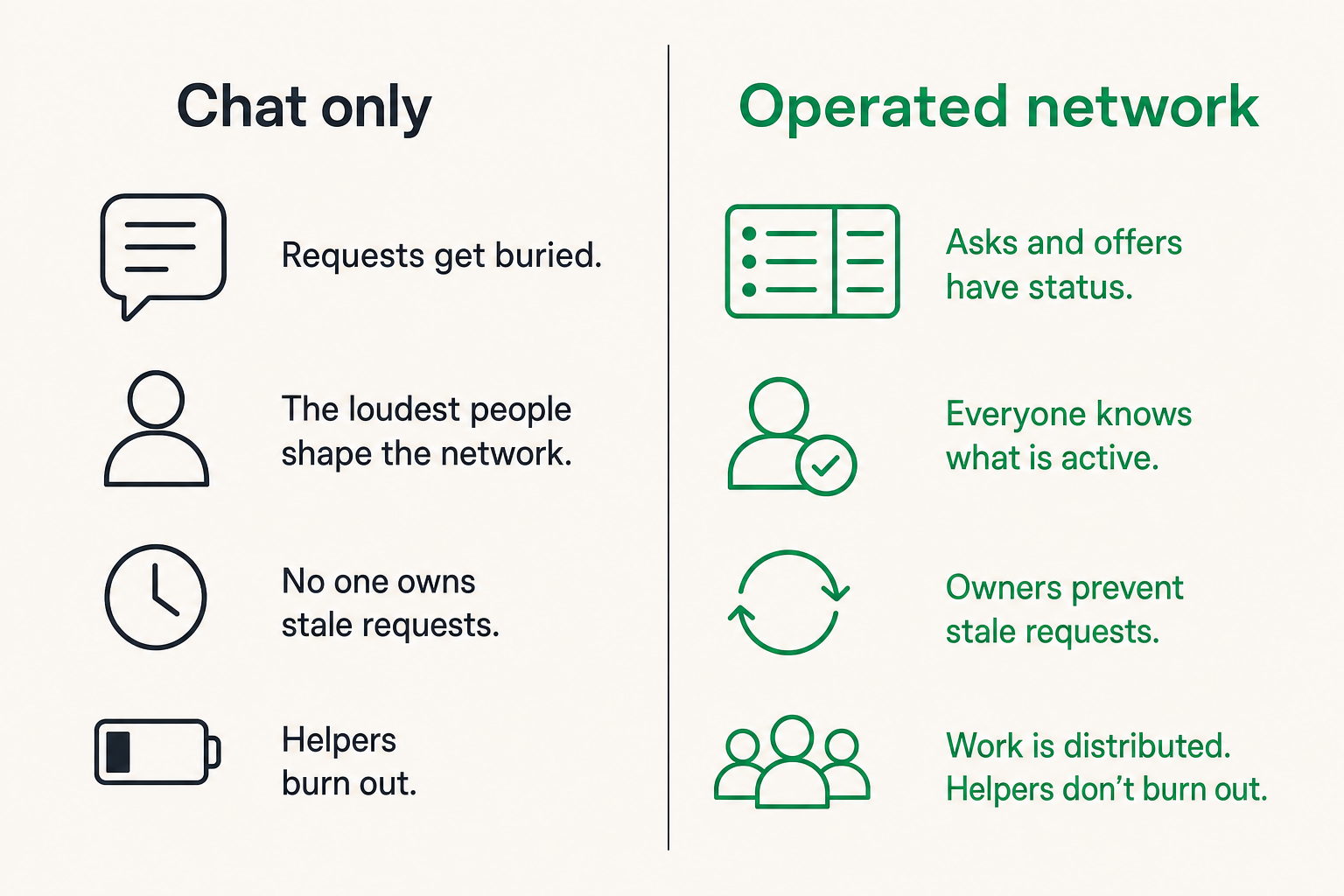
The most common failure mode is mistaking conversation for utility. A busy chat looks alive, but it is a terrible database and a weak workflow engine.
Requests get buried. Helpers miss relevant opportunities. New members do not know what is active. The loudest people shape the network. Quiet but capable members disappear.
What works is using chat as a notification and discussion layer, not the source of truth. The source of truth should be a list, board, directory, marketplace, or database where asks and offers have status.
Helpers burn out
In early networks, the best helpers get overused. They respond quickly, solve problems, and care about the mission. Then every request routes to them because operators trust them.
That is understandable and dangerous. Burnout is not just an emotional issue. It is a capacity planning failure.
What fails:
- No rotation
- No maximum load
- No backup pool
- No distinction between urgent and flexible work
- No way for helpers to pause availability
What works:
- Availability windows
- Helper categories
- Backup routing
- Clear compensation or appreciation norms
- A visible unmatched queue for recruiting new supply
No one owns stale requests
Stale requests quietly kill trust. The requester feels ignored. Helpers assume someone else handled it. Operators avoid the awkward follow-up. Eventually people stop posting real needs.
A stale request is any ask that has not moved after the expected response window. It should have a status, not a vague feeling.
Use statuses like:
| Status | Meaning | Operator action |
|---|---|---|
| New | Needs review | Clarify or route |
| Routed | Sent to possible helpers | Wait for response until deadline |
| Matched | Helper accepted | Confirm handoff |
| Completed | Outcome confirmed | Close and record |
| Stale | No movement | Escalate, repost, or close |
| Referred out | Better served elsewhere | Send resource and close |
Practical rule: If stale requests are invisible, your community is measuring vibes while trust leaks out of the system.
A practical implementation sequence for 2026
Phase 1: map demand
Start by collecting real asks before building a big program. Interview members, scan local threads, talk to small businesses, ask service providers what people request repeatedly, and review what organizers are already handling manually.
Do not ask people what kind of community they want in the abstract. Ask what they tried to get done locally in the last month and where it got stuck.
Your output should be a short demand map:
- Top five recurring request types
- Typical urgency
- Required geography
- Trust or safety concerns
- Existing informal helpers
- Cases you should not handle
This gives you a grounded starting point. It also prevents the classic founder mistake of building a community around imagined needs.
Phase 2: recruit supply
Once demand is visible, recruit against categories, not general enthusiasm.
If people need errands, recruit errand runners. If small businesses need admin automation, recruit operators who can scope workflow cleanup. If residents need referrals, recruit trusted connectors by category.
A specific ask like looking for small business automation projects in Winston Salem is useful because it names a real supply-building opportunity. It is not just networking. It is market discovery inside a local coordination layer.
Build a supply table with service type, geography, availability, risk level, price model, and last active date. Then test matching manually before automating anything.
Phase 3: tighten follow-up
Follow-up is where trust becomes visible. People remember whether someone got back to them more than they remember the elegance of your intake form.
A practical launch workflow:
- Pick one service category and one geography.
- Publish a structured ask template and offer template.
- Recruit ten to twenty initial helpers or providers.
- Route requests manually for two weeks.
- Record every status change.
- Review stale items twice a week.
- Publish safe outcome summaries.
- Adjust scope, timing, and verification rules.
- Add automation only where the manual pattern is stable.
That last point matters. Automation before pattern recognition usually automates confusion.
Tools, roles, and data you actually need
The core roles
A local community network does not need a large staff. It does need named responsibilities.
Core roles:
- Network operator: owns the queue and review cadence
- Intake reviewer: clarifies asks and offers
- Router: matches demand to supply
- Trust lead: handles verification, safety boundaries, and issue reports
- Category lead: understands a specific domain like rides, errands, home help, or business services
- Community host: maintains tone, onboarding, and public updates
One person can hold multiple roles early on. The important thing is that the roles exist. If everyone owns routing, nobody owns routing.
The simple stack
Use boring tools first. A form, spreadsheet, shared inbox, lightweight CRM, directory, and messaging channel can take you surprisingly far if the workflow is clear.
Compare the options by operating need:
| Need | Lightweight option | When to upgrade |
|---|---|---|
| Ask intake | Form or structured post | Too many clarifying questions |
| Offer directory | Spreadsheet or profile list | Search and filtering become painful |
| Routing | Manual operator review | Response time depends on one person |
| Follow-up | Status column and reminders | Stale items are missed repeatedly |
| Trust notes | Restricted-access log | Multiple operators need safe context |
| Public updates | Email or community post | Members cannot see active demand |
The tool is not the strategy. The workflow is the strategy. Tools should make the workflow easier to run, audit, and improve.
The operating table
At minimum, keep one operating table for active coordination. It can live in a spreadsheet, database, marketplace admin view, or CRM.
Recommended columns:
- Request or offer ID
- Type
- Location
- Urgency
- Public summary
- Private details location
- Owner
- Status
- Matched person or provider
- Last update
- Next action
- Risk level
- Outcome
This table is the difference between a community that feels busy and a network that can be operated. It also creates the evidence you need to improve the system without relying on memory.
How to run a local community network with d0rz.com
Where d0rz fits in the architecture
d0rz.com is built around a practical idea: local coordination works better when asks and offers are visible, specific, and routeable. That fits the operating model described here.
If you are deciding how to run a local community network, you can use d0rz as part of the public coordination layer: people post what they need, what they offer, where it applies, and how follow-up should happen. The network operator can then use those entries as structured signals instead of trying to extract intent from scattered chat messages.
The earlier d0rz article on local network architecture goes deeper on why asks, offers, trust, and follow-up need to be designed as connected infrastructure rather than disconnected community features.
This is not about replacing human judgment. Local networks still need operators. The product fit is in reducing ambiguity: clearer asks, clearer offers, easier routing, and a better record of what is active.
A soft launch pattern
Do not launch with every category at once. Pick a narrow local use case and run it as an operating test.
For example:
- Week 1: collect ten real asks from local businesses or residents
- Week 2: recruit matching offers from known providers or helpers
- Week 3: route matches manually and track statuses
- Week 4: publish what was completed, what stalled, and what supply is missing
Then decide whether to expand the category, narrow the promise, or recruit more supply. This is how a local network becomes reliable: not through hype, but through repeated closure of real requests.
The mistake teams make is launching a community as if attention is the scarce resource. In local coordination, the scarce resource is dependable follow-through.
Try d0rz.com
d0rz.com is for people building practical local networks where asks, offers, trust, routing, and follow-up matter. If you are serious about how to run a local community network as coordination infrastructure, start with structured local asks and offers.