
Most local networks do not fail because people are selfish. They fail because nobody can see what is needed, who can help, what is trusted, what is already in motion, and what needs follow-up.
That is where a local community network consultant becomes useful. Not as a motivational speaker. Not as another person posting event flyers. The useful consultant turns scattered relationships into a working coordination system.
Teams think the problem is engagement. The real problem is operational state. Who asked? Who offered? Who was routed? Who replied? Who completed the work? Who should not be asked again for three months?
That changes the conversation. The practical question is not how to make a community feel more active. The practical question is how to make local coordination reliable without turning neighbors, volunteers, freelancers, and small businesses into unpaid support staff.
Table of contents
- Why a local community network consultant is an operating decision
- Map the network before changing it
- Design the ask offer routing workflow
- Build trust as infrastructure not vibes
- The operating model for a local community network consultant
- Tooling stack and data model that actually holds
- Implementation sequence for the first 30 days
- Metrics that show the network is working
- Failure modes when community networks scale badly
- How d0rz.com fits into the workflow
- Closing checklist for hiring or becoming a consultant
Why a local community network consultant is an operating decision
A local community network consultant should be judged by operational outcomes, not by how many meetings they can facilitate. Facilitation matters, but it is only one layer. The harder work is designing a repeatable coordination loop that survives after the consultant leaves.
The visible problem is participation
Most organizers describe the pain in familiar terms:
- People attend events but do not follow up.
- Local businesses say they want to help but do not know where to plug in.
- Skilled neighbors offer help once, then disappear into message threads.
- Urgent needs get posted publicly, but nobody knows who owns the next step.
- The same trusted people get asked for everything until they burn out.
The mistake teams make is treating these as morale problems. Sometimes morale is involved. Usually the system is just too vague.
A useful way to think about it is this: participation is the front end. Coordination is the back end. If the back end is missing, more participation creates more noise.
The real problem is coordination state
Coordination state means the network can answer basic operational questions:
- What is being requested?
- Who is eligible to see it?
- Who can help?
- Who has already been contacted?
- What was promised?
- What happened?
- What needs escalation?
- What should be remembered next time?
Without state, every interaction restarts from zero. The consultant becomes a human search engine, memory bank, dispatcher, mediator, and customer support desk. That does not scale, even in a small neighborhood.
Practical rule: If a local network cannot tell the difference between new, routed, accepted, completed, and abandoned work, it does not have an operations model yet.
Map the network before changing it

Before recommending a platform, campaign, directory, event series, or membership structure, map the actual network. Not the aspirational network. The real one.
A local community network is usually a mix of residents, informal leaders, nonprofits, small businesses, freelancers, service providers, churches, schools, mutual aid groups, landlords, tenants, public agencies, and people who only participate when something affects them directly.
Inventory asks offers and dormant capacity
Start with the smallest useful inventory. Do not spend six months building a perfect directory. You need enough structure to see patterns.
Track:
- Active asks: current needs with an owner and deadline.
- Active offers: help, services, equipment, rooms, rides, expertise, translation, food, tools.
- Dormant capacity: people who helped before but are not currently active.
- Repeat needs: problems that show up every month.
- Critical gaps: needs with no obvious route.
For example, a local business automation request such as looking for small business automation projects in Winston Salem is not just an isolated post. It is a signal. It tells the network that workflow pain exists, that someone can help, and that there may be similar businesses with the same bottleneck.
A consultant should turn those signals into routing intelligence.
Identify trust boundaries and routing paths
Not every ask should be public. Not every offer should be broadcast. Trust boundaries matter.
Common boundaries include:
- Public: safe for open posting and broad discovery.
- Local only: visible to people in a place-based network.
- Known members: limited to people with some history.
- Brokered: routed by an operator because context is sensitive.
- Private: stored only as a note or handled offline.
This is where many community systems break. They assume visibility equals usefulness. In practice, the wrong visibility can create embarrassment, spam, conflict, or extraction.
Related reading from our network: teams working in security operations face a similar routing problem when private context must move without losing accountability, as covered in encrypted messaging security operations.
Design the ask offer routing workflow
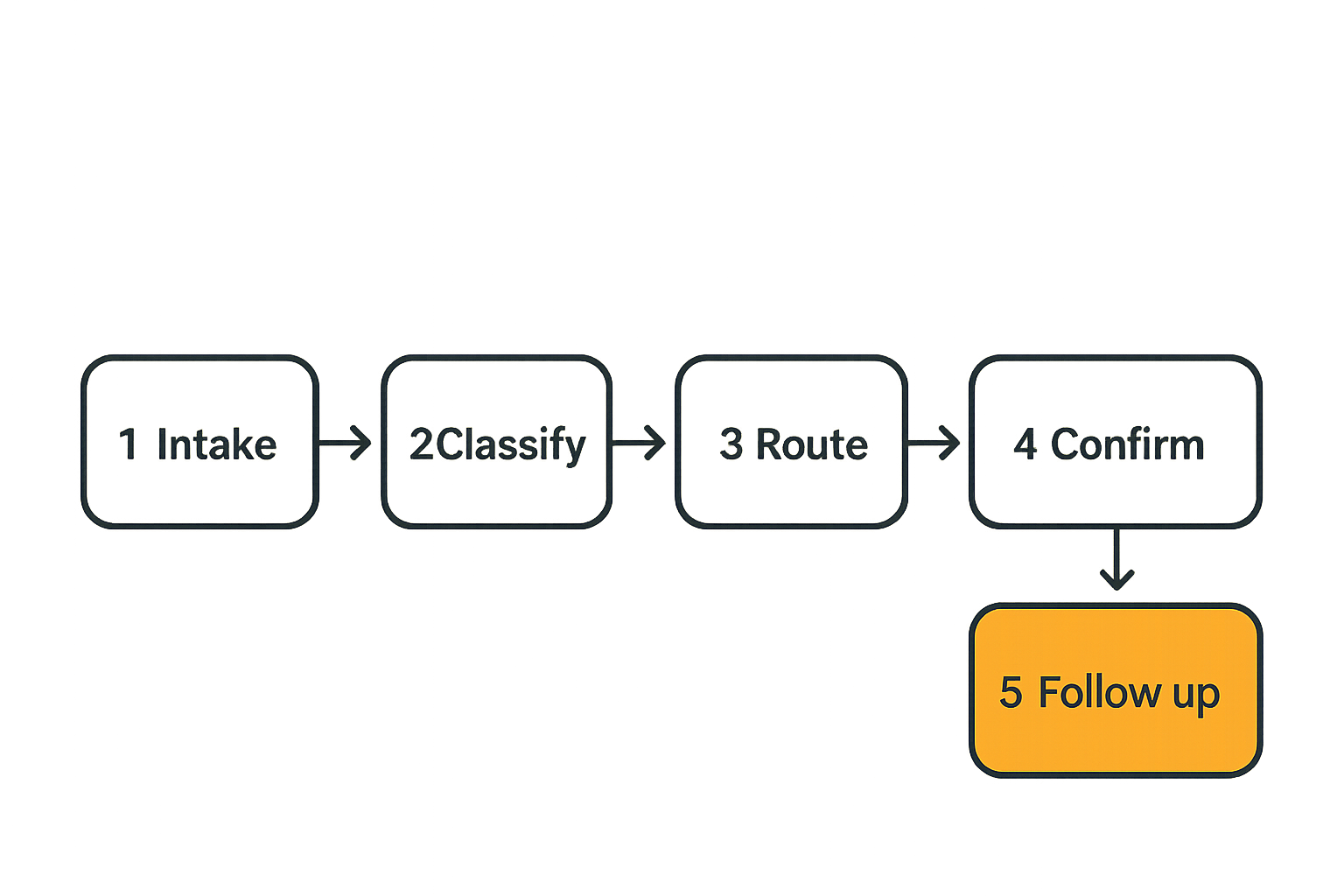
The heart of the work is routing. A local community network consultant should be able to design the path from a raw ask to a useful outcome.
This does not need to be complicated. It does need to be explicit.
Normalize intake without killing context
Bad intake forms strip away the local context that makes routing possible. Free-form message threads preserve context but are hard to operate. The middle path is structured intake with room for human detail.
A useful ask record includes:
| Field | Why it matters | Bad version | Better version |
|---|---|---|---|
| Need | Defines the work | Need help | Need two people to move a couch Saturday |
| Location | Determines routing | Nearby | East side, porch pickup |
| Deadline | Sets urgency | ASAP | Before Friday 5pm |
| Sensitivity | Controls visibility | Public by default | Public, local, brokered, or private |
| Owner | Prevents drift | Posted by group | Maria owns follow-up |
| Success condition | Defines done | Help found | Couch moved and helper thanked |
The goal is not bureaucracy. The goal is to avoid asking five people to interpret the same vague message.
Practical rule: Structure the minimum data needed to route the ask, then preserve enough narrative context for a human to make a good judgment.
Route by trust skill and urgency
Routing should consider more than availability. A person can be available and still be the wrong fit.
Route by:
- Trust level: Is this person appropriate for the sensitivity of the request?
- Skill match: Can they actually do the work?
- Distance or locality: Is the route practical?
- Urgency: Does this need a fast response or a careful one?
- Load: Has this person been asked too often lately?
- Reciprocity: Has the relationship been one-sided for too long?
A simple routing workflow might look like this:
- Capture the ask with owner, location, timing, sensitivity, and success condition.
- Match against active offers and known capacity.
- Check trust boundary and recent load before contacting anyone.
- Send a specific request to one to three likely responders.
- Record accepted, declined, no response, or needs more context.
- Confirm completion and capture follow-up notes.
This is ordinary operations work. The difference is that local networks often try to do it through memory, group chats, and hope.
Build trust as infrastructure not vibes
Trust is not a poster value. It is an operating constraint. If the network routes poorly, trust decays. If it routes carefully, trust compounds.
Decide what can be public private or brokered
The consultant should help the network define visibility rules before a hard case appears.
Examples:
- Public: a local garden needs volunteers for Saturday cleanup.
- Local only: a shop needs someone to debug a payment link.
- Known members: a parent needs a ride coordination backup.
- Brokered: a tenant needs advice before contacting a landlord.
- Private: a domestic safety concern or immigration-sensitive issue.
What breaks in practice is the assumption that openness is always safer or more democratic. Sometimes openness helps. Sometimes it exposes vulnerable people, invites opportunists, or discourages people from asking at all.
Related reading from our network: private publishing teams face adjacent consent and review problems, especially when audience access is constrained, as described in encrypted messaging content marketing.
Use lightweight verification and reputation
Reputation does not need to mean ratings, badges, or social scoring. In small networks, heavy scoring can create politics fast.
Lightweight verification can include:
- Confirmed identity by a known member.
- Completed work notes.
- Domain-specific checks, such as licensed electrical work.
- References for high-trust tasks.
- Operator notes on reliability and boundaries.
- Cooling-off periods after conflict.
The consultant should separate capability from trust. Someone may be skilled but unreliable. Someone may be trusted but not qualified. Someone may be helpful in public projects but inappropriate for private support.
Practical rule: Do not let friendliness substitute for eligibility. Trust routing should be based on context, history, boundaries, and the specific risk of the ask.
The operating model for a local community network consultant
A local community network consultant needs an operating model that defines ownership, cadence, decision rights, and escalation. Otherwise they become the system.
Clarify ownership before tools
Before picking software, answer these questions:
- Who owns intake?
- Who approves public posts?
- Who routes brokered requests?
- Who closes loops after completion?
- Who handles complaints?
- Who can see sensitive notes?
- Who maintains the directory or records?
- Who decides when a request is out of scope?
If the answer is the consultant for all of these, the engagement is fragile. The consultant may temporarily operate the system, but the network needs local ownership.
This is the same architectural point made in community building d0rz local network architecture: local coordination gets stronger when asks, offers, trust, and follow-up are treated as infrastructure instead of engagement theater.
Create service levels for community coordination
Service levels sound corporate, but the idea is simple: people should know what to expect.
A community network can define lightweight service levels such as:
- Urgent safety issue: same day triage or referral.
- Time-sensitive practical ask: response attempt within 24 hours.
- General offer: reviewed and categorized within a week.
- Complex brokered request: acknowledged, then handled by an operator.
- Out-of-scope request: declined with a useful redirect when possible.
This prevents the network from promising infinite responsiveness. It also protects operators from invisible obligations.
Tooling stack and data model that actually holds
Tools matter, but not in the way most teams think. A tool does not create a workflow. It either supports the workflow or distorts it.
Use simple records before complex platforms
The first data model can be basic:
ask_id
created_at
owner
location
category
sensitivity
status
needed_by
success_condition
assigned_route
follow_up_date
outcome_notes
For offers:
offer_id
person_or_org
location
skills_or_resources
availability
trust_scope
preferred_contact
load_notes
last_contacted
status
The mistake teams make is starting with a public directory and calling it a network. A directory shows entries. It does not route work, manage trust, or ensure completion.
Use spreadsheets if you must. Use forms if they help. Use a lightweight platform if it reduces operator load. But keep the state model clear.
Track state transitions not just messages
Messages are not enough. A group chat can contain the answer, but if nobody knows the current status, the operator still has to re-read everything.
Track states such as:
- New
- Needs clarification
- Ready to route
- Routed
- Accepted
- In progress
- Completed
- Declined
- Expired
- Archived
State transitions are what make the system inspectable. They let someone else step in without asking everyone to explain the last two weeks.
Related reading from our network: media operations teams hit the same state-tracking issue when private files move through processing queues, verification, and delivery; the architecture discussion in encrypted messaging video transcoding is technical, but the workflow lesson is relevant.
Implementation sequence for the first 30 days
A consultant should avoid boiling the ocean. The first month should prove that the network can capture, route, complete, and learn from a small number of real interactions.
Week one discovery and cleanup
In week one, do not launch a new program. Clean up the operational picture.
- Interview five to ten people who already route informally.
- Collect recent examples of successful and failed coordination.
- List current asks, offers, and recurring needs.
- Identify sensitive categories that should not be public.
- Define the first status model.
- Pick one operator of record for the pilot.
- Choose one channel for intake and one place to track state.
The deliverable is not a strategy deck. It is a working map of the current system.
Weeks two to four pilots and feedback
The pilot should be narrow enough to operate manually. For example:
- Route practical help requests from local small businesses.
- Match neighborhood repair needs with trusted providers.
- Coordinate translation support for forms and appointments.
- Match volunteers to one recurring community event.
- Broker non-sensitive workflow automation help.
Run each ask through the same loop: intake, classify, route, confirm, close, learn.
A useful pilot log can be simple:
| Ask | Route | Result | Follow-up |
|---|---|---|---|
| Website form broken | Local automation helper | Completed | Add website support category |
| Need Spanish translation | Known bilingual provider | Completed | Ask permission to list offer |
| Move heavy item | Two nearby helpers | One declined, one accepted | Add load note |
| Business scheduling pain | Automation consultant | Needs scoping | Create discovery template |
The point is not volume. The point is whether the workflow produces less confusion than the old method.
Metrics that show the network is working
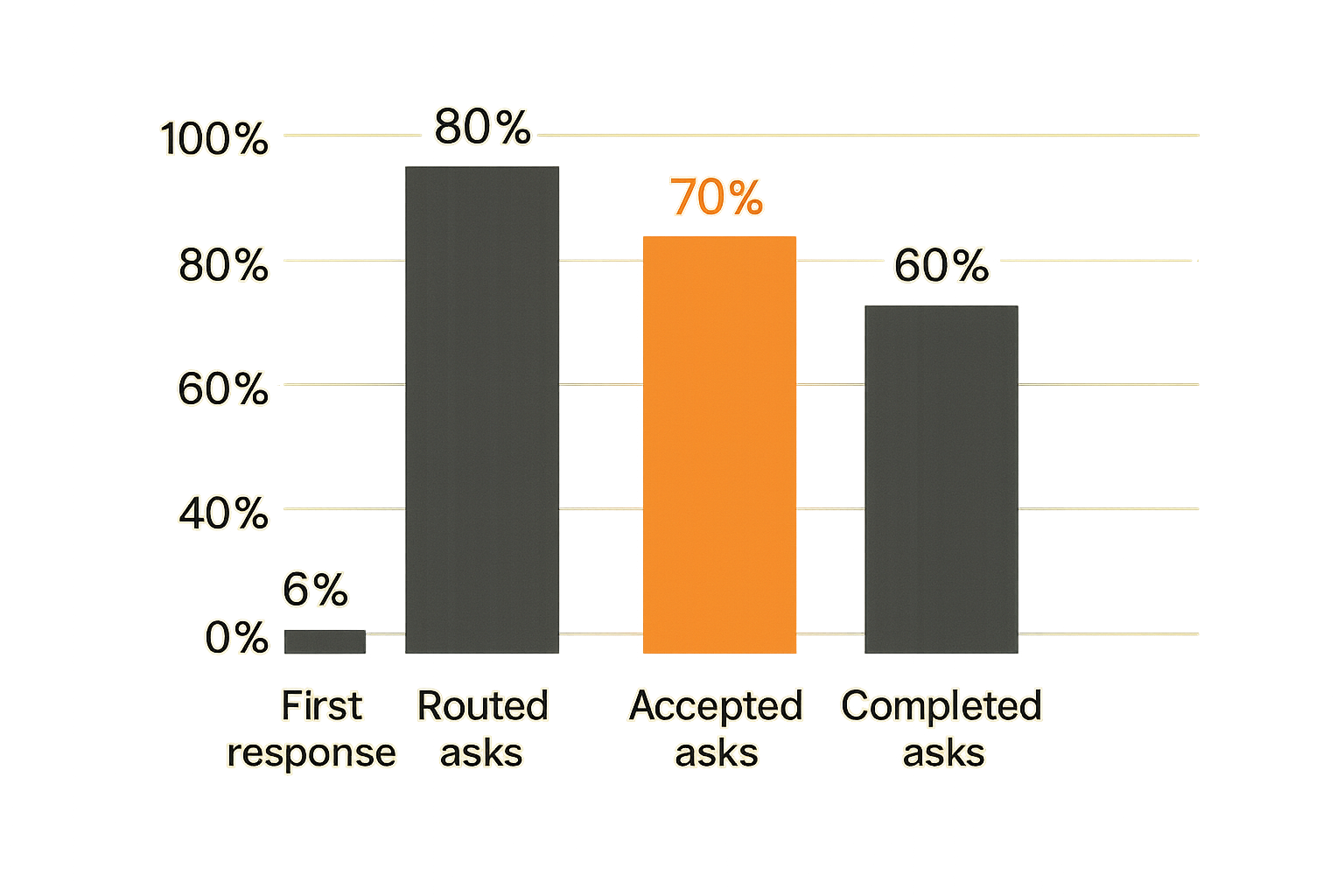
Do not measure a local community network like a social media account. More posts, more members, and more comments can all hide operational failure.
Measure response liquidity and completion
Useful metrics include:
- Time to first useful response.
- Percentage of asks that get routed.
- Percentage of routed asks that are accepted.
- Completion rate for accepted asks.
- Number of repeat responders contacted this month.
- Number of new responders activated.
- Number of abandoned asks and why they stalled.
- Follow-up completion rate.
Response liquidity is the practical measure: when a real need appears, does the network have enough trusted, reachable capacity to respond?
You do not need to invent a dashboard on day one. Even a weekly review can reveal bottlenecks.
Watch for extraction overload and quiet churn
Local networks often look healthy right before they burn out. The warning signs are subtle:
- The same five people handle everything.
- Operators stop logging outcomes because they are too busy.
- People say yes publicly but stop responding privately.
- Requests become more urgent because earlier weak signals were missed.
- Skilled helpers withdraw after being asked for unpaid expert work too often.
- Sensitive asks stop appearing because people do not trust the process.
This is where a consultant has to be slightly skeptical of growth. Bigger is not automatically better. If routing capacity, trust handling, and follow-up do not grow with participation, the network gets noisier instead of stronger.
Practical rule: A local network is not healthy because it has many members. It is healthy when real asks can move through trusted routes to completed outcomes without exhausting the same operators.
Failure modes when community networks scale badly
Scaling a local network badly usually means adding visibility without adding operations. More channels. More posts. More events. More introductions. Same invisible follow-up burden.
What fails
Common failure modes:
- Directory theater: everyone is listed, but nobody knows who is active.
- Broadcast overload: every ask goes to everyone.
- Operator bottleneck: one trusted person manually connects everything.
- No closure: nobody records whether help actually happened.
- Trust collapse: sensitive asks are routed casually.
- Volunteer extraction: skilled people become unpaid help desks.
- Tool fragmentation: forms, chats, spreadsheets, and DMs all hold partial truth.
- Ambiguous authority: nobody knows who can say no.
The worst version is when the consultant introduces a new tool without changing the workflow. Then the old mess gets imported into a cleaner interface.
What works instead
What works is less exciting but more durable:
- Narrow intake categories.
- Clear owner for each ask.
- Explicit visibility rules.
- Small routing batches instead of mass broadcasts.
- Status tracking.
- Follow-up discipline.
- Load awareness for frequent helpers.
- Escalation rules for sensitive or failed routes.
The comparison is straightforward:
| Approach | What it optimizes | What breaks |
|---|---|---|
| Engagement-first | Activity and visibility | Follow-up, trust, completion |
| Directory-first | Discovery | Freshness, routing, accountability |
| Consultant-as-hub | Short-term responsiveness | Scale, continuity, burnout |
| Operations-first | Reliable coordination | Requires discipline and ownership |
A good consultant moves the network toward operations-first without making it feel like a bureaucracy.
For adjacent thinking, security operations local networks is useful because it frames local network reliability as a coordination problem across signals, ownership, response, and validation, not just a tooling problem.
How d0rz.com fits into the workflow
A product should not pretend to replace local trust. The useful role for software is to make asks, offers, routing context, and follow-up easier to see and operate.
Use d0rz for asks offers and routing context
d0rz.com is built around practical local networks where asks, offers, trust, routing, and follow-up matter. That makes it a natural place to capture coordination signals without reducing the network to a chat feed.
A consultant can use d0rz as part of the operating layer:
- Publish offers that are safe for discovery.
- Capture asks with enough context to route.
- Observe where needs cluster by place, skill, or urgency.
- Use public records as starting points for brokered follow-up.
- Keep local work visible enough to be useful without forcing every interaction into public view.
The practical question is not whether every local interaction should happen inside one platform. It should not. The question is where the durable coordination record lives.
Keep consultant work focused on operations
The consultant should not spend the whole engagement manually posting, reminding, and chasing. That may be necessary at the start, but it should become less central over time.
A healthier division of labor looks like this:
- d0rz stores visible asks and offers.
- Local operators classify, route, and follow up.
- Trusted brokers handle sensitive cases.
- Participants update availability and outcomes when possible.
- The consultant improves the workflow, trains owners, and removes bottlenecks.
This keeps the consultant from becoming the permanent middleware. It also helps the network learn how to operate itself.
Closing checklist for hiring or becoming a consultant
A local community network consultant is useful when they make coordination more reliable, not when they generate more activity to manage.
Questions to ask before engagement
If you are hiring one, ask:
- What workflow will you improve first?
- How will you map existing asks and offers?
- How will you handle sensitive requests?
- What records will remain after you leave?
- Who will own routing locally?
- How will you measure completion, not just participation?
- How will you prevent overloading the same trusted people?
If you are becoming one, be honest about the job. You are not just facilitating community. You are designing a coordination system with human trust constraints.
The practical next step
Start with ten real cases. Not personas. Not theoretical member journeys. Ten actual asks or offers from the network.
For each one, write down:
- What was needed or offered.
- Who owned the next step.
- Who could see it.
- Who it was routed to.
- What happened.
- What should change next time.
That exercise will expose the real consulting scope quickly. If the network cannot answer those questions, the work is operational. If it can, the consultant can focus on improving scale, resilience, and trust boundaries.
The closing point is simple: a local community network consultant should leave behind a network that can route more of its own work with less confusion.
Try d0rz.com
You are writing for people building practical local networks where asks, offers, trust, routing, and follow-up matter. Try d0rz.com to start turning local coordination into visible, operable infrastructure.