

A local community network consultant usually gets called after the network already feels heavy. People are showing up, but requests disappear. Offers are hard to find. The same three helpers get tagged for everything. Someone remembers that a neighbor knows a contractor, a Spanish translator, or a grant writer, but nobody can reliably route the request when it matters.
Teams think the problem is engagement. The real problem is operating architecture.
If you run a neighborhood mutual aid group, founder circle, chamber of commerce, school parent network, faith community, repair collective, freelancer network, or local service directory, the work is not just getting people into a room. The practical question is whether asks, offers, trust, routing, and follow-up move through the network without heroic manual effort.
That changes the conversation. A local community network consultant is not useful because they bring vague community energy. They are useful when they turn informal goodwill into repeatable coordination infrastructure.
Table of contents
- What a local community network consultant actually operates
- Diagnose the network before you add tools
- Build the architecture around asks offers trust routing and follow-up
- How to scope a local community network consultant engagement
- Design the intake and routing workflow
- Treat data and memory as shared infrastructure
- Build trust safety and permissions into the operating model
- Measure what changes behavior
- Implementation sequence for the first thirty days
- What works and what fails in practice
- Product fit where d0rz.com belongs in the workflow
What a local community network consultant actually operates
The job is not generic community management
The mistake teams make is hiring for personality when the failure is workflow. A friendly facilitator can make meetings better. A good moderator can reduce noise in a group chat. Those things matter, but they do not solve the core network problem.
The core problem is movement. Can a real ask move from person A to the right person B, with enough context, enough trust, and a clear next step? Can an offer stay discoverable after the original post scrolls away? Can a local operator tell what happened last week without reading 300 messages?
A local community network consultant should be evaluated on whether they can make the network easier to operate, not whether they can generate temporary excitement.
The boundary is coordination infrastructure
A useful way to think about it is this: the consultant works on the pipes, not just the room. The pipes include intake, categorization, routing, permission, reminders, verification, handoff, and after-action learning.
In a local business network, that might mean turning scattered recommendations into a searchable set of offers. In a volunteer group, it might mean making sure urgent needs get routed to people who opted into that kind of help. In a freelancer network, it might mean separating casual introductions from paid referrals.
Practical rule: If the same coordination task has to be remembered by one person every time, it is not yet infrastructure.
The consultant should leave an operating system behind
A consultant is not a permanent hero. If the network becomes dependent on them for every match, reminder, and decision, the project has just created a new bottleneck.
The output should be an operating system: lightweight records, routing rules, role definitions, escalation paths, review cadence, and a shared understanding of what the network is for. That operating system can live in simple tools. It does not need to be expensive. But it does need to be explicit.
The handoff test is simple: if the consultant takes two weeks off, can someone else continue the workflow without guessing?
Diagnose the network before you add tools
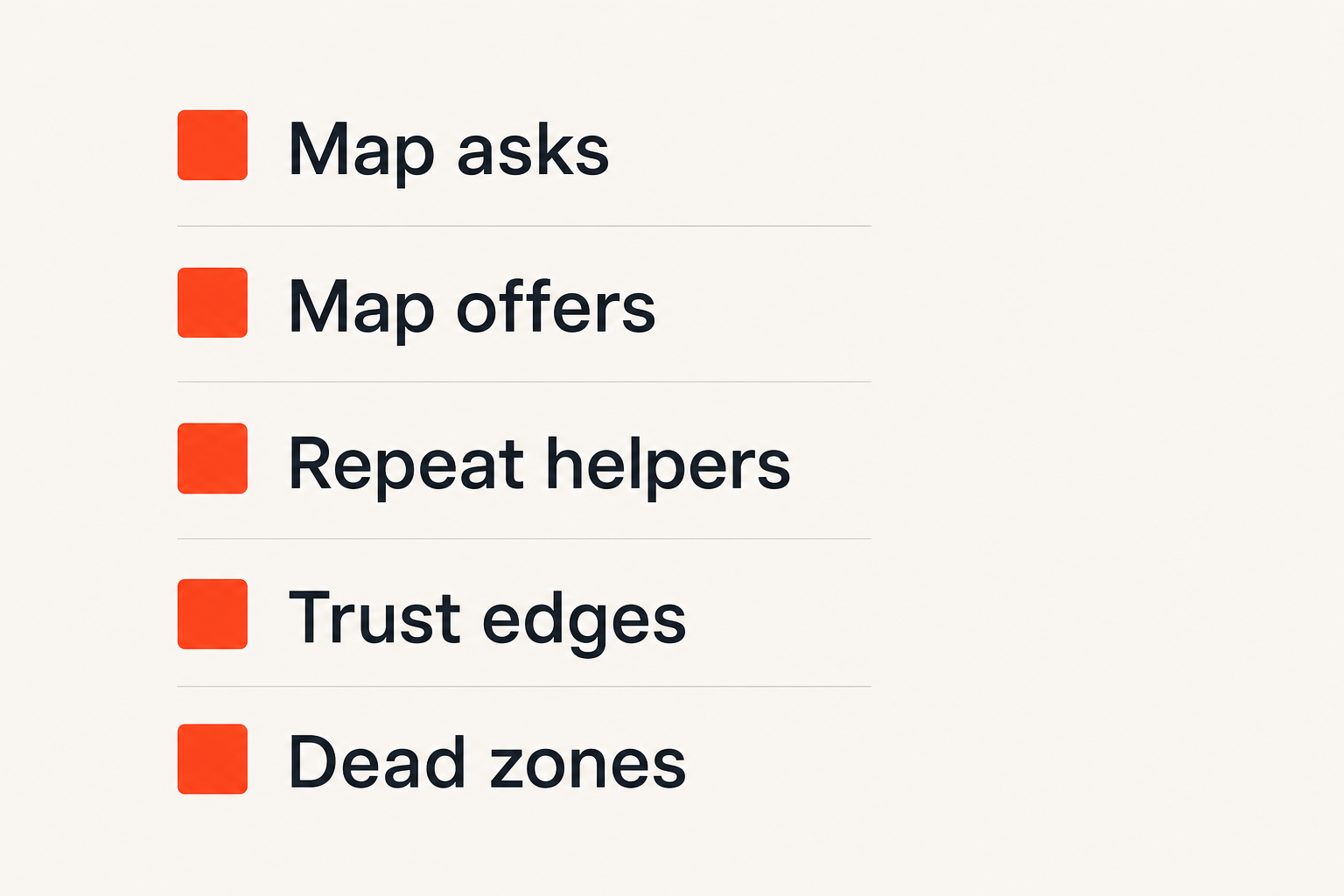
Map current asks offers and repeat helpers
Before changing anything, map what already happens. Look at the last 30 to 90 days of real activity. Do not start with a whiteboard fantasy. Start with actual asks, actual offers, actual referrals, and actual dead ends.
For each ask, record the category, urgency, location, trust sensitivity, who handled it, who was contacted, and what happened. For each offer, record what is offered, by whom, where it applies, whether it is free or paid, and how someone should request it.
This exposes the hidden network. You will usually find that a small group is doing most of the routing. You will also find unused offers that never reach the people who need them.
Find routing dead zones
A dead zone is not just an unanswered request. It is a pattern where the network repeatedly fails to move certain kinds of work.
Common dead zones include:
- Requests that are too sensitive for a public chat.
- Offers that require more context than a one-line post.
- Needs that cross neighborhood, language, or transportation boundaries.
- Paid work that gets mixed with volunteer help and creates awkwardness.
- Follow-ups that nobody owns after the first introduction.
What breaks in practice is not goodwill. It is ambiguity. Nobody knows whether they are allowed to route the ask, whether the helper is still available, or whether the person who asked still needs help.
Define success in operational terms
Do not define success as more members or more posts. Those can be useful signals, but they are not proof that the network works.
Better success criteria look like this:
- A new ask gets triaged within a defined time window.
- A qualified offer can be found without asking the same person from memory.
- Sensitive requests are handled in a private path.
- Matches have a clear next step.
- Dead ends are recorded and reviewed.
Practical rule: A healthy local network is not one where everyone talks all the time. It is one where the right help can be found and routed when needed.
Build the architecture around asks offers trust routing and follow-up
Asks and offers are inventory not content
Most community tools treat asks and offers like posts. That is fine for conversation and terrible for operations. Posts age quickly. They are hard to query. They mix jokes, updates, urgent needs, and durable resources in one feed.
A network operator should treat asks and offers as inventory. Inventory has status, owner, category, geography, freshness, and constraints. An offer to debug a local business website form is different from a general comment about being good with computers. For example, a concrete same-day website form and workflow debugging offer is easier to route because it names the service, scope, and remote boundary.
That changes how you design the system. You stop asking, who remembers someone? You start asking, what inventory is available, and what constraints determine routing?
Trust is a routing constraint
Trust is not a slogan. It is an input into routing.
Some requests can be routed broadly: who has extra moving boxes, who knows a notary, who can recommend a plumber. Other requests require tighter handling: childcare, elder support, housing insecurity, immigration paperwork, domestic conflict, emergency cash, medical transportation.
The network needs trust levels. They do not have to be formal scores. They can be simple categories:
- Public: safe to post broadly.
- Known group: visible to members with basic standing.
- Vouched: routed through trusted operators or known helpers.
- Private: handled by a small group with explicit permission.
If everything goes everywhere, people stop sharing sensitive needs. If everything is private, the network cannot scale. The consultant has to design the middle path.
Follow-up is part of the transaction
A match is not done when two people are introduced. It is done when the next step is clear, the status is updated, and the network learns from the outcome.
Follow-up answers basic questions:
- Did the requester get a response?
- Was the offer still available?
- Was the introduction appropriate?
- Did money, safety, or timing create friction?
- Should this helper be routed similar requests again?
This is where many networks lose institutional memory. The operator knows something happened, but the system does not. The next person repeats the same mistake.
For a deeper architecture view of turning participation into durable local workflows, the prior d0rz essay on Community Building d0rz is adjacent to this operating model.
How to scope a local community network consultant engagement
Start with a narrow operating surface
Do not hire a local community network consultant to fix the entire community. That scope is too vague. Start with one operating surface.
Good starting surfaces include:
- Local business help requests.
- Volunteer onboarding and shift coverage.
- Mutual aid request triage.
- Neighborhood service recommendations.
- Freelancer referrals.
- Event setup and post-event follow-up.
- Skill-sharing offers across a city or region.
The surface should have enough activity to observe, but not so much complexity that the first month becomes a governance debate.
Separate facilitation work from system work
Facilitation work is live human coordination: meetings, calls, conflict smoothing, introductions, and trust-building. System work is the infrastructure that makes future coordination easier: forms, records, routing rules, status updates, owner assignments, and review cadence.
You need both, but they are different deliverables. If you do not separate them, the consultant can spend all their time being helpful without improving the system.
A simple scope statement might say:
- Observe current routing for two weeks.
- Build a shared ask and offer record.
- Define three routing paths.
- Run a weekly review for one month.
- Train two local operators to maintain the workflow.
Put ownership in writing
Local networks often fail because ownership is polite but unclear. Everyone supports the idea. Nobody owns the queue.
For each workflow, define:
- Who receives new asks.
- Who can approve or reject routing.
- Who contacts potential helpers.
- Who follows up.
- Who closes the record.
- Who reviews failures.
Practical rule: If an ask has no owner, it is not in progress. It is just visible.
Design the intake and routing workflow
Intake should capture decision context
Bad intake asks only what someone needs. Good intake captures what an operator needs to decide where the ask should go.
A practical local ask record includes:
| Field | Why it matters | Example |
|---|---|---|
| Need category | Determines routing path | home repair, translation, website help |
| Location | Limits feasible helpers | downtown, east side, remote |
| Urgency | Sets response expectation | today, this week, flexible |
| Sensitivity | Controls visibility | public, vouched, private |
| Budget | Separates paid and volunteer paths | unpaid, small budget, market rate |
| Status | Prevents duplicate routing | new, routed, waiting, closed |
| Owner | Makes follow-up real | named operator |
This does not have to be a complex form. It can start as a shared table. The important part is that the same decision context appears every time.
Routing needs rules not vibes
A routing rule is a simple if-this-then-that decision. It reduces guesswork and makes handoff possible.
Examples:
- If the ask is public and low sensitivity, route to the relevant channel and tag the category owner.
- If the ask involves entering someone’s home, route only to vouched helpers.
- If the ask is paid work, route to providers who accept paid referrals.
- If no helper responds within 48 hours, mark as blocked and review in the weekly meeting.
- If the requester is under time pressure, contact two operators directly instead of posting broadly.
The mistake teams make is calling every judgment call community nuance. Some nuance is real. But many decisions are repeatable.
Escalation paths prevent quiet failure
Quiet failure is the most common failure mode in local networks. The ask was posted. Someone reacted. A helper was mentioned. Then nothing happened. Nobody knows whether the person got help.
Escalation paths make silence visible. They define what happens when the normal path stalls.
A basic escalation policy:
- New ask enters queue.
- Operator routes within 24 hours.
- If no response in 48 hours, owner checks with requester.
- If still unresolved, ask is escalated to a second operator or marked blocked.
- Blocked asks are reviewed weekly for pattern detection.
Related reading from our network: crisis-response teams face a more severe version of this same routing problem in location-aware crisis response architecture, where signals, ownership, and escalation cannot be left implicit.
Treat data and memory as shared infrastructure
Use a minimal common record
The goal is not to build a giant database. The goal is to prevent the network from forgetting what it already knows.
A minimal common record has four entities:
- People: requester, helper, operator, sponsor, verifier.
- Asks: need, status, context, owner, deadline.
- Offers: capability, availability, constraints, contact path.
- Interactions: introductions, follow-ups, outcomes, notes.
This gives the network memory without turning every human relationship into bureaucracy. The consultant’s job is to choose the smallest record that supports the operating model.
Keep notes usable by the next operator
Notes should explain decisions, not collect gossip. A good note helps the next operator understand what happened and what to do next.
Useful note:
- Routed to Maria because she accepts paid weekend translation work and is vouched by two members. Check back Friday.
Bad note:
- Maria maybe?
Another useful note:
- Requester prefers text, not phone. Budget is limited. Do not post publicly.
The discipline is simple: write notes for handoff, not for personal memory.
Reconciliation matters outside payments too
Payments teams use reconciliation to compare expected state against actual state. Local network operators need the same habit. Did the ask that was routed actually become a completed match? Did the offer marked active still exist? Did the follow-up happen?
Related reading from our network: payment operators deal with a stricter version of state, webhooks, and settlement in merchant payment architecture, but the lesson transfers: if state is not reconciled, support work becomes guesswork.
In community operations, reconciliation can be lightweight:
- Review open asks every week.
- Confirm active offers every month or quarter.
- Close stale records instead of letting them linger.
- Mark unresolved requests honestly.
- Capture why a route failed.
A local community network consultant who ignores reconciliation will leave behind a nicer-looking mess.
Build trust safety and permissions into the operating model
Trust is earned in layers
Local trust is contextual. Someone can be excellent at fixing bikes but not appropriate for childcare referrals. Someone can be generous in public and unreliable in follow-up. Someone can be trusted by one neighborhood group but unknown to another.
Do not flatten trust into member or non-member. Use layers.
Examples of trust layers:
- Self-listed: person created an offer.
- Known: operator has interacted with them.
- Vouched: trusted member recommends them for a category.
- Proven: prior successful match in the network.
- Restricted: can help only in specific contexts.
These layers protect both requesters and helpers. They also give operators a defensible reason for routing decisions.
Sensitive requests need different handling
Sensitive asks require different defaults. This is not about making the network cold. It is about protecting people from exposure.
Sensitive categories may include:
- Legal or immigration questions.
- Housing insecurity.
- Domestic safety.
- Childcare.
- Elder care.
- Medical transportation.
- Emergency cash.
- Anything involving access to a home.
For these, the workflow should ask for permission before sharing details, route through known operators, limit visibility, and avoid public tagging. A consultant should help the network decide which categories are never routed broadly.
Crisis and risk signals need owners
Most local networks are not emergency response systems. They should not pretend to be. But they still encounter risk signals: someone is unsafe, an event is disrupted, a volunteer is accused of misconduct, a family needs urgent help, a public post creates panic.
The operating model needs risk owners. Not everyone should improvise.
At minimum, define:
- Who can pause public routing.
- Who contacts the requester privately.
- Who documents the incident.
- Who decides whether outside services are needed.
- Who communicates back to the community.
For d0rz readers working on broader safety workflows, the prior post on security operations local networks extends this idea into signals, response ownership, and operational context.
Measure what changes behavior
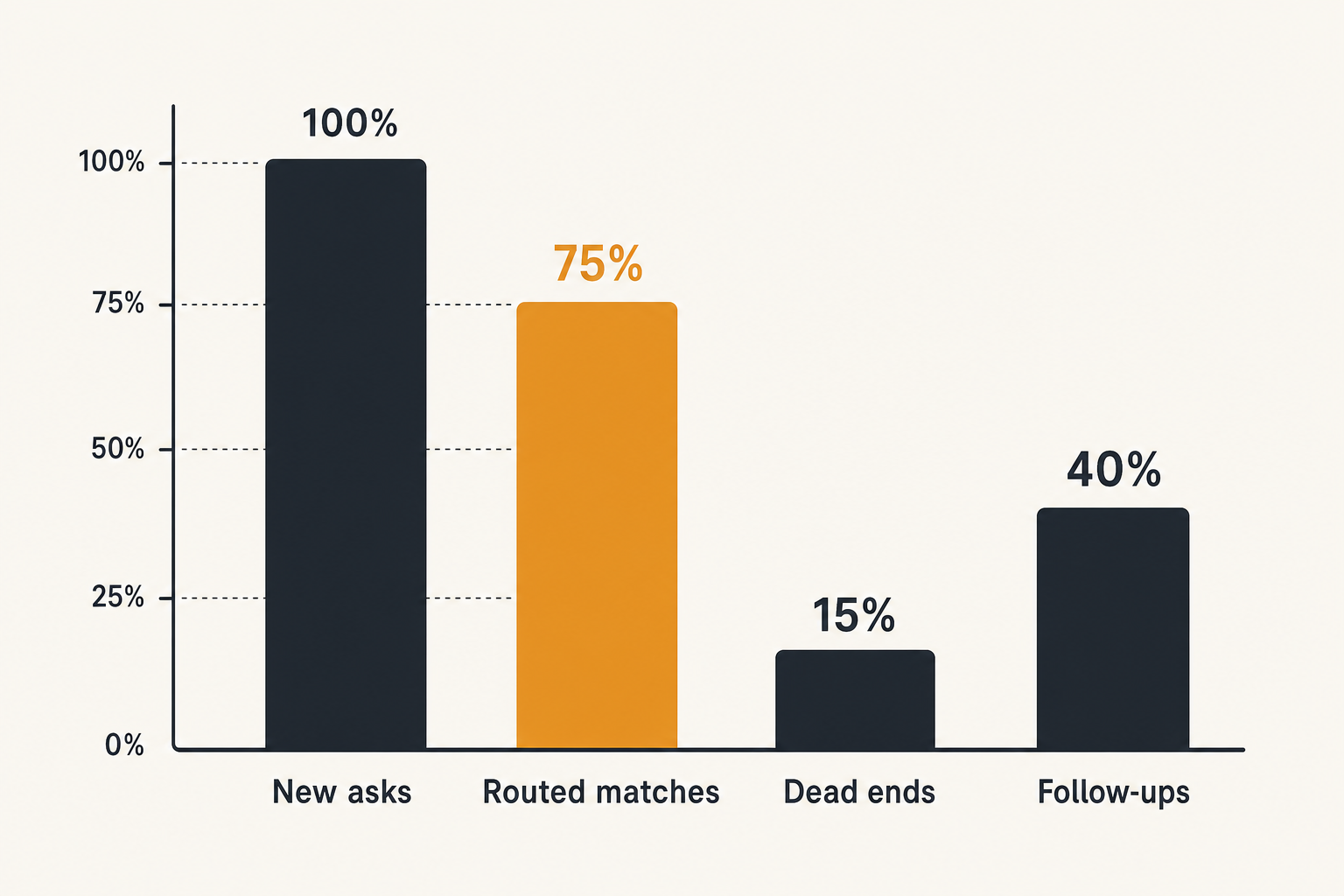
Track movement not vanity engagement
Vanity metrics are tempting because they are easy: members, followers, messages, event RSVPs. They can help with fundraising or reporting, but they do not prove coordination works.
Operational metrics are different. They measure whether work moves.
Useful metrics include:
- New asks received.
- Asks triaged within target time.
- Asks routed to at least one qualified helper.
- Matches completed.
- Asks blocked or unresolved.
- Average time to first response.
- Active offers confirmed this month.
- Repeat helper load.
The point is not to create a dashboard theater. The point is to see friction early.
Run a weekly operating review
A weekly review is where the network improves. Keep it short and concrete. Review open asks, blocked asks, stale offers, overloaded helpers, and any trust or safety concerns.
A good agenda:
- What came in?
- What was routed?
- What is stuck?
- What failed and why?
- Which offers need refreshing?
- Which routing rule should change?
- Who owns each next step?
The consultant should run this at first, then transfer facilitation to local operators. If the review dies after the consultant leaves, the system was not adopted.
Use metrics to remove friction
Metrics are useful only when they change behavior. If asks sit for five days before triage, reduce intake ambiguity or assign a daily queue owner. If one helper receives every request, expand the offer base or tighten categories. If many asks are unresolved, stop celebrating activity and inspect routing quality.
A useful way to think about it is queue health. Every local network has queues, even if nobody calls them that. The ask inbox is a queue. Volunteer signup is a queue. Provider referrals are a queue. Event follow-up is a queue.
Healthy queues have owners, statuses, and review. Unhealthy queues have hope.
Implementation sequence for the first thirty days
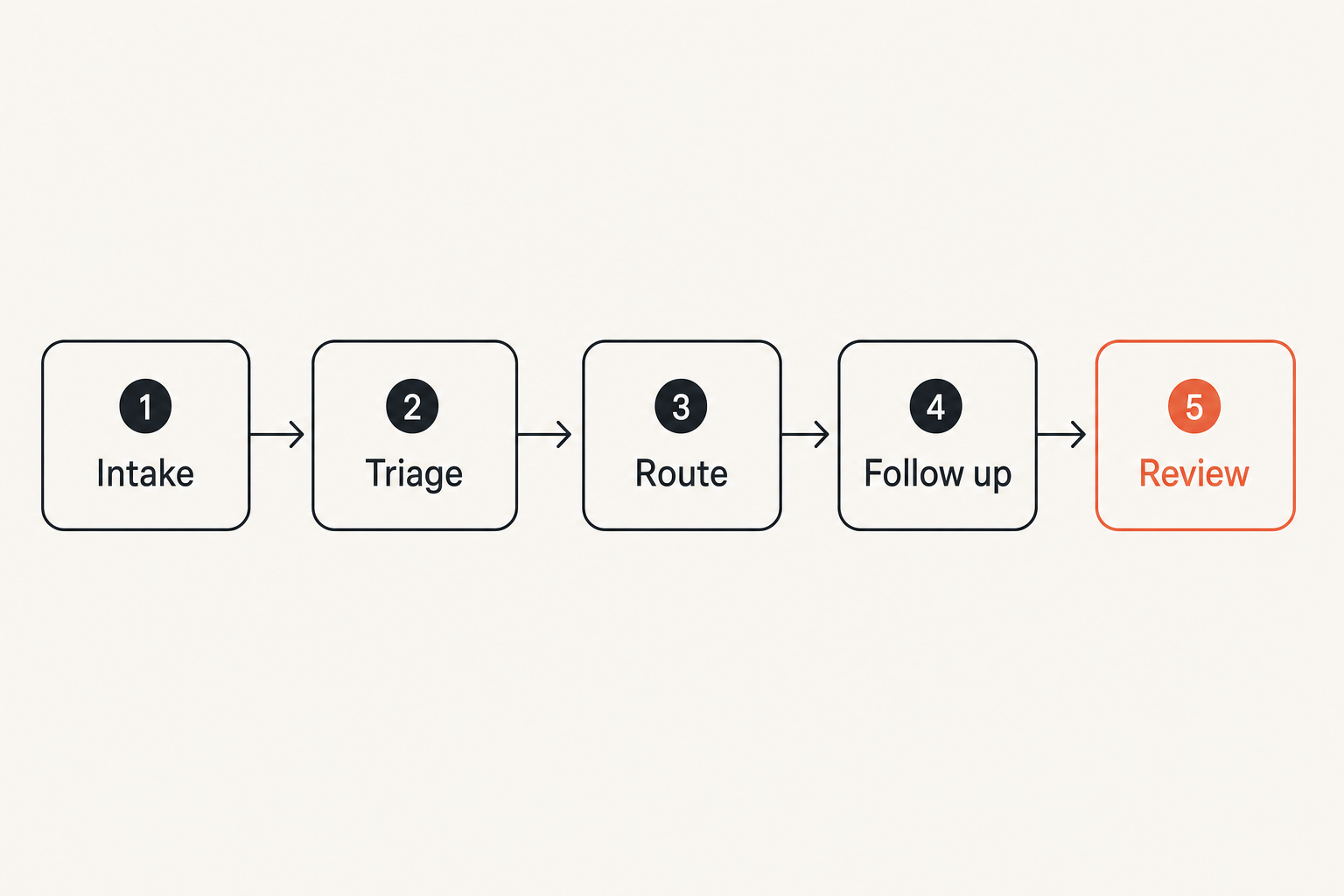
Week one inventory and interviews
The first week is discovery, but it should produce artifacts. Interview the people who already route work. Look at real messages, forms, spreadsheets, and event notes. Identify the most common categories and the most painful dead zones.
Deliverables by the end of week one:
- A map of current ask categories.
- A list of active offers and likely stale offers.
- A list of repeat helpers and overloaded operators.
- A first draft of trust-sensitive categories.
- A short failure log from recent examples.
Do not redesign yet. Learn how the network already behaves.
Week two workflow prototype
In week two, build the simplest workflow that can run live. This may be a shared sheet, a form, a d0rz surface, a private operator channel, and a weekly review agenda.
Prototype the record fields, statuses, and routing paths. Choose a small number of categories. Write down the rules. Test them against recent asks.
A practical workflow sequence:
- Intake captures category, location, urgency, sensitivity, and budget.
- Operator reviews new ask and assigns a status.
- Routing rule selects public, known group, vouched, or private path.
- Helper response is recorded.
- Follow-up confirms outcome or marks the ask blocked.
- Weekly review updates rules and stale offers.
Related reading from our network: infrastructure teams evaluating decentralized compute face similar ownership and retry questions in an Akash Network alternative workflow guide. The domain is different, but the operator lesson is the same: workflows fail where ownership, retries, and validation are vague.
Week three live routing
Week three is where theory meets reality. Route real asks through the new workflow. Keep the surface small enough to manage. Watch where people avoid the system and where the system slows them down.
Expect friction:
- Some people will keep DMing the old operator.
- Some offers will be stale.
- Some asks will not fit categories.
- Some helpers will want public credit.
- Some requesters will not respond after intake.
Do not treat this as failure. Treat it as signal. The consultant should adjust fields, rules, and communication based on live behavior.
Week four review and handoff
Week four should focus on adoption and handoff. The question is no longer whether the consultant can run the workflow. The question is whether the network can.
Handoff should include:
- A written operating guide.
- Named workflow owners.
- A weekly review template.
- Current open asks and statuses.
- Current active offers.
- Routing rules and exceptions.
- Trust and safety handling notes.
- A list of unresolved design questions.
The consultant should also recommend what not to automate yet. Automating a bad workflow makes failure faster.
What works and what fails in practice
What works
What works is boring and repeatable. Clear categories. Simple status. Named owners. Lightweight trust layers. Honest follow-up. Regular review. Small improvements based on real routing failures.
Strong local networks often look less exciting from the outside than weak ones. They may have fewer public posts, but more resolved needs. They may have smaller meetings, but better handoff. They may avoid dramatic launches because they are busy building usable coordination.
What fails
What fails is usually overreach or vagueness.
| Approach | What it looks like | What breaks in practice |
|---|---|---|
| Engagement-first | More events, posts, and announcements | Activity rises but routing remains manual |
| Tool-first | New platform before workflow design | People recreate old chaos in a new interface |
| Hero-operator | One trusted person handles everything | Burnout, hidden memory, no handoff |
| Fully open routing | Every ask posted broadly | Sensitive needs disappear or get mishandled |
| Over-formal governance | Committees for every decision | Small asks stall before help moves |
| No reconciliation | Records stay open forever | Nobody knows what worked |
The practical question is not which approach sounds best. It is which approach keeps asks moving with appropriate trust and follow-up.
Common failure modes to watch
Watch these closely:
- The same person is tagged in every request.
- Helpers complain about being surprised by context.
- Requesters do not know whether their ask is being handled.
- Operators cannot tell which offers are active.
- Paid and unpaid help are mixed without clarity.
- Sensitive asks leak into public channels.
- Meetings produce ideas but no queue movement.
- The consultant becomes the only person who understands the system.
When these show up, do not add more promotion. Fix the operating model.
Practical rule: If a network cannot explain how an ask becomes a routed next step, it is not a network yet. It is an audience with good intentions.
Product fit where d0rz.com belongs in the workflow
Use d0rz.com as a live coordination surface
d0rz.com is built around a practical premise: local networks need visible asks, visible offers, trust-aware routing, and follow-up. The UI is not the whole system. The value is in making the work legible enough that operators can route it.
A local community network consultant can use d0rz.com as a surface for real inventory instead of burying everything in chat history. Offers can be concrete. Asks can be specific. Operators can point people to live coordination objects rather than asking everyone to remember who said what.
This matters for small business help, neighborhood tasks, local services, skill-sharing, and volunteer coordination. The network becomes easier to inspect and easier to improve.
Where a consultant still matters
A product does not replace the consultant’s judgment. It gives the consultant a better operating surface.
The consultant still helps decide:
- Which categories matter locally.
- Which asks require private handling.
- Which offers are durable enough to list.
- Who should own routing.
- What follow-up cadence is realistic.
- Which failures indicate a trust issue versus a workflow issue.
The software can hold asks and offers. The network still needs human operators who understand context.
If you are hiring, acting as, or becoming a local community network consultant in 2026, focus less on community theater and more on coordination reliability. The work is not to make every interaction perfect. The work is to make the next useful step easier to find, route, trust, and complete.
Try d0rz.com
d0rz.com is for people building practical local networks where asks, offers, trust, routing, and follow-up matter. Try d0rz.com.