

Most community builders hit the same wall. The group is active, the chat is noisy, the events are happening, and still the important asks get lost.
Someone needs a ride. Someone needs a contractor. A freelancer has capacity this week. A neighbor can help, but only if the request is clear. The online community vs local network question shows up right there: is this group built for conversation, or is it built for coordination?
Teams think the problem is engagement. The real problem is routing.
An online community can create attention. A local network has to move a need from one person to the right person, with enough trust, context, and follow-up that the work actually happens. That changes the conversation. You stop asking how to get more posts and start asking how to make requests legible, offers discoverable, handoffs accountable, and outcomes visible.
In 2026, this matters because more work is fragmented, more people are independent, and local services still run on weak coordination. Group chats, social feeds, and directories are not enough. The practical question is not whether online communities are good or bad. The practical question is what operating model you need when the goal is real local action.
Table of contents
- Online community vs local network: the operating choice
- What a local network has to do that a community feed cannot
- The core objects: asks, offers, trust, routing, and follow-up
- Architecture comparison: online community, directory, or local network
- Designing the matching workflow
- Trust and verification in a local network
- What breaks when teams implement this badly
- Online community vs local network metrics that matter
- A 2026 implementation sequence for local network operators
- Where d0rz.com fits in the local network stack
Online community vs local network: the operating choice
Why engagement does not equal coordination
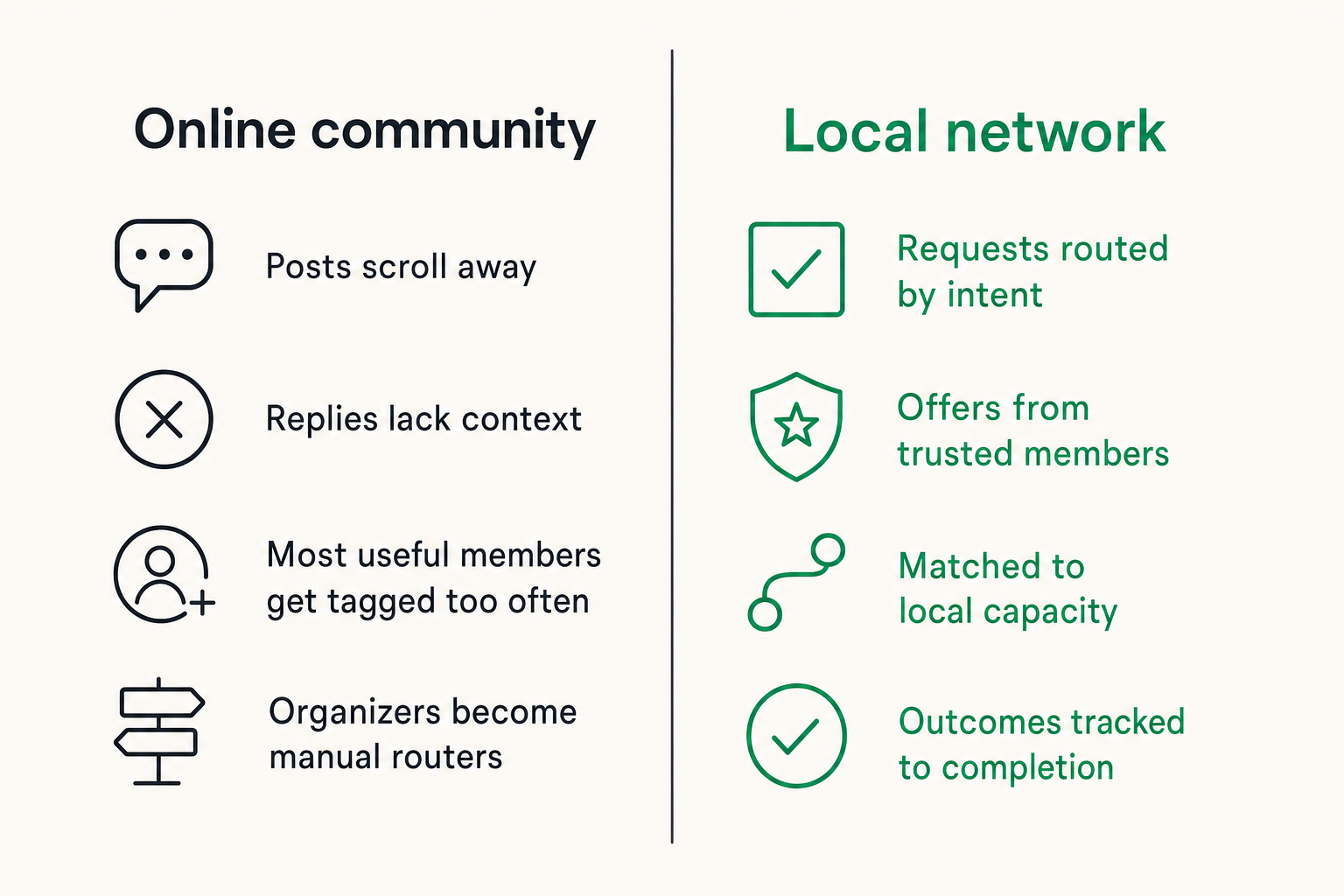
A busy online community can still fail the people who came there for help. Posts scroll away. Replies lack context. The most useful members get tagged too often. New people do not know who is reliable. Organizers become manual routers because the system itself does not understand intent.
The mistake teams make is treating activity as proof that the network works. Activity only proves that people are present. It does not prove that needs are being matched to capacity.
A useful way to think about it is this: an online community optimizes for participation, while a local network optimizes for completion. Participation is a signal. Completion is an outcome.
Practical rule: If a request cannot be tracked from ask to match to result, you are running a conversation space, not a coordination network.
Where online communities still work well
Online communities are good at awareness, belonging, discussion, lightweight discovery, and broad updates. They are useful when the cost of failure is low and the expected action is loose.
A neighborhood chat can surface that a road is closed. A freelancer group can discuss pricing. A founder group can share tools. These are valid use cases. The community creates ambient knowledge.
But ambient knowledge is not a service layer. If someone needs a plumber today, a ride tomorrow, a venue next week, or a trusted person to handle a time-sensitive errand, the feed starts to break down. The request has state. The result matters. The person asking needs confidence that someone owns the next step.
Where local networks become necessary
A local network becomes necessary when requests have constraints: location, timing, skill, budget, risk, trust, availability, and follow-up. Those constraints require structure.
This does not mean the network has to feel bureaucratic. It means the system has to preserve enough information for the next person to act. If every request has to be re-explained in a comment thread or direct message, the network is leaking operational context.
That is the real online community vs local network distinction. One creates shared attention. The other creates reliable routing.
What a local network has to do that a community feed cannot
It must preserve intent
Intent is the difference between a vague post and an actionable request. Someone saying they are looking for help with a website is not enough. Are they trying to fix a broken form, create a payment link, clean up a booking flow, or find a long-term developer?
A local network needs to capture the job-to-be-done in a format that can travel. That includes:
- What the person needs
- Where it applies
- When it matters
- What has already been tried
- What constraints exist
- What a good outcome looks like
Without intent, every match becomes guesswork. Operators end up asking the same qualifying questions manually, which does not scale past a small trusted circle.
It must route by context
Routing is not search. Search asks the requester to know what to look for. Routing uses context to move the request toward the right supply.
For example, a local business owner asking for automation help might not know whether they need Zapier, a custom script, email filtering, CRM cleanup, or a person who can translate the mess into a workflow. A network that only provides a member directory pushes the burden back onto the requester.
Routing should consider category, geography, urgency, budget, risk, and relationship distance. A public ask for local automation work, like looking for small business automation projects in Winston Salem, is more useful when the network can expose it to people with the right operating context instead of hoping the right person sees it.
It must close the loop
The most underrated part of local network operations is follow-up. Did someone respond? Was the match accepted? Did the job happen? Was the requester satisfied? Did the provider want more of that work?
What breaks in practice is that organizers remember the open loops until there are too many. Then the network becomes unreliable. People stop asking because they do not want to be ignored. Providers stop offering because they do not know whether leads are real.
Practical rule: Every meaningful ask needs an owner, a status, and a next follow-up moment. Without those three fields, the network depends on memory.
The core objects: asks, offers, trust, routing, and follow-up
Asks need structure without friction
An ask is not just a post. It is a request object. It should be easy to create but specific enough to route.
A good ask usually includes:
- Category: ride, delivery, repair, business help, home help, event support
- Location: neighborhood, city, service area, or remote/local hybrid
- Time window: now, today, this week, flexible
- Stakes: low, medium, high, sensitive
- Budget or exchange expectation
- Permission level: public, network-only, private routing
The practical question is how much structure to require up front. Too little and routing fails. Too much and people abandon the form. Start with the minimum fields required to make the first routing decision. Add details after a responder is likely.
Offers need availability and boundaries
An offer is not a profile. It is capacity with boundaries.
People can offer skills, tools, vehicles, time, space, introductions, or local knowledge. But the offer only becomes operational when it includes conditions. Who is it for? Where is it available? What is excluded? How fast can the person respond? What kinds of asks should not be routed to them?
This is where many online communities get noisy. A member says they can help with websites. Six months later, they are unavailable, moved cities, changed focus, or only want paid work. The community still treats the old statement as current supply.
Offers need freshness. They should expire, renew, or be checked after use.
Trust is an operational signal
Trust in a local network is not abstract goodwill. It is evidence that affects routing decisions.
Trust signals can include direct experience, mutual connections, completed work, verification level, response history, domain expertise, and recency. None of these are perfect. Together, they help operators decide how much friction to add before a match.
Related reading from our network: freelance communities face a similar issue when trust has to survive sourcing, delivery, and review, which is covered in AI workflow for freelancers.
The mistake teams make is treating trust as a brand value instead of a workflow input. In production, trust decides who sees what, who can respond directly, who needs moderation, and which matches require confirmation.
Architecture comparison: online community, directory, or local network
The wrong stack creates the wrong behavior
Tools shape behavior. If the only tool is a group chat, every need becomes a message. If the only tool is a directory, every requester becomes their own dispatcher. If the only tool is an event calendar, the network optimizes for attendance rather than help.
That does not mean chats, directories, and calendars are bad. It means they should not be confused with the coordination layer.
For a deeper version of this architecture argument, the prior d0rz breakdown on local network architecture that actually holds is useful because it separates community energy from the operational objects that make routing possible.
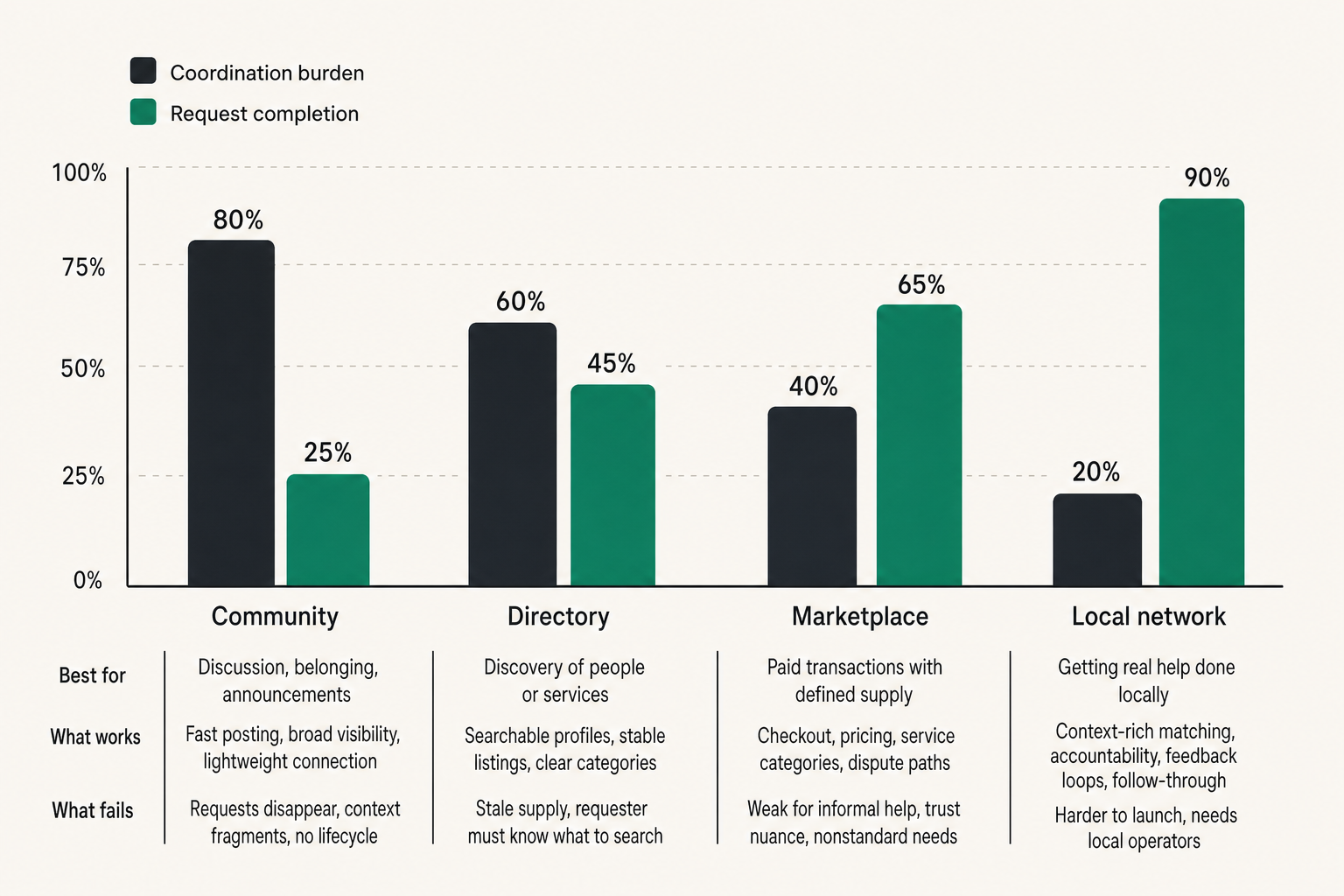
A practical comparison table
| Model | Best for | What works | What fails | Operator burden |
|---|---|---|---|---|
| Online community | Discussion, belonging, announcements | Fast posting, broad visibility, lightweight connection | Requests disappear, context fragments, no lifecycle | Moderation and manual routing |
| Directory | Discovery of people or services | Searchable profiles, stable listings, clear categories | Stale supply, requester must know what to search | Data cleanup and updates |
| Marketplace | Paid transactions with defined supply | Checkout, pricing, service categories, dispute paths | Weak for informal help, trust nuance, nonstandard asks | Support, payments, fulfillment |
| Local network | Routing asks to trusted capacity | Context-aware matching, follow-up, flexible participation | Needs operating discipline, ownership, status tracking | Workflow design and stewardship |
The local network is not automatically better. It is better when the work has state and the outcome matters.
Practical rule: Pick the architecture based on the cost of a dropped request, not based on which platform is easiest to launch.
When to combine models
Most real systems combine models. The online community creates surface area. The directory stores supply. The marketplace may handle paid fulfillment. The local network routes the request and tracks the outcome.
For example, a local organizer might keep a public group for announcements, use a structured ask form for needs, maintain offers from trusted providers, and use a simple status board for follow-up. That is not over-engineering. That is acknowledging that conversation, discovery, transaction, and coordination are different jobs.
Related reading from our network: payment operators face the same separation problem in a different domain, where the checkout screen is not the whole system; stablecoin payments for merchants explains why state, reconciliation, refunds, and support matter behind the visible UI.
Designing the matching workflow
Start with the request lifecycle
Do not start with features. Start with the lifecycle of a request.
A practical lifecycle looks like this:
- Intake: the ask is created with enough structure to classify it.
- Triage: the network decides urgency, risk, category, and visibility.
- Routing: the ask is sent to likely responders or made discoverable to a trusted segment.
- Response: one or more people accept, decline, ask a question, or suggest a better route.
- Match: the requester and responder confirm the next step.
- Follow-up: the system checks whether the work happened.
- Outcome: the result is recorded in a lightweight way.
- Learning: routing rules improve based on what happened.
This workflow is simple, but it changes operations. It gives the network memory.
Use routing rules before automation
Automation is useful only after the states are clear. If you automate a messy community process, you usually make the mess faster.
Start with routing rules that a human can explain:
- Emergency requests go to a small trusted operator group first.
- Paid business asks go to providers who opted into paid work.
- Sensitive home access requests require higher trust verification.
- Remote technical help can route beyond the immediate neighborhood.
- Stale asks are closed or refreshed after a defined time window.
Once these rules work manually, automate notifications, reminders, status changes, and duplicate detection. Do not automate judgment before you have operational evidence.
Keep humans in the escalation path
Local coordination contains edge cases. People misstate needs. Providers overestimate availability. Trust signals conflict. A request may look simple but involve risk.
The system should make the normal path efficient and the exception path visible. That means operators need queues, flags, and override ability. If the workflow hides exceptions, people will route around the system with private messages. Then you lose the audit trail and the network becomes informal again.
A useful escalation design includes:
- A reason code for manual review
- A named operator or steward
- A timestamp for next action
- A way to return the request to normal flow
- A record of what decision was made
Trust and verification in a local network
Trust is not one score
A single reputation score is tempting because it feels clean. Local networks are not clean.
Someone might be excellent at website debugging but untested for home access. A neighbor may be trusted personally but unreliable on timing. A freelancer may have strong references but no local relationship yet. A driver may be fine for scheduled errands but not appropriate for urgent medical transport.
Trust is multidimensional. Treat it as a set of signals, not a universal ranking.
Useful trust dimensions include:
- Identity confidence
- Relationship distance
- Completed local interactions
- Skill-specific evidence
- Responsiveness
- Complaint or issue history
- Recency of activity
- Operator notes for edge cases
Verification should match the risk
Not every interaction needs heavy verification. Over-verification kills participation. Under-verification creates harm.
Match the level of verification to the risk of the request:
- Low risk: public advice, tool recommendations, event referrals
- Medium risk: paid remote work, introductions, light errands
- Higher risk: home access, transportation, childcare-adjacent help, handling money, sensitive business systems
The mistake teams make is applying one trust policy across everything. That either makes low-risk asks too slow or high-risk asks too loose.
Reputation needs recent context
Local networks change quickly. People move. Availability changes. Skills improve. Burnout happens. A good match six months ago does not prove capacity today.
Reputation should decay or refresh. That does not mean deleting history. It means weighting recent signals more heavily for routing.
A provider who completed three jobs last year but has not responded in two months should not be routed as aggressively as someone who accepted similar work last week. The same applies to requesters. If someone repeatedly posts urgent asks and never follows up, that affects routing and operator attention.
What breaks when teams implement this badly
Failure mode: everything becomes a chat thread
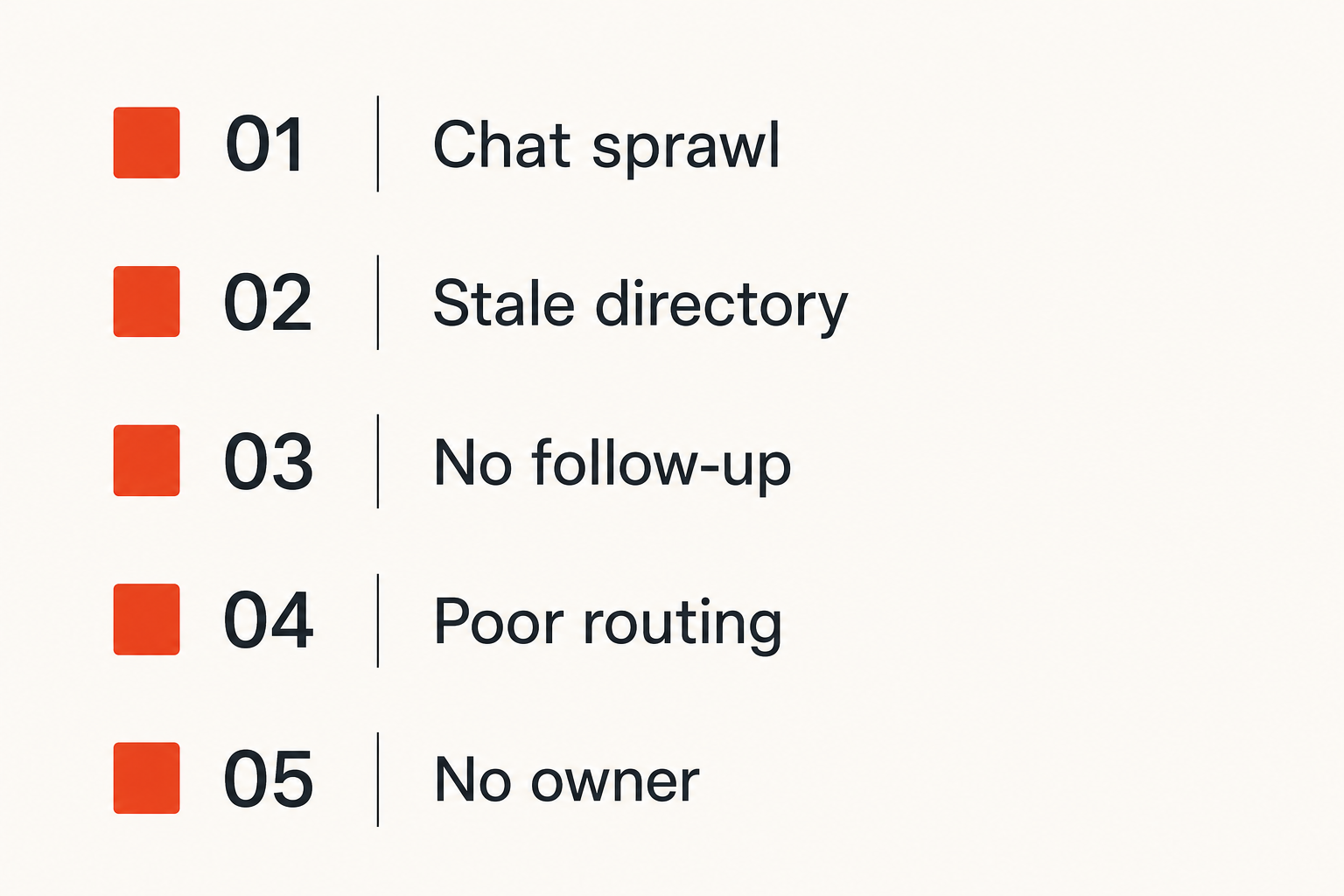
The most common failure is chat gravity. The team launches a form or directory, but everyone keeps dropping needs into the chat because that is where attention lives.
What breaks in practice is state. A request starts in a post, moves to comments, jumps to direct messages, gets half-resolved offline, and nobody knows whether it closed. The organizer becomes the hidden database.
What works:
- Let chat be the announcement layer, not the source of truth.
- Convert meaningful requests into structured asks.
- Reply in chat with the canonical ask link or status.
- Train members that serious needs go through the workflow.
What fails:
- Asking people to search old threads.
- Letting moderators manually remember matches.
- Treating likes and replies as outcomes.
Failure mode: the directory goes stale
Directories decay unless they are tied to activity. A static list of helpers looks useful on launch day and questionable six months later.
Stale directories create bad matches. Requesters contact people who are unavailable. Providers get irrelevant pings. Operators lose credibility because the system seems alive but is not operationally current.
To prevent this, offers should have renewal dates, last-active signals, and post-interaction updates. If a person declines three relevant asks because they are busy, their availability should change. If someone completes a match, their offer should become more trusted for similar requests.
Failure mode: nobody owns follow-up
Follow-up is where many community systems quietly fail. Everyone assumes someone else checked. The requester feels ignored. The provider assumes the lead was cold. The operator only hears about failures when frustration becomes public.
Assign ownership. It can be the requester, a provider, or a steward, but it cannot be nobody.
A basic follow-up policy might be:
- New ask with no response after 24 hours: steward review
- Matched ask with no confirmation after 48 hours: reminder
- Completed ask: outcome prompt
- Unresolved ask after seven days: close, refresh, or escalate
Related reading from our network: even in a very different niche like media operations, the lesson is similar; streaming community ita workflows shows how messy collections become safer when metadata, routing, and cleanup rules are explicit.
Online community vs local network metrics that matter
Measure conversion from ask to outcome
If you are comparing online community vs local network performance, do not stop at members, posts, views, or event RSVPs. Those metrics are not useless, but they do not prove coordination.
Track the funnel:
- Asks created
- Asks accepted for routing
- Asks with at least one qualified response
- Matches confirmed
- Outcomes completed
- Outcomes unresolved
- Average time to first useful response
- Average time to closure
The number that matters is not how many people saw the ask. It is whether the ask reached someone who could act.
Measure routing quality
Routing quality tells you whether the network understands context.
Useful signals include:
- Percentage of responses that are relevant
- Number of reroutes before a match
- Declines due to wrong category
- Declines due to location mismatch
- Declines due to availability mismatch
- Operator interventions per ask
If every request requires manual interpretation, your intake is too vague or your offer data is too weak. If people receive too many irrelevant asks, they will tune out. Noise is not just annoying. It destroys routing capacity.
Measure operational drag
Operational drag is the hidden cost of keeping the network working.
Watch for:
- How many open loops exist right now
- How many requests are waiting on an operator
- How many providers are stale
- How often people bypass the workflow
- How much time moderators spend clarifying requests
- How many unresolved issues require private knowledge
A local network should reduce organizer load over time. If it increases load forever, you built a dependency on operators rather than coordination infrastructure.
Practical rule: A healthy local network makes the next match easier because it preserves learning from the last match.
A 2026 implementation sequence for local network operators
Phase 1: define the jobs your network handles
Start narrow. Do not claim the network can handle every local need. Pick a few categories where you have real supply and clear demand.
Examples:
- Local business website and workflow help
- Rides and errands for known members
- Event staffing and venue support
- Contractor referrals
- Freelance project matching
- Mutual aid requests with steward review
For each category, define the minimum intake fields, routing criteria, trust requirements, and follow-up policy. This is the local network version of service design.
A prior d0rz piece on the local network operating model goes deeper on why asks, offers, trust, support, and sustained participation need to be designed together instead of treated as separate community tasks.
Phase 2: instrument the handoffs
Handoffs are where coordination fails. Instrument them before you add more members.
At minimum, every request should show:
- Current status
- Current owner
- Next action
- Last update
- Matched responder, if any
- Outcome, once known
You do not need a complex system at first. A spreadsheet can prove the workflow. A lightweight database is better. A purpose-built local network layer is better still. The point is not the tool. The point is that the request has state outside any one person’s memory.
Phase 3: add automation only where state is clear
Once the lifecycle is stable, automate the boring parts:
- Send reminders when asks are stale.
- Notify providers only when a request matches their offer boundaries.
- Expire offers that have not been renewed.
- Flag high-risk asks for steward review.
- Prompt outcome updates after a match.
- Suggest similar prior matches to operators.
This is where local network operations become leverageable. Automation should not replace stewardship. It should remove avoidable forgetting.
A simple pseudo-configuration might look like this:
if ask.category = business_workflow_help
and ask.location in provider.service_area
and provider.availability = active
and ask.risk_level <= provider.trust_scope
then notify provider
else route to steward_review
That is not hype. That is the basic logic many teams never write down.
Where d0rz.com fits in the local network stack
Use d0rz.com as coordination infrastructure
The product-fit question is simple: where should asks and offers live so they can be routed, trusted, and followed up on?
d0rz.com is built around the practical objects local networks need: asks, offers, trust, routing, and follow-up. It is not trying to replace every group chat or local relationship. Those channels still matter. The job is to give meaningful requests and real capacity a place to become operational.
For example, a specific offer such as same-day website form and workflow debugging is more useful as a routable offer than as a buried post. A requester can understand what is available, operators can point relevant asks toward it, and the network can learn from what happens next.
This is the architecture shift: the UI is not the community. The workflow is the community’s operating system.
The closing test for your network
Here is the test I would use before adding more members, launching another channel, or planning another engagement campaign:
- Can a person create a clear ask in under two minutes?
- Can the network decide who should see it?
- Can responders set boundaries without awkward negotiation?
- Can trust level change the route?
- Can an operator see stuck requests?
- Can the requester know what happens next?
- Can the network learn from completed outcomes?
If the answer is no, you do not have a growth problem yet. You have an operating model problem.
The online community vs local network decision is not philosophical. It determines whether your group is built for discussion or for dependable coordination. Most teams need some of both. The mistake is expecting the discussion layer to do the routing layer’s job.
Try d0rz.com
d0rz.com is for people building practical local networks where asks, offers, trust, routing, and follow-up matter. If you are ready to move beyond the online community vs local network debate and build coordination that holds, Try d0rz.com.