
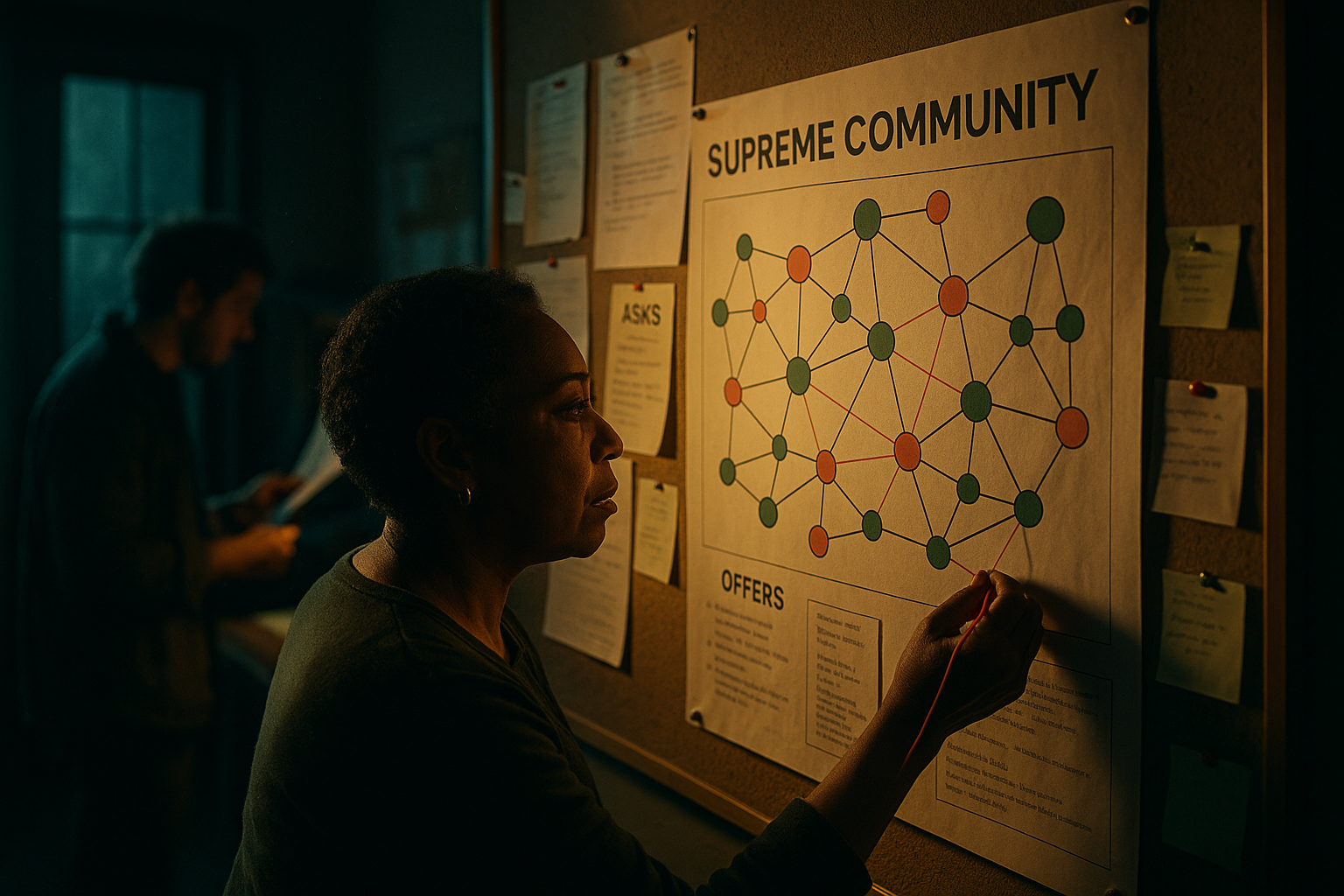
A supreme community does not fail because people stop caring. It usually fails because nobody can tell what needs to happen next.
The group chat is active. The newsletter goes out. The organizer knows everyone. Still, requests disappear, offers get underused, and follow-up depends on memory. A local business asks for help, three people say they might know someone, and two weeks later nobody can say whether the problem was solved.
Teams think the problem is engagement. The real problem is coordination architecture.
That changes the conversation. A supreme community is not the biggest audience, the warmest brand, or the most inspirational gathering. It is a local operating system where asks, offers, trust, routing, and follow-up are visible enough to produce reliable outcomes.
Table of contents
- What supreme community means operationally
- Why local networks fail before they scale
- Design the ask-offer graph
- Build routing rules, not heroic moderation
- Trust is a workflow
- Run the weekly operating cadence
- Tooling architecture for supreme community operations
- Metrics that matter for a supreme community
- Common failure modes
- Implementation sequence for the first 90 days
- How d0rz.com fits a supreme community operating model
What supreme community means operationally
Not a vibe, a coordination promise
A useful way to think about it is this: a supreme community is a network that can absorb local demand and route it to capable supply without depending on one charismatic person to remember everything.
That sounds less exciting than community energy, but it is what makes the energy useful. If a resident needs a ride, a freelancer needs a referral, a shop owner needs a broken form fixed, or an organizer needs volunteers for a Saturday cleanup, the network needs a way to receive the ask, understand the constraints, find a realistic offer, and confirm what happened.
The mistake teams make is treating community as a content channel. They publish more, host more, and announce more. That can create attention, but attention is not coordination. The practical question is whether the community can turn participation into completed local work.
For a deeper architecture view of how asks, offers, and follow-up connect, the prior d0rz piece on local network architecture is useful context.
Matching beats broadcasting
Broadcasting says: here is a need, maybe someone will respond.
Matching says: this need has a category, location, urgency, trust requirement, budget range, and success condition. These providers, neighbors, or volunteers are plausible fits. This router owns the next step. This is when we check back.
The second version is slower to design but faster in production. It reduces duplicate messages, vague replies, and social pressure. It also makes the network more inclusive because outcomes do not depend only on who is loud, connected, or always online.
Practical rule: If an ask cannot be routed, it is not ready to broadcast. Clarify the ask before you amplify it.
The local operator test
A supreme community passes a simple operator test:
- Can a newcomer make a specific ask without knowing the insider map?
- Can a capable person offer help without being spammed by irrelevant requests?
- Can an organizer see which matches are stuck?
- Can the network learn from completed and failed interactions?
- Can responsibility move from one person to a repeatable process?
If the answer is no, the community may still be valuable. It is just not yet reliable infrastructure.
Why local networks fail before they scale
Participation decays when work is unclear
Most local communities begin with goodwill. People join because they want to help, belong, learn, sell, volunteer, or stay informed. The decay starts when participation becomes hard to interpret.
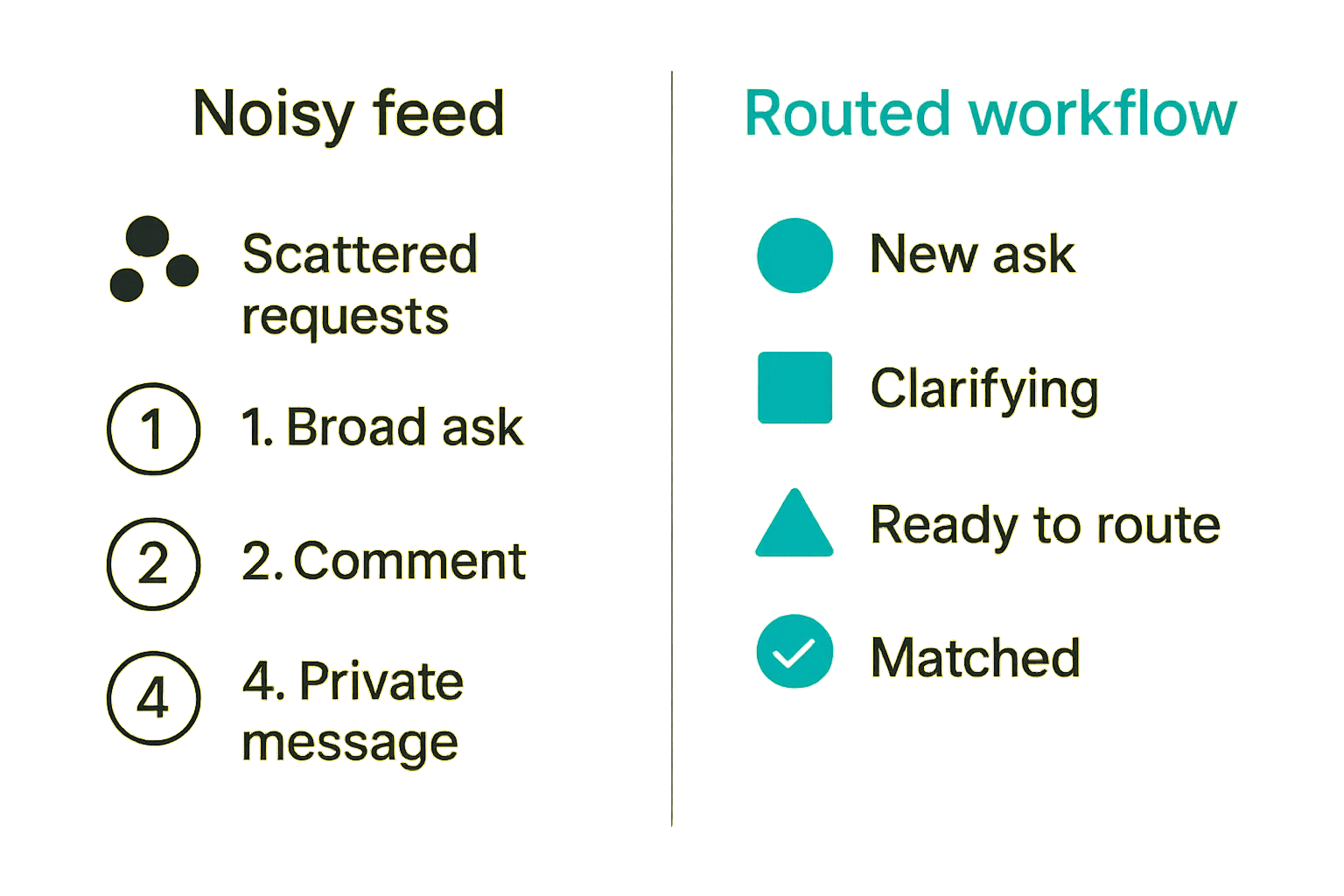
Someone posts a broad ask. Ten people react. Two people comment. One person sends a private message. Nobody updates the thread. The original asker is embarrassed to keep asking. The organizer assumes it was handled. The helpers assume somebody else took it.
What breaks in practice is not intention. It is state.
Community operators need to know the state of work:
- New ask
- Clarifying
- Ready to route
- Matched
- In progress
- Blocked
- Done
- Abandoned
Without state, every conversation restarts from scratch.
Trust becomes a bottleneck
Early networks often run on personal trust. That is normal. The founder knows who is reliable, who is safe, who pays, who follows through, and who needs a softer handoff.
The problem is that personal trust does not scale cleanly. If every match requires the founder to personally approve it, the founder becomes the network API. That is fragile. It slows response time and keeps context trapped in one head.
A supreme community does not remove human judgment. It structures it. You define which interactions require high trust, which can be open, which need references, and which need an intermediary.
Follow-up disappears into private channels
The moment a match moves to text, phone, direct message, or hallway conversation, the network loses visibility. That is sometimes fine. Privacy matters. But the system still needs a minimal outcome signal.
Did they connect? Did the work happen? Was payment involved? Was anyone uncomfortable? Should this provider be suggested again? Should the ask be reopened?
The goal is not surveillance. The goal is operational closure.
Practical rule: Track outcomes, not private details. A community needs enough signal to improve routing without turning every relationship into a ticketing system.
Design the ask-offer graph
Normalize asks without killing nuance
The ask is the atomic unit of local coordination. If the ask is vague, the rest of the workflow gets expensive.
A good ask captures:
- What is needed
- Where it applies
- When it is needed
- Who is affected
- What constraints exist
- What success looks like
- Whether money, barter, volunteer help, or referral is expected
Bad ask: Need help with my website.
Routable ask: Local bakery in Winston-Salem needs a checkout form debugged before Friday. Current issue: customers submit orders but no confirmation email arrives. Budget available. Remote help is fine. Success means one test order completes and sends confirmation.
The second ask can be routed. The first one creates chatter.
Classify offers by capability and constraint
Offers need the same discipline. A person saying I can help with tech is not enough. The network needs capability and constraint.
Useful offer fields include:
- Skill category
- Service area or remote availability
- Response time
- Price model
- Capacity
- Proof or examples
- Trust requirements
- Exclusions
A real offer might be narrow and therefore useful. For example, an operator offering same-day website form and workflow debugging is easier to route than a generic technology helper because the fit conditions are clearer.
Narrow offers are not weaker. They are more matchable.
Preserve operational context
Context is the difference between a warm handoff and a cold referral. When you connect an ask to an offer, the receiving person should not have to rediscover the whole story.
Minimum routing context:
- Why this match is plausible
- What the requester already tried
- Urgency and deadline
- Known constraints
- Preferred contact method
- Next action expected
This can be simple. A five-line handoff beats a beautiful directory with no operational detail.
Build routing rules, not heroic moderation
Define the first router
Every community needs a first router. This can be a person, a rotating role, or a small team. The job is not to solve every problem. The job is to move each ask to its next useful state.
First router responsibilities:
- Confirm the ask is specific enough.
- Identify category and urgency.
- Decide whether it is public, private, or sensitive.
- Suggest one to three possible matches.
- Set a follow-up time.
The first router is where many communities quietly fail. If everyone owns routing, nobody owns it. If the founder owns all routing forever, the network cannot grow.
Use escalation paths before conflict appears
Escalation is not only for disputes. It is for uncertainty.
You need escalation paths for:
- Safety concerns
- Payment disputes
- No response after match
- Sensitive personal needs
- Repeated low-quality offers
- Requests outside the network scope
- Urgent needs that cannot wait for normal cadence
Related reading from our network: remote teams face a similar problem when calls are treated as the work instead of one step in a larger operating flow, as covered in Zoom video chat for remote team workflow.
Keep async updates boring
The best routing updates are boring. They should be short, structured, and easy to scan.
Example update format:
Ask: checkout form broken for bakery
State: matched
Owner: Maya
Provider: remote website debugging offer
Next step: provider sends test link today
Check back: Friday 10am
Risk: deadline before weekend orders
This is not bureaucracy. This is how you avoid losing the thread.
Practical rule: Route with owners and timestamps. A match without an owner is a suggestion, not coordination.
Trust is a workflow
Identity is not enough
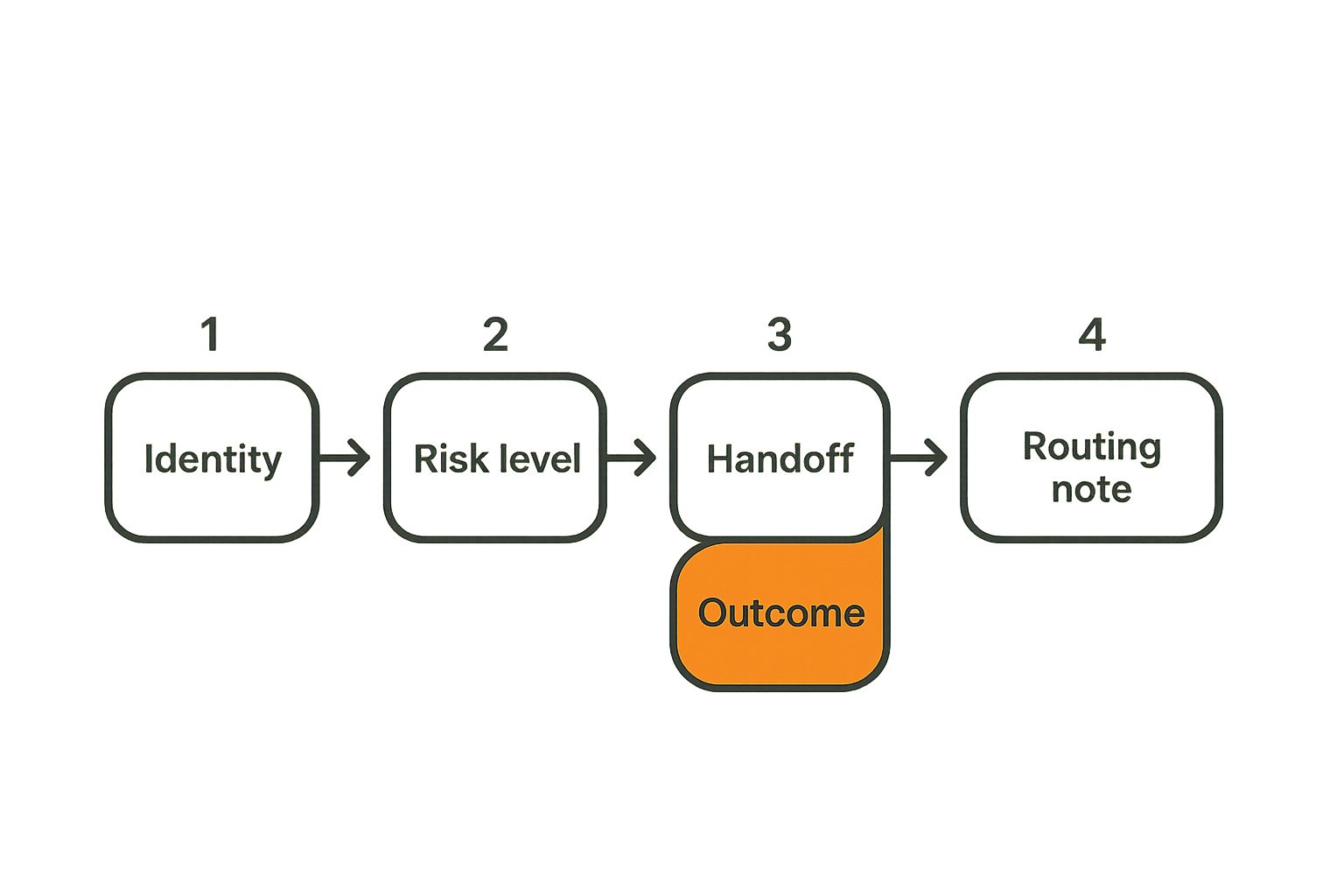
Knowing who someone is helps, but identity alone does not create safe coordination. A verified neighbor can still miss deadlines. A skilled freelancer can still be a poor fit for elder support. A friendly volunteer can still overcommit.
Trust in a supreme community should be situational. The trust needed to recommend a plumber is different from the trust needed to enter a home, transport a child, handle money, or access a business system.
Build trust levels around risk:
| Interaction type | Trust need | Practical control |
|---|---|---|
| Public referral | Low | Basic profile and category fit |
| Paid local service | Medium | Clear scope, price, and outcome check |
| Home access | High | References, known intermediary, explicit consent |
| Sensitive support | High | Private routing and trained owner |
| Business system access | High | Limited access, test environment, rollback plan |
Reputation must attach to outcomes
Most communities collect reputation informally. People remember who helped, who disappeared, and who created drama. The issue is that informal reputation is uneven and sometimes unfair.
Outcome-based reputation is cleaner. It asks:
- Did the provider respond?
- Did the requester provide enough information?
- Was the match completed?
- Was the scope respected?
- Would the network route similar work this way again?
You do not need public ratings for everything. In many local contexts, public scores create more harm than value. But the operator needs private routing notes.
Boundaries protect the network
Good community operators say no. They reject unclear asks, unsafe matches, exploitative requests, and work that belongs to a professional with licensing or insurance.
Boundaries are not anti-community. They are how the network survives.
Related reading from our network: secure communication teams deal with the same boundary problem around identity, routing, retention, and metadata in VA secure messaging workflow architecture.
Run the weekly operating cadence
Intake review
A supreme community needs rhythm. Daily chaos is not an operating model. Monthly review is too slow for many local needs. Weekly is often the useful default.
The intake review asks:
- What new asks came in?
- Which asks are unclear?
- Which asks are urgent?
- Which asks should not be handled by this network?
- What information is missing?
This is where you prevent the network from becoming a dumping ground. Not every need belongs in the same channel. Some requests need public visibility. Some need private routing. Some need a referral to an institution, agency, specialist, or emergency service.
Match review
The match review looks at supply. Who can help? Who has capacity? Who should not receive more requests this week? Which offers are stale?
A practical match review table can be simple:
| Ask | Possible match | Confidence | Owner | Follow-up |
|---|---|---|---|---|
| Broken order form | Website debugging provider | High | Ana | Friday |
| Event chairs needed | Church storage contact | Medium | Rob | Wednesday |
| Bookkeeping setup | Local accountant referral | Medium | Sam | Monday |
| Senior ride request | Vetted volunteer list | High | Priya | Today |
This cadence turns the community from a feed into a queue.
The prior d0rz article on the local network operating model goes deeper on how operators can separate participation, routing, and support roles.
Close-the-loop review
Close-the-loop review is where the network learns.
Ask these questions:
- Which matches completed?
- Which stalled?
- Which were misrouted?
- Which created new offers?
- Which revealed missing capacity?
- Which need a thank-you, repair, refund, or escalation?
The mistake teams make is celebrating the match and ignoring the outcome. Matching is not success. Completion is success. Learning is how the next match gets cheaper.
Tooling architecture for supreme community operations
Choose a system of record
The tool matters less than the boundary. You need one place where the state of asks, offers, matches, owners, and outcomes is tracked.
That could start as a spreadsheet. It could become a lightweight CRM, Airtable base, Notion database, custom app, marketplace, or local network platform. The important point is that chat is not the system of record.
Comparison of common setups:
| Setup | What works | What fails |
|---|---|---|
| Group chat only | Fast, familiar, low friction | No durable state, weak search, poor ownership |
| Spreadsheet plus chat | Cheap, flexible, visible queue | Manual updates, permission issues |
| CRM adapted for community | Better tracking, assignments, history | Can feel salesy or heavy |
| Custom local platform | Fit to asks, offers, routing | Requires maintenance and adoption |
| Marketplace-style system | Clear supply and demand | Needs trust, support, and dispute handling |
A supreme community can begin with simple tools. It cannot run forever on vibes and pinned posts.
Separate messaging from tracking
Messaging is for conversation. Tracking is for state. Mixing them creates confusion.
Use messaging for:
- Clarifying details
- Human handoffs
- Sensitive context
- Relationship building
- Quick updates
Use tracking for:
- Current status
- Owner
- Deadline
- Match candidate
- Outcome
- Follow-up date
When teams combine everything in chat, older work becomes invisible. When they over-centralize every conversation into a database, people stop using it. The balance is to track just enough state and let humans communicate naturally.
Automate nudges, not judgment
Automation helps when it removes forgetfulness. It hurts when it pretends to understand local trust better than humans do.
Good automations:
- Remind owner when follow-up is due
- Flag asks with missing fields
- Detect stale offers
- Send confirmation after intake
- Request outcome check after a match
Bad automations:
- Auto-match sensitive requests without review
- Spam every provider in a category
- Rank people without context
- Close asks because a timer expired
- Publish private details by default
The practical question is not whether to automate. It is where automation reduces coordination drag without erasing judgment.
Metrics that matter for a supreme community
Track conversion across the whole path
Do not measure only member count or event attendance. Those are inputs. They do not prove coordination.
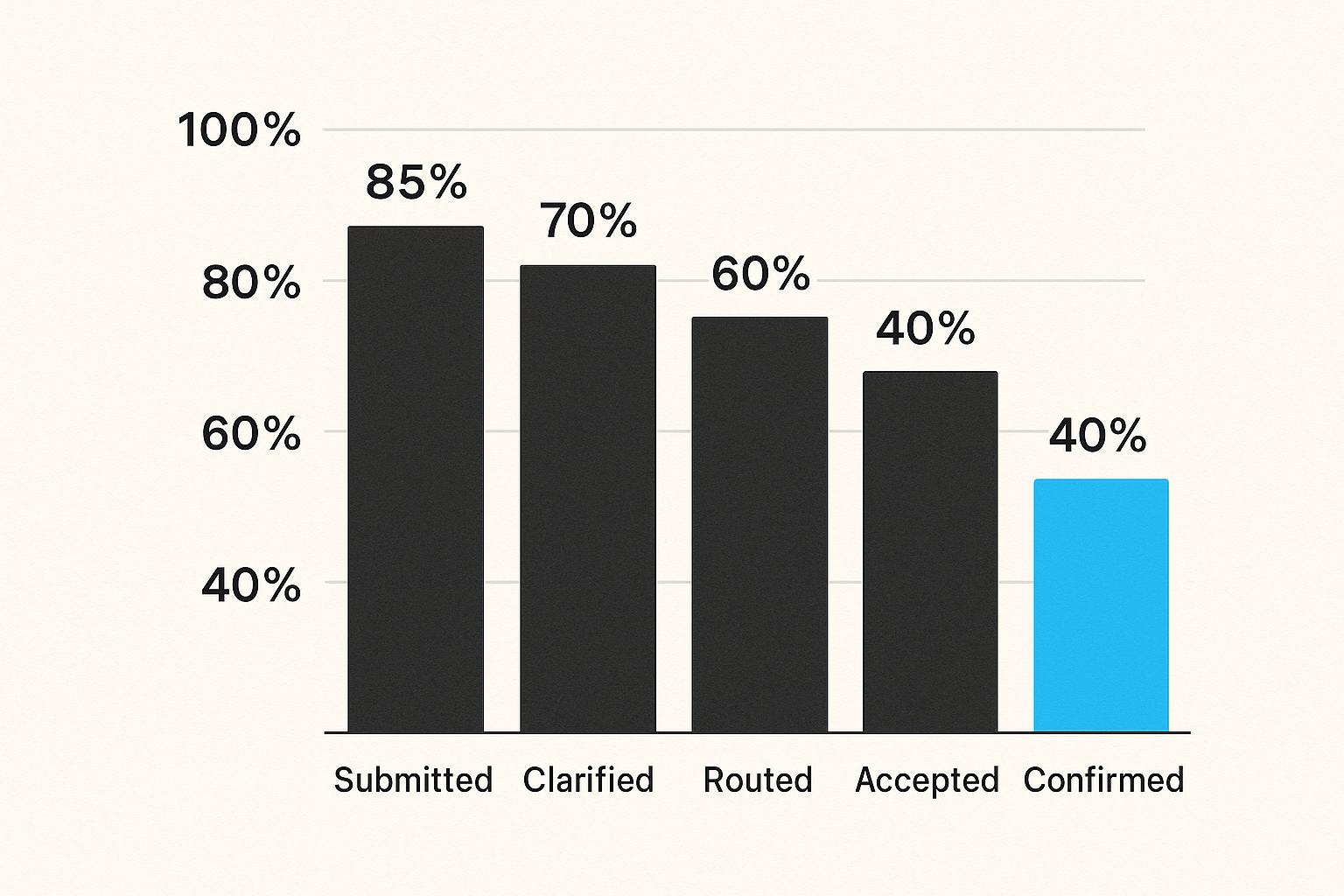
Track the path:
- Ask submitted
- Ask clarified
- Ask routed
- Match accepted
- Work started
- Outcome confirmed
- Learning captured
Each step has a drop-off. The drop-off tells you where the operating model is weak.
If many asks never clarify, your intake is bad. If clarified asks do not route, your offer graph is weak. If routed asks do not complete, your trust model or follow-up process is failing.
Measure latency where people feel it
Latency is the time between need and meaningful response. In local networks, latency is emotional. A person asking for help does not care that the community has 2,000 members if nobody responds for four days.
Useful latency metrics:
- Time to first human response
- Time to clarified ask
- Time to first plausible match
- Time to accepted match
- Time to outcome confirmation
The goal is not instant response for everything. The goal is expectation management. If a request is low urgency, say so. If it needs professional help, route it out. If it is urgent, do not leave it in a casual queue.
Related reading from our network: SOC teams also separate signal, ownership, and response time when designing analyst workflows, which is a useful analogy in cyber security analyst jobs and SOC workflow.
Watch concentration risk
Concentration risk appears when too much of the network depends on too few people.
Watch for:
- One organizer routing most asks
- One provider receiving most referrals
- One channel holding most context
- One volunteer doing most follow-up
- One sponsor funding all operations
A supreme community should develop redundancy. Not infinite redundancy, but enough that the network does not collapse when one person gets sick, busy, annoyed, or burned out.
Practical rule: If removing one person breaks the network, you have a hero system, not a community system.
Common failure modes
What fails
The most common failure modes are predictable.
First, teams overbuild the front door. They launch a polished form, directory, event series, or landing page before designing the back office. The UI looks credible, but asks still do not move.
Second, they confuse inclusion with no boundaries. Every ask goes everywhere. Every offer is accepted. Nobody wants to say this is not a fit. The result is noise, weak trust, and quiet disengagement from reliable people.
Third, they hide all operations in private messages. This protects relationships in the short term but prevents learning. The organizer becomes the only person who knows what happened.
Fourth, they measure the wrong thing. Growth in members can hide decay in outcomes. More posts can mean less clarity. More events can produce fewer completed matches.
What works
What works is usually less glamorous:
- Clear ask templates
- Narrow offer categories
- Named routing owners
- Weekly review
- Follow-up dates
- Outcome notes
- Escalation rules
- A visible queue
- A small trusted operator group
These practices are not complicated. They are just easy to skip when the community is young and everyone knows each other.
The operator has to install the workflow before pain makes it urgent.
Recovery playbook
If the network is already messy, do not start with a rebrand. Start with recovery.
- Export or list all open asks from the last 30 days.
- Mark each as done, stale, unclear, sensitive, or still active.
- Contact active askers with a simple status check.
- Identify the top ten repeat offer categories.
- Assign one routing owner for the next two weeks.
- Close anything that cannot be responsibly handled.
- Publish a clearer intake path.
- Review outcomes weekly until the queue stabilizes.
This is operational cleanup. It may feel small, but it rebuilds confidence. People trust communities that close loops.
Implementation sequence for the first 90 days
Days 1 to 14: map the real network
Do not begin by inviting everyone into a new platform. Begin by mapping what already exists.
Document:
- Common asks
- Existing helpers
- Trusted intermediaries
- Local businesses
- Volunteer groups
- Sensitive request types
- Current communication channels
- Known failure points
Interview ten to twenty people who already route help informally. Ask what they get asked for, what they ignore, who they trust, and where handoffs fail.
Your output for the first two weeks should be a simple operating map, not a brand campaign.
Days 15 to 45: run controlled routing
Now choose three to five ask categories to support. Keep the scope narrow enough to learn.
Example categories:
- Local business workflow help
- Event support
- Home errands
- Volunteer referrals
- Professional service recommendations
Run a controlled workflow:
- Publish a clear ask intake path.
- Review asks twice per week.
- Route only to known or lightly vetted offers.
- Track owner, state, and follow-up date.
- Confirm outcome with both sides when appropriate.
- Capture what would make the next match easier.
This phase is not about scale. It is about proving the loop.
Days 46 to 90: make the loop repeatable
Once the loop works, reduce dependence on the founder.
Create:
- A routing checklist
- Offer category definitions
- Escalation rules
- Weekly review agenda
- Outcome note format
- Basic metrics dashboard
- Backup owner list
Then add more supply. Invite providers, volunteers, and connectors into the specific categories where demand is proven. Do not recruit generic members. Recruit capacity against observed asks.
The practical question is always: what demand are we ready to route responsibly?
How d0rz.com fits a supreme community operating model
Where d0rz helps
D0rz.com is built for people building practical local networks where asks, offers, trust, routing, and follow-up matter. That makes it a fit when your community is moving from informal conversation toward visible coordination.
The product fit is architectural. A local network needs doors into the system: asks from people who need something, offers from people who can help, and enough structure to make routing possible. The point is not to replace relationships. The point is to stop losing operational state between conversations.
A supreme community still needs human operators. Software can make the queue visible, keep asks and offers structured, and support follow-up. It cannot decide every trust question for you.
Product boundaries
Use d0rz when you want to make local demand and local capacity easier to see, route, and revisit.
Do not expect any tool to solve:
- Weak operator ownership
- No trust policy
- Unclear community scope
- Unsafe or inappropriate requests
- Lack of local supply
- No follow-up discipline
The mistake teams make is buying or building software to avoid making operating decisions. The better move is to define the workflow, then choose tools that support it.
A supreme community is not a louder room. It is a system that helps the right people find the right next step, with enough trust and follow-up to make the result real.
Try d0rz.com
You are writing for people building practical local networks where asks, offers, trust, routing, and follow-up matter. If you are building a supreme community that needs better local coordination, Try d0rz.com.