

A synonym for community sounds like a naming problem. In practice, it becomes an operations problem the moment someone shows up with a real ask, a real offer, a time constraint, and an expectation that the network will help.
Teams think the problem is finding a warmer word than community. The real problem is choosing the coordination model implied by that word.
Call it a circle, network, guild, neighborhood, hub, collective, marketplace, mutual aid group, or local exchange. Each term creates a different promise. Some promise belonging. Some promise access. Some promise help. Some promise identity. Some promise accountability. If the workflow underneath cannot support the promise, the word becomes debt.
The practical question is not only what is another word for community. The practical question is: what kind of local system are you prepared to operate?
Table of contents
- Why a synonym for community is an operating decision
- The vocabulary map for local network builders
- Start with asks and offers, not identity
- Design trust as workflow, not vibe
- Build routing before you build engagement
- The operating model behind a local community
- What breaks when teams pick the wrong synonym for community
- Tooling architecture for community alternatives
- Metrics that matter for a practical local network
- Implementation sequence for 2026
- Where d0rz.com fits
- Closing: choose the synonym for community that supports the work
Why a synonym for community is an operating decision
A useful way to think about it is that every synonym carries a service-level expectation. A neighborhood group may tolerate slow replies because the point is belonging. A mutual aid network may not, because unmet needs can become urgent. A professional guild may expect standards. A marketplace may expect matching, fulfillment, and dispute handling.
That changes the conversation. You are not selecting language for a homepage. You are deciding what people believe will happen after they participate.
The word changes what people expect
If you call something a community, people usually expect participation, welcome, norms, and some shared identity. If you call it a network, they expect access and connections. If you call it an exchange, they expect transactions. If you call it a hub, they expect routing. If you call it a collective, they expect shared responsibility.
None of these are wrong. The mistake teams make is choosing the warmest word without building the workflow behind it.
Practical rule: Pick the word that matches the action you can reliably support, not the feeling you hope people will have.
For local organizers, this matters because the unit of value is not content. It is movement: an ask moves to the right person, an offer becomes usable, a referral closes, a neighbor gets help, a provider gets work, and someone follows up.
The name should match the coordination job
Before choosing a synonym for community, write down the coordination job in one sentence.
Examples:
- Help local residents find trusted help for errands, repairs, rides, and support.
- Help small businesses discover providers who can solve practical workflow problems.
- Help volunteers respond to neighborhood needs without losing requests in chat.
- Help freelancers become discoverable through concrete offers instead of vague profiles.
Once the job is clear, the name becomes easier. If the job is routing help, hub may be better than community. If the job is peer learning, circle may work. If the job is repeat local transactions, exchange or network may be more honest.
The vocabulary map for local network builders
The search for another word for community usually starts with a list. That is fine, but the list only becomes useful when you connect each word to workflow, trust, and accountability.
Common alternatives and what they imply
| Term | Implied promise | Works best when | Operational risk |
|---|---|---|---|
| Network | Access to people and resources | Matching and referrals matter | Becomes vague if no routing exists |
| Circle | Belonging and intimacy | Small groups need trust | Does not scale cleanly |
| Hub | Central routing point | Many asks need direction | Operators become bottlenecks |
| Guild | Standards and craft | Providers share practice | Can feel exclusionary |
| Collective | Shared ownership | Members contribute labor | Decision-making slows down |
| Exchange | Offers and requests move both ways | Supply and demand are explicit | Needs fulfillment tracking |
| Neighborhood | Place-based trust | Geography matters | Boundaries can be unclear |
| Marketplace | Discovery and transaction | Buyers and providers need matching | Requires support and dispute workflows |
This is why vocabulary is architecture. The label tells people where to send energy and what to expect back.
When each term starts to break
Every term fails at a different scale.
A circle breaks when too many people join and trust becomes assumed instead of maintained. A hub breaks when all decisions route through one organizer. A marketplace breaks when listings exist but fulfillment is invisible. A network breaks when everyone can post but nobody owns routing.
What breaks in practice is rarely enthusiasm. It is the handoff between expression and action.
Related reading from our network: operators building software workflows face similar naming-versus-architecture tradeoffs in Mac tools for AI agent workflow architecture, where the useful unit is not the tool name but the workflow boundary.
Start with asks and offers, not identity
If you run a local network, the cleanest primitive is not member, post, event, or channel. It is the ask and the offer.
An ask says what someone needs. An offer says what someone can provide. Everything else is supporting structure: trust, routing, timing, cost, location, availability, follow-up, and learning.
Capture demand in a form people can act on
A weak ask sounds like this: I need help with my business.
A routable ask sounds like this: I run a small bakery in Winston-Salem and need help automating email sorting and customer response templates before next month.
The second ask has enough structure to move. It contains context, category, location, timing, and a probable type of provider. That is why local networks should make asking easier without making asks vague. Free-form text is useful, but the operator still needs fields or tags that support routing.
A live ask such as small business automation projects in Winston Salem shows the difference between generic participation and actionable demand: there is a concrete workflow, a target audience, and a reason someone qualified can respond.
Make offers specific enough to route
Offers fail when they read like identity statements. I am a helpful person. I do websites. I can do admin. These may be true, but they are hard to route.
A useful offer says:
- What problem the provider handles
- Whether the work is remote or local
- What inputs are needed
- What turnaround time is realistic
- What the provider will not do
- How the first step should happen
For example, remote website and automation help for local businesses is easier to match because it narrows the offer to broken forms, payment links, GitHub issues, Stripe or PayPal setup, and small business support.
Practical rule: If an ask or offer cannot be routed by a person who did not write it, it is not structured enough.
Design trust as workflow, not vibe
Trust is the word local organizers use when they know something matters but have not operationalized it yet. That is dangerous. Trust cannot only live in memory, reputation, or private DMs.
The practical question is: what signals does the network capture before, during, and after a match?
Trust signals need structure
Useful trust signals include:
- Clear identity or pseudonymous continuity
- Location or service area
- Prior completed interactions
- Endorsements from known participants
- Response behavior
- Scope clarity
- Follow-up notes
- Boundary setting
Not every network needs public reviews. Some local networks would make people less safe by exposing too much. But every practical network needs some way to know whether a person follows through, communicates clearly, and stays inside the agreed scope.
Trust is not a badge. It is a memory system.
Privacy and visibility are operating choices
The mistake teams make is treating visibility as a default instead of a design decision. Public posts create discoverability. Private routing protects sensitive context. Semi-public offers help people understand network capacity. Operator notes help maintain quality but should not become gossip infrastructure.
A useful permission model separates:
- What the requester shares publicly
- What matched providers can see
- What operators can see for routing
- What is stored for follow-up
- What is deleted or hidden after closure
This matters more in local networks than in generic online groups because people may meet in person, share addresses, discuss money, or ask for help during stressful moments.
Build routing before you build engagement
Engagement is easy to fake. Routing is not.
A local group can look active because people are posting, reacting, attending events, and introducing themselves. But if requests do not reach the right people, the network is not operating. It is broadcasting.
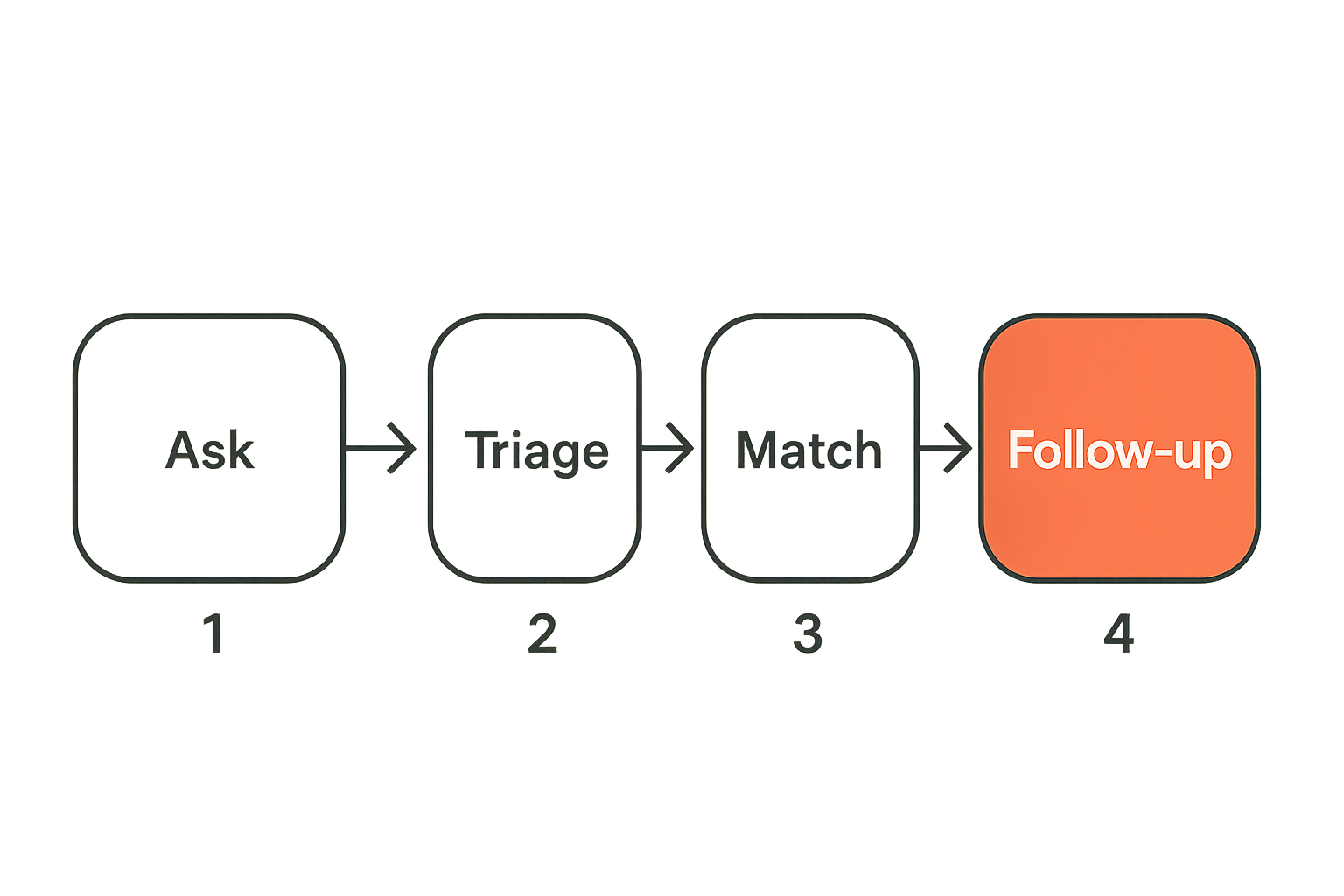
Intake, triage, match, follow-up
The basic routing workflow has four steps:
- Intake: capture the ask or offer with enough context.
- Triage: decide category, urgency, geography, and constraints.
- Match: identify the right person, provider, group, or next action.
- Follow-up: confirm whether anything happened and what changed.
This sequence is simple. It is also where many community systems fail. They collect input but do not triage. They introduce people but do not confirm outcome. They celebrate volume but do not learn from misses.
Practical rule: A local network is only as good as its follow-up loop.
Escalation is part of the product
Escalation does not mean crisis management only. It means knowing what happens when the normal path fails.
Examples:
- Nobody responds to an urgent ride request.
- A provider accepts work but misses the appointment.
- Two people disagree about scope or payment.
- A request is outside the network's capability.
- A safety concern appears after a match.
Escalation paths can be lightweight: operator review, trusted volunteer review, referral to an external service, or closing the ask with an explanation. But they must exist. Otherwise, the network trains people not to rely on it.
Related reading from our network: payment and settlement systems have the same lesson in a different domain; AI agents blockchain payments architecture is really about state, custody boundaries, webhooks, and what happens after a transaction is initiated.
The operating model behind a local community
A local community does not run because a channel exists. It runs because roles, cadence, and decision rights are clear enough that work can continue without heroic coordination.
This is where the term community can still be useful. It describes belonging. But belonging has to connect to operations if the network is supposed to solve real needs.
Define roles before adding channels
Common roles include:
- Requester: person with an ask
- Provider: person with an offer
- Router: person who matches asks to offers
- Steward: person who maintains norms and trust
- Verifier: person who checks completion or quality
- Partner: organization that contributes capacity
- Observer: person who may later participate
One person can hold multiple roles early on. That is normal. But the roles should still be named. If everyone is responsible for routing, nobody is.
For a deeper operating-model view, the prior d0rz article on community building as a local network operating model is directly adjacent: it treats participation as infrastructure, not as a branding exercise.
Use cadence to keep the network alive
Cadence is the rhythm by which the network checks itself. Without cadence, local systems decay into stale posts and unclosed loops.
Practical cadences:
- Daily review of new urgent asks
- Twice-weekly routing review for open asks
- Weekly digest of active offers and unresolved needs
- Monthly trust and safety review
- Quarterly cleanup of stale offers and inactive categories
Cadence also protects organizers. If everything is handled ad hoc, the most responsible person becomes the hidden backend. That does not scale, and it usually burns out the person holding the network together.
What breaks when teams pick the wrong synonym for community
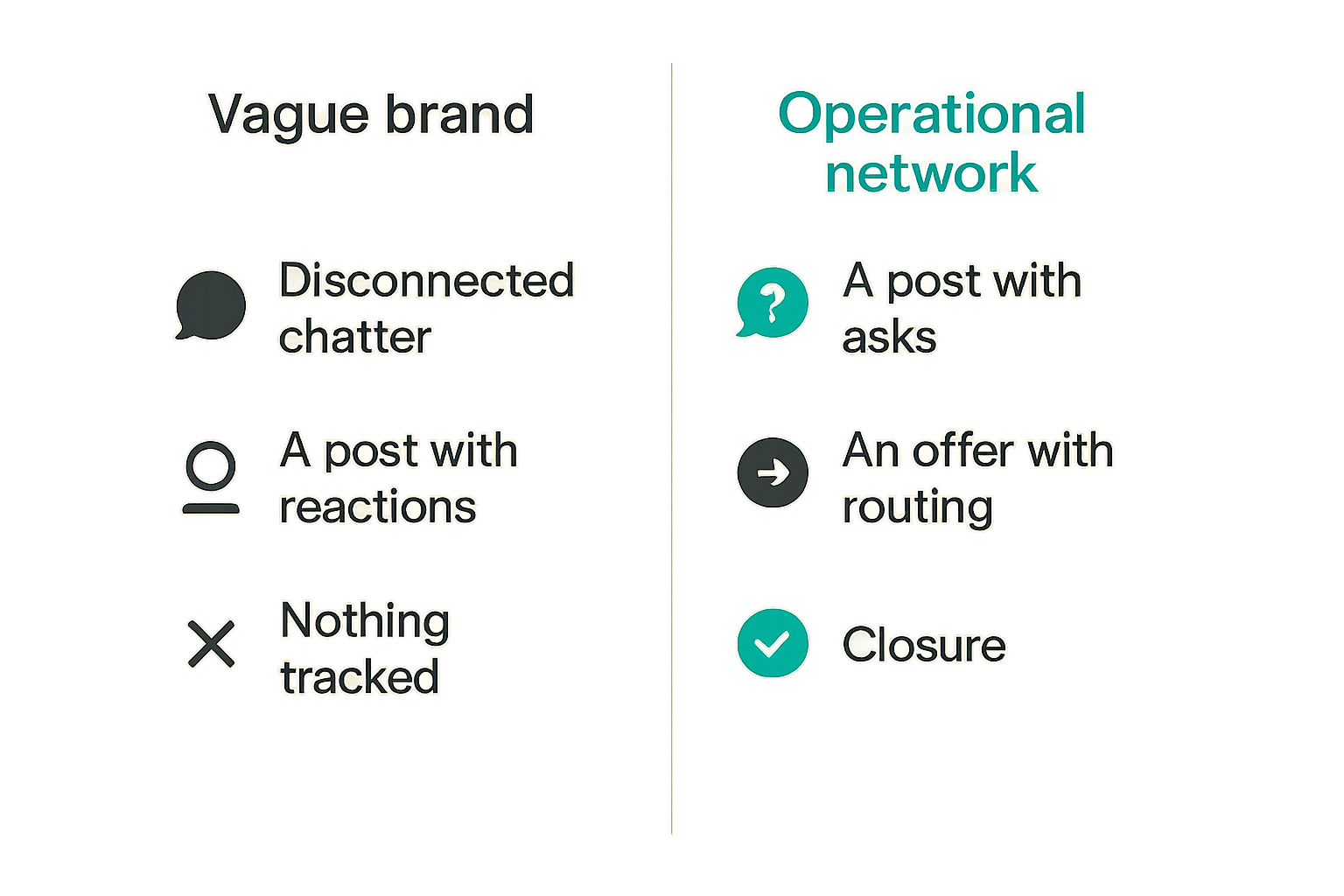
A synonym for community can make the system clearer, or it can hide a mismatch. The failure usually appears after launch, when the word attracts one behavior but the workflow supports another.
Branding outpaces operations
If you call it a marketplace but do not handle matching, status, payment expectations, or disputes, people will experience it as unreliable. If you call it a mutual aid network but every request depends on one admin manually forwarding messages, the network is fragile. If you call it a guild but have no standards, review, or shared practice, the word is decoration.
The mistake teams make is using language to borrow legitimacy from a model they have not implemented.
A better approach is to use plain language until the operating model earns a stronger name.
Members expect service but receive chatter
This is the common failure mode in local groups. A person joins because they need a babysitter, a ride, a translator, a website fix, a pet sitter, a tenant resource, or a repair referral. They post. People react. Someone says good luck. Maybe a friend tags a friend. Then nothing is tracked.
From the organizer's view, the group is active. From the requester's view, the system failed.
That gap matters. A practical local network should know the difference between:
- A post that got attention
- A request that got routed
- A match that got accepted
- Work that was completed
- A relationship that can be reused
If you cannot distinguish those states, you do not have coordination infrastructure. You have conversation.
Tooling architecture for community alternatives
Tools do not fix unclear operating models. They amplify them. A messy process in a spreadsheet becomes a messy process with notifications. A vague group becomes a vague group with better design.
The practical question is what system of record you need for asks, offers, trust, routing, and outcomes.
Do not confuse a chat channel with infrastructure
Chat is useful for presence and quick coordination. It is weak as a durable system of record.
A chat-first setup usually struggles with:
- Lost requests
- Duplicate answers
- No clear status
- No owner for follow-up
- Poor search
- Context buried in threads
- No distinction between casual discussion and active need
This does not mean abandon chat. It means chat should be a surface, not the backbone. The backbone needs structured records: ask, offer, person, location, category, status, match, note, outcome.
Automation should preserve context
Automation can help with reminders, routing suggestions, duplicate detection, stale-post cleanup, and digest generation. But automation that removes local context makes the network worse.
Good automation asks: what information helps a human make a better match faster?
Bad automation asks: how do we remove humans from a trust-heavy process before we understand the edge cases?
Related reading from our network: security teams run into the same trap when automating before ownership is clear; AI agents in security operations is useful because it frames automation around signals, workflow, validation, and response.
Metrics that matter for a practical local network
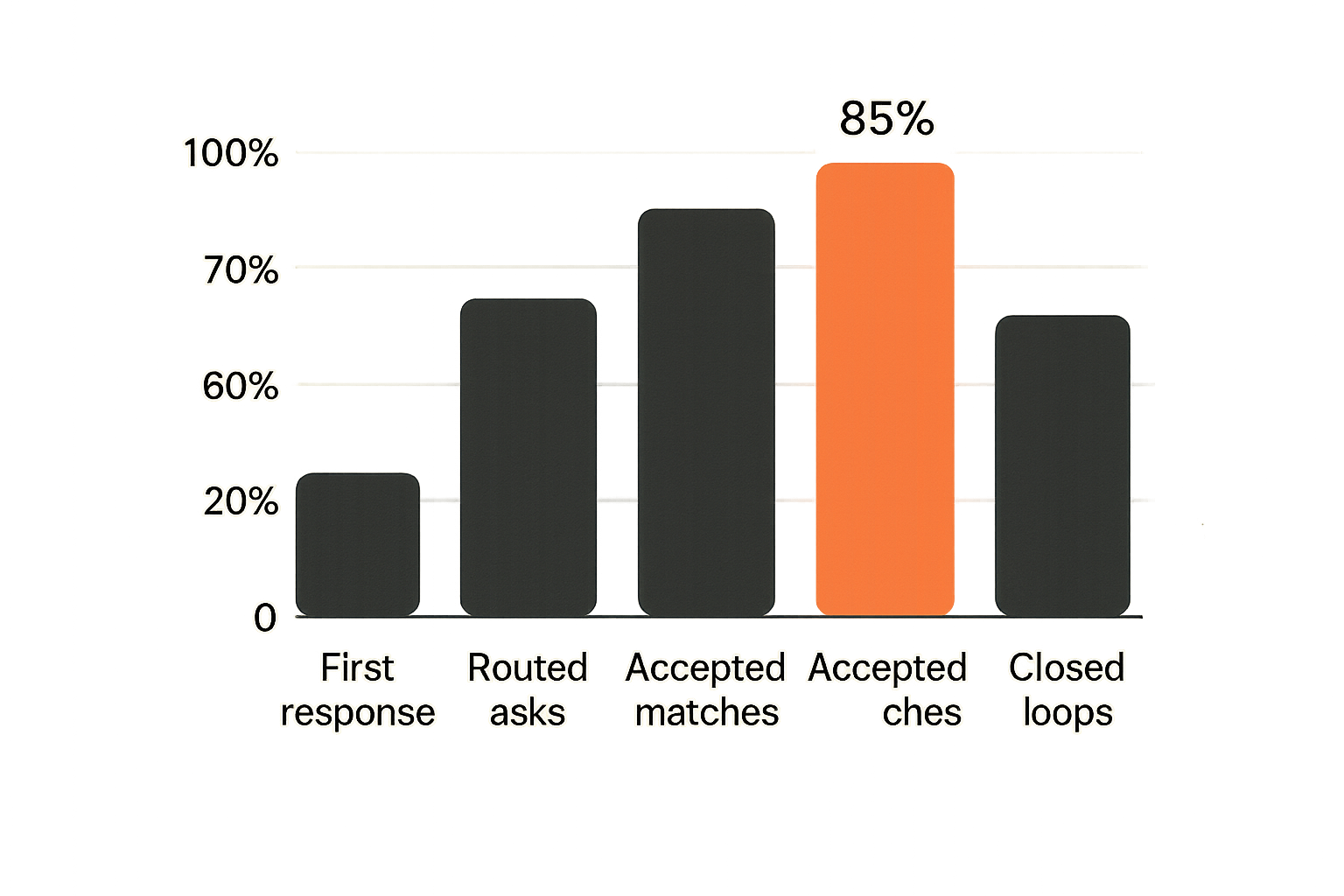
Local network metrics should measure coordination quality, not vanity participation. A thousand members with no routing capacity may be less useful than forty reliable providers and ten active routers.
Measure coordination, not applause
Useful metrics include:
- Time from ask creation to first qualified response
- Percentage of asks routed within a target window
- Percentage of matches accepted
- Completion or closure rate
- Repeat participation by providers
- Number of stale open asks
- Categories with demand but no supply
- Categories with supply but no demand
- Follow-up notes captured per match
Avoid making likes, impressions, or total member count the primary dashboard. Those can be secondary signals, but they do not tell you whether the network solved anything.
Practical rule: If a metric does not help you improve routing, trust, response, or follow-up, it is probably not an operating metric.
Healthy supply and demand are visible
A healthy local exchange lets operators see imbalance. Maybe there are many asks for home repair but few vetted providers. Maybe there are many offers for tutoring but no current demand. Maybe translation help exists but requesters do not know how to ask for it.
Visibility changes the operator's next move. You can recruit providers, reword categories, feature underused offers, create partner relationships, or close categories that are not working.
This is also where public asks can help. A general page of customer asks on d0rz makes demand legible instead of burying it inside private messages or scattered social posts.
Implementation sequence for 2026
Do not start by debating the perfect synonym for community for three weeks. Start by building a small operating loop. The right language usually emerges after you see what people actually do.
A 30-day rollout that does not overbuild
- Define the coordination job in one sentence.
- Pick three request categories you can realistically support.
- Recruit ten concrete offers with scope, geography, and availability.
- Create a simple intake format for asks.
- Assign one person to triage new asks for the first month.
- Track status manually: new, routed, accepted, completed, closed.
- Follow up on every routed ask, even if the answer is no match found.
- Review misses weekly and adjust categories or provider recruitment.
- Publish a short digest of active asks and useful offers.
- After 30 days, choose the public term that best matches the behavior.
This sequence keeps the system honest. If no one asks for anything, you have a demand problem. If asks arrive but nobody can answer, you have a supply problem. If matches happen but outcomes are unknown, you have a follow-up problem.
What works and what fails
What works:
- Specific asks and offers
- Visible status
- Named routing ownership
- Lightweight trust signals
- Clear category boundaries
- Follow-up after matches
- Periodic cleanup
What fails:
- Launching a broad community with no first use case
- Depending on one charismatic organizer
- Treating every post as equal
- Assuming trust because people are local
- Adding automation before status is clear
- Measuring engagement instead of resolution
The operator's job is not to make the network feel busy. It is to make the next useful action obvious.
Where d0rz.com fits
d0rz.com is built around a simple view of local networks: asks, offers, trust, routing, and follow-up matter more than abstract engagement. That makes it useful for people who do not want to run another noisy group but do want practical coordination.
This is not about replacing every local channel. It is about giving the work a better backbone.
Asks and offers as network primitives
When asks and offers are first-class objects, the network can reason about them. Operators can see what people need, what people can provide, what is stale, what is specific, and what needs routing.
That is different from a feed where everything competes for attention. A feed is optimized for recency. A local coordination system should be optimized for usefulness, context, and closure.
Keep local context attached to the work
Local context changes everything. A ride request, a translation offer, a small business automation need, and a same-day website debugging request may all involve different trust levels, response times, and handoff details.
The value is not just the listing. The value is preserving enough context that a real person can decide what to do next without starting from zero.
For a companion architecture view, the prior d0rz article on community building as local network architecture goes deeper on how asks, offers, trust, and follow-up become infrastructure.
Closing: choose the synonym for community that supports the work
A synonym for community is useful only if it makes the operating model clearer. Network, hub, circle, guild, collective, exchange, neighborhood, marketplace, and association can all be right. They can also all be wrong.
The test is operational: can people understand what to ask for, what to offer, who routes, what trust means, what happens next, and how the loop closes?
Language should reduce coordination cost
Good language reduces explanation. It helps people participate correctly. It sets expectations the system can meet. It makes the next action obvious.
Bad language creates emotional appeal while hiding operational gaps. It attracts people into a promise the network cannot fulfill.
So choose the word after you understand the workflow. If the work is belonging, community may be right. If the work is matching, network may be better. If the work is reciprocal local help, exchange may be clearer. If the work is routing, hub may be honest.
The point is not to sound more modern. The point is to build a local system people can rely on.
Try d0rz.com
d0rz.com is for people building practical local networks where asks, offers, trust, routing, and follow-up matter. Try d0rz.com.