
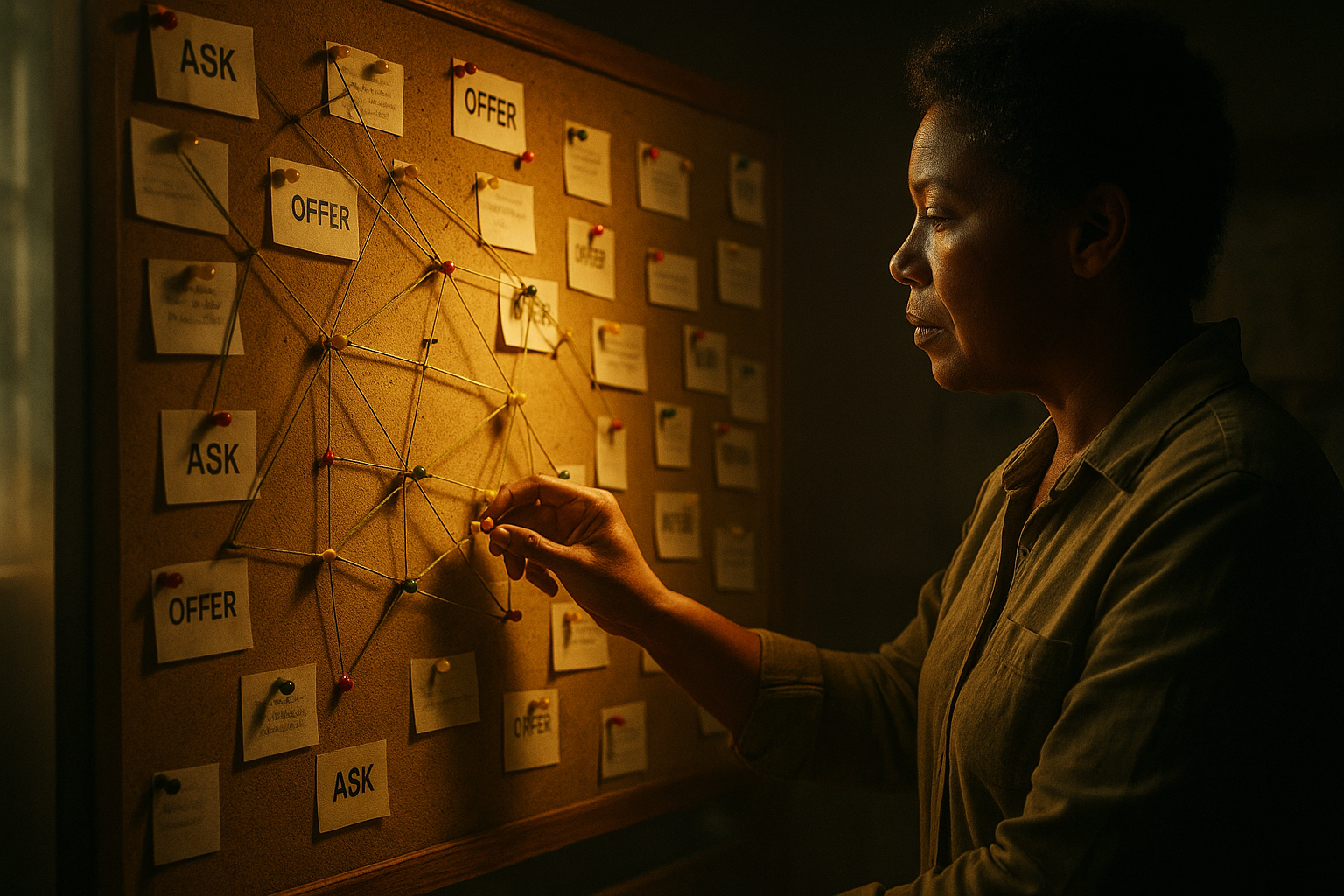
A united community usually breaks in the same quiet way. The event was good. The chat was active. People said they wanted to help. Then a parent still cannot find after-school support, a freelancer never hears back about a referral, and the organizer becomes the human switchboard for everything.
Teams think the problem is engagement. The real problem is coordination architecture.
In 2026, local communities have more channels than ever: group chats, newsletters, social posts, forms, calendars, directories, and volunteer boards. But more surfaces do not create a united community. They create more places where asks go stale, offers get buried, and trust has to be re-earned from scratch.
The practical question is not how to make people feel aligned for a week. The practical question is how to build a local network where asks, offers, routing, trust, and follow-up keep working after the first burst of energy.
Table of contents
- United community is an operating system not a slogan
- Map asks offers and routing before planning events
- Build trust as workflow not vibes
- The workflow model for a united community
- What works in practice
- What fails when teams implement it badly
- Metrics that show the network is getting healthier
- Tooling choices for local network operators
- Governance moderation and safety
- Where d0rz.com fits
United community is an operating system not a slogan
A united community is often described in emotional terms: shared values, belonging, solidarity, neighborliness. Those matter. But if you operate a local network, you cannot manage sentiment directly. You manage flows.
Who needs something? Who can help? Who is trusted for which type of help? Who should see the request? Who followed up? What happened after the introduction?
A useful way to think about it is this: a community is not united because everyone knows everyone. It is united when people can reliably move useful support through the network without forcing one organizer to remember every detail.
For a deeper architecture view of local network design, the earlier d0rz piece on community building d0rz as local network architecture is adjacent to this problem: the durable layer is not attention, it is routing.
The visible layer is not the work
The visible layer is events, posts, announcements, and group activity. It is easy to mistake that for the system. It is measurable, public, and usually where funders, members, or stakeholders look first.
What breaks in practice is the hidden layer:
- The private ask that never becomes visible enough to route.
- The useful offer that is too vague to match.
- The person who says yes once and then gets overloaded.
- The introduction that happens but is never closed.
- The local business, volunteer, or provider who wants to help but needs a clear next step.
The mistake teams make is optimizing the visible layer before they have a working back-end for coordination.
Practical rule: If an ask cannot be captured, routed, followed up, and remembered, it is not yet part of the community operating system.
Coordination has to survive weak ties
Most local networks run on weak ties. People do not all share the same history, schedule, language, risk tolerance, or level of commitment. That is normal. A united community does not eliminate weak ties. It makes them usable.
Strong-tie networks can coordinate through memory and social pressure. Weak-tie networks need more structure. They need clear asks, scoped offers, simple trust signals, and explicit ownership.
That changes the conversation. Instead of asking whether people care enough, ask whether the system makes it easy to take the next safe action.
The operator owns the loop
Every local network has operators, even if nobody uses that word. They are the people who notice stuck requests, connect people, maintain norms, and translate vague intent into usable action.
The operator does not need to control everything. But someone has to own the loop from intake to outcome. Without that, community work becomes a pile of good intentions with no state.
Map asks offers and routing before planning events
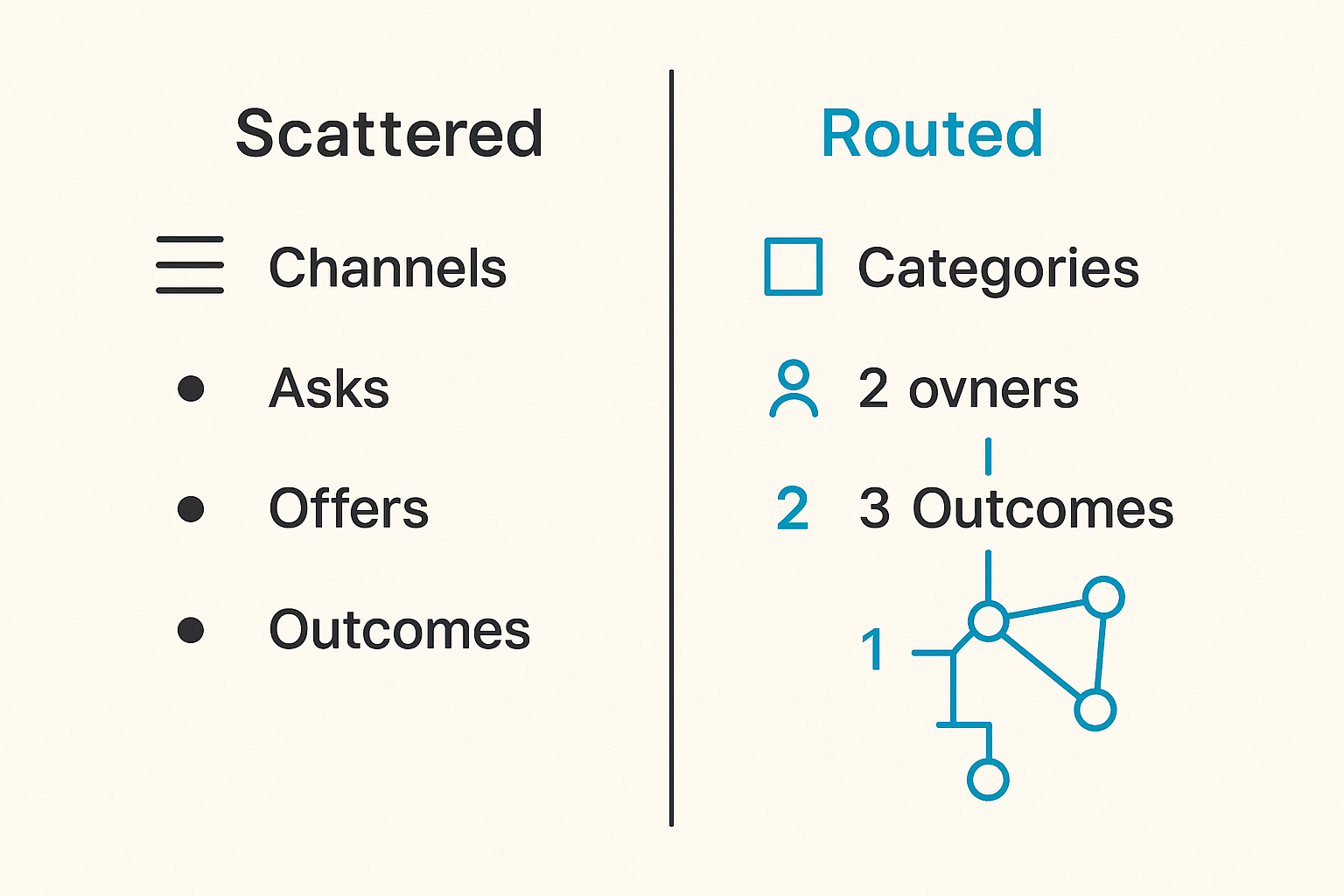
Most organizers start with programming: workshops, meetups, volunteer days, panels, office hours. Programming can help, but it is downstream. Before planning more events, map the actual coordination units in the network.
The practical question is: what kinds of transactions does this community need to handle repeatedly?
Start with transaction types
A transaction is not necessarily money. In local community operations, a transaction is any request-response pattern that needs trust and follow-up.
Common transaction types include:
| Transaction type | Example ask | Example offer | Operational risk |
|---|---|---|---|
| Referral | Need a reliable bookkeeper | Can recommend two local providers | Bad match damages trust |
| Skill help | Need a broken form fixed | Can debug websites remotely | Scope creep and unclear completion |
| Space sharing | Need a meeting room | Can offer a room on Thursdays | Access rules and scheduling |
| Translation | Need help with a letter | Can translate English and Spanish | Privacy and accuracy |
| Volunteer support | Need three people Saturday | Can help for two hours | No-shows and burnout |
| Business workflow | Need scheduling automation | Can build a small workflow | Requirements unclear |
A united community gets stronger when these transaction types are explicit. People should not need to guess whether the network can handle their request.
Separate discovery from assignment
Discovery is making an ask or offer visible. Assignment is deciding who should act on it. Many community teams collapse these into one public post. That creates noise.
A better model:
- Capture the ask or offer in a structured way.
- Decide whether it is safe and appropriate to show publicly.
- Route it to the smallest relevant audience.
- Assign or invite a specific next action.
- Follow up until the state changes.
Public broadcast is useful for some discovery. It is a poor default for assignment. If every request is blasted to everyone, the network learns to ignore requests.
Practical rule: Broadcast for awareness, route for action.
Keep the smallest useful record
You do not need a heavy CRM to run a local network. You do need enough state to prevent memory loss.
The smallest useful record usually includes:
- Ask or offer summary.
- Category and location context.
- Contact preference.
- Trust or referral source.
- Current status.
- Owner.
- Last follow-up date.
- Outcome.
This record is not bureaucracy. It is how you avoid asking the same person the same question five times or losing a sensitive request in a chat thread.
Build trust as workflow not vibes
Trust is often treated as atmosphere. In production, trust is a workflow problem.
People ask different questions depending on the risk: Who knows this person? Have they done this before? Is this request appropriate? Are there safety concerns? Is the information private? Who is accountable if the match goes badly?
A united community does not require blind trust. It gives people enough context to make bounded commitments.
Trust needs provenance
Provenance means knowing where something came from. In community terms, it means the source of an ask, offer, referral, or recommendation.
A request from a known neighborhood group is different from a request from a new account with no context. An offer from someone who helped three businesses last month is different from a generic promise to help anyone with anything.
Provenance can be lightweight:
- Referred by a named member.
- Posted by a verified local provider.
- Completed prior request successfully.
- Known to an operator.
- Associated with a local organization.
Do not overcomplicate this into a social scoring system. The goal is not to rank humans. The goal is to route risk responsibly.
Reputation should be contextual
Reputation is not universal. Someone may be excellent at translating documents but not appropriate for childcare referrals. A contractor may be reliable for small repairs but unavailable for urgent calls. A volunteer may be great at event setup but not comfortable handling sensitive intake.
The system should remember reputation by context:
- Skill area.
- Response speed.
- Reliability.
- Boundaries.
- Languages.
- Geography.
- Prior outcomes.
This is where a united community becomes more than a directory. A directory says who exists. An operating network remembers where each person is actually useful.
Protect people from overexposure
Good contributors are easy to burn out. Once someone becomes known as helpful, every vague request starts finding them.
Protecting capacity is part of trust. Track availability. Ask before routing. Let people define boundaries. Rotate opportunities. Make it acceptable to pause.
The mistake teams make is treating responsiveness as an infinite resource. It is not. If the system always routes to the same five people, you are not building a united community. You are building a hidden dependency.
The workflow model for a united community
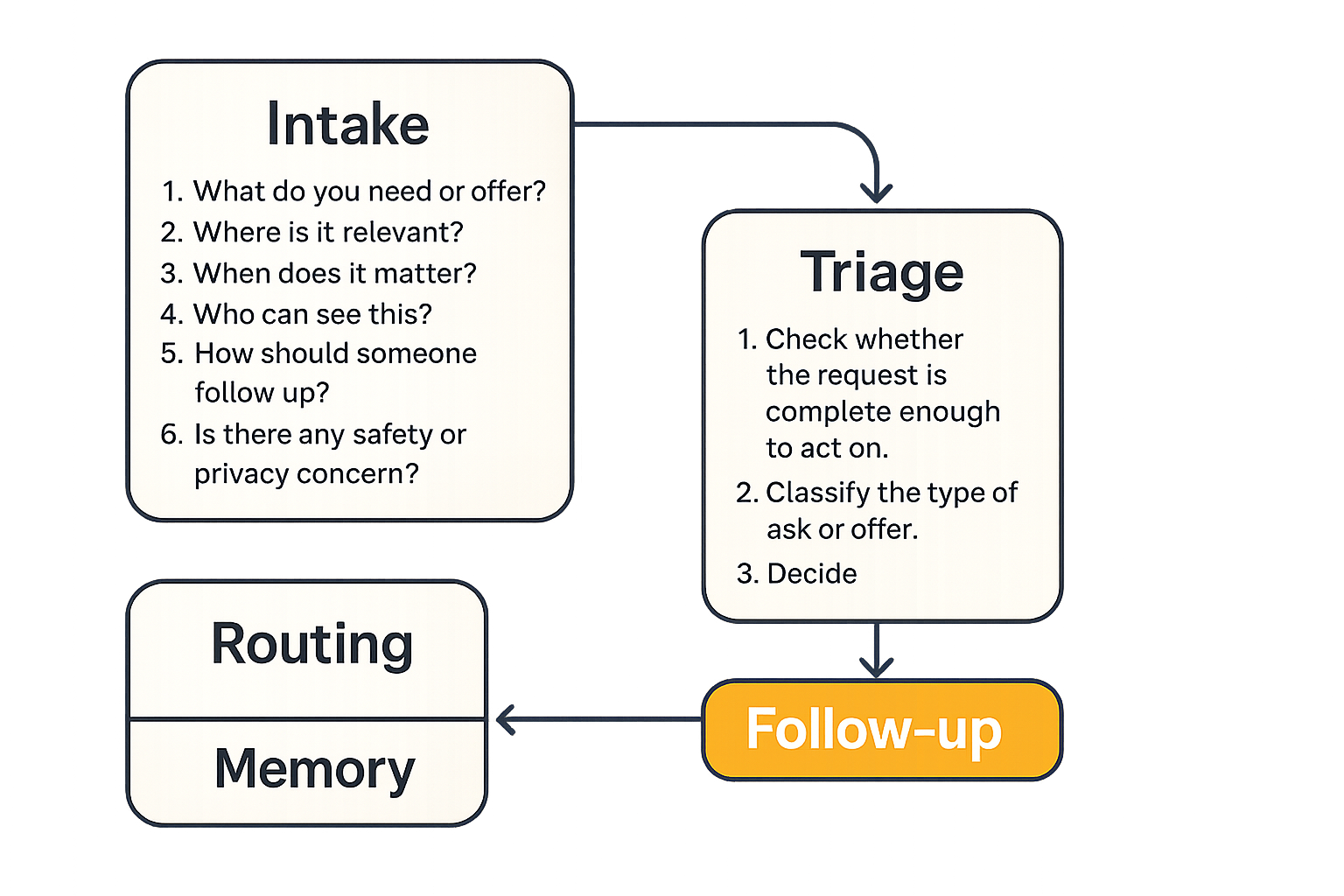
A practical united community workflow has three major stages: intake, triage and routing, then follow-up and memory. You can implement this with paper, spreadsheets, forms, or software. The sequence matters more than the tool.
Related reading from our network: teams designing safe operational roles in security face a similar issue, where the work has to be structured before people are added; see this SOC-focused piece on designing entry level cybersecurity jobs around workflow.
Intake
Intake is where vague intent becomes a usable record. Most people will not submit perfect requests. Operators have to make the path simple.
A good intake form asks only what is needed to route the request:
- What do you need or offer?
- Where is it relevant?
- When does it matter?
- Who can see this?
- How should someone follow up?
- Is there any safety or privacy concern?
Keep the language plain. Do not force people into organizational jargon. If the community serves multilingual members, intake has to support that reality rather than treating translation as an afterthought.
Triage and routing
Triage turns records into decisions. Operators should review new asks and offers on a regular cadence, not whenever they happen to notice them.
A simple triage sequence:
- Check whether the request is complete enough to act on.
- Classify the type of ask or offer.
- Decide whether it is public, limited, or private.
- Identify likely responders or routing channels.
- Assign an owner for follow-up.
- Set the next review date.
The prior d0rz article on the local network operating model for community building goes deeper on ownership and cadence. That operating model matters because routing without ownership is just forwarding.
Practical rule: Every routed ask needs a next owner, a next action, and a next check date.
Follow up and memory
Follow-up is where many communities lose credibility. An introduction is made, everyone feels useful, and then nobody knows what happened.
Track outcomes in plain states:
- New.
- Needs clarification.
- Routed.
- Waiting on requester.
- Waiting on provider.
- Completed.
- Closed unresolved.
- Reopened.
The point is not surveillance. The point is memory. If a request is completed, the network learns. If it fails, the network learns. If it stalls, the operator can intervene before trust decays.
What works in practice
The best local network systems are boring. They make it easy to ask, easy to offer, and easy to know what happens next.
They also resist the temptation to turn every community problem into a campaign. Campaigns create attention. Operations create reliability.
Small asks beat broad campaigns
A broad campaign says: support local businesses. A small ask says: who can help a bakery fix a broken online order form this week?
A broad campaign says: neighbors helping neighbors. A small ask says: who can translate a two-page employment letter by Friday?
Small asks work because they reduce ambiguity. They let people decide quickly whether they can help. They also create completion, and completion is what builds confidence in the network.
Public edges and private details
Not every detail belongs in public. But not every request should disappear into private operator memory either.
A useful pattern is public edges with private details:
- Public: local business needs help debugging a form.
- Private: exact revenue impact, customer data, contact details.
- Public: volunteer translation help available at a library.
- Private: documents, immigration concerns, phone number.
This pattern keeps the network legible while protecting people.
Operators need weekly queues
A united community needs a queue, not just a calendar. The weekly queue is where operators review open asks, pending offers, stalled matches, and follow-ups.
A basic weekly review can be thirty minutes:
- New asks and offers.
- Items waiting for clarification.
- Items routed but not accepted.
- Items accepted but not completed.
- Completed outcomes to record.
- People at risk of overload.
- Patterns that need a new resource or event.
This is also where events become useful. If the queue shows ten small businesses need workflow support, then a focused clinic makes sense. If the queue shows many translation requests, recruit translators or create office hours.
What fails when teams implement it badly
Community systems usually fail from operational ambiguity, not lack of goodwill. People show up. They offer. They ask. Then the system makes it hard to act.
The practical question is where state disappears.
Event centric systems lose context
Events are useful for connection, but weak as the main database of community need. People mention problems in conversations. Someone promises an introduction. A business card changes hands. Then the room resets.
If there is no capture mechanism, every event becomes a temporary spike in connection with little durable routing.
What fails:
- No intake after conversations.
- No owner for promising leads.
- No record of offers made verbally.
- No follow-up after introductions.
- No link between event themes and actual network demand.
Events should feed the operating system. They should not be the operating system.
Chat groups turn into fog
Chat is fast, human, and useful. It is also a terrible long-term coordination layer.
In chat, urgent and casual messages look the same. Search is unreliable. New members lack context. Sensitive information leaks easily. Requests vanish above the fold. The loudest participants shape the perceived needs of the whole network.
Chat works best as a notification surface, not as the source of truth.
Use chat for:
- Announcing new public asks.
- Nudging accepted responders.
- Coordinating time-sensitive logistics.
- Sharing lightweight updates.
Do not use chat as the only place where asks, offers, status, and outcomes live.
No owner means no outcome
A request posted to everyone is often owned by no one. People assume someone else will help. Or three people start helping without coordination. Or the requester gets overwhelmed with partial responses.
Ownership does not mean hierarchy. It means one person is accountable for the next state transition.
Comparison:
| Weak implementation | Strong implementation |
|---|---|
| Post every ask to a group chat | Route asks to relevant responders |
| Let requester manage all replies | Assign an operator or responder owner |
| Track success by likes | Track success by completed outcomes |
| Keep details in memory | Maintain a small state record |
| Ask the same helpers repeatedly | Track capacity and rotate matches |
Metrics that show the network is getting healthier
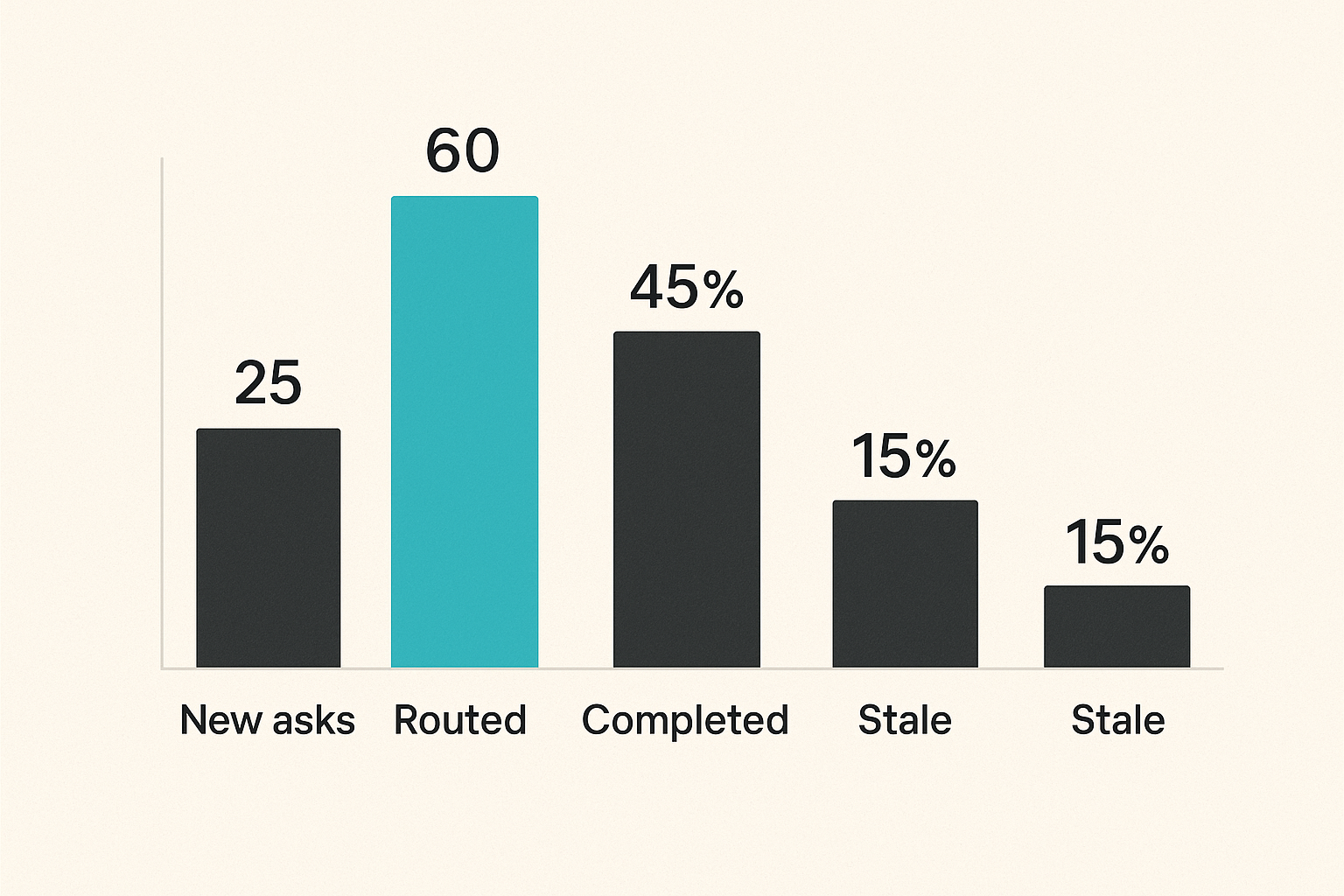
You do not need fake precision. You do need signals that show whether the network is becoming easier to use.
A united community should produce faster routing, clearer ownership, better follow-up, and less dependence on a single organizer.
Measure flow not vanity
Vanity metrics have their place, but they do not tell you whether coordination works. Member count, attendance, impressions, and reactions can rise while actual support gets worse.
Better operational metrics:
- New asks per week.
- New offers per week.
- Percent of asks with enough detail to route.
- Median time to first useful response.
- Percent of routed asks accepted.
- Percent completed or closed with reason.
- Number of active responders by category.
- Repeat load on top contributors.
Related reading from our network: small business teams face a parallel measurement problem when choosing billing systems, where the real issue is month-end workflow rather than screens; see this guide to invoicing software workflow decisions.
Watch bottlenecks
A bottleneck is any point where requests stop moving. Common bottlenecks include unclear intake, operator backlog, too few trusted responders, slow requester replies, and no completion confirmation.
Bottleneck review should be concrete:
- Which category is stuck?
- Is the ask unclear or is capacity missing?
- Did routing fail because trust was unknown?
- Did the responder accept but not finish?
- Did the requester disappear?
This review turns vague frustration into operational fixes.
Review dead ends
Closed unresolved is not failure by itself. It is a learning state.
A request may close unresolved because it was out of scope, unsafe, too urgent, too vague, or not matched to available capacity. Track the reason. Over time, unresolved patterns show what the community should build next.
For example, if many local businesses ask for automation help but no one responds, recruit providers. If many document translation requests are urgent, create a standing office hour. If many housing questions are too sensitive for public routing, build a private referral path.
Tooling choices for local network operators
Tools matter, but not in the way vendors usually describe. The UI is not the whole system. State, trust, routing, and support are the real work.
The mistake teams make is buying or building a platform before naming the workflow it has to preserve.
Spreadsheet first is acceptable
A spreadsheet is not embarrassing. For many early networks, it is the right first control plane.
Use columns like:
- ID.
- Type.
- Summary.
- Public or private.
- Category.
- Location.
- Requester.
- Potential responders.
- Owner.
- Status.
- Last update.
- Outcome.
The spreadsheet fails when access becomes messy, private data spreads, or follow-up depends on someone remembering to check filters. That is the point where you need stronger tooling.
Automation should reduce handoffs
Automation is useful when it removes repeated handoffs, not when it hides judgment.
Good automation:
- Sends reminders for stale routed asks.
- Notifies operators when new intake arrives.
- Suggests categories based on prior records.
- Creates weekly review queues.
- Confirms completion with requester and responder.
Bad automation:
- Broadcasts sensitive requests without review.
- Routes based only on keywords.
- Sends too many notifications.
- Treats all responders as always available.
- Makes it hard to override decisions.
If your local network is exploring practical workflow automation, a live example is this d0rz ask for small business automation projects in Winston Salem, which shows the kind of scoped local need that can be routed and followed up.
Related reading from our network: builders working with local runtimes and agents run into similar issues around credentials, events, and auditability; this guide to Mac tools for AI agent builders is technical, but the workflow lesson is the same.
Integration boundaries matter
Do not connect every tool to every other tool. Local community data includes sensitive signals: who needs help, who can provide help, who is overloaded, who is vulnerable, and who has unresolved issues.
Set boundaries:
- Public listings can be searchable.
- Private details should have limited access.
- Operator notes should not automatically publish.
- Contact details should be shared intentionally.
- Completion records should avoid unnecessary personal data.
A united community needs memory, but not unlimited exposure.
Governance moderation and safety
Governance is not paperwork. It is how the network protects trust under pressure.
As the community grows, edge cases become normal: inappropriate offers, urgent requests, conflicts of interest, unreliable helpers, sensitive personal information, and disputes after a match.
Define acceptable asks and offers
Write down what belongs in the network and what does not. Keep it short enough for operators to use.
Define:
- Allowed categories.
- Prohibited categories.
- Emergency boundaries.
- Paid versus unpaid expectations.
- Required disclosures.
- Privacy rules.
- Conflict escalation.
This prevents every moderation decision from becoming a custom debate.
Make escalation boring
Escalation should not require drama. It should be a normal path when risk increases.
Examples:
- A request mentions immediate safety concerns.
- A responder asks for inappropriate information.
- A provider repeatedly accepts work and does not complete it.
- A member disputes the outcome.
- A request involves legal, medical, housing, or financial sensitivity.
A boring escalation process names who reviews it, what information is needed, what actions are possible, and when the case is closed.
Practical rule: If operators are afraid to escalate because it feels personal, the governance path is not clear enough.
Design for multilingual and offline access
A united community cannot assume every useful participant lives in the same digital channel. Some members prefer phone calls. Some rely on libraries, schools, churches, neighborhood groups, or small business corridors. Some need translation. Some have limited time or bandwidth.
Design practical access paths:
- Phone or in-person intake through trusted partners.
- Translated ask and offer templates.
- Public printouts for non-sensitive opportunities.
- Operator support for people who cannot fill forms.
- Clear consent before publishing details.
Digital tooling should widen access, not quietly exclude the people the network claims to serve.
Where d0rz.com fits
A united community becomes real when the network can capture asks, show offers, route help, and maintain enough follow-up to improve over time.
That is the product-fit zone for d0rz.com: practical local coordination where asks, offers, trust, routing, and follow-up matter more than performative engagement.
A practical layer for asks offers and follow up
d0rz.com is useful when you need a lightweight public layer for local asks and offers, without pretending the public page is the entire workflow. Operators can use visible posts as routing objects, then manage context, trust, and follow-up around them.
The value is not that every problem becomes public. The value is that appropriate asks and offers become easier to discover, easier to route, and easier to revisit.
When to use it
Use d0rz.com when your local network has:
- Real asks that disappear in chat.
- Offers that are too scattered to find.
- Local providers who need clearer demand signals.
- Organizers acting as manual routers.
- Repeated categories of need.
- A desire to make useful coordination visible without exposing every private detail.
Do not use it as a substitute for trust, moderation, or operator judgment. Use it as part of the operating system.
A united community in 2026 is not the loudest network. It is the one where people can ask, offer, route, follow up, and learn without forcing every relationship through one overloaded organizer.
Try d0rz.com
d0rz.com is for people building practical local networks where asks, offers, trust, routing, and follow-up matter. Try d0rz.com.